Face Attendance for Manufacturing Companies: Features and Benefits
Face Attendance for Manufacturing Companies: Features and Benefits
Managing employee attendance in a manufacturing company can be challenging. Factories often have large workforces, multiple shifts, production floors, contract workers, and different departments operating at the same time. Traditional attendance registers, cards, or manual systems can make it difficult to maintain accurate and timely attendance records.
Face attendance software for manufacturing companies provides an automated way to verify employees and record their attendance. By using facial recognition technology, businesses can simplify check-in and check-out while creating centralized attendance records for employees working across different shifts and locations.
What Is Face Attendance for Manufacturing Companies?
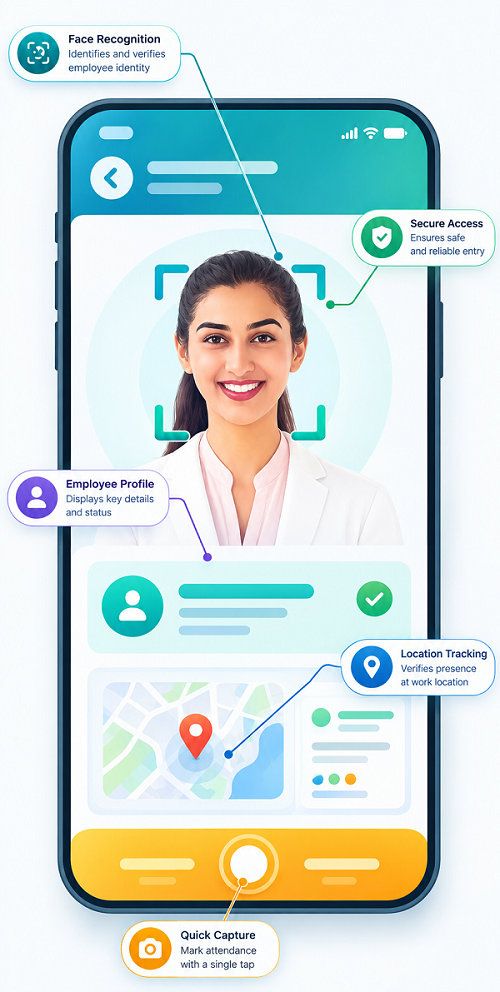
Face attendance is an automated attendance solution that identifies employees using facial recognition. Employees can record their attendance by presenting their face to a supported attendance device or mobile application.
For manufacturing organizations, face attendance can be combined with features such as shift management, overtime tracking, leave management, GPS, geo-fencing, attendance reports, and payroll integration.
This can help HR teams manage attendance for production workers, supervisors, administrative staff, and other employees through a centralized system.
Why Manufacturing Companies Need Automated Attendance
Manufacturing companies often operate differently from standard office environments. Employees may work in multiple shifts, including morning, evening, night, and rotating shifts.
Common attendance challenges include:
- Large numbers of employees checking in simultaneously
- Multiple shifts and changing schedules
- Manual attendance data entry
- Proxy or buddy punching
- Tracking late arrivals and early departures
- Managing overtime
- Attendance across different production units
- Payroll calculation based on attendance
- Managing employee and shift records
Face attendance can automate many of these routine activities and provide HR teams with better visibility into workforce attendance.
Key Features of Face Attendance Software for Manufacturing
1. Facial Recognition
The core feature is facial recognition-based employee verification. Employees can record attendance without using physical cards, PINs, or manual registers.
This can make the attendance process faster and easier for large workforces.
2. Shift-Based Attendance
Manufacturing companies often operate multiple shifts. Face attendance software can connect employee attendance with assigned shifts.
HR teams can configure different shift schedules and monitor whether employees arrive within their expected working hours.
3. Multiple Shift Management
Factories may operate several shifts throughout the day and night. Attendance software can support different shift timings and help HR manage attendance according to employee schedules.
This is particularly useful for organizations with rotating or overlapping shifts.
4. Overtime Tracking
Manufacturing employees may work beyond their scheduled shift. An integrated attendance system can capture working hours and overtime information according to the company's configured policies.
This can help HR reduce manual overtime calculations.
5. Real-Time Attendance Records
Managers and HR teams can access updated attendance information from a centralized system. This can help them quickly identify absences, late arrivals, or attendance exceptions.
6. Multiple Location Support
Large manufacturing businesses may have several factories, plants, warehouses, or production units.
A centralized attendance system can help administrators manage different locations while maintaining consolidated employee attendance records.
7. GPS and Geo-Fencing
For employees who work outside fixed production areas or at different company sites, GPS and geo-fencing features can provide additional location-based attendance controls.
Businesses can define authorized locations and configure attendance policies according to their operational requirements.
8. Leave Management
Face attendance software can be integrated with leave management. HR teams can compare attendance records with approved leave and identify attendance exceptions more easily.
Employees can also submit leave requests through a connected employee application where supported.
9. Payroll Integration
Attendance information is often an important input for payroll. A connected system can provide attendance, leave, overtime, and working-hour data for payroll processing.
This reduces repetitive data entry between attendance and payroll systems.
10. Attendance Reports
Manufacturing organizations can use reports to analyze attendance by employee, department, shift, location, or date.
Common reports may include:
- Daily attendance
- Monthly attendance
- Absence reports
- Late arrival reports
- Early departure reports
- Overtime reports
- Shift-wise attendance
- Location-wise attendance
- Attendance exception reports
Benefits of Face Attendance for Manufacturing Companies
Reduces Proxy Attendance
Facial verification helps ensure that attendance is associated with the registered employee. This can help reduce proxy attendance and improve the reliability of attendance records.
Saves HR Time
Automated attendance reduces the need for manual register management and repetitive data entry. HR teams can spend more time on workforce planning, employee support, and compliance activities.
Improves Attendance Accuracy
Automated check-in and check-out records can reduce errors associated with handwritten registers or manually entered attendance data.
Faster Employee Check-In
Employees can verify their identity using facial recognition instead of searching for attendance cards or entering PINs. This can be useful during busy shift changes when many employees arrive at the same time.
Better Shift Management
Manufacturing businesses can connect employee attendance with shift schedules. This gives managers better visibility into employees who are present, absent, late, or working beyond their scheduled hours.
Easier Overtime Management
Accurate working-hour records can help HR teams review overtime more efficiently and use the information for payroll processing according to company policies.
Centralized Workforce Visibility
For companies with multiple production facilities, centralized attendance software can bring records from different locations into one system.
Better Payroll Preparation
When attendance, leave, and overtime information are available in a connected system, HR teams can reduce manual calculations and data transfers during payroll processing.
Face Attendance vs. Traditional Attendance
| Feature | Traditional Attendance | Face Attendance |
|---|---|---|
| Employee verification | Manual/card-based | Facial recognition |
| Proxy attendance control | Limited | Stronger identity verification |
| Data entry | Often manual | Automated |
| Shift tracking | Manual or separate | Can be integrated |
| Overtime tracking | Manual | Automated records |
| Multi-location management | Difficult | Centralized |
| Attendance reports | Time-consuming | Faster and automated |
| Payroll integration | May require manual transfer | Can be integrated |
| Real-time visibility | Limited | Available through software |
Best Practices for Implementing Face Attendance in Manufacturing
Before deploying face attendance software, manufacturing companies should consider their operational environment.
Identify Attendance Points
Determine where employees should record attendance, such as factory entrances, designated attendance areas, or authorized work locations.
Configure Shifts Carefully
Set up all relevant shifts, including night shifts, rotating shifts, and overlapping schedules.
Test Devices
Manufacturing environments can be busy and physically demanding. Attendance devices should be positioned appropriately and tested under actual operating conditions.
Define Overtime Rules
Configure overtime policies clearly so that attendance data can be interpreted consistently.
Train Employees
Explain how the face attendance system works and provide clear instructions for handling recognition or device issues.
Protect Employee Data
Facial recognition involves sensitive personal information. Businesses should implement appropriate security, access controls, retention practices, and privacy procedures in line with applicable requirements.
Who Can Use Face Attendance in Manufacturing?
Face attendance can be useful for:
- Manufacturing plants
- Automobile factories
- Textile industries
- Electronics manufacturing
- Food processing units
- Pharmaceutical manufacturing
- Engineering companies
- Warehouses and distribution centers
- Industrial facilities
- Multi-location production companies
Conclusion
Face attendance for manufacturing companies can simplify employee attendance management in workplaces with large teams, multiple shifts, overtime, and multiple production locations. Facial recognition can improve employee verification while automated attendance records reduce manual HR work.
When combined with shift management, leave management, overtime tracking, GPS, geo-fencing, reports, and payroll integration, face attendance software can become an important part of a modern workforce management system.
For manufacturing companies looking to improve attendance accuracy and streamline HR processes, selecting software that supports their shift structure, workforce size, locations, and payroll requirements is essential.
Manufacturing companies can use InnBuilt Face Attendance Software for fast, identity-verified check-ins across plants, shifts, and production teams. Touch-free attendance, shift matching, overtime tracking, and payroll integration improve accuracy even during high-volume shift changes.