What Should Bahrain Employers Consider Before Introducing Face Attendance?
What Should Bahrain Employers Consider Before Introducing Face Attendance?
Introduction
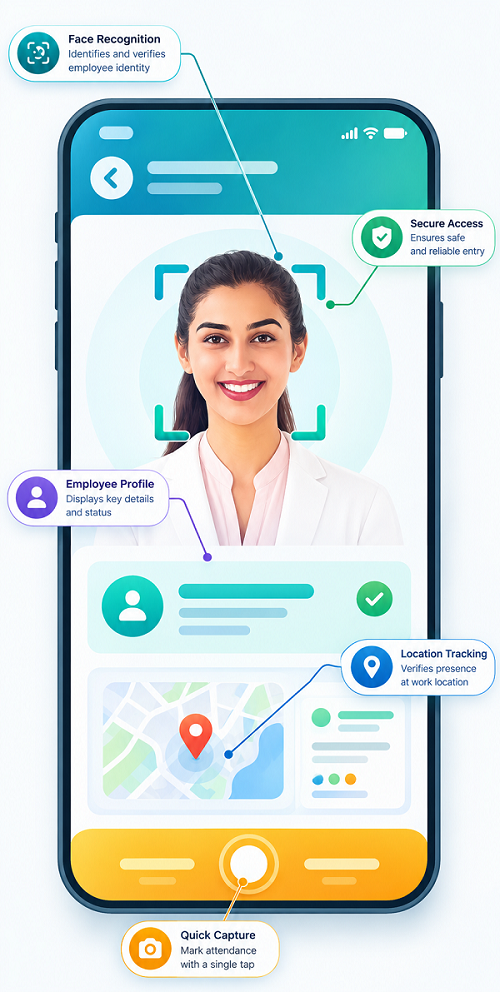
Face attendance systems use facial recognition technology to verify employee identity and record attendance events such as clock-in and clock-out. For employers in Bahrain, these systems can help reduce manual attendance entry, improve workforce visibility, and support attendance management across offices, factories, retail outlets, hotels, warehouses, and construction sites.
However, introducing face attendance requires more than installing cameras or purchasing biometric terminals. Employers must evaluate whether the technology is suitable for their workforce, how biometric information will be collected and protected, whether regulatory authorisation is required, and how attendance records will connect with HR and payroll processes.
Privacy and compliance deserve particular attention. Bahrain's Personal Data Protection Law, Law No. 30 of 2018, requires prior written authorisation for specified automated processing operations, including biometric data processing necessary to verify an individual's identity. Employers should determine the requirements applicable to their proposed system before collecting or processing biometric attendance data.
1. Determine Whether Face Attendance Is Necessary
Before purchasing a system, employers should identify the specific attendance problem they want to solve.
For example, a business may be experiencing proxy attendance, inconsistent attendance records across branches, lengthy queues at manual attendance terminals, or difficulties reconciling employee working hours with payroll.
Face recognition may help address some of these challenges, but it is not automatically the best solution for every workplace.
Employers should compare it with alternatives such as:
- Fingerprint attendance terminals
- Employee access cards or PIN-based time clocks
- Mobile attendance applications
- Supervisor-approved digital timesheets
- QR-based attendance with appropriate controls
- A combination of attendance methods for different work locations
The evaluation should consider the organisation's size, workforce structure, operating environment, existing systems, privacy risks, and budget.
For example, a fixed office with a stable workforce may have different requirements from a construction company managing employees across outdoor project sites.
Practical recommendation: Document the business problem, the expected benefits, the alternatives considered, and the reasons for selecting face attendance. This helps establish whether the technology is necessary and proportionate to the intended purpose.
2. Review Bahrain's Biometric Data Protection Requirements
Legal compliance should be assessed before the organisation begins biometric enrolment or attendance processing.
Bahrain's Personal Data Protection Law, Law No. 30 of 2018, regulates the processing of personal data. Article 15 establishes a prior written authorisation requirement for specified automated processing operations, including biometric data processing necessary to verify an individual's identity. It also covers certain other processing operations, including specified sensitive-data processing and visual recording used for surveillance.
The official legislation is available through Bahrain's Personal Data Protection Authority and the Legislation and Legal Opinion Commission.
Before introducing face attendance, employers should:
- Map the biometric data the proposed system will collect and process.
- Identify the purposes for which the information will be used.
- Determine whether the processing falls within Article 15 or any other applicable authorisation requirement.
- Obtain any required prior written authorisation before commencing the relevant processing.
- Establish the applicable legal basis and provide the required information to employees.
- Review data security, retention, access, and disclosure arrangements.
- Assess whether data will be processed or transferred outside Bahrain.
- Document responsibilities for handling requests, complaints, and security incidents.
Employers should not assume that a vendor's claim of compliance or an employee's acknowledgement automatically satisfies every legal obligation.
The precise requirements may depend on how the system operates, what information it processes, and whether additional processing activities are involved. Legal or data-protection advice should be obtained where necessary.
3. Understand What Biometric Information the System Collects
Not all face attendance systems process or store information in the same way.
Some systems capture facial images and retain them. Others generate a mathematical representation, often called a facial template, for comparison with a live capture. Some systems may retain both images and templates, together with attendance events and verification logs.
Before selecting a product, employers should ask the vendor:
- Is a facial image stored, or is a facial template generated?
- Is the original image retained after enrolment?
- Is the image or template stored on the terminal, a local server, or a cloud platform?
- Can the vendor access the stored biometric information?
- Is biometric data encrypted in storage and during transmission?
- Can the system export biometric data?
- What happens to the data when an employee leaves?
- How is the data securely deleted?
- Which third parties can access or process the information?
Employers should obtain clear documentation rather than relying on general descriptions such as "secure biometric technology."
A facial template should not automatically be treated as anonymous. Its privacy and security implications depend on the technology, how it can be linked to an employee, and whether it can be accessed or reused.
4. Assess Employee Privacy and Transparency
Employees should understand why face attendance is being introduced and how the system will operate.
Before enrolment, employers should provide clear information about the purpose of collection, the types of data involved, who can access the records, how long information will be retained, and how employees can raise questions or challenge inaccurate attendance records.
The communication should explain:
- Why the organisation is considering face recognition.
- Which employees or locations will use the system.
- What happens during enrolment and daily verification.
- Whether images, templates, or both will be stored.
- How attendance records will be used for HR and payroll.
- How verification failures will be handled.
- How employees can request corrections or raise concerns.
- What alternative process is available when the system cannot be used.
Employers should also avoid collecting more information than necessary for attendance verification.
For example, if the purpose is to record attendance at an entrance terminal, the organisation should not automatically expand the system to continuous facial surveillance or unrelated employee monitoring without a separate legal and privacy assessment.
Employee communication is an important safeguard, but it does not replace required authorisations or other legal obligations.
5. Evaluate System Accuracy and Reliability
A face attendance system must work consistently under real workplace conditions.
Recognition performance can be affected by lighting, camera position, image quality, changes in appearance, protective equipment, network availability, and the system's matching configuration.
A system that performs well in a demonstration may not deliver the same results at a busy factory entrance or an outdoor construction site.
Employers should assess:
- Recognition accuracy in the intended environment.
- The frequency of legitimate employees being rejected.
- The frequency of incorrect identity matches.
- Performance during peak arrival and departure times.
- Liveness detection and protection against presentation attacks.
- Camera performance under expected lighting conditions.
- Compatibility with required personal protective equipment.
- Availability during network or power interruptions.
- The speed of verification and employee queue times.
- The process for correcting failed or inaccurate records.
Vendors should explain their testing methods and provide evidence relevant to the proposed deployment.
Employers should also test the system across the intended workforce and environmental conditions. Performance should not be assumed to be uniform across all individuals.
A failed match should trigger a verification or exception process—not an automatic finding of absence or misconduct.
6. Consider Bahrain's Workplace Conditions
The operating environment can affect which attendance technology is practical.
For indoor offices, employers may be able to use fixed terminals with controlled lighting and reliable connectivity. Factories, warehouses, outdoor project sites, and remote facilities may require additional testing.
In Bahrain workplaces, employers should consider:
- High temperatures and direct sunlight at outdoor locations.
- Dust and other environmental conditions that may affect equipment.
- Camera placement and protection against damage.
- Network connectivity at remote sites.
- Power interruptions and backup arrangements.
- Employee queues at shift changes.
- Protective helmets, masks, glasses, and other required equipment.
- The availability of secure indoor terminals where appropriate.
For example, a terminal at a construction-site gate may face different conditions from one installed in a climate-controlled office.
Employers should pilot the system in representative locations before expanding it across the organisation. Where face recognition cannot operate reliably, an approved alternative method should remain available.
7. Check Integration With HR, Attendance, and Payroll Systems
Face recognition records an identity-verification event, but employers still need to determine the employee's scheduled working hours and payroll treatment.
Before purchasing a system, verify that it can connect with the organisation's existing workforce systems.
The integration should support:
- Consistent employee IDs across systems.
- Employee enrolment and departure processes.
- Shift schedules and approved shift changes.
- Clock-in and clock-out records.
- Missing punches and attendance exceptions.
- Leave and absence records.
- Overtime approvals.
- Payroll exports or direct integration.
- Audit logs for attendance corrections.
- Reports for authorised HR and operations staff.
Consider a shift worker scheduled from 10 p.m. to 6 a.m. The employee may clock in before midnight and clock out the following morning. The system must link both events to the correct shift and avoid assigning the clock-out to an unrelated workday.
Similarly, an employee may successfully verify their identity but forget to clock out. The system should flag the incomplete record for review rather than assuming that the full shift was worked.
Integration testing should cover overnight shifts, late approvals, cancelled leave, failed verification, duplicate punches, and corrections submitted after payroll cut-off.
8. Establish an Alternative Attendance Process
No attendance system is completely reliable under every condition. Employers should establish an alternative process before deploying face recognition.
Alternative methods may be necessary when:
- The camera or terminal is unavailable.
- The network connection fails.
- The system cannot recognise a legitimate employee.
- An employee is wearing equipment that interferes with facial capture.
- A worker is assigned to a location without a suitable terminal.
- A technical issue prevents the attendance event from being recorded.
The fallback process should specify who can verify attendance, which evidence is acceptable, how corrections are approved, and how the final record is linked to the employee's attendance history.
For example, an authorised supervisor may verify an employee's arrival and submit a documented manual attendance entry when the terminal is unavailable.
The system should record who made the correction, when it was made, why it was necessary, and who approved it where required.
Alternative methods should be applied consistently. Employers should not penalise employees solely because the technology failed to verify them.
9. Define Access Controls and Security Responsibilities
Biometric information and attendance records should be accessible only to authorised personnel who need them for legitimate business purposes.
Employers should establish clear access rules for HR administrators, line managers, payroll staff, IT personnel, and external vendors.
Important controls include:
- Role-based access permissions.
- Strong authentication for administrators.
- Encryption of biometric information and attendance records.
- Secure communications between terminals and servers.
- Logs of access and administrative changes.
- Regular review of user permissions.
- Security updates and vulnerability management.
- Backup and recovery procedures.
- A documented incident response process.
- Controls over data exports and third-party access.
Payroll staff may need verified attendance hours and approved exceptions, but they may not need direct access to facial templates.
Similarly, a line manager may need to review attendance discrepancies for their team without being able to export biometric enrolment data.
Employers should also agree on clear responsibilities with vendors, including how security incidents are reported, who investigates them, and how data is returned or deleted when a service ends.
10. Review Data Storage, Retention, and Cross-Border Transfers
The location where biometric information is stored matters, particularly when a vendor offers cloud-hosted attendance software.
Employers should determine whether the system stores information in Bahrain or another country, which entities can access it, and whether any transfers are involved.
Before deployment, review:
- The physical or cloud storage location.
- The identity of the data controller and relevant service providers.
- Any subcontractors that process the information.
- The locations from which support personnel can access data.
- Applicable requirements for international data transfers.
- Contractual restrictions on vendor reuse of biometric information.
- Data return and deletion arrangements at contract termination.
Bahrain's Personal Data Protection Law contains rules concerning transfers of personal data outside the Kingdom. Employers should assess the proposed data flows against the applicable legal requirements rather than assuming that cloud storage is automatically permitted or prohibited.
Retention periods should also be defined separately for biometric enrolment data, attendance events, correction logs, and records that must be retained for other legal or operational reasons.
The organisation should document when data is deleted, how deletion is verified, and which records must be preserved under applicable retention obligations.
11. Estimate the Total Cost of Ownership
The purchase price is only one component of implementing face attendance.
Employers should estimate the total cost of operating and maintaining the system over its expected life.
| Cost area | What to consider |
|---|---|
| Hardware | Cameras, terminals, mounts, protective enclosures, and accessories |
| Software | Licence fees, subscriptions, user limits, and additional modules |
| Infrastructure | Network access, servers, power supply, and backup arrangements |
| Implementation | Installation, configuration, migration, and integration |
| Privacy and compliance | Legal review, authorisation procedures, and documentation |
| Training | Employee communications, supervisor training, and administrator support |
| Maintenance | Repairs, replacement devices, software updates, and technical assistance |
| Security | Monitoring, access controls, incident response, and system testing |
| Expansion | Additional branches, sites, employees, or terminals |
| Exit arrangements | Data export, deletion, migration, and contract termination costs |
Employers should compare the expected cost with the operational benefits, such as reduced manual work, fewer attendance disputes, and more consistent records.
A low-cost product may become expensive if it requires extensive manual corrections, has poor integration, or cannot support the organisation's privacy and security requirements.
12. Train Employees, Supervisors, and HR Teams
Successful implementation depends on people understanding how to use the system and how attendance decisions will be made.
Employee training should explain the enrolment process, correct terminal use, what to do when recognition fails, and how to report an incorrect attendance record.
Supervisors should understand how to review exceptions, verify attendance, approve corrections, and avoid treating an automated result as conclusive evidence of misconduct.
HR and payroll teams should be trained to:
- Review missing and duplicate punches.
- Resolve disputed attendance records.
- Check attendance against approved schedules and leave.
- Preserve correction histories.
- Reconcile working hours before payroll.
- Handle employee questions and complaints.
- Escalate technical or privacy incidents appropriately.
Employers should provide accessible instructions and communicate the process to employees across different work locations and shifts.
A clear process helps prevent employees from being incorrectly marked absent because they did not understand how to use the system.
13. Run a Pilot Before Full Deployment
A pilot allows employers to identify technical, operational, and employee-experience issues before expanding the system.
A practical pilot can cover one office, branch, or representative worksite. It should include employees working different shifts and, where relevant, different environmental conditions.
During the pilot, measure:
- Successful verification rates.
- Failed verification and retry rates.
- Average time needed to record attendance.
- Queue times during shift changes.
- Frequency of manual attendance corrections.
- Device and network availability.
- Attendance discrepancies requiring supervisor review.
- Employee feedback and complaints.
- Integration accuracy with HR and payroll systems.
- Compliance and security issues identified during testing.
The pilot should have clear acceptance criteria and a documented review before the organisation proceeds to wider deployment.
If the system performs poorly, generates excessive corrections, or cannot meet applicable legal and privacy requirements, employers should address those issues before expanding it.
14. Create a Face Attendance Implementation Checklist
Before introducing face attendance, Bahrain employers can use the following checklist to confirm that the main requirements have been addressed.
- Define the business problem and intended purpose.
- Compare face recognition with less intrusive alternatives.
- Identify the biometric data and other personal information involved.
- Assess the applicable requirements under Bahrain's Personal Data Protection Law.
- Obtain required prior written authorisation before relevant processing begins.
- Document the legal basis and employee privacy information.
- Review vendor security, data storage, and data-transfer arrangements.
- Define access permissions and retention periods.
- Test recognition performance in the intended work environment.
- Establish an alternative attendance method.
- Integrate the system with schedules, leave, and payroll.
- Create procedures for missing punches and failed verification.
- Train employees, supervisors, HR, and payroll teams.
- Run a controlled pilot and review its results.
- Approve the deployment only after unresolved issues are addressed.
- Schedule periodic reviews of accuracy, security, and compliance.
Frequently Asked Questions (FAQs)
1. Is face attendance suitable for every Bahrain workplace?
No. Its suitability depends on the workplace environment, workforce structure, attendance requirements, privacy risks, and available alternatives. Employers should assess whether the technology is necessary and practical for the intended purpose.
2. Do Bahrain employers need authorisation before using face recognition for attendance?
Article 15 of Bahrain's Personal Data Protection Law requires prior written authorisation for specified automated processing operations, including biometric data processing necessary to verify an individual's identity. Employers should confirm whether the proposed system falls within the requirement and obtain any necessary authorisation before the relevant processing begins.
3. What biometric information can a face attendance system collect?
Depending on the system, it may process facial images, facial templates, verification results, and associated attendance information. Employers should obtain documentation describing exactly what is collected, retained, and shared.
4. Is storing a facial template safer than storing a photograph?
A facial template may reduce some risks associated with retaining original images, depending on how it is designed and protected. However, it can still be linked to an employee or create privacy risks. Employers should assess the complete processing method rather than assuming that templates are anonymous.
5. What should employers do if the system fails to recognise an employee?
They should provide an alternative verification and attendance-recording process, investigate the problem, and document any correction. A failed match should not automatically be treated as proof of absence or misconduct.
6. Can face attendance connect to payroll software?
Yes. Many systems can export attendance events or integrate with workforce and payroll platforms. Employers must still verify schedules, actual working hours, leave, overtime, and exceptions before processing payroll.
7. Can a cloud-based face attendance system be used in Bahrain?
Potentially, depending on the system and its data-processing arrangements. Employers should assess the storage location, vendor access, subcontractors, international data transfers, security controls, and applicable legal requirements before deployment.
Conclusion
Before introducing face attendance, Bahrain employers should evaluate the business need, biometric-data protection requirements, system accuracy, workplace conditions, security arrangements, and integration with existing HR and payroll processes.
The most important first step is to understand the proposed processing and determine which legal requirements apply. Bahrain's Personal Data Protection Law includes a prior written authorisation requirement for specified automated biometric identity-verification processing, so employers should not begin the relevant processing until any required authorisation has been obtained.
Employers should also provide clear employee information, minimise unnecessary data collection, establish alternative attendance methods, and ensure that failed verification does not automatically result in an adverse attendance decision.
A controlled pilot, clear operating procedures, secure data handling, and regular performance reviews can help organisations determine whether face attendance is suitable for their workforce. The goal should be accurate and reliable attendance management while respecting employee privacy and meeting Bahrain's legal requirements.
Before rolling out face attendance, employers should plan enrollment, access and retention practices. InnBuilt Face Attendance Software can support Bahrain teams as they define a workable attendance process.