How Does Face Recognition Attendance Work for Bahrain Workplaces?
How Does Face Recognition Attendance Work for Bahrain Workplaces?
Introduction
Face recognition attendance is a workforce management technology that uses facial image analysis to help verify employee identity when recording attendance. Instead of requiring employees to punch a time clock, swipe a card, or enter a PIN, a face recognition system compares a live facial capture with an enrolled reference and records an attendance event when the configured verification requirements are met.
For workplaces in Bahrain, this technology can help organisations manage employee attendance across offices, factories, retail outlets, hotels, construction sites, warehouses, and other locations. It can also reduce some forms of proxy attendance, where one employee attempts to record attendance on behalf of another.
However, implementing face recognition involves more than installing a camera. Employers need to consider biometric data protection, system accuracy, employee privacy, attendance corrections, shift schedules, payroll integration, and the legal requirements applicable in Bahrain.
An important compliance consideration: Bahrain's Personal Data Protection Law, Law No. 30 of 2018, includes a prior-authorisation requirement for certain automated processing operations, specifically including biometric data processing necessary to verify an individual's identity. Employers should verify the applicable authorisation requirements with the relevant authority before deploying a face recognition attendance system.
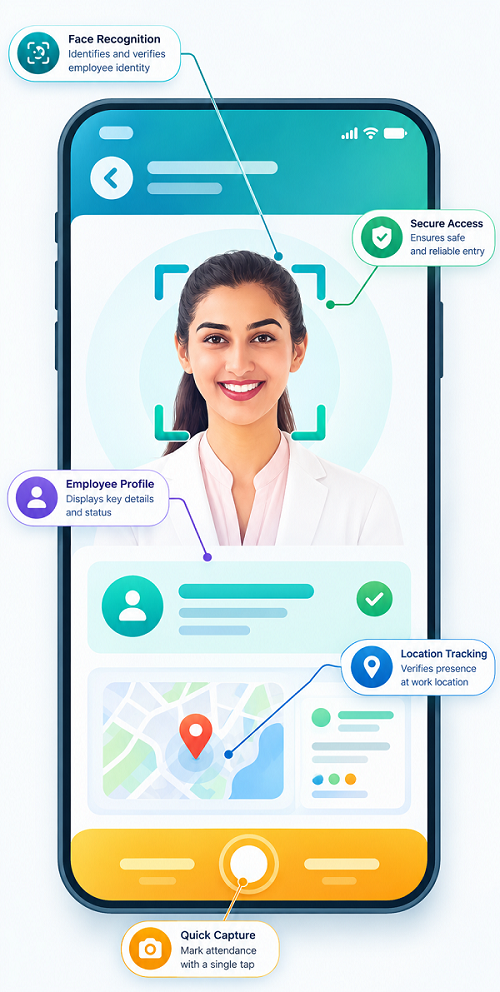
1. What Is Face Recognition Attendance?
Face recognition attendance is an automated method of recording employee attendance by verifying a person's face against an enrolled facial reference.
A typical system consists of a camera or compatible mobile device, facial recognition software, an employee database, an attendance application, and reporting or payroll integrations.
When an employee arrives at work, the system captures a facial image or relevant facial data and processes it according to the system's verification method. If the identity check succeeds, the system records an event such as clock-in or clock-out.
Depending on the product, the system may also check for a live person rather than a photograph or displayed image. This feature is commonly called liveness detection or presentation-attack detection, and its availability and effectiveness vary by vendor.
Face recognition attendance can support several workplace functions:
- Recording employee clock-in and clock-out events.
- Verifying identity at designated attendance terminals.
- Supporting attendance across multiple branches.
- Linking attendance to scheduled shifts.
- Flagging missing or unusual attendance events.
- Sending verified records to HR and payroll systems.
- Producing attendance reports for authorised managers.
The technology does not independently establish whether an employee worked every minute of a shift. Employers still need to review working hours, breaks, absences, overtime, and other relevant records.
2. How Does Face Recognition Attendance Work?
A face recognition attendance process generally follows a series of steps, from employee enrolment to attendance reporting.
Step 1: Employee enrolment
An authorised administrator registers an employee in the attendance system. Depending on the technology, enrolment may involve capturing one or more facial images and generating a mathematical representation known as a facial template.
The system links the enrolled reference to an employee ID and the relevant workforce record.
Before enrolment, employers should explain the purpose of the system, identify the information being collected, provide the required privacy information, and confirm that the proposed processing has the necessary legal basis and authorisations.
Step 2: Facial capture
When the employee arrives at an attendance terminal or uses an authorised mobile application, the device captures a facial image or video frame.
Capture quality can be affected by lighting, camera position, distance, image resolution, and environmental conditions. Poor capture quality may cause a legitimate employee to be rejected or require another attempt.
Step 3: Facial analysis and comparison
The software analyses the captured face and compares relevant features with an enrolled facial reference.
Depending on the system configuration, verification may compare the captured face against a claimed employee identity, or the system may search a larger set of enrolled identities.
These approaches are often described as one-to-one verification and one-to-many identification, respectively. They have different operational and privacy implications, so employers should understand which method the vendor uses.
Step 4: Identity verification result
The software produces a result based on its matching method and configured threshold.
If verification succeeds, the system can permit the attendance event to proceed. If verification fails, it may request another attempt or direct the employee to an alternative process.
A failed match should not automatically be treated as proof of misconduct. Technical problems, changes in appearance, camera conditions, and recognition errors can all affect the outcome.
Step 5: Attendance event recording
After the system accepts the attendance event, it records relevant information, such as:
- Employee ID.
- Date and time.
- Attendance terminal or authorised device.
- Event type, such as clock-in or clock-out.
- Verification result or event status.
- Relevant exception details.
Employers should confirm whether the system stores the original facial image, a facial template, or both, and how long each is retained.
Step 6: Attendance processing and reporting
The attendance application matches the recorded event against the employee's schedule. It may identify late arrivals, early departures, missing clock-outs, or other exceptions.
HR or the employee's supervisor reviews exceptions before the records are used for payroll.
This distinction is important: face recognition helps verify identity, while attendance rules determine how the event affects working hours and payroll.
3. How Can Bahrain Employers Use Face Recognition Attendance?
Face recognition may be useful for workplaces where employees report to fixed entry points or where accurate identity verification is an operational priority.
Office environments: Employers can place authorised attendance terminals near designated entry points to record employee clock-in and clock-out events and reduce manual attendance entry.
Factories and industrial facilities: Face verification can support attendance recording for shift-based employees, provided the terminal placement, safety procedures, and shift schedules are appropriate.
Hotels, retail outlets, and service businesses: Businesses can use a centralised attendance system to maintain consistent records across departments or branches.
Construction and remote worksites: A suitably designed system may record attendance at site entry points. Employers must consider connectivity, outdoor conditions, safety equipment, and alternative verification methods.
The appropriate solution depends on the workplace, workforce size, operating conditions, and legal requirements. Face recognition should not be introduced simply because the technology is available; employers should assess whether it is necessary and proportionate for the intended purpose.
4. What Are the Main Benefits of Face Recognition Attendance?
When properly designed and lawfully implemented, face recognition attendance can offer several operational advantages.
Reduces some forms of proxy attendance
A system that verifies an employee's face can make it harder for another person to record attendance using only a shared PIN or borrowed access card. The level of protection depends on the system's accuracy, liveness checks, and controls against spoofing.
Reduces manual attendance entry
Automated capture can reduce the need for employees or supervisors to enter routine clock-in and clock-out information manually.
Improves attendance visibility
Managers can review attendance events and exceptions through a centralised dashboard, depending on the software's capabilities.
Supports multiple locations
A centralised system can consolidate attendance information from several branches or work sites, making it easier for HR to review records consistently.
Supports payroll preparation
Verified attendance events can feed into working-hour calculations and exception reports, helping HR identify records that require review before payroll.
Creates a more traceable attendance process
A well-configured system can retain timestamps, terminal identifiers, correction histories, and approval records. These features help HR investigate discrepancies without relying entirely on paper registers.
These benefits are not automatic. Employers still need reliable hardware, appropriate system configuration, staff training, clear procedures, and human review of disputed records.
5. What Should Bahrain Employers Know About Biometric Data Protection?
Biometric information requires particular attention because it is linked to an individual's physical characteristics and may be used to verify identity.
Bahrain's Personal Data Protection Law, Law No. 30 of 2018, regulates personal data processing. Article 15 includes a prior written authorisation requirement for specified automated processing operations, including biometric data processing necessary for identity verification. The law also establishes requirements concerning lawful processing, data security, confidentiality, and transfers in relevant circumstances.
Employers should not assume that an employee notice or a vendor's claim of legal compliance automatically satisfies every applicable requirement.
Before launching face recognition attendance, organisations should:
- Identify the exact biometric processing activities proposed.
- Determine whether prior authorisation from the relevant authority is required and obtain it before commencing the relevant processing.
- Establish and document the applicable legal basis for processing.
- Explain the purpose and operation of the system to employees.
- Collect only the information needed for the approved purpose.
- Restrict access to biometric references and attendance records.
- Establish retention and secure deletion rules.
- Assess whether the vendor stores or processes data outside Bahrain.
- Review the relevant legal requirements for cross-border transfers, if applicable.
- Maintain procedures for access requests, complaints, corrections, and security incidents.
Employers should also distinguish between storing a facial image and storing a facial template. A template is a mathematical representation used by a recognition system, but it should not automatically be treated as anonymous or harmless. Its risks depend on the technology and how the data can be linked, accessed, or reused.
Practical recommendation: Obtain a documented privacy and legal assessment before implementation. Where required, consult the competent Bahraini authority or qualified legal counsel about the authorisation process and applicable implementing decisions.
6. How Can Employers Protect Employee Privacy?
A workplace attendance system should collect information for a defined purpose and avoid unnecessary surveillance.
Employers can introduce privacy safeguards by adopting the following practices:
Explain what the system does
Employees should receive clear information about why face recognition is being introduced, what information is processed, who can access it, how it affects attendance recording, and where to raise concerns.
Limit the purpose
If facial verification is introduced for attendance, employers should not automatically reuse the collected information for unrelated monitoring, profiling, or other purposes without assessing the applicable legal requirements.
Restrict access
Access to biometric references, attendance records, and administrative controls should be limited to authorised personnel.
Define retention periods
Employers should distinguish between biometric enrolment data, routine attendance records, audit logs, and records subject to a separate legal retention requirement. Each category should have a documented retention rule.
Secure the system
Controls may include encryption, secure communications, access logging, administrator authentication, software updates, and incident response procedures.
Provide an alternative for failures
Employees need a documented process for recording attendance when a camera is unavailable, recognition fails, or a legitimate employee cannot be verified. Alternative methods should be controlled and consistently applied.
7. How Does Face Recognition Attendance Integrate With Payroll?
Face recognition records an attendance event, but payroll requires more than a successful identity check.
For payroll purposes, the attendance system should connect each verified event to the employee's schedule, applicable working-hour rules, approved leave, and authorised exceptions.
A typical workflow looks like this:
- Facial verification
- Attendance event
- Schedule and exception checks
- HR and supervisor review
- Payroll calculation
For example, if an employee's face is successfully verified at 8:05 a.m., the event records an attendance time. The system must still determine the employee's scheduled start time and apply the employer's attendance rules before calculating any lateness or related adjustment.
Likewise, a successful clock-in does not prove that the employee worked the entire shift. Payroll teams must review clock-out records, breaks, overtime, approved leave, and relevant exceptions.
8. How Should Face Recognition Attendance Handle Shift Workers?
Bahrain workplaces may operate daytime, nighttime, rotating, or overnight shifts. The attendance system must be configured to handle these schedules correctly.
For shift-based teams, employers should ensure that the system:
- Links attendance events to the correct employee and scheduled shift.
- Supports shifts that cross midnight.
- Distinguishes scheduled time from actual clock-in and clock-out times.
- Records approved shift swaps without deleting the original schedule.
- Identifies missing or duplicate punches.
- Applies authorised break and overtime rules.
- Supports attendance checks at different locations.
- Preserves the history of schedule corrections.
For example, an employee scheduled from 10 p.m. to 6 a.m. may clock in on one calendar day and clock out the next morning. The system should link both events to the appropriate shift rather than incorrectly treating the second event as a new workday.
Bahrain's Labour Law for the Private Sector, Law No. 36 of 2012, contains provisions relevant to working hours, breaks, overtime, and weekly rest. Articles 51–57 may be particularly relevant when configuring shift-related attendance rules. Employers should check the current consolidated legislation and any applicable decisions for their employee categories.
Face recognition should support the attendance process, not replace the employer's responsibility to apply the relevant working-hour and payroll rules.
9. What Happens When Face Recognition Fails?
No face recognition system is completely error-free. Legitimate employees may fail verification because of poor lighting, camera issues, changes in appearance, protective equipment, or system outages.
Employers should create an exception process before introducing the technology.
A suitable process should include:
- Allowing a reasonable retry when verification fails.
- Checking the device, camera, lighting, and network connection.
- Referring unresolved cases to an authorised supervisor.
- Using an approved alternative attendance method.
- Recording the reason for any manual attendance entry.
- Obtaining the required approval for corrections.
- Retaining a traceable correction history.
The system should not automatically mark an employee absent, late, or non-compliant solely because facial verification failed.
Employers should also evaluate whether employees wearing safety equipment, face coverings, or other workplace-required protective gear can use the system reliably. If the technology is unsuitable for a particular work environment, another attendance method may be more appropriate.
10. How Can Employers Choose the Right Face Recognition Attendance System?
Before selecting a solution, Bahrain employers should evaluate its technical features, privacy controls, integration capabilities, and suitability for the workplace.
| Evaluation area | What to check |
|---|---|
| Recognition accuracy | Performance under realistic workplace conditions |
| Liveness detection | Controls against photographs, screens, or other presentation attacks |
| Privacy compliance | Support for required authorisations, notices, and processing controls |
| Data storage | Whether images or templates are stored locally, in Bahrain, or elsewhere |
| Access control | Role-based permissions and administrator safeguards |
| Audit history | Traceable attendance corrections and administrative changes |
| Shift scheduling | Support for rotating and overnight shifts |
| Attendance exceptions | Workflows for failed matches and missing punches |
| Payroll integration | Export or integration with existing HR and payroll systems |
| Device reliability | Performance during heat, dust, connectivity issues, and heavy traffic, where relevant |
| Scalability | Ability to manage additional branches and work sites |
| Vendor support | Maintenance, security updates, incident handling, and technical assistance |
Employers should request demonstrations using realistic conditions rather than relying solely on marketing claims.
They should also ask vendors to document the system's limitations, data flows, security arrangements, subprocessors, and support for regulatory compliance. Vendor assurances are useful, but the employer should independently verify its own obligations as the organisation responsible for the processing.
11. How Can Employers Implement Face Recognition Attendance?
A phased implementation helps employers identify technical and operational problems before deploying the system across the organisation.
Phase 1: Assess workplace requirements
Identify the attendance problems the organisation wants to solve. These may include proxy attendance, manual recordkeeping, inconsistent branch reporting, or difficulties reconciling shifts.
Phase 2: Conduct a legal and privacy review
Map the proposed biometric processing, confirm the applicable legal basis, determine whether prior authorisation is required, and complete the necessary compliance steps before processing begins.
Phase 3: Select a suitable system
Evaluate accuracy, liveness detection, storage arrangements, security, integrations, and alternative attendance options.
Phase 4: Run a controlled pilot
Test the system at a limited number of suitable locations. Measure failed verification rates, employee wait times, attendance discrepancies, and the quality of exception handling.
Phase 5: Train employees and supervisors
Explain how to use the terminal, what happens when recognition fails, how to report errors, and how to request corrections.
Phase 6: Integrate attendance and payroll
Confirm that verified events are correctly linked to shifts, leave, overtime approvals, and payroll calculations.
Phase 7: Review performance regularly
Audit attendance corrections, access permissions, system errors, retention practices, and employee complaints. Reassess the system when its purpose, technology, or data flows change.
Frequently Asked Questions (FAQs)
1. What is face recognition attendance?
Face recognition attendance uses facial analysis to verify an employee's identity and record attendance events such as clock-in and clock-out. The event can then be matched against the employee's schedule.
2. Is face recognition attendance legal in Bahrain?
Employers must assess the requirements of Bahrain's Personal Data Protection Law and other applicable rules before using the technology. The law includes a prior written authorisation requirement for specified automated processing, including biometric data processing necessary to verify identity. Employers should confirm the requirements that apply to their proposed system with the relevant authority.
3. Does face recognition attendance store employees' photographs?
That depends on the system. Some systems retain facial images, some generate and store facial templates, and some may process additional data. Employers should obtain a clear explanation of what is collected, where it is stored, how it is protected, and when it is deleted.
4. Can face recognition prevent proxy attendance?
It can make some forms of proxy attendance more difficult by checking the employee's face. Effectiveness depends on recognition accuracy, liveness detection, implementation quality, and the system's security controls. It cannot eliminate every form of attendance fraud.
5. What happens if an employee's face is not recognised?
The employer should provide a documented alternative process, such as another authorised attendance terminal or a supervisor-verified entry. A failed match should be investigated rather than automatically treated as an absence or misconduct.
6. Can face recognition attendance integrate with payroll?
Yes, many workforce systems can pass attendance events into scheduling and payroll workflows. Employers must still validate actual working hours, breaks, approved leave, overtime, and exceptions before calculating wages.
8. How should employers protect facial data?
They should restrict access, secure data in storage and transit, define retention periods, maintain access logs, assess vendor arrangements, and establish incident response and deletion procedures.
Conclusion
Face recognition attendance can help Bahrain employers verify employee identity, automate attendance capture, and improve the consistency of workforce records. When integrated with shift scheduling, leave management, exception handling, and payroll, it can support a more efficient attendance process.
However, the technology also involves biometric data and requires careful consideration of accuracy, privacy, security, and legal compliance. Bahrain's Personal Data Protection Law includes a prior-authorisation requirement for specified automated biometric identity-verification processing, making a legal and privacy assessment an essential step before deployment.
Employers should choose systems that provide transparent data handling, secure access, reliable audit trails, and fair alternatives when verification fails. By combining appropriate technology with clear policies and human oversight, organisations can improve attendance.
Face recognition offers a way to link each check-in to an enrolled employee. InnBuilt Face Attendance Software can help Bahrain workplaces record arrivals while managers review setup and employee-data practices.