How Can Bahrain Hotels Plan Housekeeping Shifts and Room-Coverage Teams?
How Can Bahrain Hotels Plan Housekeeping Shifts and Room-Coverage Teams?
Introduction
Housekeeping is one of the most important operational functions in Bahrain's hotel industry. Guests expect clean, comfortable rooms that are ready when promised, while hotel managers must coordinate room attendants, floor supervisors, public-area cleaners, laundry teams, and temporary staff around changing occupancy levels and guest requests.
The challenge becomes more complex during weekends, holiday periods, major events, Ramadan, Eid, and high-occupancy seasons. A hotel may have many rooms to service within a short checkout-to-check-in window, while unexpected early arrivals, late checkouts, room extensions, and maintenance issues can change the workload throughout the day.
To manage these demands, hotels need a housekeeping plan that connects occupancy forecasts, room-cleaning priorities, employee rosters, attendance records, and live room-status updates. The goal is to have the right number of trained employees covering the right floors and rooms at the right time, without creating excessive overtime or compromising cleaning standards.
1. Forecast Housekeeping Demand From Occupancy and Checkouts
Housekeeping schedules should reflect the expected workload rather than rely only on the hotel's total room count.
A hotel with high occupancy may still have a manageable cleaning workload if many guests are staying over. A hotel with lower occupancy may face a demanding morning if a large number of guests are checking out and those rooms must be prepared for incoming guests.
Housekeeping managers should review:
- Forecast occupancy by date.
- Expected checkouts and arrivals.
- Stayover rooms requiring routine service.
- Early check-in requests and late checkouts.
- VIP arrivals and special room preparations.
- Out-of-order and out-of-service rooms.
- Group bookings, conferences, weddings, and other events.
- Additional requests, such as extra beds, baby cots, or room amenities.
The front office and housekeeping departments should share an updated arrivals-and-departures report before the daily briefing. Managers can then estimate how many rooms need service and when those rooms must be ready.
For example, if many guests are checking out before noon and incoming guests are expected in the afternoon, the hotel may need to concentrate more room attendants and supervisors on checkout rooms during the morning shift.
2. Calculate Staffing Requirements by Workload
A fixed number of rooms per attendant is a useful starting point, but it should not be the only basis for scheduling.
Different rooms require different amounts of work. A stayover room may need less time than a full checkout clean, while suites, connecting rooms, family rooms, and rooms requiring extra attention may take longer.
Hotels can estimate housekeeping workload using a simple formula:
Estimated cleaning hours = Total expected cleaning minutes / 60
For example, if a team expects to clean 30 rooms and the planning estimate averages 30 minutes per room, the estimated workload is 900 minutes, or 15 labour hours. This is only an illustrative calculation; actual time should be based on the hotel's room types, cleaning standards, service requirements, and operating experience.
Managers should also account for work that is not captured by the room count, including:
- Restocking housekeeping trolleys.
- Collecting and returning linen.
- Cleaning corridors and service areas.
- Handling guest requests.
- Reporting room damage and maintenance issues.
- Conducting room inspections.
- Moving between floors or distant room clusters.
- Completing handovers and shift-end duties.
A realistic workload estimate helps hotels avoid assigning more rooms than employees can complete to the required standard during their scheduled hours.
3. Organise Shifts Around Room-Coverage Windows
Housekeeping coverage should match the times when rooms need to be cleaned, inspected, and released for incoming guests.
Hotels can use overlapping shifts to provide additional coverage during the busiest part of the day.
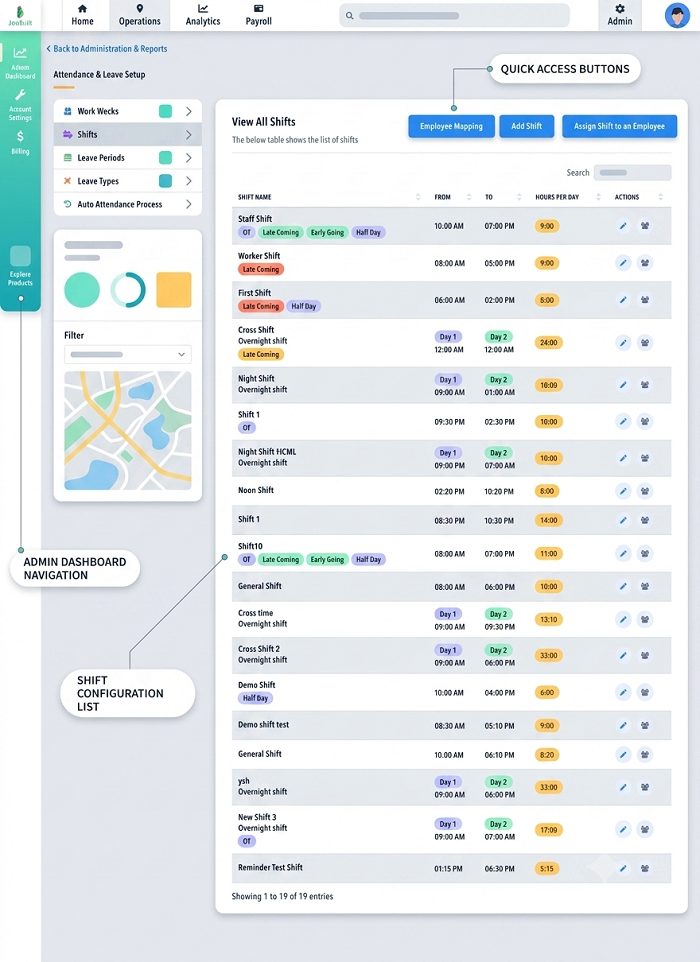
| Team or shift | Main responsibilities |
|---|---|
| Early shift | Prepare equipment, service priority checkout rooms, handle early requests, and coordinate with front office |
| Main daytime shift | Complete checkout and stayover cleaning, restock supplies, and support room inspections |
| Afternoon shift | Finish delayed rooms, handle late checkouts, respond to guest requests, and prepare rooms for late arrivals |
| Evening housekeeping team | Provide approved turndown services where offered, replenish amenities, and respond to evening service requests |
| Public-area team | Maintain lobbies, washrooms, corridors, lifts, and other shared spaces according to the cleaning schedule |
| Laundry and linen team | Process linen, replenish floor supplies, and coordinate linen availability |
Not every hotel needs every shift or team listed above. The structure should reflect the property's size, service level, facilities, guest expectations, and operating hours.
Managers should schedule overlapping coverage around predicted checkout and arrival peaks instead of distributing employees evenly across the day. Shift start and finish times should be communicated clearly, and any changes should be approved and recorded.
4. Divide the Hotel Into Practical Room-Coverage Zones
A room-coverage plan helps housekeeping teams understand exactly which rooms, floors, or areas they are responsible for during a shift.
Depending on the property, a hotel may divide coverage by:
- Floor or wing.
- Room-number range.
- Room type or suite category.
- Checkout and stayover status.
- VIP or priority-arrival rooms.
- Public areas and shared facilities.
- Special-service requirements.
For example, one attendant may be assigned to a defined group of rooms on a particular floor, while another handles checkout rooms in a separate wing. A floor supervisor can oversee both groups and coordinate support when one area has a heavier workload.
Room assignments should be adjusted when room status changes. If several unexpected checkouts occur on one floor, a supervisor may reassign an available, trained employee from a less busy area.
Hotels should avoid frequent, unnecessary reassignment because it can cause confusion, duplicate cleaning, missed rooms, and unclear accountability. Any reassignment should update the room-coverage record so that the next employee knows the current status.
5. Prioritise Rooms Based on Arrival Time and Service Needs
Not all rooms need to be completed in the same order. A room assigned to an arriving guest may have a tighter deadline than a stayover room scheduled for routine service.
Housekeeping and front office teams should agree on a prioritisation process that considers:
- Confirmed early arrivals and rooms promised for immediate check-in.
- Rooms for incoming groups or event delegates.
- Standard checkout rooms needed for the next arrivals.
- Rooms requiring additional preparation or inspection.
- Stayover services within the hotel's promised service window.
- Lower-priority tasks that can be scheduled around arrival demand.
Priority should be visible to the team, not communicated only through informal messages. A housekeeping system or shared room board can show which rooms are urgent, assigned, being cleaned, awaiting inspection, or ready for release.
Priority rules should also be reviewed when a guest changes plans or the front office modifies an expected arrival time.
6. Track Attendance and Actual Shift Coverage
A roster only shows who is scheduled. Hotel managers also need to know who actually arrived and whether all critical roles are covered.
A reliable attendance process should capture:
- Scheduled and actual shift start times.
- Scheduled and actual shift end times.
- Late arrivals and unplanned absences.
- Approved shift swaps.
- Breaks and relevant schedule changes.
- Overtime approvals and actual additional hours.
- Temporary transfers between floors or departments.
- Supervisor-approved attendance corrections.
If a room attendant is absent shortly before the main checkout period, the supervisor should identify the affected rooms and arrange appropriate backup coverage.
Digital attendance systems can help housekeeping managers compare the roster with actual attendance. When integrated with workforce planning, they can also highlight potential coverage gaps before those gaps delay room readiness.
Attendance records should remain separate from room-completion records while still being linked where appropriate. A room marked as cleaned does not, by itself, establish which employee performed the work or how long the task took.
7. Coordinate Housekeeping With Front Office and Maintenance
Housekeeping cannot plan effectively using its own records alone. Room readiness depends on timely information from the front office, maintenance, laundry, and other hotel teams.
A daily coordination briefing should cover:
- Expected arrivals and departures.
- Early check-ins and late checkouts.
- VIP and group-room priorities.
- Rooms blocked for maintenance.
- Linen and amenity shortages.
- Outstanding guest requests.
- Rooms awaiting inspection.
- Staffing shortages and replacement arrangements.
A shared room-status system reduces the risk of the front office assigning a room that is still being cleaned or awaiting an inspection.
Maintenance issues should be logged with a clear owner and status. If a room cannot be released because of a faulty air conditioner, plumbing issue, or other defect, the front office should receive an updated estimate and arrange an alternative where necessary.
Hotels should establish clear rules for who can change a room's status and who can authorise it for guest occupancy.
8. Use Room Statuses to Prevent Missed or Duplicate Work
A standard room-status workflow helps staff understand what must happen next.
A typical process may include:
- Dirty: The room needs cleaning.
- Assigned: A room attendant has accepted responsibility.
- In progress: Cleaning has started.
- Clean: The assigned cleaning tasks are complete.
- Inspected: The room has passed the required quality check.
- Ready: The room is released for guest assignment under hotel procedures.
- Blocked: The room cannot be used until an outstanding issue is resolved.
Hotels may use different terminology, so the workflow should match the property's property-management and housekeeping systems.
Each status change should be recorded promptly. Supervisors should review rooms that remain in progress for unusually long periods, rooms that have not been assigned, and rooms marked clean but not inspected when inspection is required.
Clear status ownership reduces repeated room visits, unnecessary radio calls, and disputes over whether a room is ready.
9. Plan Breaks, Rest Days, and Overtime Responsibly
Housekeeping work can be physically demanding, particularly during periods of high occupancy. A sustainable schedule must provide appropriate breaks, weekly rest, and enough time for employees to complete assigned work safely.
Managers should:
- Stagger breaks to maintain minimum room and public-area coverage.
- Assign a relief attendant or supervisor before an employee leaves a critical area.
- Check weekly rosters and rest-day arrangements.
- Record actual hours worked and approved overtime.
- Avoid relying on repeated shift extensions to compensate for poor forecasting.
- Review workload distribution when employees regularly need extra time to finish assigned rooms.
- Account for applicable working-hour rules when preparing Ramadan schedules.
Bahrain's Labour Law for the Private Sector, Law No. 36 of 2012, contains provisions covering working hours, breaks, overtime, and weekly rest. Articles 51–57 address these areas, with specific provisions and exceptions that may apply to particular categories of work. The law also contains a special provision for cleaning workers, so hotels should not assume that every general working-hour rule applies to housekeeping staff in exactly the same way. They should check the current law, relevant ministerial decisions, and the circumstances of the employee before finalising schedules or overtime calculations.
10. Use Workforce Management and Housekeeping Software
For hotels managing many floors, room types, and shifts, spreadsheets and paper checklists can become difficult to update during busy periods.
A suitable system may combine workforce scheduling with housekeeping room-status management.
Useful features include:
- Occupancy-based workload planning.
- Shift scheduling and employee availability.
- Attendance and absence alerts.
- Floor-level room assignments.
- Mobile room-status updates.
- Priority-room alerts.
- Inspection checklists.
- Maintenance issue reporting.
- Linen and amenity requests.
- Overtime approval workflows.
- Audit trails and management reports.
- Integration with the hotel's property-management and payroll systems.
Before choosing a platform, hotels should verify that it supports their existing systems, can handle connectivity limitations in service areas, and allows authorised supervisors to correct errors without losing the audit trail.
Software should simplify the workflow rather than add unnecessary administrative steps. Employees should receive practical training, and managers should test the system during a normal shift before relying on it for high-occupancy operations.
11. Maintain Cleaning Quality During High Occupancy
Increasing the number of rooms assigned to each attendant may appear to improve productivity, but it can also increase missed tasks, guest complaints, and re-cleaning.
Hotels should establish clear cleaning standards for each room type and verify that employees have enough time and supplies to meet them.
Quality controls can include:
- Standard room-cleaning checklists.
- Inspection of priority rooms before release.
- Checks of bathrooms, linen, amenities, and high-touch surfaces.
- Recording maintenance defects and damaged items.
- Tracking guest complaints related to cleanliness.
- Reviewing rooms that require repeat cleaning.
- Providing coaching when recurring issues are identified.
Supervisors should use inspection results to improve training and workload planning rather than relying only on the total number of rooms completed.
A balanced approach measures both productivity and quality. If room completion rises but inspection failures also increase, managers may need to adjust staffing levels, task allocation, or the time allowed for particular room types.
12. Prepare Backup Coverage for Unexpected Changes
Housekeeping demand can change quickly when a group checks out earlier than expected, a guest requests an urgent room change, or several employees call in sick.
Hotels should create a contingency plan that identifies available resources and the conditions under which they can be deployed.
Possible measures include:
- Maintaining a list of available, suitably trained relief employees.
- Cross-training staff for approved tasks in different areas.
- Identifying supervisors who can assist with coordination.
- Keeping a current record of employee skills and authorisations.
- Establishing an escalation process for rooms at risk of missing their deadline.
- Reviewing the use of temporary staff in line with applicable employment and contracting requirements.
Cross-training should not mean assigning employees to unfamiliar or unsafe tasks without instruction. Similarly, moving an employee from public-area cleaning to guest-room cleaning should take account of training, workload, and the service obligations of both areas.
When a staffing shortage occurs, the manager should prioritise essential guest needs and communicate realistic room-readiness times to the front office.
13. Measure Housekeeping Performance With Practical KPIs
Hotels should regularly review whether their room-coverage plans are delivering the expected results. Useful key performance indicators include:
| KPI | What it measures |
|---|---|
| Rooms cleaned per labour hour | Cleaning output relative to hours worked |
| Room-readiness rate | Percentage of required rooms ready by the agreed deadline |
| Average room turnaround time | Time between a room becoming available for cleaning and being ready for release |
| Attendance reliability | Difference between scheduled and actual attendance |
| Inspection pass rate | Percentage of inspected rooms meeting the required standard |
| Re-cleaning rate | Frequency of rooms requiring corrective cleaning |
| Overtime hours | Dependence on additional working hours |
| Guest cleanliness complaints | Guest feedback about housekeeping quality |
| Unassigned-room backlog | Rooms waiting for an attendant to begin work |
| Linen-related delays | Delays associated with unavailable linen or supplies |
These measures should be analysed together. A high room count per employee may not indicate strong performance if rooms are released late, require re-cleaning, or generate guest complaints.
Managers should also compare performance across similar room types, occupancy levels, and shifts to avoid unfair comparisons between teams with different workloads.
14. Establish a Daily Housekeeping Planning Workflow
A consistent daily routine makes room coverage easier to manage.
Before the shift: Review occupancy, arrivals, departures, employee availability, priority rooms, and outstanding maintenance issues.
At the shift briefing: Confirm assignments, cleaning standards, room deadlines, break arrangements, and escalation contacts.
During the shift: Update room statuses, monitor attendance, redistribute work when necessary, and report problems that may delay room release.
Before guest check-in peaks: Review urgent arrivals, inspect rooms where required, and inform the front office about rooms that are delayed or ready.
At shift handover: Record unfinished rooms, maintenance issues, pending inspections, guest requests, and any revised priorities.
At the end of the day: Reconcile attendance, approved overtime, room completion records, inspection results, and unresolved staffing problems.
Housekeeping managers should review recurring delays with the front office and other departments. If the same floors repeatedly miss readiness deadlines, the cause may be an inaccurate workload forecast, poor linen availability, inefficient room assignments, or a maintenance bottleneck rather than simply insufficient staffing.
Frequently Asked Questions
1. How should Bahrain hotels calculate housekeeping staffing requirements?
Hotels should estimate the number and type of rooms requiring service, use actual cleaning-time data, and account for inspections, linen handling, guest requests, public-area duties, and travel between rooms. The staffing plan should be adjusted for the expected arrival and checkout pattern.
2. What is the best way to organise housekeeping shifts?
Many hotels use an early team, a main daytime team, and afternoon coverage, with additional arrangements for public areas, laundry, or evening services where needed. The appropriate structure depends on occupancy, room deadlines, hotel size, and the level of service offered.
3. How can hotels ensure priority rooms are ready on time?
Housekeeping and front office should share a live arrivals report, identify rooms with urgent deadlines, assign responsibility, and track progress through cleaning and inspection. Delays should be escalated before they affect guest check-in.
4. How can digital attendance improve housekeeping coverage?
Digital attendance records help managers identify absences, late arrivals, and uncovered shifts. When connected to scheduling, they can support quicker reassignment of available, trained employees and more accurate recording of actual working hours.
5. How should hotels handle sudden increases in checkout rooms?
Managers should review the new workload, prioritise rooms needed for incoming guests, redistribute employees where practical, and use approved relief coverage. They should also update the front office on revised room-readiness estimates.
Conclusion
Bahrain hotels can plan housekeeping shifts and room-coverage teams more effectively by connecting occupancy forecasts with checkout volumes, room-cleaning workload, employee availability, and guest arrival deadlines. Clear floor assignments, overlapping shifts, live room-status updates, and coordination with the front office help teams respond to changing demand without losing accountability.
Digital workforce and housekeeping systems can improve visibility across rooms and shifts, while attendance reconciliation and careful overtime management support accurate payroll records. By measuring room readiness alongside cleaning quality and employee workload, hotels can improve guest satisfaction and use their housekeeping resources more efficiently.
Housekeeping coverage changes with occupancy and room turnover. InnBuilt Shift Management can help Bahrain hotels assign room-coverage teams, adjust rosters and review who attended each shift.