How Can Bahrain Businesses Manage Rotating Shifts and Weekly Rest Days?
How Can Bahrain Businesses Manage Rotating Shifts and Weekly Rest Days?
Introduction
Managing rotating shifts and weekly rest days is an important part of workforce planning for businesses in Bahrain. Organisations that operate beyond standard office hours need a reliable way to distribute shifts, maintain adequate staffing, monitor working hours, and ensure employees receive their required rest periods.
This can be particularly challenging for hotels, restaurants, hospitals, security companies, logistics providers, warehouses, manufacturing facilities, and facilities management businesses. These organisations may need morning, evening, night, weekend, and overnight coverage while coordinating employee availability and changing operational demands.
Poorly managed shift rotations can result in fatigue, understaffing, attendance errors, overtime disputes, and payroll inaccuracies. Employees may also become frustrated if their rest days change without sufficient notice or if the same people repeatedly receive less desirable shifts.
Bahrain businesses can improve shift management by establishing a clear rotation policy, publishing accurate schedules, tracking actual working hours, planning weekly rest days in advance, and reconciling approved attendance records with payroll.
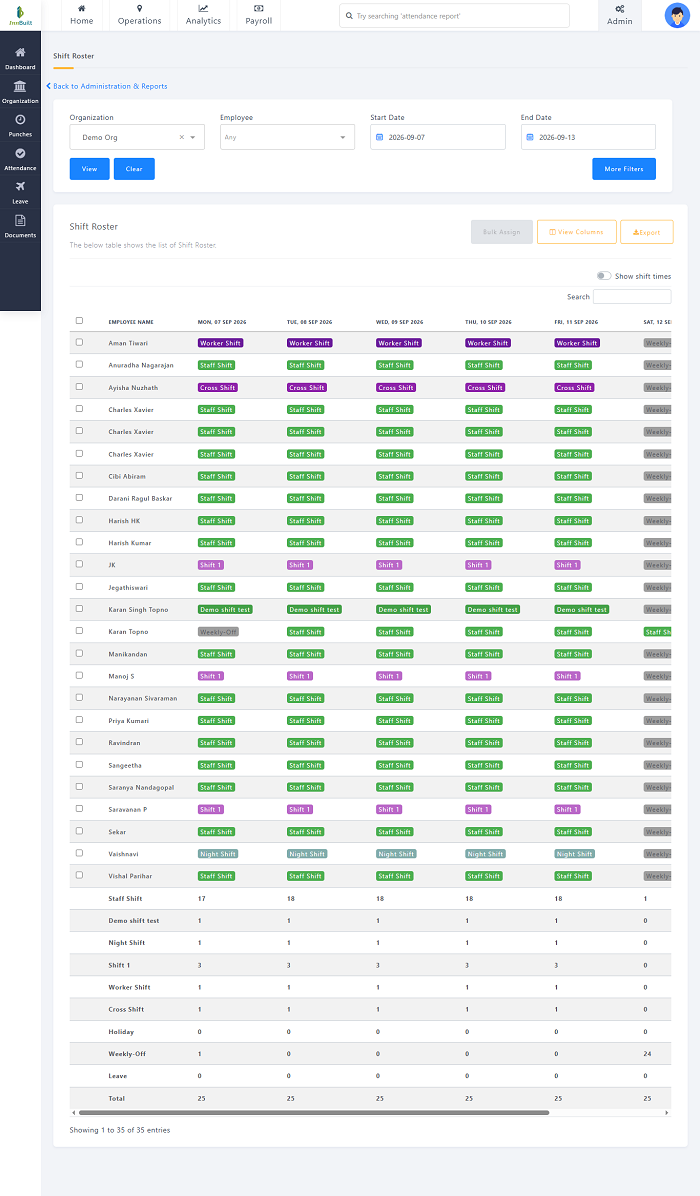
1. Understand Bahrain’s Working-Hour and Weekly Rest Requirements
Before creating a rotating shift system, employers should review Bahrain’s Labour Law for the Private Sector, Law No. 36 of 2012, including its amendments and any applicable ministerial decisions.
Several provisions are particularly relevant:
- Article 51: Generally limits actual working time to 48 hours per week and establishes a separate Ramadan limit for Muslim workers, subject to the exceptions provided by law.
- Article 52: Addresses breaks for prayer, meals, and rest, including a general minimum total break period of 30 minutes and restrictions on working more than six consecutive hours, subject to the provision and applicable exceptions.
- Article 53: Generally limits actual work to eight hours per day unless otherwise agreed, subject to a maximum of ten actual working hours per day. It also addresses the overall span between the start and end of the working day, subject to exceptions.
- Article 54: Addresses overtime and provides minimum additional pay rates for qualifying overtime hours.
- Article 55: Requires employers to display a schedule showing each worker’s weekly rest day, working hours, and rest periods, including schedule modifications.
- Article 57: Establishes the weekly rest framework, including a minimum of 24 complete consecutive hours. It also addresses working on a weekly rest day and the applicable compensation arrangements.
The precise application of these provisions depends on the employee’s circumstances, the nature of the work, and any legally applicable exceptions. Employers should not assume that all roles follow identical working-hour rules.
2. Identify Which Roles Require Rotating Shifts
Not every department needs a rotating schedule. Employers should first identify the roles that require coverage outside normal business hours and determine whether rotation is necessary.
For example:
| Industry or department | Typical shift-planning requirement |
|---|---|
| Hospitality | Maintain reception, housekeeping, food service, and security coverage |
| Healthcare | Coordinate qualified staff across day, evening, and night shifts |
| Security | Ensure assigned sites remain covered during shift changes |
| Logistics | Align warehouse, dispatch, and driver schedules with delivery requirements |
| Manufacturing | Coordinate production teams, machine operators, and maintenance support |
| Retail | Match staffing to opening hours, peak demand, and closing duties |
| Facilities management | Schedule cleaning, maintenance, and site-support teams |
| Customer support | Maintain service coverage across required operating hours |
| IT operations | Provide planned support and escalation coverage for critical systems |
For each role, managers should document the required staffing level, necessary qualifications, shift duration, handover responsibilities, and backup arrangements.
This prevents employers from rotating staff without considering whether each shift has the skills and supervision required to operate safely and efficiently.
3. Choose a Suitable Shift Rotation Pattern
A rotating shift pattern should reflect operational needs, employee availability, and applicable legal requirements. A pattern that works for a warehouse may not be suitable for a hospital or security operation.
Common approaches include:
Forward rotation: Employees move from morning shifts to evening shifts and then to night shifts. This can make schedule transitions easier to organise, but the actual design must still provide sufficient rest.
Fixed shifts with periodic rotation: Employees remain on a particular shift for a defined period before moving to another shift. This can make scheduling more predictable while distributing less desirable hours across the team.
Rotating rest days: Weekly rest days move according to a published roster so that the organisation can maintain coverage throughout the week.
Split-team rotation: Employees are divided into teams with staggered working schedules. Each team follows a defined pattern, while the overall roster maintains coverage.
Fixed shifts for specialist roles: Employees with specific qualifications or responsibilities remain on particular shifts where rotation would create operational or safety risks.
Employers should avoid choosing a rotation pattern simply because it is easy to administer. The schedule must also account for total working hours, consecutive assignments, weekly rest, employee wellbeing, and business continuity.
4. Prepare a Rotation Calendar in Advance
A rotation calendar helps managers plan staffing and communicate schedules before employees report for their shifts.
The calendar should identify:
- Employee name or ID.
- Department and assigned location.
- Shift date.
- Shift start and end times.
- Break arrangements.
- Weekly rest day.
- Supervisor or team leader.
- Approved leave and planned absences.
- Shift handover requirements.
- Any authorised changes to the published schedule.
For businesses with multiple teams, a shared calendar allows HR to compare coverage and identify gaps before the schedule takes effect.
A practical planning process is:
- Forecast staffing demand for each day and time period.
- Establish minimum staffing levels by role and location.
- Assign qualified employees to the required shifts.
- Calculate each employee’s daily and weekly working hours.
- Verify weekly rest periods and break arrangements.
- Check for conflicting assignments or insufficient time between shifts.
- Obtain approval from the responsible manager.
- Publish the roster and communicate changes.
- Preserve previous versions and approval records.
Managers should review the calendar whenever an employee takes leave, changes teams, or becomes unavailable. An outdated roster can cause attendance alerts and payroll errors even when the employee has followed a manager’s verbal instructions.
5. Schedule Weekly Rest Days Before Assigning Shifts
Weekly rest days should be part of the original roster rather than added only after the remaining shifts have been assigned.
Article 57 of Bahrain’s Labour Law generally requires at least 24 complete consecutive hours of weekly rest. Friday is identified as the weekly rest day, but the law permits employers, subject to the relevant conditions, to designate another day for some workers.
For businesses that operate every day, managers may need to stagger rest days across the workforce. The key is to preserve the required rest while maintaining adequate operational coverage.
HR teams should:
- Identify each employee’s designated weekly rest day.
- Include rest days in the published schedule.
- Check that the planned rest period is complete and consecutive.
- Avoid assigning overlapping shifts that undermine the intended rest period.
- Record any approved change to the employee’s rest day.
- Review the legal treatment if an employee is required to work on that day.
Employers should not treat a gap between two shifts as a substitute for the statutory weekly rest period unless it meets the applicable legal requirements.
A central roster also helps managers identify situations where too many employees in the same department are scheduled to rest on the same day.
6. Manage Employees Who Work on Their Weekly Rest Day
Some businesses may need employees to work on a weekly rest day because of urgent operational requirements, continuous services, or staffing shortages. These situations should be managed through an authorised process.
Article 57(b) addresses work on the weekly rest day. Where its conditions apply, the employee has the statutory choice between additional compensation equivalent to 150% of the normal wage for that day and another day of rest. The provision also restricts employment on the weekly rest day more than twice consecutively unless the employee provides written consent.
Employers should verify the current legal text and its application before processing these arrangements.
A suitable workflow includes:
- The manager identifies the operational need.
- The additional shift is requested and authorised.
- HR checks the employee’s roster and applicable rest requirements.
- The employee is informed of the arrangement.
- Actual attendance is recorded.
- The applicable compensation or alternative rest arrangement is documented.
- Payroll receives the approved records.
- HR verifies that the employee’s rest arrangements remain compliant.
Employers should not assume that an ordinary overtime approval automatically resolves the separate requirements for working on a weekly rest day.
7. Prevent Fatigue and Poor Shift Transitions
A rotating schedule can create fatigue when employees move between shifts without adequate recovery time. This may increase the risk of errors, accidents, reduced productivity, and employee dissatisfaction.
Employers should consider the following practices:
- Avoid unnecessary quick returns between late finishes and early starts.
- Design rotations that provide predictable recovery periods.
- Monitor repeated night shifts and extended working hours.
- Include adequate time for shift handovers.
- Avoid using the same employees for every emergency replacement.
- Review workloads during unusually busy periods.
- Provide a clear process for reporting fatigue or unsafe working conditions.
For example, an employee who finishes a late-night shift should not be assigned an early-morning shift without checking the available rest period and applicable requirements.
Employers should also review the actual end time of a shift. If staff regularly remain late to complete reports or transfer responsibility, the effective schedule may differ from the published roster.
8. Use a Fair and Transparent Rotation Policy
Employees are more likely to accept rotating shifts when the allocation process is understandable and consistent.
A written policy should explain how the organisation assigns morning, evening, night, weekend, and rest-day duties. It should also define how requests for shift changes are reviewed.
A fair process can consider:
- Skills and qualifications needed for each shift.
- Previous assignments and distribution of night work.
- Employee availability and approved leave.
- Contractual terms and applicable legal protections.
- Rest requirements and the risk of fatigue.
- Operational demand and minimum staffing needs.
- Requests for changes, where they can reasonably be accommodated.
Managers should keep records of shift allocations and changes. If an employee questions why a particular assignment was made, the manager should be able to explain the operational reason and show that the policy was applied consistently.
Fairness does not necessarily mean identical schedules for every employee. Specialist roles may require different assignments, but the reasons should be documented.
9. Manage Shift Swaps and Emergency Replacements
Employees may request shift swaps to manage personal commitments, appointments, or unexpected situations. Emergency absences may also require managers to arrange replacement coverage.
A controlled process should require employees to submit a request, identify the proposed replacement where applicable, and obtain approval before the roster changes.
HR should verify that the revised schedule:
- Meets the required staffing and skill levels.
- Does not create conflicting assignments.
- Complies with applicable working-hour and rest requirements.
- Reflects approved leave or absence records.
- Includes the correct reporting location and supervisor.
- Is communicated to all affected employees.
- Is updated in the attendance and payroll systems.
A shift swap should not be treated as approved merely because two employees have agreed informally. Without a central record, attendance systems may mark the wrong employee as absent or assign hours to the wrong person.
For emergencies, managers should record the reason for the change and complete the required approvals as soon as practicable under the organisation’s procedures.
10. Track Actual Attendance Against the Roster
The published shift schedule shows when an employee is expected to work. Attendance records establish whether the employee actually reported and completed the assigned hours.
Employers should maintain records of:
- Scheduled shift start and end times.
- Actual clock-in and clock-out times.
- Worksite or branch.
- Breaks where required or relevant.
- Late arrivals and early departures.
- Missing punches and corrected records.
- Absences and approved leave.
- Additional hours worked.
- Weekly rest-day work.
- Shift swaps and supervisor approvals.
Where employees work across multiple locations, a central attendance system can help HR compare planned coverage with actual staffing at each site.
Attendance exceptions should be reviewed daily or at another appropriate frequency. For example, if an employee clocks in at a different time from the approved schedule, the supervisor should verify whether a shift change was authorised before correcting the record.
Accurate attendance records are essential for payroll calculations, working-hour reviews, staffing reports, and resolving employee queries.
11. Apply Working-Hour and Overtime Rules Correctly
Rotating shifts can make it difficult to calculate working hours because employees may work different start times, finish times, and rest days throughout the week.
Article 53 generally addresses daily working hours and the span of the working day, while Article 54 covers overtime compensation. Article 51 sets the general weekly working-hour limit and a separate Ramadan rule for Muslim workers, subject to legal exceptions.
Article 54 provides for minimum additional pay of 25% above the wage for qualifying daytime overtime hours and 50% above the wage for qualifying nighttime overtime hours. The correct treatment depends on the applicable legal rules and the circumstances of the work.
HR and payroll teams should:
- Compare actual hours with the approved schedule.
- Calculate daily and weekly working time.
- Identify additional hours and determine their legal treatment.
- Review work performed on weekly rest days separately.
- Confirm approvals and supporting records.
- Apply the correct pay treatment where required.
- Investigate repeated overtime or schedule extensions.
- Retain the calculations and approvals for audit.
Employers should avoid treating all hours outside a standard daytime schedule as overtime automatically. The correct classification depends on the applicable law, contractual terms, and actual circumstances.
12. Display and Communicate the Approved Schedule
Article 55 requires employers to display a schedule showing the weekly rest day, working hours, and rest periods prescribed for each worker, including modifications.
For practical compliance, the schedule should be accessible to employees and their supervisors. Businesses may also use digital systems to communicate rosters, provided the arrangements meet applicable requirements.
The schedule should clearly show:
- The employee’s assigned working days.
- Shift start and end times.
- Weekly rest day.
- Break arrangements.
- Work location.
- Supervisor or reporting contact.
- Effective dates for the schedule.
- Approved changes.
When the roster changes, managers should update the official schedule and notify affected employees. HR should retain the change history so that it can explain why the employee’s expected hours differed from the original plan.
13. Use Workforce Management Software to Automate Rotations
Manual shift planning can become difficult when a business employs many workers across several branches or sites. Workforce management software can simplify scheduling and help HR identify potential problems before the roster is published.
Useful features include:
- Rotating shift templates.
- Weekly rest-day scheduling.
- Daily and weekly hour checks.
- Alerts for overlapping or conflicting shifts.
- Employee availability and leave management.
- Shift-swap approval workflows.
- Attendance integration.
- Overtime and rest-day work flags.
- Supervisor approval records.
- Payroll integration.
- Schedule-change notifications.
- Audit trails and role-based access.
When selecting a system, Bahrain businesses should check whether it can support their specific working-hour rules and configure exceptions for different employee groups where legally appropriate.
Automated alerts are useful, but they should not replace HR review. The employer remains responsible for confirming that the actual schedule and compensation arrangements comply with applicable requirements.
14. Review the Shift System Regularly
A rotating shift system should be reviewed whenever business needs, staffing levels, or operational risks change.
Useful performance measures include:
- Number of shifts left uncovered.
- Percentage of rosters published on time.
- Frequency of last-minute changes.
- Unplanned absences and attendance corrections.
- Overtime hours by department.
- Weekly rest-day work.
- Payroll corrections caused by scheduling errors.
- Employee complaints about shift allocation.
- Fatigue-related reports or safety incidents.
- Service quality during shift handovers.
If a department repeatedly relies on overtime or emergency replacements, managers should examine whether the rotation pattern, staffing levels, or handover process needs improvement.
The aim is to maintain reliable service without making excessive demands on employees or creating avoidable compliance risks.
Rotating Shifts and Weekly Rest Checklist
Before publishing the roster
- Review the applicable Bahrain labour-law requirements.
- Identify staffing needs by shift, role, and location.
- Choose an appropriate rotation pattern.
- Assign weekly rest days.
- Check daily and weekly working hours.
- Verify breaks and planned recovery periods.
- Obtain manager approval.
- Display and communicate the schedule.
During the schedule period
- Monitor attendance against the roster.
- Record approved shift swaps and changes.
- Investigate missing punches and unplanned absences.
- Track additional hours and weekly rest-day work.
- Review staffing gaps and emergency replacements.
- Update the official schedule when changes are approved.
Before payroll closing
- Reconcile actual hours with approved attendance.
- Review overtime and rest-day work separately.
- Verify applicable additional pay or alternative rest arrangements.
- Resolve attendance exceptions.
- Retain approvals and supporting records.
Frequently Asked Questions
1. What is the minimum weekly rest period in Bahrain?
Article 57 of Bahrain’s Labour Law generally requires a weekly rest period of at least 24 complete consecutive hours. Employers should verify the current legal text and any applicable rules for their workforce.
2. Must weekly rest always fall on Friday?
Friday is identified as the weekly rest day under Article 57, but the law allows an employer, subject to the applicable conditions, to designate another day for some workers. Employers should document the designated rest day in the employee’s schedule.
3. Can an employee be required to work on a weekly rest day?
Article 57(b) addresses circumstances in which work is required on the weekly rest day and provides for the applicable additional compensation or alternative rest arrangement. It also restricts work on the weekly rest day more than twice consecutively unless the employee gives written consent. Employers should confirm the current law and applicable circumstances before arranging such work.
4. How should businesses plan rotating shifts?
Businesses should forecast demand, set minimum staffing levels, choose an appropriate rotation pattern, assign weekly rest days, check working hours, and publish the roster in advance. Schedules should be updated when approved changes occur.
5. How can employers avoid attendance errors during shift rotations?
Employers should maintain a central roster, require approval for shift swaps, compare scheduled hours with actual clock-in and clock-out records, and investigate missing punches promptly. Approved changes should be reflected in attendance and payroll systems.
6. How is overtime handled under Bahrain’s Labour Law?
Article 54 provides minimum additional pay rates for qualifying overtime: at least 25% above the wage for daytime overtime and 50% above the wage for nighttime overtime. The applicable treatment depends on the legal rules and circumstances of the work.
Conclusion
Managing rotating shifts and weekly rest days in Bahrain requires a clear scheduling policy, advance planning, accurate attendance records, and consistent communication. Employers should establish an appropriate rotation pattern, assign weekly rest days before allocating shifts, monitor actual hours, and control shift changes through a documented approval process.
A central workforce management system can help businesses coordinate employees across departments and locations while identifying potential scheduling conflicts. By reviewing working hours, rest periods, overtime, and weekly rest-day work before payroll closing, employers can maintain operational coverage and manage their workforce more consistently.
Rotating schedules become easier to follow when rest days and shift changes share one roster. InnBuilt Shift Management can help Bahrain managers plan coverage and spot conflicting assignments.