How Can Bahrain Restaurants Track Split Shifts and Actual Hours Worked?
How Can Bahrain Restaurants Track Split Shifts and Actual Hours Worked?
Introduction
Restaurants in Bahrain often organise employee schedules around changing customer demand. Breakfast, lunch, dinner, weekend dining, catering orders, and late-night service can create several busy periods within a single day. As a result, restaurants may use split shifts, where an employee works one period, takes a break between scheduled work periods, and returns for another shift later.
Although split shifts help restaurants align staffing with demand, they can make attendance tracking and payroll calculations more complicated. Managers need to distinguish scheduled hours from actual hours worked, record the start and end of each work period, identify overtime, document approved shift changes, and ensure that attendance records match payroll calculations.
For example, a restaurant employee might work from 11:00 a.m. to 3:00 p.m., leave during the afternoon, and return from 7:00 p.m. to 11:00 p.m. The employee has worked eight hours across two periods, but the full span from the first start to the final finish is twelve hours. Recording only the first check-in and last check-out would incorrectly treat the entire span as working time unless the intervening period were accurately accounted for.
A reliable split-shift tracking process helps Bahrain restaurants maintain accurate attendance records, control labour costs, plan service coverage, and prepare payroll with greater confidence.
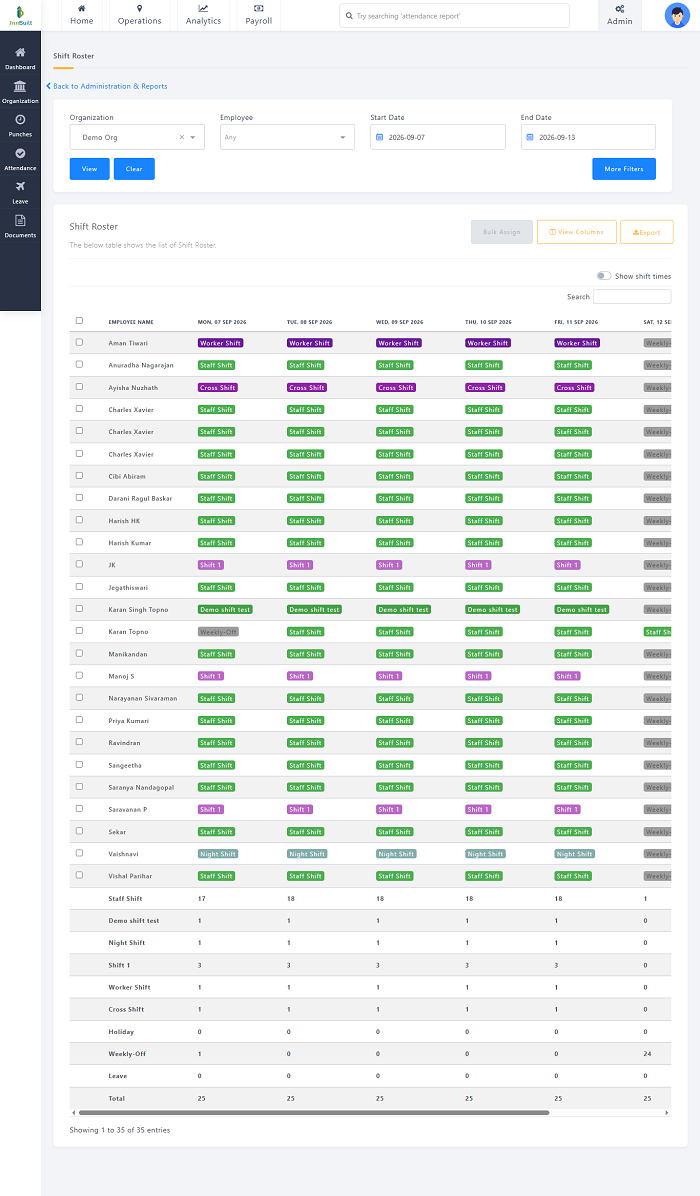
1. Understand How Split Shifts Work in Restaurants
A split shift divides an employee's scheduled work into two or more separate working periods within the same day. It is common in restaurant operations because demand often rises sharply around meal services.
Examples include:
- Kitchen staff working during lunch and dinner services.
- Servers scheduled for afternoon and evening dining.
- Cashiers covering lunch and late-night peaks.
- Delivery teams working during lunch and dinner order surges.
- Restaurant supervisors returning for an evening service.
- Catering employees covering separate preparation and service periods.
A split-shift arrangement should clearly identify each work period and the time between periods. Managers should communicate the schedule in advance and make sure employees understand when they are expected to work and when they are off duty.
Restaurants should not assume that every gap between two shifts is automatically unpaid. The treatment of that time depends on the actual arrangement, applicable legal requirements, and whether the employee is genuinely free from work duties during the interval.
2. Create a Separate Attendance Record for Each Work Period
The most important step is to record every work period individually rather than treating the entire day as one continuous shift.
For each employee, the attendance system should capture:
- Employee ID and assigned restaurant or branch.
- Scheduled start and end time for each work period.
- Actual clock-in and clock-out timestamps.
- Breaks taken during a work period, where relevant.
- Late arrivals and early departures.
- Approved schedule changes.
- Overtime start and finish times.
- Supervisor corrections and approval history.
For example, a restaurant employee could have two attendance records on the same date: one for lunch service and another for dinner service. The system can then calculate the duration of each period and add the eligible working time for the day.
This approach prevents a common error: recording the first arrival and final departure as one continuous working period, even though the employee was away from the workplace for several hours.
3. Distinguish Scheduled Hours From Actual Hours Worked
A roster shows when an employee is expected to work. An attendance record shows when the employee actually worked, subject to verification and applicable rules.
Both records are necessary.
| Record | Purpose |
|---|---|
| Scheduled start and end | Establishes the planned work period |
| Actual clock-in and clock-out | Records when the employee arrived and left |
| Break record | Identifies applicable breaks during the work period |
| Split-shift interval | Shows the gap between separate scheduled work periods |
| Overtime approval | Documents authorised additional working time |
| Attendance correction | Explains and records an approved adjustment |
| Payroll-ready hours | Provides the reviewed hours used for wage calculations |
Managers should review differences between scheduled and actual time rather than automatically replacing one with the other.
If a chef begins preparing food before the scheduled shift, for example, the manager should establish whether the work was authorised and how the time must be recorded and treated under applicable requirements. Actual work should not be omitted simply because it began earlier than planned.
4. Calculate Actual Working Hours Correctly
A restaurant should calculate working time from each recorded work period, applying the appropriate treatment to breaks and other intervals.
A simplified example is shown below.
| Work period | Scheduled time | Actual time | Recorded duration |
|---|---|---|---|
| Lunch service | 11:00 a.m.–3:00 p.m. | 11:05 a.m.–3:10 p.m. | 4 hours 5 minutes |
| Dinner service | 7:00 p.m.–11:00 p.m. | 6:55 p.m.–11:05 p.m. | 4 hours 10 minutes |
| Total | 8 scheduled hours | — | 8 hours 15 minutes |
In this illustrative example, the employee has 8 hours and 15 minutes between the recorded clock-in and clock-out times across the two work periods. The restaurant should verify the circumstances of the early arrival, late finish, and any applicable break or rounding rules before deciding how the hours should be treated for payroll.
The four-hour interval between the work periods is not automatically counted as working time merely because it falls on the same day. However, if the employee is required to remain at the workplace or perform duties during that interval, its treatment needs to be assessed according to the actual circumstances and applicable law.
For reliable calculations, systems should preserve timestamps, calculate durations consistently, and avoid rounding that systematically reduces recorded working time.
5. Use Digital Attendance Systems to Track Multiple Clock-Ins
Paper registers and spreadsheets can become difficult to manage when employees work two or more periods per day. Digital attendance systems can simplify the process by allowing multiple clock-in and clock-out events under the same employee record.
Useful features include:
- Multiple work periods per day.
- Mobile or terminal-based clock-in and clock-out.
- Separate records for different branches.
- Alerts for missed clock-outs.
- Identification of early arrivals and late finishes.
- Supervisor approval for attendance corrections.
- Overtime and schedule-change workflows.
- Exportable attendance summaries for payroll.
For restaurant groups operating several locations, a central dashboard can show whether employees have started their scheduled periods and highlight missing attendance records.
The system should also allow employees or supervisors to report genuine exceptions, such as a forgotten clock-out or a shift extended because of an unexpected rush. Corrections should preserve the original record and include an explanation and approval trail.
6. Track the Gap Between Split Shifts
The interval between work periods is an important part of a split-shift schedule. Managers should record when the first period ends and when the next one begins so that the system can calculate the gap accurately.
A clear record helps answer operational questions:
- How long is the interval between lunch and dinner service?
- Was the employee scheduled to return at the agreed time?
- Did the employee leave the premises or remain at the restaurant?
- Was the employee asked to perform duties during the interval?
- Did a manager change the second shift at short notice?
- Was the employee required to remain available for work?
Restaurants should not assume that the gap is working time or rest time solely based on its label in the roster. The actual conditions matter, particularly if employees are required to wait on-site, respond to instructions, prepare for the next service, or perform other duties during the interval.
Where the interval is intended to be off duty, managers should communicate that expectation clearly and avoid assigning work that conflicts with the arrangement.
7. Coordinate Split Shifts With Restaurant Service Demand
Accurate tracking is only one part of effective split-shift management. The schedule should also reflect the restaurant's workload.
Managers can use sales history, reservation volumes, takeaway orders, delivery demand, and staffing requirements to decide when each team should work.
For example:
- Kitchen employees may be scheduled for preparation and lunch service, then return for dinner preparation and service.
- Servers may be rostered for the periods when reservations and walk-in traffic are highest.
- Delivery staff may cover lunch and dinner order peaks.
- Cleaning teams may be scheduled around food preparation and closing requirements.
- Supervisors may overlap with teams during service handovers.
Managers should compare expected demand with actual workload. If employees regularly need to start early or finish late, the restaurant may need to revise its roster rather than rely on unplanned overtime every day.
8. Establish a Clear Shift-Change and Approval Process
Restaurant operations often change at short notice. A lunch service may run longer than expected, a large dinner booking may require extra preparation, or an employee may need a shift swap.
Without a formal process, these changes can create discrepancies between the published roster, attendance records, and payroll.
Restaurants should establish rules covering:
- Who can approve a change to a scheduled work period.
- How employees request shift swaps or revised start times.
- How the new schedule is communicated to the employee.
- How actual hours are recorded when a shift changes.
- How additional hours are reviewed and approved.
- How corrections are documented before payroll closes.
For example, if a dinner shift is moved from 7:00 p.m. to 6:00 p.m., the revised schedule should be recorded and communicated. The attendance system should retain the original roster as well as the approved change so that managers can explain the difference between planned and actual hours.
A shift swap should not be considered complete until the manager has confirmed the replacement employee, updated the roster, and checked that the change does not create a scheduling or compliance issue.
9. Monitor Overtime and Extended Service Periods
Restaurants may need employees to work beyond their scheduled finish time when customers arrive late, orders increase, or closing duties take longer than expected.
Managers should distinguish between an approved extension and a change that has not yet been reviewed. The system should record the actual time worked, the reason for the extension, and the manager responsible for approval.
Useful controls include:
- Alerts when an employee works beyond the scheduled finish.
- Approval records for additional hours.
- Daily and weekly working-time summaries.
- Reports identifying recurring late finishes.
- Review of applicable overtime rates and rest-day arrangements.
- Reconciliation of approved hours with payroll.
Under Bahrain's Labour Law for the Private Sector, Article 54 provides for overtime payment at a minimum of 25% above the wage due for daytime overtime and 50% above the wage due for nighttime overtime. The correct treatment depends on the applicable rules and circumstances. Restaurants should consult the current legislation and relevant implementing decisions before configuring payroll calculations.
If employees repeatedly work beyond their scheduled hours, managers should investigate whether the cause is understaffing, inaccurate service forecasts, late customer orders, or unrealistic closing schedules.
10. Apply Bahrain Working-Hour and Rest Requirements
Split shifts should be designed with applicable working-hour, break, overtime, and weekly-rest requirements in mind. A split shift does not automatically remove an employee from these requirements.
Bahrain's Labour Law for the Private Sector, Law No. 36 of 2012, includes several provisions relevant to restaurant scheduling:
- Article 51: Generally limits actual working time to 48 hours per week, subject to the law's provisions. It also sets a special Ramadan limit for Muslim employees of six hours per day or 36 hours per week, subject to applicable exceptions.
- Article 52: Generally requires break periods totalling at least half an hour and provides that employees should not work more than six consecutive hours without a break, subject to specified exceptions. Break periods generally do not count as actual working time.
- Article 53: Generally limits actual work to eight hours per day unless otherwise agreed, with a maximum of ten actual working hours per day. It also generally limits the span from the beginning to the end of the working day to 11 hours, counting a break as time present where the worker remains at the workplace, subject to specified exceptions.
- Article 54: Addresses additional pay for overtime.
- Article 55: Requires employers to display a schedule showing weekly rest days, working hours, and break periods, including changes to that schedule.
- Article 57: Generally requires at least 24 consecutive hours of weekly rest, subject to the law's provisions.
These are general statutory provisions, not a substitute for checking the current law and any applicable exceptions or ministerial decisions. In particular, managers should not assume that a long interval between shifts makes a schedule compliant if the overall span, actual hours, or other requirements are not satisfied.
Restaurants should also review employees' contracts, any applicable collective or workplace arrangements, and current legal guidance when designing split-shift policies.
11. Reconcile Split-Shift Records Before Payroll
Payroll teams need an accurate summary of the hours employees actually worked, not simply the total time between the day's first arrival and final departure.
A practical reconciliation process should compare:
- The published roster and approved changes.
- Clock-in and clock-out records for every work period.
- Missed punches and approved corrections.
- Recorded breaks and intervals between shifts.
- Overtime and rest-day work.
- Applicable wage rates and allowances.
- The final hours submitted to payroll.
Exceptions should be investigated before payroll is finalised. For example, if the roster shows four hours for lunch service but the attendance system records four hours and 20 minutes, the manager should determine whether the additional time involved actual work and how it should be treated.
Payroll teams should also maintain an audit trail showing who reviewed an exception, what was changed, and why. This supports internal checks and helps resolve employee questions about pay.
12. Protect Employee Attendance Data
Attendance systems may contain employee identifiers, schedules, location information, and detailed records of work patterns. Restaurants should protect this information and make it available only to authorised personnel.
Good practices include:
- Providing employees with clear information about attendance procedures.
- Restricting access according to job responsibilities.
- Keeping a traceable record of corrections.
- Establishing appropriate retention and deletion rules.
- Securing attendance terminals and mobile devices.
- Reviewing how third-party software providers handle employee data.
- Avoiding unnecessary location tracking outside working hours.
If a restaurant uses GPS-based check-ins or biometric attendance, it should assess the applicable Bahrain personal-data protection requirements before deployment. The method of tracking should be proportionate to the operational need, and employees should have a clear way to report inaccurate records.
13. Measure Split-Shift Performance With Useful KPIs
Restaurants can use attendance and scheduling reports to determine whether split shifts are improving staffing efficiency or creating avoidable problems.
| KPI | What it helps measure |
|---|---|
| Scheduled versus actual hours | Differences between planned and recorded working time |
| Missed-punch rate | Frequency of incomplete attendance records |
| Overtime hours | Additional working time beyond scheduled hours |
| Late-start rate | Frequency of late arrivals |
| Unplanned shift changes | Roster instability and last-minute adjustments |
| Labour cost per sales hour | Relationship between staffing costs and sales |
| Staff coverage by service period | Whether enough employees are scheduled for lunch and dinner |
| Payroll correction rate | Frequency of attendance-related payroll adjustments |
| Repeated late finishes | Potential scheduling or operational bottlenecks |
Managers should interpret these measures together. Lower scheduled hours do not necessarily mean better labour efficiency if overtime rises, service quality declines, or employees are consistently required to work beyond their roster.
14. Implement a Daily Split-Shift Tracking Workflow
A consistent process can help restaurant managers, supervisors, HR teams, and payroll staff work from the same information.
Before the first shift: Publish the schedule, confirm employee availability, and identify any approved changes.
At the start of each work period: Employees record their actual arrival, and supervisors investigate missing or unusual entries.
At the end of each work period: Employees record their departure. The system closes that period without incorrectly treating the gap before the next shift as working time.
Before the next work period: Managers check staffing coverage, confirm the revised schedule if necessary, and communicate any changes.
At the end of the day: Review missed punches, early arrivals, late finishes, overtime, and any work performed during the scheduled interval.
Before payroll close: Reconcile the reviewed attendance records with applicable wage calculations and retain the approval history.
A central dashboard can help restaurant groups compare branches and identify locations where split-shift changes or payroll corrections occur frequently.
Frequently Asked Questions
1. What is a split shift in a Bahrain restaurant?
A split shift is a work schedule in which an employee works two or more separate periods in one day, with a gap between those periods. Restaurants may use it to cover lunch and dinner service peaks.
2. How should restaurants record split-shift attendance?
They should record a separate clock-in and clock-out for every work period, along with relevant breaks, approved changes, and overtime. The attendance system should preserve the gap between work periods as a separate interval.
3. Does the gap between split shifts count as working time?
Not automatically. The treatment depends on the actual circumstances, including whether the employee is free from work duties or required to remain available or perform tasks. Restaurants should review the applicable Bahrain legal requirements before deciding how the interval is treated.
4. How can restaurants calculate daily hours for split-shift employees?
They should calculate the duration of each recorded work period, apply the appropriate treatment to breaks and other intervals, and then total the eligible working time. Early starts, late finishes, and attendance corrections should be reviewed before payroll is processed.
5. Can attendance software support multiple shifts in one day?
Yes. Suitable systems can record multiple clock-ins and clock-outs, flag missing punches, retain approved roster changes, and produce attendance summaries for payroll.
Conclusion
Bahrain restaurants can track split shifts and actual hours worked by recording each work period separately, comparing planned schedules with actual attendance, documenting changes, and reviewing exceptions before payroll closes.
Digital attendance systems can make the process easier by supporting multiple clock-ins, shift-change approvals, overtime alerts, and branch-level reporting. However, accurate records also depend on clear policies, trained supervisors, and consistent communication with employees.
By combining reliable attendance tracking with demand-based scheduling and careful review of Bahrain's working-hour requirements, restaurants can improve staffing efficiency, control labour costs, and prepare more accurate payroll records.
Split shifts are easier to assess when each working period is visible. InnBuilt Attendance Software can help Bahrain restaurants record separate check-ins and compare actual hours with planned service coverage.