How Can Bahrain Teams Track Night Shifts That Cross Midnight?
How Can Bahrain Teams Track Night Shifts That Cross Midnight?
Introduction
Tracking night shifts that cross midnight is an important part of attendance and payroll management for businesses in Bahrain. When an employee starts work late in the evening and finishes the following morning, the shift belongs to two calendar dates. If attendance systems record the start and end times incorrectly, employers may encounter inaccurate working-hour totals, missing attendance entries, incorrect overtime calculations, and payroll discrepancies.
These challenges are common in hotels, hospitals, security companies, warehouses, logistics operations, manufacturing facilities, restaurants, and facilities management businesses. Employees may start at 10:00 p.m. and finish at 6:00 a.m., while supervisors and payroll teams need to identify the shift correctly across both dates.
Bahrain employers can manage these situations by using overnight shift identifiers, recording complete timestamps, assigning clear attendance rules, and reconciling actual working hours with approved rosters. They must also distinguish calendar dates from the legal treatment of working hours, overtime, and rest periods.
A reliable overnight attendance process helps HR teams maintain accurate records, pay employees correctly, and identify scheduling issues before payroll is finalised.
1. Understand Why Midnight-Crossing Shifts Need Special Tracking
A shift that crosses midnight cannot always be processed correctly using a simple daily attendance report. The employee may clock in on one date and clock out on the next, but both timestamps can relate to the same scheduled shift.
For example, an employee may work from 10:00 p.m. on Monday until 6:00 a.m. on Tuesday. A system that treats each calendar date independently could show an incomplete shift on Monday and an unmatched clock-in or clock-out on Tuesday.
Common problems include:
- Clock-out records appearing on the wrong attendance date.
- Overnight shifts being incorrectly marked as incomplete.
- Hours being split across two payroll periods or daily reports.
- Overtime being calculated using incorrect start or finish times.
- Night work being classified incorrectly.
- Duplicate attendance entries when a supervisor manually corrects a record.
- Managers overlooking the actual length of a shift.
- Employees appearing absent on the day their shift ends.
To avoid these problems, employers should define how overnight shifts are identified, processed, approved, and transferred to payroll.
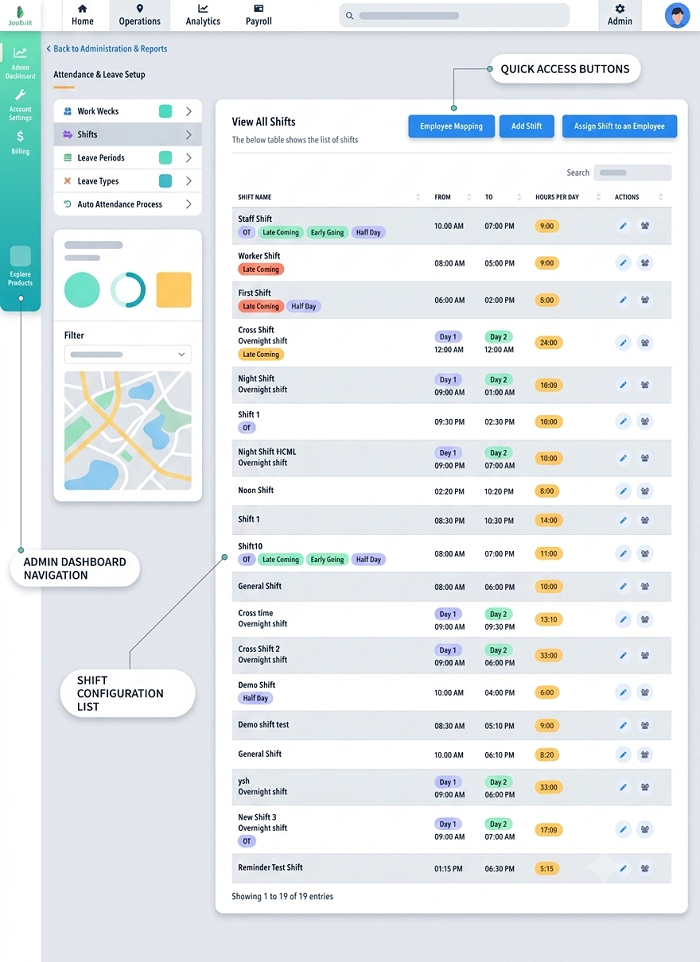
2. Create a Clear Overnight Shift Schedule
The first step is to define overnight shifts in the official roster. Employers should avoid relying on informal descriptions such as “night duty” without specifying the actual hours.
Each shift should have a unique identifier and include:
- Employee ID and name.
- Department and assigned location.
- Shift date or designated shift-start date.
- Scheduled start time.
- Scheduled end time.
- Break arrangements.
- Assigned supervisor.
- Expected working hours.
- Applicable attendance and overtime rules.
- Any approved changes to the schedule.
For example, a company could assign a shift code such as NIGHT-2200-0600 to identify a shift that starts at 10:00 p.m. and ends at 6:00 a.m. the following day.
The roster should make it clear that the shift begins on one date and ends on the next. This helps supervisors review attendance without mistakenly treating the clock-out as belonging to an unrelated shift.
A central schedule also makes it easier to coordinate overnight operations across multiple branches and worksites.
3. Record the Exact Clock-In and Clock-Out Timestamps
Accurate timestamps are essential for calculating actual working hours.
For every overnight shift, the attendance system should capture the full date and time of each event rather than storing only the time of day.
For example:
| Attendance event | Date and time |
|---|---|
| Scheduled start | Monday, 10:00 p.m. |
| Actual clock-in | Monday, 9:56 p.m. |
| Scheduled finish | Tuesday, 6:00 a.m. |
| Actual clock-out | Tuesday, 6:08 a.m. |
The example shows why the date must be stored alongside the time. Recording only “10:00 p.m.” and “6:00 a.m.” can make automated calculations ambiguous.
Employers should also define how the system handles early clock-ins, late departures, missed punches, and approved shift extensions. A clock-in before the scheduled start should not automatically be treated as authorised overtime, and a late clock-out should be reviewed to determine whether additional work was performed.
Where employees use mobile attendance, biometric terminals, access-control devices, or manual registers, the system should preserve the original event timestamps and any subsequent corrections.
4. Assign Overnight Shifts to the Correct Workday
Businesses should establish a consistent rule for assigning an overnight shift to an attendance date. Many systems use the date on which the shift starts, but the employer should confirm that its chosen method supports its reporting and payroll requirements.
For example, if an employee works from 11:00 p.m. on Thursday to 7:00 a.m. on Friday, the shift can be identified by its Thursday start date while retaining both actual timestamps.
The attendance system should distinguish between:
- The scheduled shift date.
- The actual clock-in date.
- The actual clock-out date.
- The payroll period in which the hours are processed.
- The date used for operational reporting.
These dates serve different purposes and should not be confused.
A consistent shift-date rule helps managers review attendance, but it does not automatically determine the legal treatment of hours worked at night, on a weekly rest day, or on an official public holiday. Those questions must be reviewed separately under the applicable rules.
5. Calculate Total Working Hours Correctly
The system should calculate the elapsed time between the actual start and end timestamps, then apply the appropriate break and working-time rules.
For example, an employee clocks in at 10:00 p.m. and clocks out at 6:00 a.m. the next day. The elapsed time is eight hours.
If the employee has a 30-minute unpaid break that is excluded from actual working time under the applicable arrangements, the illustrative calculation is:
| Calculation | Duration |
|---|---|
| Elapsed shift time | 8 hours |
| Unpaid break excluded from working time | 30 minutes |
| Illustrative actual working time | 7 hours 30 minutes |
This example assumes that the break is genuinely taken and is correctly excluded under the applicable rules. Employers should not automatically deduct scheduled breaks if the employee did not receive them or if the applicable legal arrangements require different treatment.
For Bahrain private-sector employees, HR should review the relevant working-hour provisions, including Articles 51–53 of the Labour Law for the Private Sector, and any applicable exceptions. The correct treatment depends on the employee’s circumstances and the nature of the work.
6. Apply Bahrain’s Night-Work and Overtime Rules Carefully
An overnight shift does not automatically mean that every hour is overtime. Employers must distinguish between ordinary scheduled hours and qualifying additional hours.
Article 54 of Bahrain’s Labour Law for the Private Sector provides that qualifying additional hours attract a wage equal to the applicable wage plus at least 25% for hours worked during the day and at least 50% for hours worked during the night.
Article 22 defines night as the period between 7:00 p.m. and 7:00 a.m. for the purposes of the law.
These provisions mean that HR and payroll teams should review the actual hours worked and identify which hours qualify for the relevant overtime treatment. They should not simply classify an entire overnight shift as overtime because it crosses midnight.
Before processing a shift, employers should check:
- The employee’s normal working schedule.
- The actual start and end timestamps.
- The hours worked within the statutory night period.
- The number of qualifying additional hours.
- The applicable wage basis.
- Any special rules or exceptions relevant to the employee.
- Whether weekly rest-day or public holiday provisions also apply.
7. Handle Shifts That Cross Into a Weekly Rest Day or Public Holiday
A night shift may begin on an ordinary working day and finish on a weekly rest day or official public holiday. Employers should not rely solely on the shift-start date to determine the legal treatment of the entire shift.
For example, an employee may start at 10:00 p.m. on Thursday and finish at 6:00 a.m. on Friday. If Friday is the employee’s designated weekly rest day, the employer should review the applicable rules and the circumstances of the work rather than automatically treating the whole shift as ordinary Thursday work.
Bahrain’s Labour Law contains separate provisions for these situations:
- Article 57 addresses weekly rest and work performed on a weekly rest day.
- Article 64 addresses official public holidays and the arrangements applicable when employees are required to work on those days.
HR should configure the system to identify the relevant dates and flag shifts requiring review. The correct legal and payroll treatment should then be determined using the applicable rules, rather than assumed from the shift code alone.
Where a shift crosses midnight on a public holiday, employers should retain the actual timestamps and the approved roster so that the relevant hours can be reviewed accurately.
8. Prevent Duplicate Attendance Records and Missing Punches
Overnight shifts can create attendance exceptions when an employee clocks in on one date but the system expects the clock-out on the same date.
To prevent this, employers should configure the attendance platform to support shifts that extend into the following day.
Recommended controls include:
- Assigning a unique shift ID to each scheduled shift.
- Linking the clock-out to the correct open shift.
- Setting a suitable window for expected clock-out events.
- Flagging missing punches instead of automatically closing shifts incorrectly.
- Requiring supervisor approval for manual corrections.
- Preserving the original timestamps after a correction.
- Preventing duplicate records for the same attendance event.
- Recording the reason for every manual adjustment.
For example, if an employee clocks in at 11:00 p.m. and forgets to clock out at 7:00 a.m., the system should create an exception for review. A supervisor can verify the actual finish time using the appropriate evidence and approve a correction according to company policy.
The correction should remain traceable so that HR and payroll can distinguish the original record from the approved adjustment.
9. Coordinate Overnight Shift Handover and Supervisor Approvals
Many overnight operations depend on a handover between the outgoing and incoming teams. If the handover is not planned correctly, employees may regularly work beyond their scheduled finishing time.
Employers should define:
- The expected handover duration.
- Which tasks must be completed before the shift ends.
- Whether the handover forms part of working time.
- Who approves an extended shift.
- How actual handover time is recorded.
- Which supervisor is responsible for unresolved attendance exceptions.
If an employee remains at work to complete a required handover, managers should assess the actual work performed and its treatment under applicable law and policy.
Supervisors should review the shift log before approving the attendance record. This is particularly important in security, healthcare, manufacturing, and logistics, where an incomplete handover may create operational or safety risks.
10. Integrate Overnight Attendance With Payroll
Payroll systems must receive the correct hours from overnight attendance records. If the attendance platform splits a shift incorrectly, payroll may undercount hours, duplicate time, or apply the wrong rate.
A reliable reconciliation process should include:
- Importing the approved roster and attendance data.
- Matching clock-in and clock-out events to the correct shift.
- Checking missing punches and manual corrections.
- Calculating actual working time and applicable breaks.
- Identifying qualifying overtime hours.
- Reviewing nighttime, weekly rest-day, and public holiday treatment where relevant.
- Confirming the applicable wage calculations.
- Resolving exceptions before payroll approval.
- Retaining supporting records for audit and employee queries.
HR should also ensure that the attendance system and payroll platform use compatible rules for overnight shifts. A shift that begins in one payroll period and ends in another may need specific processing rules, depending on the employer’s payroll cycle and applicable requirements.
11. Use Workforce Management Software to Track Cross-Midnight Shifts
Managing overnight attendance manually can become difficult when businesses operate multiple locations, use rotating shifts, or employ large teams.
Workforce management software can simplify this process through features such as:
- Overnight shift templates.
- Automatic date rollover for shifts ending the next day.
- Full timestamp capture.
- Scheduled-versus-actual attendance comparisons.
- Break tracking.
- Missing-punch alerts.
- Supervisor approval workflows.
- Night-work and overtime categorisation.
- Weekly rest-day and public holiday flags.
- Payroll integration.
- Audit trails for attendance corrections.
- Reports by employee, shift, branch, and payroll period.
Before choosing a system, employers should test common scenarios, including a shift crossing midnight, a shift ending on a rest day, a missed clock-out, an authorised extension, and a shift spanning a payroll-period boundary.
Software should support the employer’s approved policy and applicable Bahrain requirements. HR should review exceptional cases instead of relying entirely on automated calculations.
12. Protect Employee Attendance Data
Overnight attendance records may include employee identifiers, work locations, timestamps, and supervisor notes. Employers should manage this information carefully and restrict access to authorised personnel.
Good practices include:
- Collecting only the information needed for attendance and workforce management.
- Restricting access according to job responsibilities.
- Recording who changes an attendance entry and why.
- Maintaining appropriate security controls.
- Establishing retention practices consistent with applicable requirements.
- Explaining relevant attendance procedures to employees.
- Reviewing privacy implications before introducing GPS or other location-based monitoring.
A reliable audit trail should allow HR to investigate a dispute without giving every manager unrestricted access to all employee records.
13. Review Overnight Shift Reports Regularly
Regular reporting helps employers identify problems before they become recurring attendance or payroll issues.
Useful indicators include:
- Number of overnight shifts completed.
- Missing clock-in or clock-out events.
- Frequency of manual attendance corrections.
- Average scheduled versus actual shift duration.
- Unplanned shift extensions.
- Qualifying overtime hours.
- Payroll adjustments related to overnight shifts.
- Shifts that cross weekly rest days or public holidays.
- Repeated handover delays.
- Attendance exceptions by branch or supervisor.
If one location regularly records late clock-outs, managers should investigate whether staffing levels, handover procedures, or shift durations need to be revised.
The purpose of these reports is not merely to monitor attendance. They also help businesses improve workforce planning, employee safety, and payroll accuracy.
Overnight Shift Tracking Checklist
Before the shift
- Confirm the employee’s assigned overnight shift.
- Record the shift-start date and expected finish date.
- Verify scheduled hours and break arrangements.
- Confirm the reporting location and supervisor.
- Check whether the shift crosses a weekly rest day or public holiday.
During and after the shift
- Record actual clock-in and clock-out timestamps.
- Link both events to the correct shift.
- Record breaks and authorised extensions.
- Flag missing punches and unusual working hours.
- Verify handover time where relevant.
- Obtain supervisor approval for corrections.
Before payroll closing
- Reconcile scheduled hours with actual attendance.
- Calculate working time correctly across midnight.
- Review qualifying overtime and night-work hours.
- Check weekly rest-day and public holiday treatment.
- Resolve exceptions and approve payroll inputs.
- Preserve the audit trail and supporting records.
Frequently Asked Questions
1. How should a shift from 10:00 p.m. to 6:00 a.m. be recorded?
The system should record the actual clock-in date and time and the actual clock-out date and time. Both events should be linked to the same scheduled overnight shift, even though they fall on different calendar dates.
2. Should an overnight shift be assigned to the date it starts or ends?
Employers can use a consistent shift-start-date convention for scheduling and reporting, provided the system preserves the actual timestamps and supports applicable payroll requirements. The shift-start date does not by itself determine the legal treatment of every hour.
3. What is Bahrain’s legal definition of nighttime?
Article 22 of Bahrain’s Labour Law for the Private Sector defines night as the period from 7:00 p.m. to 7:00 a.m. for the purposes of the law. Employers should consult the current legislation when configuring night-work and overtime calculations.
4. How is overtime calculated for an overnight shift?
Article 54 provides for additional pay of at least 25% above the applicable wage for qualifying daytime overtime and 50% for qualifying nighttime overtime. Employers should determine which hours qualify as overtime and apply the relevant wage basis and legal requirements.
5. What happens if an overnight shift crosses into a weekly rest day?
HR should retain the actual timestamps and review the applicable weekly rest-day provisions, including Article 57. The correct treatment should be determined from the employee’s schedule, the hours worked, and the relevant legal requirements.
6. How can employers prevent missing clock-out records?
Employers should configure overnight shift windows, link clock-out events to the correct open shift, and generate exception alerts for missing punches. Any manual correction should be supported by appropriate evidence and an approval record.
Conclusion
Tracking night shifts that cross midnight requires accurate timestamps, clear shift definitions, reliable attendance-system settings, and a consistent payroll reconciliation process. Bahrain employers should identify each overnight shift by its scheduled start date while preserving the actual dates and times of all attendance events.
HR and payroll teams should calculate working hours correctly, review applicable night-work and overtime rules, and pay special attention to shifts that cross weekly rest days or public holidays. With appropriate software, documented approvals, and regular exception reviews, businesses can reduce attendance errors and maintain dependable overnight operations.
A night shift crossing midnight should remain one clear work period. InnBuilt Shift Management can help Bahrain teams associate check-ins and check-outs with the correct overnight roster.