What Privacy Controls Matter When Tracking Employee Locations in Bahrain?
What Privacy Controls Matter When Tracking Employee Locations in Bahrain?
Introduction
Employee location tracking helps businesses in Bahrain manage field teams, verify attendance, coordinate deliveries, monitor client-site visits, and improve workforce visibility. GPS-enabled mobile applications and geo-fenced attendance systems are increasingly useful for organisations with employees working across construction sites, customer premises, warehouses, retail branches, and remote locations.
However, collecting employee location data also creates privacy responsibilities. Location records can reveal employees' movements, work routines, and whereabouts beyond what is necessary for attendance management. Without suitable controls, businesses may collect excessive information, expose sensitive records, or make unfair decisions based on inaccurate GPS data.
Bahrain's Personal Data Protection Law (PDPL), Law No. 30 of 2018, establishes rules for the lawful processing, security, confidentiality, and transfer of personal data. Employers should consider this law alongside applicable employment requirements and relevant implementing decisions.
The main objective is to balance legitimate business needs with employee privacy. Employers should know what data they collect, why they collect it, who can access it, how long it is retained, and how employees can challenge inaccurate records.
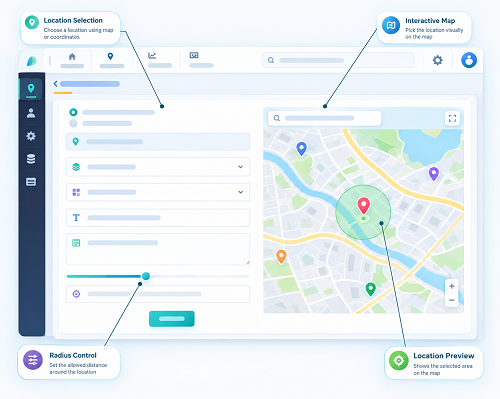
1. Establish a Clear Purpose for Location Tracking
Before implementing a location-tracking system, employers should define the specific business purpose behind it.
Common purposes include:
- Verifying employee check-ins at assigned workplaces.
- Confirming field technicians' arrival at customer locations.
- Coordinating delivery drivers and dispatch teams.
- Recording attendance at construction or maintenance sites.
- Verifying security guard coverage at client premises.
- Supporting emergency response for employees working alone.
- Investigating attendance discrepancies.
The tracking method should match the purpose. For example, a business that only needs to verify attendance at a client site may not need continuous GPS tracking throughout the employee's shift.
Employers should document the purpose of each tracking feature and review whether the information collected is genuinely necessary.
Recommended control: Maintain a written location-tracking policy that explains the purpose, the employee groups covered, and the intended use of location records.
2. Identify the Appropriate Legal Basis
Bahrain's PDPL generally restricts personal data processing without the data subject's consent, subject to specified exceptions. Article 4 includes circumstances involving contractual necessity, legal obligations, vital interests, and legitimate interests, subject to the applicable conditions. Sensitive personal data is subject to additional requirements under Article 5.
Employers should assess the legal basis for each tracking activity instead of assuming that every system requires the same approach.
The assessment should consider:
- Why location data is needed.
- Whether tracking is necessary for the stated purpose.
- Whether a less intrusive alternative is available.
- The impact on employees' rights and freedoms.
- Whether consent or another legal basis applies.
- Whether additional regulatory requirements must be met.
Employee consent should not be treated as automatic permission for unlimited monitoring. Where consent is relied upon, employers should assess whether it meets the law's requirements, including the conditions for valid consent.
Recommended control: Obtain appropriate HR, legal, or data protection review before introducing new tracking features.
3. Inform Employees About the Tracking System
Transparency helps employees understand how location data is collected and used.
Before introducing a GPS attendance application, employers should explain the system through a clear employee notice or workplace policy.
The notice should cover:
- The purpose of location collection.
- Whether the system records check-in events or continuous movement.
- When location tracking begins and ends.
- Whether tracking occurs outside scheduled working hours.
- Who can access the information.
- Whether data is shared with vendors or other organisations.
- How records are used in attendance reviews and payroll.
- How long the records are retained.
- How employees can raise questions or correct inaccurate records.
The notice should be written in straightforward language and made accessible to all affected employees.
Example: A field service company may explain that its application captures a technician's location when checking in at an assigned customer site. If the company also tracks vehicle movements continuously, it should explain that separate function clearly.
Recommended control: Record that the policy has been communicated and update the notice when the system's purpose or functionality changes.
4. Limit Tracking to Necessary Working Periods
Employee location tracking should be configured around actual work requirements.
For attendance verification, collecting location at check-in and check-out may be sufficient. Continuous tracking may be appropriate for some operational activities, such as coordinating an active delivery route, but should not be enabled without a clear justification.
Useful controls include:
- Activating tracking only during authorised work activities.
- Automatically ending tracking when a shift or assignment closes.
- Restricting location updates during personal time where continuous collection is unnecessary.
- Separating work-related tracking from personal applications and activities.
- Defining how emergency tracking is authorised.
- Testing whether tracking stops correctly after shift changes or logout.
Employers should also explain how the system operates on company-owned and personally owned devices.
Recommended control: Test the application outside normal working hours to confirm that its behaviour matches the published policy.
5. Apply Data Minimisation
Data minimisation means collecting only the personal information required for a defined purpose.
For example, an employer may need the time of a check-in, the assigned worksite, and a location verification result. It may not need a detailed history of every movement made during the day.
| Tracking method | Typical business use | Privacy consideration |
|---|---|---|
| Check-in location capture | Confirming arrival at a worksite | Collects data at a defined event |
| Geo-fenced attendance | Verifying presence within an approved area | May reduce the need for continuous monitoring |
| Periodic GPS updates | Coordinating active field assignments | Requires limits on frequency and duration |
| Continuous GPS tracking | Managing vehicle routes or live dispatch | Creates more extensive movement records |
| Manual attendance verification | Recording attendance where GPS is unnecessary | Requires reliable supervisor review |
The appropriate method depends on the work being performed, the risks involved, and the availability of less intrusive alternatives.
Bahrain's PDPL implementing rules address purpose limitation, relevance, accuracy, and avoiding excessive collection of personal data.
Recommended control: Select the least intrusive method that can reliably achieve the stated operational objective.
6. Restrict Access to Location Records
Location information should only be available to authorised people who need it for their work.
A role-based access model may include:
| Role | Appropriate access |
|---|---|
| Direct supervisor | Relevant check-ins and assigned-site exceptions |
| HR team | Attendance records and employee case information required for HR duties |
| Payroll team | Approved hours and relevant attendance corrections |
| Dispatch team | Route information needed for active operational coordination |
| IT administrator | Technical access required to maintain the system |
| Senior management | Aggregated reports where individual location histories are unnecessary |
Employers should avoid giving all managers unrestricted access to detailed location histories.
Access permissions should be reviewed when employees change roles or leave the organisation. Where supported by the system, employers should log access, exports, edits, and other sensitive actions.
Recommended control: Conduct periodic access reviews and remove permissions that are no longer required.
7. Secure Location Data
Employers must protect employee location information against unauthorised access, disclosure, alteration, loss, and other security risks.
Article 8 of Bahrain's PDPL addresses appropriate technical and organisational security measures. It also sets out safeguards concerning the appointment and use of data processors.
Practical safeguards include:
- Encrypting data in transit and, where appropriate, at rest.
- Using multi-factor authentication for privileged accounts.
- Restricting downloads and exports.
- Maintaining access and activity logs.
- Keeping applications and devices updated.
- Using secure mobile-device management.
- Training staff who handle employee records.
- Establishing incident reporting and response procedures.
- Reviewing vendor security controls.
- Removing access when a user no longer needs it.
Employers should also check whether location records remain cached on mobile devices after logout or continue to be accessible after a device is replaced.
Recommended control: Include location-tracking applications and their data stores in the organisation's information-security risk assessment.
8. Define Retention and Deletion Rules
Keeping detailed location records indefinitely increases the risk of unauthorised disclosure and inappropriate use.
Employers should establish retention periods according to the original purpose, applicable legal obligations, and legitimate operational requirements.
Different records may need different retention periods:
- Raw GPS coordinates.
- Approved attendance and timesheet records.
- Records of location exceptions and manager decisions.
- Delivery or route records.
- Evidence retained for an active complaint or legal dispute.
For example, raw GPS data may no longer be necessary after a check-in has been verified, while the approved attendance record may need to remain available for payroll or employment-record purposes.
The retention policy should explain when information will be deleted, anonymised, or retained under a documented legal hold.
Recommended control: Use automated deletion where practical and periodically verify that retention rules are followed by both the employer and its service providers.
9. Review Vendors and International Data Transfers
Many attendance platforms use cloud hosting or external service providers. Employee location information may therefore be stored or accessed outside Bahrain.
Before engaging a vendor, employers should check:
- Where personal data is stored and processed.
- Which subcontractors can access it.
- Whether data is transferred outside Bahrain.
- What security and confidentiality protections apply.
- Whether the vendor uses location data for unrelated purposes.
- How the vendor handles incidents and deletion requests.
- What happens when the contract ends.
Bahrain's PDPL contains rules concerning international transfers of personal data. Employers should assess the applicable requirements and conditions before enabling overseas access or storage.
Contracts with providers should define processing instructions, security responsibilities, confidentiality, incident notification, retention, deletion, and assistance with compliance obligations.
Recommended control: Complete a privacy and security review before implementation and repeat it when a vendor changes its hosting, subcontractors, or processing practices.
10. Investigate GPS Errors Fairly
GPS systems can produce inaccurate or incomplete results because of indoor locations, tall buildings, weak signals, network problems, device settings, or incorrectly configured site boundaries.
An out-of-zone alert should therefore be treated as an exception requiring review, not automatic proof of misconduct.
A fair review process should include:
- Confirming the employee's scheduled shift and assigned location.
- Checking the site boundary and location settings.
- Reviewing the timestamp and available accuracy indicators.
- Asking the employee or supervisor for an explanation.
- Checking supporting information, such as a work order or approved site change.
- Recording the decision and any correction.
- Updating attendance records through an authorised process.
The system should distinguish technical failures from potential policy violations.
Recommended control: Require human review before GPS alerts are used to support disciplinary decisions or materially affect attendance and pay.
11. Prevent Unrelated Uses of Location Data
Data collected to verify attendance should not automatically be used for unrelated monitoring.
For example, an employer should not routinely analyse attendance location records to infer an employee's personal relationships, medical visits, religious activities, or other private behaviour unrelated to the documented business purpose.
If the employer wants to use location data for a new purpose, it should review the legal basis, necessity, compatibility with the original purpose, transparency requirements, and potential effect on employee rights.
Where operational reports can be produced using aggregated information, employers should avoid exposing individual movement histories unnecessarily.
Recommended control: Require approval and a documented privacy assessment before introducing new uses of location data.
12. Establish an Employee Complaint and Correction Process
Employees should have a clear way to question how their location data is handled and challenge inaccurate attendance information.
The process should explain:
- Where employees can raise privacy concerns.
- Who investigates location-related complaints.
- How inaccurate GPS records can be corrected.
- How employees can challenge a decision based on location information.
- How personal data requests are handled under applicable law.
- How the review and outcome are documented.
Requests should be managed under the relevant legal requirements, including applicable identity verification, exemptions, and response rules.
A clear process can identify technical issues early and reduce disputes about attendance, payroll, or disciplinary action.
Recommended control: Assign an HR or privacy contact and monitor the time taken to resolve employee concerns.
13. Assess Privacy Risks Before Deployment
A privacy risk assessment helps employers identify problems before implementing a new tracking system.
The assessment should consider the number of employees affected, tracking frequency, location precision, data access, retention, vendor arrangements, overseas transfers, and possible consequences of misuse.
Employers should ask:
- Is the proposed tracking necessary?
- Could a less intrusive option work?
- Has the legal basis been documented?
- Have employees received an appropriate notice?
- Are access, security, and retention controls in place?
- Have vendor and transfer risks been assessed?
- Could inaccurate location results lead to unfair decisions?
- Is a formal data protection impact assessment or regulatory step required?
Bahrain's PDPL and implementing decisions contain requirements relevant to data processing and regulatory oversight. Employers should determine whether their specific processing activity triggers an assessment, notification, authorisation, or other obligation rather than assuming every system follows the same process.
Recommended control: Involve HR, IT, legal, and privacy personnel before launch and whenever tracking expands to new purposes or employee groups.
14. Integrate Privacy With Attendance and Payroll
Location tracking often connects with attendance registers, timesheets, and payroll applications. Privacy safeguards should apply throughout the process.
A well-designed workflow should:
- Collect only the information needed for the attendance event.
- Flag exceptions for review rather than automatically assuming misconduct.
- Allow authorised managers to approve corrections.
- Transfer approved attendance outcomes to payroll.
- Restrict payroll access to detailed location histories unless necessary.
- Maintain an audit trail of changes.
- Limit the export and sharing of location records.
- Apply retention rules to both raw location data and derived employment records.
For example, if a technician checks in outside the assigned geo-fence because a customer changed the appointment location, the manager can verify the change and approve the attendance record. Payroll can then receive the approved hours without needing unrestricted access to the employee's entire movement history.
This approach supports accurate payroll while limiting unnecessary exposure of personal information.
15. Privacy Checklist for Bahrain Employers
Before introducing or reviewing an employee-location tracking system, employers should confirm the following:
- The purpose of tracking is clearly documented.
- The legal basis under Bahrain's PDPL has been assessed.
- Employees receive a clear privacy notice.
- Tracking is limited to necessary working activities.
- The selected method is proportionate to the business need.
- Access is restricted according to job responsibilities.
- Technical and organisational security measures are in place.
- Retention and deletion rules are documented.
- Vendors and overseas transfers have been reviewed.
- GPS errors are investigated fairly.
- Unrelated uses of location data are restricted.
- Employees can raise questions and challenge inaccurate records.
- Applicable assessment, notification, or authorisation requirements have been checked.
- Managers and administrators receive privacy training.
- Controls are reviewed when systems or purposes change.
Frequently Asked Questions
1. Is employee GPS tracking allowed in Bahrain?
Employee GPS tracking must be assessed under Bahrain's personal data protection framework and other applicable requirements. Employers should establish an appropriate legal basis, justify the collection, provide relevant information, and implement safeguards. The outcome depends on the purpose and design of the specific system.
2. Do employers always need written consent for employee location tracking?
Not necessarily. Bahrain's PDPL establishes consent as a general requirement while providing specified exceptions. Employers should determine which legal basis applies to the particular processing activity and comply with any relevant conditions.
3. Can employers track employees outside working hours?
Employers should not assume that a work-related purpose automatically justifies monitoring outside working hours. They should limit collection to necessary activities and assess any exceptional monitoring separately under applicable law.
4. How long should employee location records be retained?
The appropriate period depends on the purpose, applicable legal obligations, and legitimate operational needs. Employers should document retention periods, delete or anonymise information when it is no longer necessary, and separately assess records that must be retained for payroll, disputes, or other legal requirements.
5. What should an employer do if GPS shows the wrong location?
The employer should verify the schedule, site boundary, timestamp, technical conditions, and any approved assignment changes. The employee should have an opportunity to explain the discrepancy, and any correction should be documented.
Conclusion
Privacy controls are essential when tracking employee locations in Bahrain. Employers should define a clear purpose, establish the appropriate legal basis, inform employees, minimise data collection, restrict access, protect records, and establish retention and deletion rules.
They should also review vendor arrangements and international data transfers, investigate GPS errors fairly, and prevent attendance information from being used for unrelated purposes without appropriate assessment.
By combining suitable technology with clear policies, secure systems, trained managers, and documented review procedures, businesses can improve workforce coordination while respecting employee privacy.
Location data should serve a clear business purpose. InnBuilt Employee Tracking App can help Bahrain employers organise field check-ins while teams define appropriate access, notice and retention practices.