What Is the Difference Between GPS Tracking and Geofenced Check-Ins for Malaysia Teams?
What Is the Difference Between GPS Tracking and Geofenced Check-Ins for Malaysia Teams?
Introduction
Managing employees who work outside traditional office environments can be challenging for businesses in Malaysia. Sales representatives, delivery personnel, construction workers, maintenance technicians, and field service teams frequently travel between customer locations, project sites, and operational facilities. Employers need reliable ways to verify attendance, understand employee movements, and maintain accurate working-hour records.
GPS tracking and geofenced check-ins are two location-based technologies that can support field workforce management. Although both use geographical location information, they serve different purposes.
GPS tracking helps employers determine an employee's location over a period of time, depending on the tracking configuration. Geofenced check-ins, on the other hand, verify whether an employee is within an authorised geographical boundary when recording attendance.
Understanding the difference is important for Malaysian businesses choosing attendance management software. The right solution depends on whether an organisation needs employee location visibility, attendance verification, or both.
1. What Is GPS Tracking?
GPS tracking uses Global Positioning System technology to determine the geographical location of a device, such as an employee's smartphone or a company-issued GPS device.
Depending on the software configuration, the system can collect location information at scheduled intervals or continuously while tracking is enabled.
For Malaysian businesses, GPS tracking can help managers understand the movement of employees who travel between different work locations.
Common applications include:
- Monitoring delivery vehicle locations.
- Tracking field service employee movements.
- Reviewing travel routes between customer locations.
- Managing mobile sales teams.
- Monitoring fleet operations.
- Identifying delays during scheduled assignments.
For example, a logistics company operating across Kuala Lumpur, Shah Alam, and Klang may use GPS tracking to monitor delivery vehicle movements throughout the working day.
Managers can use this information to review routes, identify operational delays, and improve delivery planning.
However, GPS tracking does not automatically confirm whether an employee has officially started or completed their working hours.
2. What Are Geofenced Check-Ins?
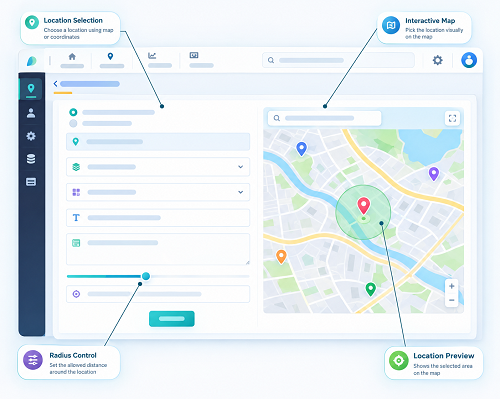
Geofenced check-ins use GPS or another supported location technology to verify whether an employee is physically within a predefined geographical boundary when recording attendance.
A geofence is a virtual perimeter created around an approved workplace, such as a construction site, warehouse, retail outlet, or customer location.
When an employee enters the designated area, the attendance application can allow them to record a check-in. The system can also verify their location during check-out.
For example, a Malaysian construction company can establish a geofence around a project site in Johor Bahru. Workers assigned to that project can use a mobile attendance application to record their arrival after reaching the authorised location.
The system checks whether the reported device location falls within the permitted boundary before accepting the attendance transaction.
Common applications include:
- Recording employee check-ins at customer premises.
- Verifying attendance at construction sites.
- Tracking attendance across multiple retail outlets.
- Recording employee check-outs.
- Reducing location-based attendance fraud.
- Maintaining site-wise attendance reports.
Unlike continuous GPS tracking, geofenced check-ins generally focus on verifying location at specific attendance events.
3. GPS Tracking vs Geofenced Check-Ins: Key Differences
Although both technologies use location information, their functions and operational requirements are different.
| Comparison area | GPS tracking | Geofenced check-ins |
|---|---|---|
| Main purpose | Monitor device location and movement | Verify attendance at authorised locations |
| Location collection | Continuous or periodic, depending on configuration | Usually during check-in and check-out |
| Primary use | Fleet and field movement management | Employee attendance management |
| Geographical boundaries | May operate without predefined boundaries | Requires configured geofences |
| Attendance verification | Does not automatically confirm attendance | Supports location-based attendance verification |
| Employee movement visibility | Can provide route and movement information | Usually does not provide continuous movement information |
| Data collection | May generate frequent location records | Generally generates event-based location records |
| Privacy considerations | Potentially greater monitoring implications | Can involve more limited location collection |
| Payroll integration | Requires additional attendance records or processing | Can directly support attendance and working-hour records |
| Common users | Logistics, delivery, and field operations | HR, payroll, construction, and retail teams |
The main distinction is that GPS tracking focuses on location visibility, while geofenced check-ins focus on attendance verification at approved locations.
4. How Does GPS Tracking Work for Malaysia Teams?
GPS tracking typically uses location services available on smartphones or dedicated tracking devices.
An employee's device receives location signals and determines its geographical coordinates. The tracking application then sends the information to a central platform, depending on the network connection and application settings.
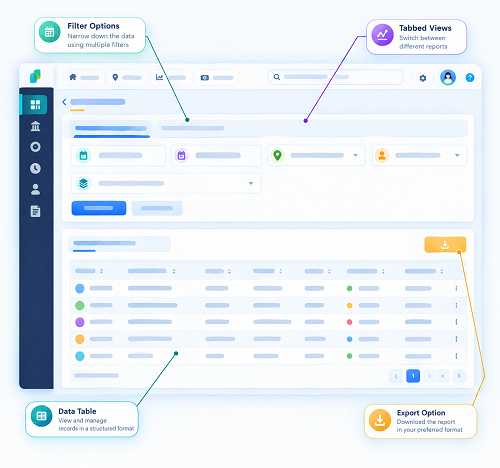
Managers can review the available location information through a dashboard.
For example, a Malaysian distribution company may use GPS tracking to manage delivery personnel travelling between warehouses and customer addresses.
The workflow may involve:
- The employee starts an assigned delivery route.
- The tracking application records location information according to its settings.
- The system updates the employee's or vehicle's location.
- Managers review route progress.
- The company analyses travel patterns and operational delays.
GPS tracking is particularly useful when businesses need visibility into travel activities rather than simply knowing whether employees have arrived at work.
5. How Do Geofenced Check-Ins Work for Malaysia Teams?
Geofenced attendance systems operate using predefined geographical boundaries.
Employers configure approved workplace locations within the attendance platform and assign employees to those locations.
When employees arrive at an authorised site, they open the attendance application and record their check-in.
The system compares the reported location with the configured geofence.
A typical workflow includes:
- HR creates a geofence around an approved workplace.
- Employees are assigned to the relevant location.
- Employees travel to the assigned workplace.
- The attendance application checks their reported location.
- The system records the check-in if the location satisfies the configured requirements.
- Employees record their check-out when their work is completed.
For example, a maintenance company with technicians working across Penang can create separate geofences around customer facilities.
Technicians can record attendance at their assigned locations without returning to the company's main office.
This makes geofenced check-ins suitable for businesses with distributed workforces.
6. Which Technology Is Better for Employee Attendance?
For organisations primarily interested in recording employee working hours, geofenced check-ins are generally more directly suited to attendance management.
GPS tracking may show that an employee's device travelled to a particular location, but this does not necessarily establish that the employee officially reported for work.
Geofenced check-ins provide a structured attendance transaction with information such as:
- Employee identification.
- Check-in timestamp.
- Check-out timestamp.
- Verified or reported location.
- Assigned workplace.
- Attendance exceptions.
However, geofencing alone does not prove employee identity. Businesses concerned about proxy attendance can combine geofenced check-ins with facial recognition, individual login credentials, or other suitable authentication methods.
For example, a sales employee working at an approved retail outlet can verify their identity and record attendance through a mobile application that checks the permitted geographical boundary.
This provides stronger attendance evidence than relying solely on device location.
7. Which Technology Is More Suitable for Field Employees?
The right choice depends on the type of work employees perform.
Different industries have different location and attendance requirements.
| Industry | GPS tracking | Geofenced check-ins |
|---|---|---|
| Logistics | Monitoring delivery routes | Recording warehouse and delivery-site attendance |
| Construction | Monitoring mobile equipment or authorised field operations | Verifying attendance at project sites |
| Retail | Limited operational use for mobile teams | Recording attendance at individual outlets |
| Field sales | Reviewing travel activities where necessary | Verifying attendance at assigned customer locations |
| Maintenance services | Reviewing technician movements | Recording attendance at service locations |
| Healthcare field services | Supporting authorised travel coordination | Verifying attendance at approved service locations |
For example, a delivery company may need GPS tracking to understand vehicle movements throughout the day. A retail business may only need geofenced check-ins to verify whether employees have reported to their assigned outlets.
Employers should select technology according to actual operational requirements rather than introducing more extensive location monitoring than necessary.
8. Can Malaysian Businesses Use Both Technologies Together?
Yes. Businesses with complex field operations may benefit from combining GPS tracking and geofenced check-ins.
The two technologies can support different operational objectives within the same workforce management system.
For example, a Malaysian logistics company may use:
- GPS tracking to monitor delivery vehicle movements.
- Geofenced check-ins to verify attendance at warehouses.
- Mobile attendance applications to record employee working hours.
- Supervisor dashboards to review attendance exceptions.
- Payroll integration to process verified working-hour records.
A combined system can provide better operational visibility while keeping attendance records separate from general location monitoring.
However, businesses should establish clear rules about which employees are tracked, when tracking takes place, and what location information is retained.
9. How Do These Technologies Affect Payroll Accuracy?
Accurate attendance information is essential for calculating employee salaries, overtime, and other payroll components.
GPS tracking can provide supporting information about employee movements, but it should not be treated as a direct substitute for verified attendance records.
Geofenced check-ins can provide structured information for attendance processing.
For Malaysian payroll teams, useful records include:
- Actual check-in and check-out times.
- Scheduled working hours.
- Approved shift assignments.
- Missing attendance transactions.
- Late arrivals and early departures.
- Approved overtime records.
- Attendance corrections.
For example, if a technician is scheduled to work at a customer site from 9:00 AM to 6:00 PM, geofenced check-ins can help verify arrival and departure events.
Payroll teams can compare these records against approved schedules and overtime authorisations before processing salary.
Employers should also ensure that attendance data is reviewed against applicable employment requirements, including the Employment Act 1955 where applicable.
10. What Are the Employee Privacy Considerations in Malaysia?
Employee location information can reveal details about an individual's movements and work activities. Malaysian employers should therefore carefully consider privacy when implementing GPS tracking or geofenced attendance.
The Personal Data Protection Act 2010 (PDPA), including its 2024 amendments, is relevant to organisations processing personal data in commercial transactions.
Employers should consider the following safeguards:
For GPS tracking:
- Explain why employee location tracking is necessary.
- Define when location tracking starts and stops.
- Avoid unnecessary tracking outside working hours.
- Restrict access to location histories.
- Establish appropriate data retention periods.
For geofenced check-ins:
- Explain when location verification takes place.
- Collect location information only for legitimate attendance purposes.
- Avoid unnecessary continuous monitoring.
- Limit access to attendance location records.
- Establish procedures for correcting inaccurate location information.
Employers should also review third-party software providers and applicable security requirements.
If facial recognition is combined with geofenced attendance, biometric information requires additional consideration because biometric data is classified as sensitive personal data under the amended PDPA.
A transparent location privacy policy can help employees understand how their information is used and protected.
11. What Should Employers Check Before Choosing an Attendance System?
Before purchasing GPS tracking or geofenced attendance software, Malaysian businesses should evaluate the system's technical capabilities and privacy controls.
Important questions include:
- Does the software support multiple workplaces and geographical boundaries?
- Can HR assign employees to specific locations?
- Does the application record check-in and check-out timestamps?
- Can managers review attendance exceptions?
- Does the system support offline attendance recording?
- Can employees request corrections to inaccurate records?
- Does the software integrate with payroll applications?
- Can administrators configure location tracking permissions?
- Does the vendor provide appropriate data security controls?
- Can the system generate location-based attendance reports?
Businesses should also test GPS accuracy at actual workplaces before implementation.
Indoor locations, high-rise buildings, network interruptions, and device limitations can affect location accuracy.
A pilot programme involving a small group of field employees can help organisations identify these issues before deploying the software across the workforce.
12. Best Practices for Implementing GPS Tracking and Geofenced Check-Ins
Malaysia employers can improve workforce management by following these practical recommendations:
- Define the business requirement: Determine whether the organisation needs employee movement visibility or attendance verification.
- Choose the appropriate technology: Use GPS tracking for authorised movement monitoring and geofencing for location-based attendance.
- Create approved workplace boundaries: Configure geofences around relevant offices, warehouses, customer locations, and project sites.
- Assign employee locations: Ensure each employee has accurate workplace and shift assignments.
- Use identity verification: Combine location checks with appropriate employee authentication.
- Integrate with payroll: Transfer verified attendance records into payroll processing workflows.
- Establish privacy policies: Clearly explain location collection, monitoring periods, access, and retention.
- Train employees and supervisors: Explain how to use the system and handle failed location verification.
- Review attendance exceptions: Investigate missing punches, inaccurate GPS readings, and unusual transactions.
- Evaluate system performance: Regularly review accuracy, employee feedback, and operational benefits.
Conclusion
GPS tracking and geofenced check-ins both use location technology, but they solve different workforce management problems.
GPS tracking helps Malaysian businesses understand employee or vehicle movements, making it useful for logistics, delivery, and field operations. Geofenced check-ins focus on verifying whether employees are at authorised workplaces when recording attendance, making them more suitable for HR and payroll administration.
Businesses with mobile workforces may benefit from using both technologies together. GPS tracking can support operational visibility, while geofenced check-ins can provide structured attendance records.
The most effective approach is to select technology based on genuine business requirements, integrate it with existing HR and payroll processes, and protect employee location information through transparent data handling practices.
By understanding these differences, Malaysia businesses can improve field workforce management, strengthen attendance accuracy, and maintain a better balance between operational control and employee privacy.
GPS route visibility and a geo-fenced attendance event answer different questions. InnBuilt field tools can help Malaysia businesses decide whether a task needs journey context or site-level check-in evidence.