How Can Malaysia Businesses Manage Rotating Shifts and Rest Days?
How Can Malaysia Businesses Manage Rotating Shifts and Rest Days?
Rotating shifts and scheduled rest days are essential for Malaysian businesses that operate beyond standard office hours. Manufacturing plants, hospitals, hotels, logistics companies, security providers and customer service centres often need employees to work in different shifts to maintain continuous operations.
However, managing rotating shifts requires careful planning. Employers must balance business coverage with employees' working-hour limits, weekly rest days, overtime entitlements and health and safety needs. Poor scheduling can lead to fatigue, payroll errors, employee dissatisfaction and non-compliance with employment legislation.
Malaysia businesses can manage these challenges by establishing clear shift patterns, maintaining accurate attendance records and reviewing rest-day arrangements before publishing employee rosters.
This article explains how employers can organise rotating shifts and rest days while supporting operational efficiency and employee wellbeing.
1. Understand the Legal Requirements for Working Hours and Rest Days
Before designing a rotating shift schedule, employers should understand the employment legislation applicable to their employees.
For employees covered by the Employment Act 1955 in Peninsular Malaysia and Labuan, several provisions are particularly important:
- Section 59: Provides for one whole rest day in each week, subject to the statutory framework.
- Section 60A: Establishes general working-hour requirements, including the 45-hour normal weekly working-hour limit and rules concerning daily hours and rest breaks.
- Section 60C: Provides specific rules for shift work.
- Section 60D: Covers paid public holidays and related entitlements.
- Section 60A(3): Sets out statutory overtime payment requirements for employees covered by that provision.
For employees engaged in shift work, Section 60C allows working hours to be arranged differently from ordinary daily schedules, subject to statutory conditions. The average working hours over the applicable three-week period must generally not exceed 45 hours per week, and the Act contains a maximum 12-hour workday rule subject to specified exceptions.
Employers in Sabah and Sarawak should check their respective Labour Ordinances and current amendments rather than automatically applying every provision of the Employment Act 1955.
2. Identify the Business Requirements Before Creating Shift Rotations
The first scheduling step is to understand how many employees are required at different times of the day.
Managers should assess:
- Business operating hours.
- Customer service requirements.
- Production targets.
- Peak and off-peak workload periods.
- Required technical and supervisory coverage.
- Employee skills and qualifications.
- Weekend and public holiday operations.
- Emergency and backup staffing needs.
For example, a manufacturing facility operating 24 hours a day may need three shifts to cover production continuously. A retail business operating from 9:00 a.m. to 10:00 p.m. may require morning, afternoon and evening shifts.
The number of employees assigned to each shift should reflect actual workload rather than simply dividing the workforce into equal groups.
3. Choose a Suitable Rotating Shift Pattern
Businesses can use different shift rotation models depending on their operating requirements.
Common arrangements include:
| Shift pattern | How it works | Suitable workplaces |
|---|---|---|
| Two-shift rotation | Employees alternate between two daily shifts | Retail, customer support and manufacturing |
| Three-shift rotation | Employees rotate between morning, evening and night shifts | Factories, hospitals and logistics |
| Fixed shifts | Employees remain on a consistent shift | Businesses with stable staffing requirements |
| Weekly rotation | Employees change shifts every week | Continuous operations |
| Monthly rotation | Employees change shifts at longer intervals | Certain industrial and service operations |
| Split shifts | Employees work separate periods within a day | Hospitality and service businesses |
Managers should select a pattern that provides adequate coverage while allowing employees sufficient recovery time between working periods.
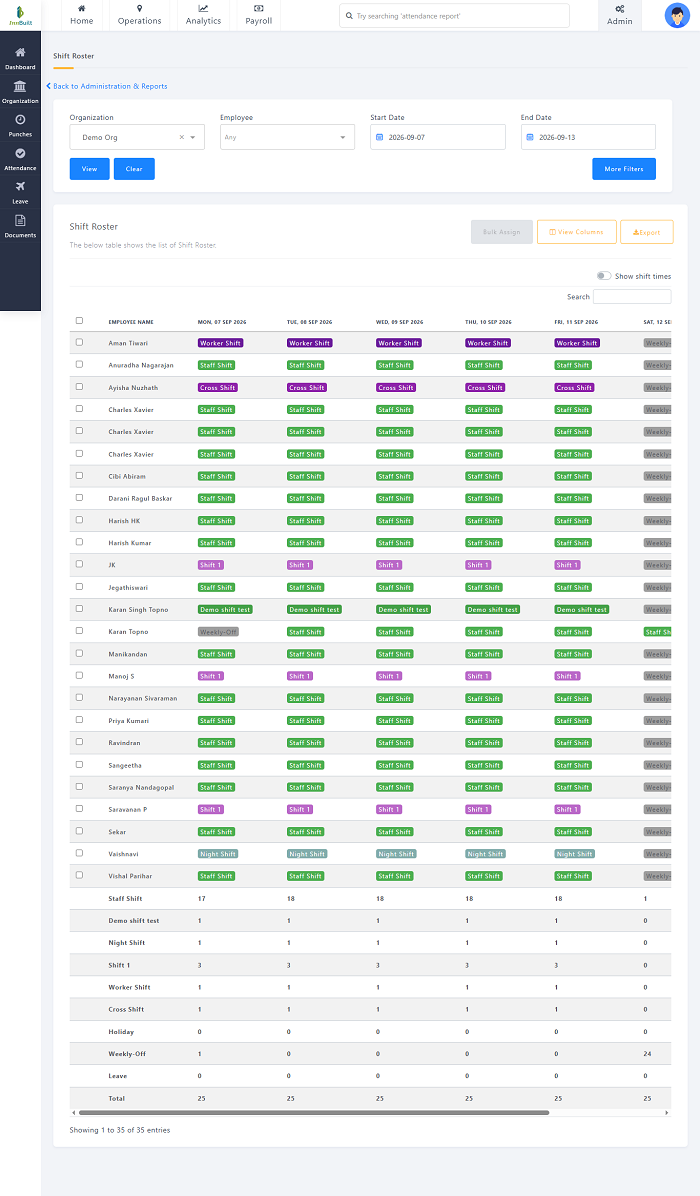
4. Prepare a Clear Shift Roster
A shift roster should clearly identify when each employee is expected to work and when they are entitled to rest.
For example, a three-shift operation may use the following illustrative schedule:
| Shift | Working hours |
|---|---|
| Morning | 7:00 a.m. – 3:00 p.m. |
| Evening | 3:00 p.m. – 11:00 p.m. |
| Night | 11:00 p.m. – 7:00 a.m. |
These are example shift windows, not a statutory schedule. Employers must account for actual working time, meal breaks, handover arrangements and applicable working-hour requirements.
A complete roster should include:
- Employee names and identification numbers.
- Department and assigned shift.
- Shift start and end times.
- Rest days.
- Meal and rest breaks.
- Public holiday assignments.
- Approved leave.
- Shift swaps and replacements.
- Supervisor responsible for each shift.
HR should publish rosters sufficiently in advance so employees can plan transport, family commitments and personal activities.
5. Schedule Weekly Rest Days Correctly
Rest days must be planned as carefully as working shifts.
Under Section 59 of the Employment Act 1955, employees covered by the provision must generally receive one whole rest day each week. Employers determine the rest day according to the statutory requirements.
For shift workers, a continuous period of at least 30 hours constitutes a rest day under Section 59(1A).
Managers should distinguish between:
- Rest day: The weekly day recognised under the statutory framework.
- Off day: An additional non-working day provided under the roster or employment arrangement.
- Annual leave: Approved leave deducted from the employee's annual leave balance.
- Public holiday: A paid holiday governed by the applicable statutory provisions.
If an employee receives more than one rest day in a week, Section 59 generally treats the last of those days as the rest day for the purposes of the relevant statutory provisions.
This distinction is important when calculating payment for work performed on a rest day.
6. Prepare Rest-Day Rosters Before the Month Begins
Employers should not leave weekly rest-day arrangements unclear or communicate them only after employees have started working.
Section 59(2) requires employers to prepare a rest-day roster before the commencement of the month in which the rest days fall. Where all employees at a workplace have the same fixed rest day, an appropriately displayed notice may be used instead of an individual roster.
The roster should identify:
- Employee name and identification number.
- Assigned shift.
- Weekly rest day.
- Additional off days, if applicable.
- Approved changes to the schedule.
- Supervisor responsible for the roster.
Employers must preserve the roster and its recorded particulars for inspection for the statutory retention period, which is up to six years from the last day of the relevant month.
7. Calculate Working Hours Across the Shift Cycle
Rotating shift schedules may involve longer working days or different weekly working hours. Employers should review the entire shift cycle rather than checking only individual days.
Under Section 60C of the Employment Act 1955, employees engaged under a contract of service in shift work may work more than eight hours in a day or more than 45 hours in a week, provided their average working hours over a three-week period do not exceed 45 hours per week. A longer averaging period requires approval from the Director General of Labour.
The provision remains subject to the applicable break requirements and the statutory daily maximum, which is generally 12 hours, subject to specified exceptions.
For example, a company may use a rotating shift pattern in which employees work longer shifts on certain days and shorter shifts or rest days on others. HR should calculate the average across the applicable three-week period to confirm compliance.
| Review item | What HR should check |
|---|---|
| Daily hours | Actual working time for each shift |
| Weekly hours | Total working hours in each week |
| Three-week average | Whether the average exceeds 45 hours per week |
| Breaks | Required leisure and meal periods |
| Daily maximum | Whether the shift exceeds the statutory limit |
| Exceptions | Whether any special approval or statutory exception applies |
The three-week averaging rule is a specific feature of shift work; it should not be treated as permission to schedule unlimited additional hours.
8. Manage Shift Changes and Handover Periods
Shift changes are common in businesses that operate around the clock. However, poorly managed handovers can create gaps in coverage or cause employees to work beyond their scheduled hours.
For example, an outgoing night-shift employee may need to explain equipment issues or unfinished work to the incoming morning-shift team.
Managers should establish a standard handover procedure covering:
- Production or service status.
- Outstanding tasks.
- Equipment and safety issues.
- Customer or operational incidents.
- Pending approvals.
- Stock or inventory discrepancies.
- Supervisor acknowledgements.
Handover time should be included in working-hour records where employees remain at the employer's disposal and are not free to use their time and movements.
Managers should also avoid routinely requiring employees to arrive early or remain late without recording the additional working time and assessing any overtime implications.
9. Establish Rules for Shift Swaps
Employees may sometimes request to exchange shifts because of personal commitments, transport difficulties or family responsibilities.
Businesses can allow shift swaps, but they should be controlled through a formal approval process.
A suitable shift-swap procedure should require:
- The employee to submit a shift-swap request.
- The replacement employee to agree to the arrangement.
- The manager to check staffing requirements.
- HR or the authorised supervisor to verify working-hour and rest-day compliance.
- The updated roster to be recorded.
- Attendance and payroll systems to reflect the approved change.
Managers should not approve a shift swap merely because both employees agree. The revised schedule must still meet applicable rest-day, working-hour and safety requirements.
10. Review Overtime and Rest-Day Work Separately
Working on a scheduled rest day is not automatically treated in the same way as ordinary overtime.
Under Section 60 of the Employment Act 1955, specific rules govern work performed on a rest day. The payment calculation depends on the employee's wage arrangement, the hours worked and the employee's statutory coverage.
For employees covered by the relevant provisions, the general treatment includes:
| Rest-day work | General statutory treatment |
|---|---|
| Monthly- or weekly-rated employee works up to half normal daily hours | Additional payment equivalent to half the ordinary rate of pay |
| Monthly- or weekly-rated employee works more than half but up to normal daily hours | Additional payment equivalent to one day's ordinary rate of pay |
| Work beyond normal daily hours on a rest day | At least twice the hourly rate of pay |
Different rules apply to employees paid by daily, hourly or other similar rates. Employers should use the applicable statutory calculation rather than applying one formula to every employee.
Managers should also distinguish rest-day work from ordinary working-day overtime and public holiday work. The applicable rules are found in Sections 60, 60A and 60D.
11. Plan Night Shifts with Employee Health and Safety in Mind
Night shifts can affect sleep patterns, concentration and employee wellbeing. Businesses should therefore consider fatigue risks when creating rotating schedules.
Useful practices include:
- Avoiding unnecessarily frequent shift changes.
- Providing sufficient recovery time between shifts.
- Scheduling appropriate meal and rest breaks.
- Avoiding excessive consecutive night shifts where practicable.
- Providing adequate lighting and safe working conditions.
- Ensuring access to supervisors during night operations.
- Reviewing transport arrangements for employees finishing late.
- Monitoring fatigue-related incidents and near misses.
A forward rotation, such as morning to evening to night, may be easier for some employees to adapt to than repeatedly switching in the opposite direction. This is a scheduling consideration rather than a specific statutory requirement.
Employers should also assess risks under applicable occupational safety and health requirements, particularly for employees operating machinery, driving vehicles or performing safety-sensitive tasks.
12. Coordinate Public Holidays with Rotating Shift Schedules
Employees working rotating shifts may be scheduled to work on dates that are public holidays for their work location.
HR should identify the public holidays applicable to each employee and determine whether the employee is entitled to a paid holiday under the relevant legislation and employment arrangements.
Under Section 60D of the Employment Act 1955, eligible employees are entitled to paid public holidays, with specific rules for work performed on those days and qualifying replacement holidays.
Managers should check:
- The employee's applicable holiday calendar.
- Whether the holiday falls on a scheduled working day.
- Whether a substitute holiday is required.
- Whether the employee is assigned to work.
- The applicable public holiday payment rules.
- Whether the roster has been updated correctly.
A rotating shift should not cause an employee to lose an applicable public holiday entitlement simply because the employee's normal work pattern includes weekends or public holidays.
13. Use HR Software to Manage Rotating Shifts and Rest Days
Managing several shift groups manually can become difficult, particularly when employees work at multiple locations or follow changing schedules.
HR software can centralise shift planning, attendance, rest-day records and payroll information.
| Software feature | How it helps businesses |
|---|---|
| Shift scheduling | Creates and publishes rotating rosters |
| Rest-day management | Records weekly rest days and additional off days |
| Attendance integration | Compares scheduled hours with actual attendance |
| Shift-swap workflow | Routes employee requests for approval |
| Working-hour monitoring | Tracks daily and weekly working hours |
| Three-week averaging reports | Helps review shift-work averages |
| Overtime tracking | Identifies additional hours requiring review |
| Public holiday calendars | Applies location-specific holiday schedules |
| Payroll integration | Transfers verified work and leave information |
| Audit history | Records roster changes and approvals |
The software should be configured according to the applicable legislation, employment contracts and actual work arrangements. HR should regularly review system settings rather than assuming that an automated roster is legally compliant.
14. Communicate Shift Rotations to Employees in Advance
Employees need sufficient information to organise their personal commitments around rotating shifts.
HR should provide employees with:
- The shift pattern and rotation frequency.
- Start and finish times.
- Weekly rest days.
- Meal and rest break arrangements.
- Procedures for shift swaps.
- Overtime approval requirements.
- Public holiday working arrangements.
- Contact details for reporting scheduling problems.
Managers should communicate changes promptly and explain why an adjustment is necessary.
Where shift changes affect contractual working arrangements, employers should also review the employment contract and any applicable consultation or agreement requirements.
15. Monitor Shift Patterns and Review Scheduling Performance
Shift scheduling should be reviewed regularly to identify operational problems and employee wellbeing concerns.
Useful indicators include:
- Average working hours per employee.
- Number of missed or changed rest days.
- Overtime hours by shift.
- Absenteeism by shift group.
- Employee turnover among night-shift workers.
- Shift-swap frequency.
- Late handovers.
- Fatigue-related incidents.
- Payroll corrections.
For example, if employees on a particular night shift regularly work beyond their scheduled finishing time, managers should investigate whether the shift is understaffed or the handover process needs improvement.
Regular reviews help businesses improve staffing levels, reduce excessive overtime and make shift rotations more predictable.
Practical Checklist for Managing Rotating Shifts and Rest Days
| Activity | Recommended action |
|---|---|
| Legal review | Check the applicable labour legislation |
| Business planning | Identify staffing needs for every operating period |
| Shift pattern | Select an appropriate rotation model |
| Weekly hours | Review normal working hours and shift-work averages |
| Rest days | Allocate the required weekly rest periods |
| Monthly roster | Prepare rest-day rosters before the month begins |
| Breaks | Schedule required leisure and meal periods |
| Shift swaps | Introduce a documented approval process |
| Overtime | Review additional hours and applicable payment rules |
| Public holidays | Apply the correct holiday calendar |
| Employee wellbeing | Monitor fatigue and safety risks |
| HR software | Connect rosters with attendance and payroll |
| Recordkeeping | Retain rosters and supporting records |
Conclusion
Managing rotating shifts and rest days requires a balance between operational coverage, statutory compliance and employee wellbeing. Malaysia businesses should select appropriate shift patterns, prepare clear rosters, allocate weekly rest days and monitor working hours across the full shift cycle.
Managers should also distinguish between ordinary working days, rest days and public holidays when reviewing overtime and payroll. Accurate attendance records, documented shift changes and integrated HR software can help reduce scheduling errors.
By establishing consistent procedures and reviewing shift arrangements regularly, employers can maintain continuous operations while giving employees predictable working schedules and appropriate rest periods.
Rotating rosters become harder to manage when rest days and changes live in separate files. InnBuilt Shift Management can help Malaysia supervisors keep coverage and revised assignments together.