How Can Qatar Employers Review Absence Exceptions Before Closing Monthly Payroll?
How Can Qatar Employers Review Absence Exceptions Before Closing Monthly Payroll?
Introduction
Accurate attendance records are essential for processing monthly payroll in Qatar. When employees miss scheduled shifts, arrive late, leave early, forget to clock in, or take leave without a recorded approval, HR and payroll teams must investigate these exceptions before finalising salaries.
Unresolved absence records can lead to incorrect salary calculations, inappropriate deductions, inaccurate leave balances, and employee disputes. These issues become more complicated when a business operates multiple locations, rotating shifts, remote work arrangements, or a large frontline workforce.
Qatar employers can reduce these risks by establishing a structured absence-review process that connects attendance records, leave approvals, supervisor verification, and payroll calculations.
Qatar Labour Law No. 14 of 2004 contains provisions governing remuneration, disciplinary measures, and unauthorised absence for workers covered by the law. Employers should distinguish between a genuine absence, an attendance-recording error, approved leave, and a potential disciplinary matter before taking payroll action.
1. Define What Counts as an Absence Exception
An absence exception is a discrepancy between an employee’s expected attendance and the available attendance or leave records. It does not automatically mean that the employee was absent without permission.
For example, an employee may have attended work but forgotten to clock in. Another employee may have taken approved medical leave that has not yet been entered into the attendance system. Both cases may appear as absences in an initial payroll report, but they require different treatment.
Common absence exceptions
| Exception type | Example | Required review |
|---|---|---|
| Full-day absence | No attendance recorded for a scheduled workday | Check leave approvals, attendance evidence, and the employee’s explanation |
| Late arrival | Clock-in occurs after the scheduled start time | Verify the shift schedule and any authorised adjustment |
| Early departure | Employee clocks out before the scheduled end | Confirm approval and actual hours worked |
| Missing clock-in | No recorded start time | Check supervisor confirmation and access records |
| Missing clock-out | No recorded end time | Verify the actual departure time |
| Approved leave not recorded | Leave approval exists but the attendance system shows absence | Correct the leave record |
| Unauthorised absence | No attendance or approved leave can be confirmed | Investigate and refer for appropriate review |
| Shift assignment mismatch | Employee works a changed shift not reflected in the roster | Verify the revised schedule |
| Duplicate attendance entry | Two punches or overlapping shifts appear | Validate the correct record |
| Public holiday or rest-day mismatch | A scheduled non-working day appears as an absence | Check the applicable calendar and roster |
HR should classify each exception before deciding whether it affects salary, leave balances, or disciplinary procedures.
2. Establish a Monthly Absence-Review Calendar
Absence reviews should take place throughout the month rather than being postponed until payroll is due.
A month-end-only approach gives supervisors little time to investigate missing records, contact employees, obtain supporting documents, or correct attendance errors.
Recommended review schedule
- Daily: Supervisors check missing punches, unexpected absences, and shift mismatches.
- Weekly: HR reviews unresolved exceptions, pending leave requests, and repeated attendance discrepancies.
- Before payroll cut-off: Department managers verify outstanding cases and submit approved corrections.
- During payroll preparation: Payroll reconciles the final attendance report against approved leave, employee schedules, and authorised adjustments.
- After payroll: HR records any necessary corrections and reviews recurring problems to improve the next payroll cycle.
The organisation should publish clear cut-off dates for submitting attendance corrections and supporting documents. Employees should also know whom to contact if an absence or attendance entry is recorded incorrectly.
3. Reconcile Attendance Records With Employee Schedules
The first step in reviewing an absence exception is to confirm that the employee was actually scheduled to work.
An employee who was not scheduled for a particular day should not be classified as absent simply because the attendance system contains no punch.
This is particularly important for employers with rotating shifts, compressed schedules, split shifts, night work, or frequent shift swaps.
Records to compare
- Published work schedules.
- Approved shift changes and substitutions.
- Attendance clock-in and clock-out records.
- Approved annual, sick, or other leave.
- Weekly rest days and applicable public holidays.
- Business travel, off-site assignments, and authorised remote work.
- Supervisor confirmations and attendance corrections.
Example
Suppose an employee’s normal shift is 8:00 a.m. to 5:00 p.m., but the supervisor approved a shift change to 10:00 a.m. to 7:00 p.m.
If the system continues to use the original schedule, the employee may appear late and may also appear to have left early. HR should verify the approved change and correct the schedule before calculating the employee’s working time.
Best practice: Use one approved source of truth for schedules and ensure that authorised changes are communicated to both attendance administrators and payroll.
4. Classify Each Absence Exception Correctly
After verifying the employee’s schedule, HR should assign a clear status to each exception.
A standard classification system makes it easier to determine which cases require correction, additional documentation, payroll review, or escalation.
Recommended absence statuses
| Status | Meaning | Payroll action |
|---|---|---|
| Approved leave | Absence is supported by an approved leave record | Apply the correct leave and pay treatment |
| Attendance error | The employee worked but the attendance record is incomplete or incorrect | Correct the verified time record |
| Pending verification | Evidence or supervisor confirmation is outstanding | Hold the disputed item for review where feasible |
| Unpaid authorised absence | Absence is approved but designated as unpaid under applicable rules | Apply the verified, lawful payroll treatment |
| Unauthorised absence confirmed | Review establishes that no valid approval or explanation applies | Refer for payroll and, if appropriate, disciplinary review |
| Shift or roster mismatch | The schedule does not reflect an approved arrangement | Correct the roster and recalculate attendance |
| Leave record pending | A request or supporting document has not yet been fully processed | Complete the review before determining the final treatment |
Avoid using a single status such as “absent” for all exceptions. Clear categories help prevent approved leave from being treated as unauthorised absence or a missing punch from becoming an unjustified deduction.
5. Verify Absence Records With Supervisors and Employees
Supervisors are often best placed to confirm whether an employee attended work, changed shifts, worked at another location, or received permission to leave early.
However, verbal confirmation alone may not provide a sufficient audit trail. Employers should record the explanation and the evidence used to resolve the case.
Recommended verification workflow
- Generate a report of employees with attendance exceptions.
- Confirm that each employee was scheduled to work.
- Check whether approved leave or a shift change exists.
- Ask the relevant supervisor to verify the employee’s actual attendance.
- Contact the employee if the reason for the exception remains unclear.
- Request supporting documentation when reasonably necessary under the applicable policy.
- Record the decision, reviewer, date, and reason for the correction.
- Update the attendance system and notify payroll of the final status.
If an employee disputes the recorded absence, the case should be investigated before an adverse payroll adjustment is finalised.
A documented process promotes fairness and helps the organisation explain why an attendance record was changed or left unchanged.
6. Review Leave Approvals Before Making Salary Adjustments
Approved leave may not immediately appear in the attendance system. This can happen when managers approve requests by email, leave administrators enter requests late, or employees submit documentation after returning to work.
Payroll teams should compare absence reports with the organisation’s leave records before classifying any day as unpaid.
Leave records to check
- Annual leave approvals.
- Sick leave requests and supporting documentation where required.
- Maternity or other statutory leave records, where applicable.
- Approved unpaid leave.
- Emergency or compassionate leave under company policy.
- Public holidays and scheduled weekly rest days.
- Approved leave extensions or changes to return dates.
Each type of leave may have a different entitlement and pay treatment. HR should not assume that all approved leave is paid or that all missing attendance is unpaid.
For example, if an employee’s sick leave has been approved but is still missing from the attendance system, HR should update the record and apply the appropriate entitlement under the applicable law and policy.
7. Calculate Salary Adjustments Carefully
Absence-related payroll adjustments should be based on verified attendance facts, the employee’s contractual arrangements, and the applicable legal requirements.
Payroll should distinguish between:
- Time not worked under an arrangement that lawfully affects pay.
- Paid statutory or contractual leave.
- An attendance-recording error.
- A disciplinary penalty.
- A disputed case that has not yet been resolved.
These categories should not be treated as interchangeable.
A basic calculation framework
Where an absence has been verified as unpaid and a deduction is legally permissible, payroll may use an approved calculation method based on the applicable wage arrangement and payroll rules.
A simplified illustration is:
Illustrative absence adjustment = Applicable daily wage rate × Verified unpaid days
Suppose an employee has a verified daily wage rate of QAR 200 and one full day is confirmed as unpaid under the applicable rules.
QAR 200 × 1 day = QAR 200
This is only a mathematical example. It does not establish the correct daily wage divisor, deduction method, or legal basis for a particular employee. Payroll must confirm those factors before applying any adjustment.
Important safeguards
- Do not calculate deductions from an unverified absence report.
- Do not deduct pay for a day when the employee was not scheduled to work without a valid basis.
- Do not classify approved paid leave as unpaid.
- Do not treat a missing punch as proof that work was not performed.
- Do not apply arbitrary financial penalties for late arrivals or absences.
- Check applicable limits and procedures before imposing disciplinary deductions.
- Document the calculation and approval for each adjustment.
A second-person review is advisable for material or unusual absence adjustments.
8. Distinguish Pay Adjustments From Disciplinary Penalties
An important payroll control is to separate the treatment of time not worked from a penalty imposed for a workplace violation.
Qatar Labour Law No. 14 of 2004 contains specific provisions governing disciplinary measures and wage deductions. Article 60 limits the total deduction from a worker’s wage in execution of disciplinary sanctions and other deductions covered by that provision to the equivalent of five days’ wage per month. It also requires employers to maintain a register of disciplinary penalties, including the employee’s name, deduction amount, reason, and date.
This provision should not be interpreted as a blanket authorisation to make any absence-related deduction up to that limit. Employers must establish the proper legal basis and follow the applicable procedures.
Article 62 also establishes requirements concerning disciplinary action, including time limits and the connection between the violation and work.
9. Manage Repeated Absences Through a Documented Review
Repeated absence exceptions may indicate an attendance problem, but they may also reveal weaknesses in scheduling, communication, leave administration, or the attendance system.
HR should review the circumstances rather than relying solely on the number of system alerts.
Questions to investigate
- Does the employee repeatedly miss clock-in or clock-out punches?
- Are absences concentrated on particular shifts or locations?
- Are supervisors approving leave outside the formal system?
- Are employees receiving roster changes on time?
- Is the employee reporting a genuine reason for absence?
- Are supporting documents being submitted or processed late?
- Does the issue affect other employees in the same department?
If the review identifies a potential misconduct issue, HR should follow the applicable disciplinary process and allow the employee an appropriate opportunity to respond.
Article 61 of Qatar Labour Law includes a provision allowing dismissal without notice and without end-of-service gratuity in specified circumstances, including absence without legitimate cause for more than seven consecutive days or fifteen interrupted days in one year. This is a specific statutory ground, not an automatic consequence of every absence. Employers should verify all relevant facts, legal requirements, and applicable procedures before relying on it.
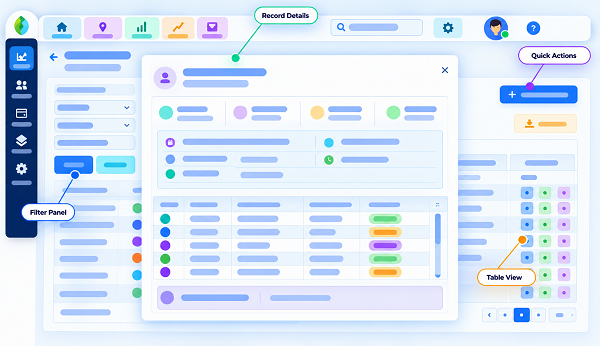
10. Use an Attendance Exception Dashboard
An attendance exception dashboard helps HR and payroll identify unresolved cases before the monthly payroll cut-off.
Instead of manually reviewing multiple spreadsheets, teams can filter exceptions by employee, department, location, shift, date, or status.
Recommended dashboard fields
| Field | Purpose |
|---|---|
| Employee ID | Identifies the employee |
| Department and location | Shows where the exception occurred |
| Scheduled shift | Establishes expected working hours |
| Exception date | Identifies the affected day |
| Exception type | Classifies the issue |
| Supervisor | Identifies the responsible reviewer |
| Supporting evidence | Records documents or verification notes |
| Review status | Shows whether the case is open, pending, or resolved |
| Payroll impact | Flags a possible adjustment for review |
| Final decision | Records the approved outcome |
| Approval timestamp | Creates an audit trail |
Useful automated alerts
- Missing attendance punches.
- Unresolved absences approaching payroll cut-off.
- Leave approvals not reflected in attendance.
- Repeated late arrivals requiring review.
- Roster changes that have not reached the attendance system.
- Absence adjustments awaiting authorised approval.
Automation should flag potential exceptions rather than making unsupported decisions. The system should not automatically deduct pay or issue disciplinary penalties merely because an alert has been triggered.
11. Reconcile Final Attendance Data With Payroll
Before closing monthly payroll, HR should provide payroll with a verified attendance report rather than a raw exception report.
The reconciliation should confirm that each exception has been resolved, appropriately classified, or explicitly escalated under the organisation’s approved procedure.
Final reconciliation steps
- Freeze the attendance cut-off: Confirm the period being processed and the deadline for corrections.
- Compare schedules and attendance: Identify employees whose actual records differ from their expected working time.
- Match approved leave: Confirm that approved leave and other authorised absences are correctly recorded.
- Resolve missing punches: Obtain verified times and retain the evidence supporting corrections.
- Validate payroll adjustments: Check that every proposed deduction or paid-leave treatment has an appropriate basis.
- Review exceptions requiring escalation: Ensure disputed or incomplete cases are handled according to the organisation’s documented procedure and applicable law.
- Approve the payroll input file: An authorised reviewer confirms that the attendance data is ready for processing.
- Retain the reconciliation report: Store the final report and approval record for audit and future reference.
Article 66 of Qatar Labour Law provides that workers engaged on annual or monthly remuneration must be paid at least once a month. Employers should therefore plan their absence-review process to support timely wage payment rather than allowing avoidable administrative delays to accumulate.
12. Protect Employee Data During Absence Reviews
Absence reviews may involve personal information, medical documentation, family circumstances, or other confidential details. Employers should limit access to the information needed for attendance administration and payroll decisions.
Recommended controls include:
- Restricting medical and sensitive documents to authorised personnel.
- Avoiding unnecessary disclosure of an employee’s reason for absence to colleagues.
- Recording only the information required for the review.
- Maintaining secure access to attendance and leave systems.
- Keeping a log of material changes to attendance records.
- Applying approved retention and deletion policies.
- Providing employees with a clear way to challenge inaccurate records.
Qatar’s Personal Data Privacy Protection Law No. 13 of 2016 may be relevant to the collection and use of employee information. Employers should assess their obligations under the law and any applicable requirements for sensitive personal data.
Official reference: Qatar Personal Data Privacy Protection Law No. 13 of 2016.
13. Monitor Key Performance Indicators
HR teams can measure the effectiveness of absence reviews through a small set of monthly indicators.
| KPI | What it measures | Why it matters |
|---|---|---|
| Unresolved absence exceptions | Cases still open at payroll cut-off | Highlights process delays |
| Attendance correction rate | Records amended after initial review | Identifies data-quality problems |
| Leave-record mismatch rate | Absences incorrectly shown despite approved leave | Reveals integration gaps |
| Missing-punch frequency | Incomplete clock-in or clock-out records | Shows where attendance controls need improvement |
| Payroll adjustment correction rate | Absence-related adjustments later amended | Measures calculation accuracy |
| Average resolution time | Time needed to close an exception | Helps improve turnaround |
| Repeat absence cases | Repeated exceptions involving the same employee or team | Identifies issues requiring investigation |
| On-time payroll completion | Whether payroll is closed according to schedule | Measures overall process efficiency |
Review these metrics monthly and investigate repeated patterns. For example, a high missing-punch rate at one site may indicate a faulty attendance terminal rather than a workforce discipline issue.
14. Monthly Absence-Review Checklist for Qatar Employers
Before approving the monthly payroll file, HR and payroll teams should confirm that:
- All employees have an approved schedule for the relevant period.
- Absence reports have been compared with actual shifts and rest days.
- Approved leave has been matched against attendance records.
- Missing punches and shift mismatches have been investigated.
- Employees and supervisors have had an opportunity to clarify discrepancies.
- Each exception has a documented status and outcome.
- Unpaid absence has been verified before any permissible pay adjustment.
- Disciplinary penalties are reviewed separately under applicable rules.
- All adjustments have the required authorisation.
- Sensitive employee information is protected.
- Payroll has received the verified attendance report.
- Outstanding cases have been escalated under a documented process.
- Final reconciliation reports and approvals have been retained.
Frequently Asked Questions
1. What is an absence exception in payroll?
An absence exception is a discrepancy between expected attendance and recorded attendance. It may involve a full-day absence, late arrival, early departure, missing punch, unrecorded leave approval, or incorrect shift assignment.
2. Should employers deduct salary automatically when an employee is marked absent?
No. Employers should verify the schedule, attendance evidence, approved leave, and the circumstances before making an adjustment. Any deduction must have a valid basis under the applicable law and employment arrangements.
3. How should HR handle a missing clock-in record?
HR should check the employee’s schedule, supervisor confirmation, available access records, and any other reliable evidence. If the employee worked, the record should be corrected using an authorised process.
4. Can approved leave still appear as an absence in the attendance system?
Yes. This may happen when leave approvals are entered late or the leave and attendance systems are not synchronised. HR should reconcile the records and apply the correct leave and pay treatment.
5. What should payroll do with unresolved absence cases at month-end?
Payroll should follow a documented exception procedure, escalate cases that require additional verification, and avoid unsupported deductions. Employers should plan reviews early enough to meet wage-payment deadlines while ensuring that the final payroll treatment is accurate and lawful.
6. What does Qatar Labour Law say about repeated unauthorised absence?
Article 61 includes a specific dismissal ground involving absence without legitimate cause for more than seven consecutive days or fifteen interrupted days in one year. Employers should verify the facts and applicable legal requirements before relying on this provision.
Conclusion
Qatar employers can review absence exceptions effectively before closing monthly payroll by combining accurate schedules, reliable attendance records, documented leave approvals, and a structured verification process.
The key is to avoid treating every missing punch or absence alert as an unauthorised absence. HR should confirm the facts, classify the exception, and ensure that any salary adjustment or disciplinary action has an appropriate legal basis.
By introducing clear review deadlines, attendance dashboards, authorised correction workflows, and payroll reconciliation controls, employers can reduce salary errors, improve employee trust, and strengthen compliance with Qatar’s applicable employment requirements.
Unresolved absence exceptions can distort a payroll run. InnBuilt Attendance Software can flag missing punches and pending manager decisions for Qatar HR to review before monthly close.