How Can Employers Track Attendance Across Multiple Worksites in Qatar?
Introduction
Employers in Qatar often manage employees across multiple worksites, including construction projects, manufacturing facilities, warehouses, hospitals, hospitality venues, maintenance locations, and client premises. Businesses operating across these locations need accurate attendance records to calculate working hours, manage shifts, control overtime, process payroll, and monitor workforce deployment.
However, tracking attendance across multiple worksites can be challenging. Employees may move between project locations, work under different supervisors, follow rotating shifts, or operate at sites where internet connectivity is limited. When attendance is recorded through paper registers, spreadsheets, or separate systems, employers may face duplicate entries, missing records, incorrect overtime calculations, and delays in payroll processing.
A centralized attendance management system helps employers in Qatar record employee attendance consistently across all locations. By combining digital check-in methods, site-level controls, employee identification, and real-time reporting, businesses can improve attendance accuracy and workforce visibility.
This article explains how employers can track attendance across multiple worksites in Qatar and build a reliable process for managing distributed teams.
1. Establish a Centralized Employee Attendance Database
The first step is to maintain a centralized employee database that connects each employee to their employment details, assigned worksite, department, supervisor, shift, and attendance policy.
When employee records are maintained separately at different locations, transferring workers between sites can create duplicate profiles and inconsistent attendance data.
A centralized database should include:
- Employee ID and full name.
- Department, job title, and employment category.
- Assigned worksite and project code.
- Reporting manager or site supervisor.
- Standard working schedule and shift pattern.
- Weekly rest days and approved leave details.
- Attendance rules and overtime approval requirements.
- Employment status and transfer history.
Each worksite should have a unique site ID. This allows attendance records to be linked to the employee, location, date, shift, and relevant project.
For example, a construction company operating in Doha, Lusail, and Al Wakrah can maintain one employee database while assigning workers to different project sites. When an employee moves from one site to another, the authorized transfer should update the attendance assignment without creating a new employee record.
2. Register Every Worksite in the Attendance System
Employers should create a structured worksite directory before implementing digital attendance tracking.
Each location should have a unique identifier and clearly defined operational details. This is especially important for companies managing construction projects, client premises, maintenance teams, or temporary work locations.
A worksite register may contain:
| Field | Purpose |
|---|---|
| Worksite ID | Uniquely identifies each location |
| Worksite name | Displays the project, facility, or client site |
| Location details | Identifies the approved attendance location |
| Site manager | Defines local responsibility |
| Active workforce | Shows employees assigned to the site |
| Shift schedules | Defines the expected attendance periods |
| Attendance method | Specifies the permitted check-in method |
| Site status | Indicates whether the location is active, temporary, or closed |
Worksite records should be reviewed whenever a project opens, closes, changes location, or transfers responsibility to another contractor.
For temporary sites, employers should define who can authorize attendance at the location and how the records will be consolidated once the assignment ends.
3. Choose the Right Attendance Tracking Method
Not every worksite requires the same attendance technology. Employers should choose a method based on site conditions, workforce size, security requirements, connectivity, and the nature of the work.
Biometric attendance terminals
Suitable for permanent facilities, offices, warehouses, and controlled entrances. These systems can reduce buddy punching when properly configured, but employers should consider privacy, device reliability, and alternatives for employees who cannot use a particular biometric method.
Mobile attendance applications
Useful for field employees, maintenance teams, engineers, and workers assigned to changing project locations. Depending on the application, employees may check in through their phones, submit attendance records, and receive shift notifications.
QR code or site-based check-in
Employees scan an approved site code to record attendance. Rotating codes or additional verification can help reduce misuse compared with a permanently displayed code.
Supervisor-assisted or offline attendance
Helpful at remote locations, temporary projects, or sites with unreliable connectivity. Supervisors record attendance using an approved process, and authorized staff reconcile the records when the system becomes available.
Employers can combine methods across locations while maintaining a common attendance database. The key requirement is consistent reporting and validation, not necessarily using the same physical device at every site.
4. Use Site-Based Check-In and Check-Out Controls
A centralized system should record where and when an employee starts and finishes work. It should also distinguish actual attendance from a planned shift or scheduled assignment.
Depending on the approved method, the system may capture:
- Employee ID.
- Worksite ID.
- Check-in and check-out timestamps.
- Scheduled shift and actual attendance period.
- Device or transaction reference.
- Supervisor approval, where required.
- Exception reasons for missing or corrected entries.
For mobile attendance, employers may use location verification at the time of check-in and check-out, where appropriate and lawful. Location information should be collected for a defined business purpose and should not automatically become continuous employee surveillance.
A site-based control is especially useful when workers are deployed to different locations on different days. It helps managers identify attendance recorded against the wrong project and distinguish between employees who reported to the correct site and those who require clarification.
However, a GPS record by itself does not prove that an employee worked the entire shift. Employers should combine attendance evidence with shift records, supervisor reviews, and appropriate operational controls.
5. Manage Employee Transfers Between Worksites
Employees in Qatar may move between projects because of changing workloads, maintenance requirements, project schedules, or staffing shortages. Attendance systems should accommodate these transfers without creating confusion about responsibility.
A transfer workflow should include:
- Approval from the authorized manager.
- Effective date and time of the transfer.
- Original worksite and destination worksite.
- Updated shift and reporting supervisor.
- Confirmation of the employee's new assignment.
- A record of any attendance entries requiring reconciliation.
The system should prevent an employee from being assigned to conflicting full-shift schedules at different locations.
For employees who travel between sites during the working day, employers should define how travel time, check-out from the first site, arrival at the second site, and any applicable work-hour treatment will be recorded under company policy and relevant requirements.
A documented transfer process reduces disputes over which site manager is responsible for confirming attendance and approving timesheets.
6. Configure Shift Schedules for Each Location
Different worksites may operate on different schedules. A warehouse may run day and night shifts, while a construction project or maintenance team may follow a separate roster.
The attendance system should support worksite-specific shift patterns, scheduled rest days, overnight shifts, rotating rosters, and approved schedule changes.
Important configuration rules include:
- Defining the expected start and end time of each shift.
- Setting reasonable check-in windows and grace periods.
- Recording late arrivals and early departures consistently.
- Linking employees to the correct roster.
- Handling shifts that cross midnight.
- Recording approved shift swaps and overtime.
- Preventing duplicate attendance entries for the same employee and shift.
Overnight shifts require special attention. For example, a shift starting at 10:00 p.m. and ending at 6:00 a.m. crosses two calendar dates. The system should associate both attendance events with the correct shift so that hours are not accidentally omitted or counted twice.
Employers should configure the system according to their actual work schedules, employment arrangements, and applicable Qatar requirements rather than assuming every worksite follows the same rules.
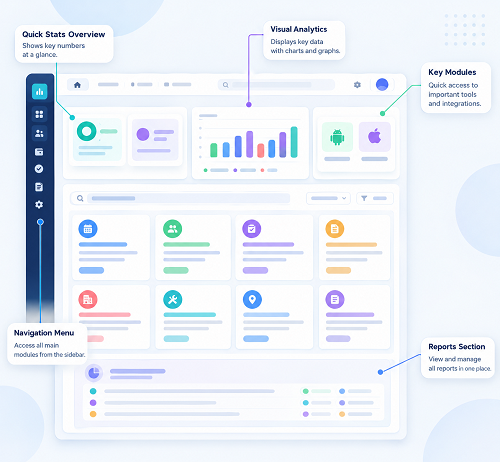
7. Monitor Attendance Through a Centralized Dashboard
A centralized dashboard allows HR teams and operations managers to review attendance across all active worksites without collecting separate spreadsheets from every supervisor.
A useful dashboard can display:
- Employees expected at each worksite.
- Employees checked in and not yet checked in.
- Late arrivals and unexplained absences.
- Missing check-out records.
- Employees assigned to the wrong site.
- Shift coverage and staffing shortages.
- Overtime requests awaiting approval.
- Attendance corrections awaiting review.
Managers should be able to filter the dashboard by worksite, project, department, supervisor, shift, and date.
For example, if a project has 150 employees scheduled for a shift but only 137 valid check-ins, the system can flag the 13 unmatched records for review. The manager can then determine whether employees are absent, assigned elsewhere, delayed, or affected by a technical issue.
The dashboard should support investigation rather than automatically treating every missing check-in as unauthorized absence.
8. Connect Attendance Records With Payroll
Attendance data affects payroll calculations, particularly where working hours, overtime, unpaid absence, shift arrangements, or approved deductions are involved.
When attendance is maintained separately from payroll, HR teams may need to reconcile multiple files manually. This increases the risk of incorrect hours, duplicate entries, missed approvals, and delayed salary processing.
A connected attendance and payroll workflow should:
- Import approved attendance records into payroll.
- Compare scheduled hours with recorded hours.
- Flag missing check-in or check-out events.
- Separate approved overtime from unapproved additional hours.
- Apply the employer's approved leave and absence rules.
- Route exceptions to authorized managers.
- Maintain a record of changes made after payroll review.
- Reconcile payroll totals with approved timesheets.
Employers should ensure that attendance rules and payroll calculations reflect applicable Qatar labour requirements, relevant employment categories, contractual terms, and any applicable exceptions. A missing clock-out should trigger a review, not an automatic salary deduction without the necessary checks.
The attendance system should also retain a clear distinction between hours recorded, hours approved, and hours actually used in payroll calculations.
9. Track Overtime and Working-Hour Exceptions
Employees working at multiple sites may have different workloads, extended shifts, urgent assignments, or additional working hours during peak operational periods.
Without centralized monitoring, overtime may be recorded inconsistently across locations or approved after payroll has already been processed.
A practical overtime workflow should capture:
- Employee and worksite details.
- Scheduled shift hours.
- Actual recorded working hours.
- Reason for additional work.
- Requested and approved overtime hours.
- Approving manager.
- Relevant payroll treatment.
Managers should review overtime trends by project, department, and supervisor. Repeated overtime at one site may indicate staffing shortages, inefficient scheduling, or excessive workload.
Employers must also ensure that work schedules, overtime handling, rest periods, and related payments comply with the applicable Qatar rules and the employee's employment arrangements. Certain employee categories and circumstances may be subject to specific provisions or exceptions, so payroll rules should be reviewed rather than applied universally.
10. Address Attendance Challenges at Remote and Construction Sites
Remote construction projects, outdoor operations, and temporary client locations can create challenges that are less common in permanent offices.
Common issues include poor network coverage, device damage, high workforce turnover, shared devices, changing site boundaries, and workers moving between project areas.
Employers can address these challenges through the following measures:
| Challenge | Recommended solution |
|---|---|
| Limited internet connectivity | Enable controlled offline attendance recording and later synchronization |
| Shared mobile devices | Require individual employee authentication and maintain device-level audit records |
| Incorrect site selection | Use approved site lists, QR codes, or location verification |
| Damaged attendance terminals | Establish a documented fallback attendance process |
| Frequent workforce transfers | Use effective-dated site assignments and transfer approvals |
| Missing check-out events | Generate exception reports and require supervisor review |
| High workforce turnover | Standardize employee onboarding and deactivate access when appropriate |
| Incorrect manual entries | Restrict corrections to authorized users and preserve the original record |
For large construction projects, employers may also use separate attendance points for site entry and work-zone deployment where operationally necessary. These records should have clearly defined purposes so that entry into a site is not automatically treated as proof of all working hours.
11. Integrate Attendance With HR and Workforce Management Systems
A centralized attendance platform becomes more useful when it connects to the employer's other operational systems.
Recommended integrations include:
HR management system: Maintains employee profiles, departments, reporting lines, and employment status.
Workforce scheduling system: Supplies shift rosters, planned deployments, and approved schedule changes.
Payroll system: Receives validated attendance, working-hour totals, and approved overtime.
Project management system: Connects employee hours to projects, cost centres, and operational reporting.
Leave management system: Matches approved leave with attendance records and helps identify inconsistencies.
Access control system: Where appropriate, provides supporting information about entry and exit events without assuming that access records alone establish working time.
Integrations should use a consistent employee ID and worksite ID. Employers should also establish which system is the authoritative source for each type of record, how errors are corrected, and how failed data transfers are identified.
12. Protect Employee Data and Maintain Reliable Records
Attendance records contain personal information about employees, their schedules, and potentially their locations. Employers should manage this information responsibly while maintaining reliable records for HR, payroll, and operational review.
Recommended controls include:
- Restricting access based on job responsibilities.
- Collecting only the information necessary for attendance management.
- Informing employees about the attendance method and its purpose.
- Applying appropriate safeguards to biometric and location data.
- Maintaining audit logs for attendance changes and approvals.
- Establishing documented retention and deletion rules.
- Reviewing third-party attendance software and data-processing arrangements.
- Providing a process for employees to question inaccurate records.
Employers should review applicable Qatar data protection requirements and any relevant labour, contractual, or sector-specific obligations before introducing biometric attendance or location tracking.
Records should be retained for the periods required by applicable rules and legitimate business needs. Employers should avoid collecting continuous location data when event-based verification is sufficient for the attendance purpose.
13. Measure Attendance Performance Across Worksites
Attendance dashboards can help employers identify patterns and improve workforce planning. However, metrics should be interpreted in context and should not replace a review of individual exceptions.
Useful key performance indicators (KPIs) include:
| KPI | Calculation | Purpose |
|---|---|---|
| Attendance compliance rate | Valid recorded attendances ÷ Expected attendances × 100 | Measures attendance record completion |
| Worksite coverage rate | Employees present ÷ Employees scheduled × 100 | Shows staffing coverage |
| Missing punch rate | Attendance records with missing punches ÷ Total attendance records × 100 | Identifies recording problems |
| On-time arrival rate | Employees arriving within the approved window ÷ Employees expected × 100 | Monitors punctuality |
| Timesheet approval rate | Approved timesheets ÷ Timesheets submitted × 100 | Measures approval progress |
| Overtime rate | Approved overtime hours ÷ Regular recorded hours × 100 | Helps monitor additional work |
| Correction rate | Attendance records corrected ÷ Total attendance records × 100 | Identifies data quality issues |
For example, if 940 out of 1,000 expected attendance records are valid, the attendance compliance rate is:
Attendance compliance rate = (940 ÷ 1,000) × 100 = 94%
The remaining 6% should be investigated to determine whether the cause was absence, a missing punch, an assignment change, or a system issue.
Comparisons across worksites should account for shift types, operating conditions, employee categories, and connectivity limitations.
14. Build a Standard Attendance Management Policy
Technology alone cannot ensure accurate attendance. Employers should establish a written policy that defines the responsibilities of employees, site supervisors, HR teams, payroll administrators, and system administrators.
The policy should explain:
- Which attendance method applies at each worksite.
- How employees record arrival and departure.
- How employees report technical issues.
- Who approves transfers and schedule changes.
- How overtime is requested and approved.
- How missed punches and disputed records are corrected.
- How attendance data is used in payroll.
- How employees can review and challenge errors.
- How attendance records are protected and retained.
Training should be provided to both employees and supervisors. Employees need to understand how to record attendance correctly, while supervisors must know how to review exceptions without making unauthorized changes.
A standard policy ensures that workers at different locations are subject to consistent processes while allowing approved adjustments for site-specific operating conditions.
15. Implement Multi-Worksite Attendance Tracking in Phases
Employers can reduce implementation risks by rolling out the attendance system gradually.
Phase 1: Assess current attendance practices
Identify all active worksites, employee groups, shift patterns, current recording methods, and payroll dependencies.
Phase 2: Standardize employee and site records
Create unique employee IDs and worksite IDs, remove duplicate profiles, and define assignment and transfer rules.
Phase 3: Select attendance methods
Choose biometric terminals, mobile applications, QR-based check-ins, or supervised fallback processes based on each location's needs.
Phase 4: Configure shifts and approvals
Set up shift schedules, check-in windows, overtime workflows, correction permissions, and exception reports.
Phase 5: Pilot selected locations
Test the process at a small number of sites. Check record accuracy, employee adoption, offline functionality, and payroll reconciliation.
Phase 6: Integrate and expand
Connect the system with HR, scheduling, and payroll platforms. Expand to other worksites after addressing the issues identified during the pilot.
Phase 7: Review performance regularly
Monitor missing records, attendance corrections, site coverage, overtime, and payroll discrepancies. Update procedures as workforce requirements change.
Conclusion
Employers can track attendance across multiple worksites in Qatar by combining a centralized employee database, unique worksite identifiers, appropriate digital check-in methods, standardized shift schedules, and consistent approval workflows.
A centralized attendance system helps HR teams and operations managers see who is scheduled, where employees are assigned, whether attendance has been recorded correctly, and which exceptions need investigation. Integrating attendance with payroll, leave management, and workforce scheduling can further reduce manual reconciliation and improve working-hour accuracy.
The most effective approach combines technology with clear policies, supervisor accountability, employee training, and appropriate data protection controls. By implementing these practices, employers can improve attendance visibility across Qatar's distributed worksites while supporting reliable payroll processing and consistent workforce management.
Across Qatar worksites, InnBuilt Attendance Software can bring mobile check-ins and site-wise timesheets into one view, helping managers find missed punches and verify hours before approving attendance.