How Can Face Recognition Attendance Reduce Proxy Check-Ins at Qatar Worksites?
Introduction
Managing employee attendance across worksites can be challenging for businesses in Qatar, particularly in construction, manufacturing, logistics, facilities management, and other industries with large or distributed workforces. Traditional attendance methods, such as paper registers, punch cards, and shared employee access cards, can create opportunities for proxy check-ins, where one employee records attendance on behalf of another.
Proxy attendance can lead to inaccurate timesheets, incorrect salary calculations, unapproved overtime claims, and difficulties in workforce planning. For employers managing multiple shifts, contractors, and remote work locations, these issues can also increase administrative costs and weaken attendance accountability.
Face recognition attendance systems offer a technology-based way to reduce proxy check-ins by verifying an employee's identity during clock-in and clock-out. When integrated with attendance management and payroll software, these systems can help Qatar employers maintain more reliable attendance records, identify exceptions, and improve workforce visibility.
However, face recognition should be implemented with appropriate privacy safeguards, clear employee communication, and a process for handling recognition failures. This article explains how the technology works, its benefits, implementation considerations, and how businesses in Qatar can use it responsibly.
1. What Is Face Recognition Attendance?
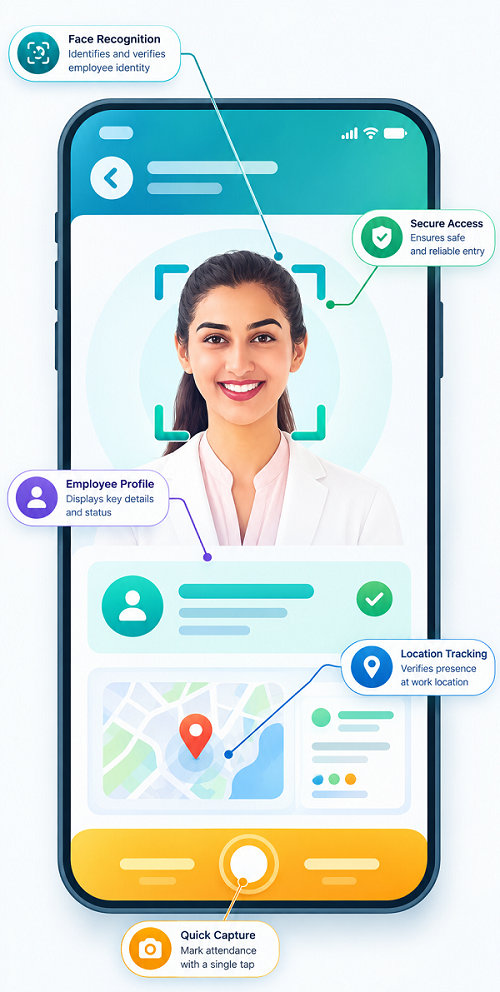
Face recognition attendance is an automated time-tracking method that uses facial image analysis to help verify whether the person checking in matches an enrolled employee.
Unlike a traditional access card or PIN, which can be shared, face recognition attempts to match the person present with an authorised employee profile.
A typical system follows these steps:
- Employee enrolment: The employer creates an employee profile and completes the required identity-verification and facial enrolment process.
- Attendance check-in: The employee approaches an approved terminal or opens an authorised mobile attendance application.
- Identity matching: The system compares the captured facial data with the enrolled reference.
- Attendance recording: Once the verification process is successful, the system records the check-in or check-out time and relevant worksite information.
- Exception handling: Failed matches, duplicate attempts, device issues, or unusual attendance events are flagged for review.
- Timesheet processing: Approved attendance records can be transferred to workforce management or payroll software.
The exact process depends on the device, software configuration, connectivity, and security features selected by the employer.
2. How Does Face Recognition Reduce Proxy Check-Ins?
Proxy check-ins occur when an employee records attendance for another worker. This can happen when employees share access cards, exchange PINs, or ask colleagues to sign a manual register.
Face recognition helps reduce this risk by requiring a facial match rather than relying solely on a transferable credential.
Key anti-proxy mechanisms
| Feature | How it helps |
|---|---|
| Facial identity matching | Checks whether the person clocking in matches an enrolled employee profile |
| Liveness detection | On supported systems, helps distinguish a live person from a photograph or replayed image |
| Time-stamped attendance | Records the time of each successful attendance event |
| Worksite-linked terminals | Associates attendance with an approved terminal or location |
| Duplicate-event detection | Flags repeated or unusual check-in attempts for review |
| Exception alerts | Notifies authorised supervisors about failed verification or suspicious patterns |
| Audit trails | Helps HR review attendance corrections, approvals, and changes |
These controls make many common proxy-check-in methods more difficult. However, face recognition does not eliminate every form of attendance fraud. System design, liveness detection quality, access controls, supervision, and exception reviews all influence effectiveness.
Employers should avoid treating a failed facial match as automatic proof of misconduct. Technical errors, lighting conditions, changes in appearance, or accessibility needs may also cause unsuccessful verification.
3. Why Is Proxy Attendance a Concern at Qatar Worksites?
Qatar employers often manage employees across construction projects, warehouses, service locations, factories, hotels, and other operational environments. Some organisations also coordinate subcontractors and temporary workforces.
In these settings, inaccurate attendance records can create several challenges.
Incorrect payroll calculations
When attendance records do not reflect actual working hours, salary calculations may be affected. Errors can influence payable hours, overtime, absence deductions, and other attendance-linked components.
Unauthorised overtime claims
Proxy check-ins or manipulated time records may make it harder to verify whether an employee worked the hours recorded in a timesheet.
Poor workforce visibility
Managers may not know how many workers are physically present at a site, which can affect shift allocation, task assignments, and operational planning.
Contractor billing discrepancies
Where contractor payments depend on approved worker hours or attendance reports, inaccurate records can create disputes between the principal company and the contractor.
Compliance and audit difficulties
Inconsistent records can make it harder to explain payroll calculations, investigate discrepancies, and produce reliable employment records when required.
An appropriately configured face recognition system can improve the reliability of the identity-verification step, while attendance approvals and payroll reconciliation address the wider recordkeeping process.
4. How Can Qatar Employers Implement Face Recognition at Worksites?
A successful implementation starts with the attendance process, not simply the purchase of a facial recognition device.
Step 1: Identify high-risk attendance points
Review where proxy check-ins are most likely to occur. Examples include:
- Main gates and worker entry points
- Construction site access areas
- Warehouse entrances
- Factory clock-in stations
- Staff entrances at hotels and commercial facilities
- Shift handover points
- Remote operational locations
Employers should also review current attendance exceptions, repeated manual corrections, shared-card practices, and disputes involving overtime or missing hours.
Step 2: Select suitable devices
The device should match the worksite's physical environment.
For example, a construction site may require a rugged terminal suitable for dust, heat, and outdoor conditions. A warehouse may need a high-throughput terminal that can process shift changes without creating long queues.
Before purchasing, assess:
- Operating temperature and environmental protection
- Performance under different lighting conditions
- Recognition speed and accuracy
- Liveness detection capabilities
- Connectivity and offline functionality
- Integration with existing attendance software
- Security updates and vendor support
- Accessibility and alternative check-in options
For mobile attendance, assess whether the application verifies identity and whether its location controls are appropriate for the intended use. GPS alone does not verify a person's identity, and facial verification alone does not prove that a person is at an approved worksite.
Step 3: Create accurate employee profiles
HR should ensure that each enrolled employee has a unique record linked to the correct employee ID.
For contractor workforces, the system should distinguish between the contractor's employee records and the host organisation's site-access or assignment records. Access permissions should be limited to the information each organisation needs.
Enrolment should follow a documented process, with appropriate notice, access restrictions, retention rules, and a procedure for correcting inaccurate records.
Step 4: Configure site and shift rules
Configure attendance policies for each site, department, and shift.
Examples include:
- Permitted check-in windows
- Approved worksite terminals
- Shift start and end times
- Grace periods, where applicable
- Rules for overnight shifts
- Missed check-in and check-out procedures
- Supervisor approval requirements
- Procedures for workers moved between sites
For overnight shifts, ensure the system assigns clock-in and clock-out events to the correct shift and payroll period rather than automatically treating midnight as the end of a working day.
Step 5: Enable exception alerts
Configure alerts for events that require review, such as repeated recognition failures, missing check-outs, duplicate attendance entries, or manual changes to approved records.
Alerts should be proportionate and should not automatically label an employee as dishonest. HR or an authorised supervisor should review the available evidence and give the employee an opportunity to explain discrepancies.
Step 6: Pilot before full deployment
Start with one site or department. Measure recognition performance, queue times, failed matches, employee feedback, and the number of attendance corrections.
Use the pilot to adjust device placement, lighting, enrolment procedures, and fallback methods before extending the system to other locations.
5. What Role Does Liveness Detection Play?
Facial matching and liveness detection are related but different functions.
Facial matching compares a captured face with an enrolled profile. Liveness detection attempts to establish that the capture represents a live person rather than a photograph, screen replay, or other presentation attack.
Depending on the technology, liveness detection may use camera-based analysis, depth information, infrared sensing, or other methods.
For Qatar worksites, employers should evaluate whether the vendor's anti-spoofing features have been tested under realistic operating conditions. Ask the vendor to explain how the system responds to:
- Printed photographs
- Images displayed on mobile phones
- Video replay attempts
- Poor lighting
- Face coverings or personal protective equipment
- Changes in appearance
- Repeated failed attempts
Liveness detection can reduce some spoofing risks, but it is not a guarantee against every attack. Employers should combine it with secure device configuration, protected employee accounts, access controls, monitoring, and periodic system reviews.
6. How Does Face Recognition Improve Payroll Accuracy?
Attendance data is often a key input for payroll processing. When employee identity is verified more reliably, payroll teams can spend less time investigating attendance entries that may have been recorded by the wrong person.
An integrated workflow can operate as follows:
- The employee completes a successful check-in.
- The attendance system records the event against the employee's profile.
- The system associates the event with the relevant site, shift, and scheduled hours.
- Check-in and check-out events are used to calculate recorded working time, subject to the employer's rules.
- Overtime, absences, lateness, and missing punches are flagged for review.
- Supervisors approve or correct exceptions through a documented process.
- Approved timesheets are transferred to payroll.
- Payroll staff reconcile the calculated amounts and retain supporting records.
Face recognition does not itself determine whether all recorded time is payable or whether overtime is legally due. Those decisions depend on applicable employment rules, the actual hours worked, approved policies, and relevant legal requirements.
For employers in Qatar, attendance software should support the payroll process without replacing HR review of statutory entitlements, working-hour limits, rest periods, and applicable employment obligations.
7. How Can Face Recognition Help Manage Contractors and Multiple Sites?
Companies operating across multiple worksites may need to track employees, subcontractor crews, and temporary workers using different reporting arrangements.
A centralised attendance platform can provide a common view of approved attendance events while maintaining separate permissions for each organisation.
Useful capabilities include:
- Assigning workers to a specific project or worksite
- Recording attendance against approved terminals
- Managing shift and crew assignments
- Identifying missing attendance records
- Producing contractor-specific timesheets
- Comparing attendance with approved work orders
- Exporting verified records for contractor billing review
- Tracking corrections and supervisor approvals
For example, a construction company can compare a subcontractor's approved timesheet with attendance records captured at the relevant site. If the two records differ, an authorised manager can investigate before approving the contractor's invoice.
However, site attendance should not be treated as conclusive proof that every recorded minute was spent working. Access records, task assignments, supervisor reports, and other operational evidence may be needed, depending on the situation.
8. Privacy and Legal Considerations in Qatar
Face recognition involves biometric information, which requires careful handling. Qatar employers should assess the applicable legal framework before introducing biometric attendance, including Qatar's Personal Data Privacy Protection Law, Law No. 13 of 2016, and any relevant amendments, implementing requirements, or sector-specific rules.
The exact obligations depend on the organisation, its processing activities, and the circumstances in which biometric data is collected and used. Employers should obtain appropriate legal and privacy advice rather than assume that biometric attendance is automatically permitted in every situation.
Recommended privacy safeguards
Explain the purpose clearly. Tell employees why face recognition is being introduced, what information is collected, how attendance decisions are made, and who can access the records.
Assess necessity and proportionality. Determine whether biometric verification is necessary for the attendance problem being addressed and whether a less intrusive method could achieve the same objective.
Review the legal basis. Establish the applicable legal basis and any required notices, permissions, assessments, or other safeguards before collecting biometric data.
Limit collection. Configure the system to collect only the information needed for the stated purpose. Understand whether the vendor stores raw facial images, facial templates, or both.
Protect biometric records. Use appropriate encryption, access controls, secure authentication, logging, and vendor security reviews.
Define retention periods. Set documented retention and deletion rules for biometric templates, attendance logs, and related records, taking account of applicable legal and recordkeeping requirements.
Control vendor access. Review data-processing arrangements, storage locations, subcontractors, data transfers, incident notification procedures, and deletion obligations.
Provide a reasonable fallback. Establish an alternative method for employees who cannot be reliably verified or for whom biometric processing cannot appropriately be used.
Maintain human review. Provide a way to challenge inaccurate records and request correction without relying solely on automated decisions.
Avoid unrelated monitoring. Do not use attendance biometric data for unrelated purposes without assessing the applicable legal requirements and informing affected individuals as required.
Privacy should be built into the system from the start, rather than added only after deployment.
9. What Challenges Should Employers Plan For?
| Challenge | Recommended response |
|---|---|
| Poor lighting or camera positioning | Test terminal placement and lighting before deployment |
| PPE or face coverings | Select equipment suitable for the actual work environment and define an alternative verification process |
| Recognition failures | Allow a documented manual or alternative check-in process |
| Network outages | Use secure offline recording where supported, with controlled synchronisation |
| Long queues at shift changes | Estimate peak throughput and add terminals where needed |
| Employee concerns | Explain the purpose, safeguards, and complaint process before rollout |
| Incorrect employee profiles | Maintain a controlled process for enrolment updates and profile corrections |
| Unauthorised data access | Apply least-privilege permissions and audit access to sensitive records |
| Vendor or device failure | Maintain a contingency procedure and support escalation process |
| Inaccurate overtime calculations | Reconcile approved attendance with work schedules, exceptions, and payroll rules |
Employers should also test the system across the workforce rather than relying solely on vendor demonstrations. Recognition performance can vary with camera quality, environmental conditions, and the characteristics of the people being enrolled.
10. How Should Employers Measure Effectiveness?
A face recognition attendance system should be evaluated against operational results, not simply the number of successful scans.
Useful key performance indicators (KPIs) include:
- Number of suspected proxy-check-in incidents before and after implementation
- Attendance correction rate
- Failed recognition rate
- Average time required to complete check-in
- Average queue time at shift changes
- Number of missing check-ins and check-outs
- Payroll adjustments linked to attendance errors
- Number of disputed timesheets
- Frequency of manual overrides
- Time taken to resolve attendance exceptions
- Employee complaints and privacy-related incidents
Employers should establish a baseline before deployment and compare results over a suitable period. A decline in suspicious attendance events can be useful evidence of improvement, but it should be considered alongside system failures, false rejections, and the volume of manual corrections.
The goal is to improve attendance accuracy while preserving fair treatment and efficient site operations.
11. How Attendance Management Software Supports Face Recognition
A face recognition terminal is only one part of a complete attendance process. Attendance management software helps turn identity-verification events into records that HR, supervisors, operations teams, and payroll staff can use.
Important software features include:
- Integration with face recognition terminals
- Employee and contractor profile management
- Multi-site attendance dashboards
- Shift scheduling and roster management
- Late arrival and missing-punch alerts
- Overtime and exception workflows
- Supervisor approvals and audit trails
- Payroll and HR system integration
- Role-based access to employee information
- Attendance reports by employee, department, project, and site
- Configurable retention and data access controls
For companies in Qatar, an integrated platform can reduce duplicate data entry, make attendance corrections easier to trace, and help payroll teams work from approved records.
Employers should verify that the software supports their actual operating environment, applicable local requirements, and the privacy safeguards needed for biometric processing.
Frequently Asked Questions (FAQs)
1. How does face recognition prevent proxy attendance?
It checks whether the person clocking in matches an enrolled employee profile. When combined with liveness detection and secure attendance controls, it makes it more difficult for one employee to record attendance on behalf of another.
2. Can face recognition completely eliminate proxy check-ins?
No. It can reduce common proxy-check-in methods, but effectiveness depends on the technology, configuration, and operating environment. Employers should also use audit trails, exception reviews, secure devices, and documented attendance procedures.
3. Is face recognition attendance suitable for construction sites in Qatar?
It can be suitable where devices are selected for the site's environmental conditions and the system can manage multiple crews, shifts, and locations. Employers should test performance under actual site conditions, including lighting, connectivity, and personal protective equipment.
4. Does face recognition improve payroll accuracy?
It can improve the reliability of employee identity records linked to attendance events. Payroll accuracy also depends on correct shift rules, approved overtime, exception handling, and appropriate payroll calculations.
5. What happens if the system fails to recognise an employee?
The employer should provide a documented alternative verification method, such as an authorised supervisor check or another approved attendance process. Failed recognition should be investigated fairly rather than automatically treated as misconduct.
6. Is biometric attendance legally permitted in Qatar?
Employers should assess the applicable requirements before introducing it. Qatar's Personal Data Privacy Protection Law, Law No. 13 of 2016, is an important starting point, but the precise obligations depend on the circumstances and current applicable rules. Employers should obtain appropriate legal advice.
Conclusion
Face recognition attendance can help Qatar employers reduce proxy check-ins by making employee identity verification part of the clock-in and clock-out process. Features such as liveness detection, site-linked terminals, time-stamped records, exception alerts, and audit trails can strengthen attendance controls across construction sites, warehouses, factories, hospitality operations, and other workplaces.
The best results come from combining reliable technology with accurate employee records, clear shift rules, human review, payroll integration, and strong data protection.
Before implementation, employers should evaluate whether biometric attendance is necessary and proportionate, review applicable Qatar privacy requirements, and establish an alternative process for recognition failures. With these safeguards in place, face recognition can support more reliable workforce records and more transparent attendance management.
When shared cards allow proxy punches, InnBuilt Face Attendance Software offers Qatar worksites a person-linked check-in method that can make attendance exceptions easier to investigate.