How Can Qatar Employers Track Overtime Approvals and Pay for Night Shifts?
How Can Qatar Employers Track Overtime Approvals and Pay for Night Shifts?
Introduction
Managing overtime approvals and night-shift payments is an important part of payroll compliance in Qatar. Businesses operating in construction, healthcare, hospitality, logistics, manufacturing, security, facilities management, and customer support often need employees to work beyond their regular schedules or cover shifts outside standard daytime hours.
Without a clear approval and tracking process, employers may face inaccurate payroll calculations, disputes over working hours, unapproved overtime costs, and difficulties maintaining reliable employment records.
Qatar Labour Law No. 14 of 2004 establishes rules governing ordinary working hours, overtime compensation, night work, and weekly rest for workers covered by the law. Under Articles 73 and 74, ordinary working hours are generally limited to eight hours per day and 48 hours per week, with reduced limits during Ramadan. Overtime is generally subject to a minimum additional payment of 25% over the applicable basic wage rate. Article 74 also addresses compensation for qualifying night work, with an exception for shift workers.
For employers, the objective is to establish a reliable process that connects shift schedules, attendance records, supervisor approvals, overtime calculations, and payroll processing.
This article explains how Qatar businesses can track overtime approvals and night-shift payments, calculate eligible compensation, reduce payroll errors, and use workforce management software to improve compliance.
1. Understand Qatar’s Rules for Overtime and Night Work
Before implementing an approval system, employers should understand the legal requirements that apply to their workforce.
Ordinary working hours
Article 73 of Qatar Labour Law No. 14 of 2004 generally establishes the following maximum ordinary working hours for covered workers:
| Working period | General ordinary-hours limit |
|---|---|
| Normal months | 8 hours per day and 48 hours per week |
| Ramadan | 6 hours per day and 36 hours per week |
| Rest intervals | Generally 1–3 hours in total, excluded from working-hour calculations, subject to the law |
The law also generally provides that a worker should not work more than five consecutive hours without the applicable rest arrangements. Special categories and exceptions may apply. Employers should review Article 76 and other relevant provisions before applying these limits to particular roles.
Overtime compensation
Under Article 74, qualifying additional working hours must generally be paid at a rate of at least the basic wage for the relevant ordinary hours plus an additional amount of at least 25%.
The same article generally limits actual working time to ten hours per day, except where continuation of work is necessary to prevent serious loss or a dangerous accident, or to mitigate the consequences.
Night-work compensation
Article 74 also addresses workers performing work during night hours. The official English text on Al Meezan provides for an increase of at least 50% for workers working between 9:00 p.m. and 6:00 a.m., excluding shift workers. Employers should verify the current applicable legal text and the classification of each employee before calculating this entitlement.
Important distinction: The statutory night-work provision contains an exception for shift workers. Employers should not automatically apply the same night premium to every employee working after 9:00 p.m. Equally, the exception should not be interpreted as removing all overtime or other compensation entitlements from shift workers. The treatment of overtime, shift arrangements, weekly rest, and contractual benefits must be assessed separately.
2. Create a Clear Overtime Approval Policy
Employers should establish a written overtime policy that explains when additional working hours may be authorised, who can approve them, how employees record the hours, and how payroll calculates the resulting payment.
Without a defined policy, managers may approve overtime informally through phone calls, messaging applications, or verbal instructions. These arrangements can create gaps in the records used by payroll teams.
Recommended overtime approval workflow
- Identify the requirement: The department manager explains why additional work is needed.
- Submit a request: The supervisor records the employee, date, expected hours, reason, and relevant work order.
- Check working-time limits: The system or responsible manager reviews the proposed hours against applicable legal limits and existing shifts.
- Obtain approval: An authorised manager approves or rejects the request before the overtime begins, where practicable.
- Record actual attendance: The employee's actual start and end times are captured through the attendance system.
- Verify the hours: The supervisor confirms the additional work performed.
- Approve payroll treatment: The verified hours are assigned the correct overtime category and pay rate.
- Reconcile the payroll result: Payroll compares approved hours, calculated compensation, and the final payroll register.
Emergency work may require a documented exception to advance approval. Employers should record the reason, authorising person, actual hours, and subsequent review without treating the exception as permission to disregard statutory requirements.
3. Define the Roles and Responsibilities in the Approval Process
A strong approval process separates the responsibility for requesting overtime from the responsibility for verifying and paying it.
| Role | Main responsibility |
|---|---|
| Employee | Records actual working time and reports discrepancies |
| Team supervisor | Requests overtime and verifies attendance |
| Department manager | Confirms operational need and approves the request |
| HR team | Maintains employee categories, schedules, and policy rules |
| Payroll team | Applies approved pay rules and calculates compensation |
| Finance team | Reviews payroll totals, costs, and payment reconciliation |
| System administrator | Maintains access permissions and configured rules |
For smaller businesses, one person may perform more than one function. However, employers should maintain appropriate review controls so that overtime cannot be added, approved, and paid without a reliable audit trail.
4. Track Scheduled Hours and Actual Working Hours Separately
A scheduled shift and actual attendance are not necessarily the same. Employees may arrive late, leave early, work beyond their scheduled finish time, or cover an additional shift.
Payroll teams should therefore distinguish between the planned schedule, recorded attendance, approved working time, and the hours eligible for additional compensation.
Example of an attendance record
| Employee | Scheduled shift | Actual attendance | Overtime requested | Approval status |
|---|---|---|---|---|
| Employee A | 8:00 a.m.–4:00 p.m. | 8:00 a.m.–6:00 p.m. | 2 hours | Pending |
| Employee B | 2:00 p.m.–10:00 p.m. | 2:00 p.m.–11:00 p.m. | 1 hour | Approved |
| Employee C | 10:00 p.m.–6:00 a.m. | 10:00 p.m.–6:00 a.m. | None recorded | Regular night shift |
These are illustrative records, not legal determinations. The employer must assess the applicable working-time rules, actual hours worked, break periods, shift classification, and contractual terms before calculating pay.
Why the distinction matters
An employee who stays at the workplace after the scheduled shift may not necessarily have worked every additional minute. Conversely, an employee who performs authorised duties beyond the schedule must not have qualifying hours excluded merely because the manager forgot to update the roster.
A reliable system should compare the schedule against attendance and require an explanation for differences.
5. Calculate Overtime Pay Using the Applicable Basic Wage Rate
Payroll teams should use a documented calculation method based on the applicable basic wage and the legal or contractual overtime rate.
Under Article 74, the minimum statutory overtime rate for covered workers is generally the basic wage for the relevant ordinary hours plus an additional 25%.
Illustrative overtime calculation
Assume an employee's basic monthly wage is QAR 3,000 and the employer uses a 30-day month and eight ordinary hours per day for this illustration.
Step 1: Calculate the illustrative daily basic wage
QAR 3,000 ÷ 30 = QAR 100.
Step 2: Calculate the illustrative hourly basic wage
QAR 100 ÷ 8 = QAR 12.50.
Step 3: Apply the illustrative minimum overtime multiplier
QAR 12.50 × 1.25 = QAR 15.625 per overtime hour.
Step 4: Calculate payment for two qualifying overtime hours
QAR 15.625 × 2 = QAR 31.25.
Under these assumptions, the additional overtime payment would be QAR 31.25.
This example is for illustration only. Employers should verify the correct wage basis, divisor, working-hour classification, and any more favourable contractual or applicable legal entitlement before using a calculation in production payroll. Ramadan schedules and special categories may require different treatment.
6. Establish a Separate Process for Night-Shift Payments
Night-shift management requires employers to distinguish between a scheduled night shift and additional hours worked beyond that shift.
For example, an employee may work a regular scheduled shift from 10:00 p.m. to 6:00 a.m. Another employee may work a daytime schedule and be asked to remain late into the evening. These arrangements may have different legal and contractual implications.
Information to capture for night shifts
- Employee ID and job category.
- Shift start and end dates.
- Scheduled start and finish times.
- Actual check-in and check-out times.
- Breaks and other excluded periods.
- Whether the employee is classified as a shift worker.
- Whether any hours qualify as overtime.
- Applicable night-work or shift allowance rules.
- Manager approval and payroll review status.
- Any applicable weekly-rest or public-holiday treatment.
Apply the correct employee classification
The shift-worker exception under Article 74 makes employee classification important. Employers should maintain a documented classification for each role and verify that the actual working arrangement matches the classification.
Do not assume that assigning an employee to a roster labelled “night shift” automatically resolves the legal treatment of night work. HR should review the relevant law, contractual provisions, and applicable guidance.
7. Avoid Double Counting Overtime and Night-Shift Compensation
One common payroll problem is applying multiple allowances to the same hours without understanding how the relevant entitlements interact.
Consider an employee who works beyond a scheduled shift and performs some of those additional hours at night. Payroll must determine which rules apply to the employee and hours concerned, including whether the worker is a shift worker and whether any additional contractual benefit applies.
Employers should not automatically:
- Apply the standard night-work premium to every shift worker.
- Assume that the night-work exception eliminates overtime pay.
- Add every available premium together without checking the applicable rules.
- Pay only one allowance when a separate entitlement is legally or contractually due.
- Use a general payroll rule without considering the employee's category and working arrangement.
Recommended payroll configuration
Create separate earning codes for different payment types, such as:
| Earning code | Purpose |
|---|---|
| OT_125 | Qualifying overtime paid at the applicable minimum 125% rate |
| NIGHT_WORK | Night-work payment where legally or contractually applicable |
| SHIFT_ALLOWANCE | Contractual or company-policy shift allowance |
| REST_DAY_WORK | Work performed on a weekly rest day, subject to applicable rules |
| HOLIDAY_WORK | Work subject to an applicable public-holiday payment rule |
The code names are examples only. The payroll system should apply each code only when the employee and hours qualify. Employers should also configure interactions between codes to prevent both underpayment and accidental duplication.
8. Monitor Daily and Weekly Working-Time Limits
Tracking overtime only at the end of the month may allow scheduling problems to go unnoticed until payroll processing.
Employers should monitor working hours as shifts are assigned and attendance records are updated.
Useful controls include
- Alerts when an employee approaches an applicable daily working-time limit.
- Warnings when proposed overtime conflicts with an existing shift.
- Weekly working-hour summaries for each employee.
- Checks for insufficient rest between consecutive shifts.
- Notifications when actual hours exceed approved hours.
- Escalation when a manager repeatedly requests excessive overtime.
- Separate rules for Ramadan and other applicable special schedules.
Article 74 generally limits actual working hours to ten hours per day, subject to the specific exception in the law. Article 73 establishes ordinary working-hour limits. Employers should review applicable exemptions and special provisions before implementing automated controls.
Automated warnings are useful, but they should not replace managerial review or the employer's legal obligations.
9. Integrate Attendance, Shift Scheduling, and Payroll Software
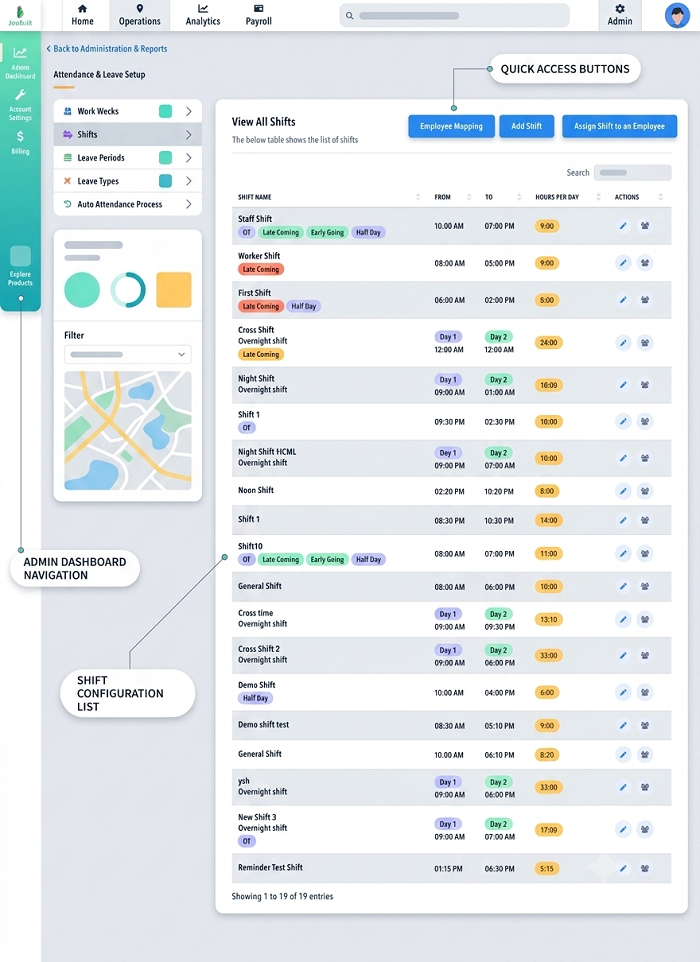
Businesses with large or rotating workforces can benefit from connecting their attendance, scheduling, approval, and payroll systems.
When these systems operate separately, HR may use one spreadsheet for overtime, supervisors may use messaging applications to approve hours, and payroll may receive incomplete information shortly before the salary payment deadline.
An integrated process reduces repeated data entry and provides a more reliable audit trail.
Recommended system features
Shift scheduling: Creates and publishes regular, rotating, and night-shift rosters.
Overtime requests: Allows supervisors to submit requests with reasons, dates, and expected hours.
Approval workflows: Routes requests to the appropriate manager and records approval timestamps.
Attendance integration: Imports actual check-in and check-out times from approved attendance devices or mobile applications.
Payroll rules: Calculates eligible overtime and applicable allowances according to employee classification and configured pay rules.
Exception reporting: Flags missing approvals, unmatched attendance, excessive hours, and unusual payroll values.
Audit history: Records changes to shifts, attendance, approvals, and payroll inputs.
Payroll exports: Transfers verified earning codes and hours to the payroll register.
Software should be configured and tested against the employer's actual legal obligations and employment terms. A default setting in a vendor product should never be treated as proof of compliance.
10. Reconcile Approved Overtime With Payroll Before Payment
Before payroll is finalised, payroll teams should compare the overtime register with attendance records and approved requests.
Monthly reconciliation checklist
- Confirm that the employee is active and assigned to the correct payroll category.
- Compare the published roster with actual attendance.
- Identify all hours beyond scheduled working time.
- Confirm approval or documented exception for each qualifying overtime entry.
- Check the employee's applicable hourly wage basis.
- Validate overtime and night-work classifications.
- Review any rest-day or public-holiday work separately.
- Check for duplicate entries and missing earning codes.
- Compare overtime totals with the payroll register.
- Resolve discrepancies and retain supporting records before payroll approval.
Example of a reconciliation report
| Employee | Approved overtime | Payroll overtime | Difference | Action |
|---|---|---|---|---|
| Employee A | 5 hours | 5 hours | 0 | No action |
| Employee B | 8 hours | 6 hours | 2 hours | Investigate missing hours |
| Employee C | 3 hours | 4 hours | 1 hour | Check for duplicate or incorrect entry |
The table is illustrative. Any discrepancy should be investigated rather than automatically adding or removing hours.
11. Maintain Records for Audits and Employee Queries
Accurate records help employers explain how additional hours were approved and how compensation was calculated.
Employers should maintain appropriate records of:
- Published work schedules and shift changes.
- Attendance and timesheets.
- Overtime requests and approval decisions.
- Actual additional hours worked.
- Night-shift classifications and applicable allowances.
- Payroll calculations and earning-code details.
- Adjustments made after payroll review.
- Employee queries and their resolutions.
Access to these records should be restricted to authorised personnel. Employers should also establish appropriate retention periods and safeguards for employee data.
A clear record trail is particularly useful when an employee questions an overtime payment or when HR must investigate differences between a roster, attendance data, and the payslip.
12. Train Supervisors and Payroll Teams
Even a well-designed system can fail if supervisors do not understand the approval process or payroll staff apply incorrect earning codes.
Training should cover:
- The difference between ordinary hours and overtime.
- How to request and approve additional hours.
- The importance of recording actual working time.
- The distinction between shift workers and other employee categories.
- The treatment of night work and applicable allowances.
- Daily and weekly working-time controls.
- How to correct attendance errors.
- How to document emergency work.
- How to escalate payroll disputes.
Employers should also review overtime trends with managers. If one department repeatedly generates excessive overtime, the cause may be understaffing, unrealistic deadlines, poor shift planning, or inefficient task allocation.
13. Measure Overtime and Night-Shift Payroll Performance
Businesses should use a small set of measurable indicators to identify errors and control workforce costs.
| KPI | What it measures |
|---|---|
| Overtime approval compliance | Percentage of overtime entries with valid approvals or documented exceptions |
| Payroll correction rate | Frequency of overtime or night-shift payment corrections |
| Unmatched attendance rate | Entries where attendance and approved hours do not agree |
| Overtime cost as a percentage of payroll | Financial impact of additional working hours |
| Average overtime hours per employee | Distribution of additional work across the workforce |
| Night-shift payroll accuracy | Agreement between eligible night-work records and payroll results |
| Approval turnaround time | Time taken for managers to approve or reject requests |
| Repeated excessive-hours alerts | Frequency of scheduling patterns requiring review |
Review these metrics monthly. Managers should investigate persistent overtime rather than treating higher overtime expenditure as an unavoidable cost of doing business.
Frequently Asked Questions (FAQs)
1. What is the minimum overtime rate in Qatar?
Under Article 74 of Qatar Labour Law No. 14 of 2004, qualifying overtime for covered workers is generally paid at the applicable basic wage rate plus an additional amount of at least 25%. Employers should verify the applicable wage basis and any more favourable terms.
2. What are the ordinary working-hour limits in Qatar?
Article 73 generally sets ordinary working hours at eight hours per day and 48 hours per week, reduced to six hours per day and 36 hours per week during Ramadan for covered workers. Applicable exemptions and special rules should be reviewed.
3. Are employees entitled to extra pay for night work in Qatar?
Article 74 addresses night-work compensation and provides for an increase of at least 50% for covered workers working between 9:00 p.m. and 6:00 a.m., with an exception for shift workers. Employers should consult the applicable legal text and assess the employee's classification and contractual terms.
4. Are shift workers exempt from overtime pay?
The night-work exception for shift workers should not be interpreted as a blanket exemption from overtime compensation. Employers must assess whether the employee has worked qualifying overtime and apply the relevant legal and contractual rules.
5. Can employers require overtime without prior approval?
Employers should establish an approval process and communicate when additional hours may be required. If urgent circumstances prevent advance approval, the business should document the reason and verify the hours afterwards. Employers must still comply with applicable working-time and compensation requirements.
Conclusion
Qatar employers can manage overtime approvals and night-shift payments more accurately by connecting shift schedules, attendance records, approval workflows, and payroll calculations.
The starting point is understanding the relevant provisions of Qatar Labour Law No. 14 of 2004, particularly Articles 73 and 74. Employers should distinguish ordinary working hours from qualifying overtime, review the legal treatment of night work and shift workers, and apply the correct wage basis and payment rules.
An effective process combines written policies, supervisor accountability, reliable attendance data, employee classification, payroll reconciliation, and secure recordkeeping. Workforce management software can support these controls by flagging exceptions and transferring approved hours into payroll, but legal review remains essential.
By reviewing overtime and night-shift records throughout the month instead of waiting until payroll closes, businesses can reduce errors, manage staffing costs, and build greater confidence in their payroll process.
Overnight work is easier to pay accurately when extra hours are approved. InnBuilt Attendance and Payroll Software can help Qatar managers link night-shift punches, exceptions and overtime decisions.