How Can Qatar Warehouses Plan Shift Handoffs and Record Extra Hours?
How Can Qatar Warehouses Plan Shift Handoffs and Record Extra Hours?
Introduction
Warehouses in Qatar often operate across multiple shifts to support goods receiving, inventory storage, order picking, packing, dispatch, and last-mile distribution. When one shift ends and another begins, employees must exchange operational information, confirm pending tasks, and ensure that warehouse activities continue without interruption.
However, poorly planned shift handoffs can lead to missed orders, inventory discrepancies, delayed shipments, safety risks, and disagreements about actual working hours. These problems become more difficult to manage when employees remain after their scheduled shifts to complete urgent dispatches, resolve stock issues, or cover unexpected absences.
Qatar warehouse operators can address these challenges by introducing standardised handover procedures, reliable attendance tracking, documented overtime approvals, and payroll reconciliation controls.
Qatar Labour Law No. 14 of 2004 establishes general working-hours, overtime, and weekly-rest provisions for workers covered by the relevant law. Employers should consider these requirements when creating shift schedules and recording additional hours.
This guide explains how warehouses in Qatar can plan shift handoffs, record extra hours accurately, and connect attendance information with payroll.
1. Create a Structured Warehouse Shift Schedule
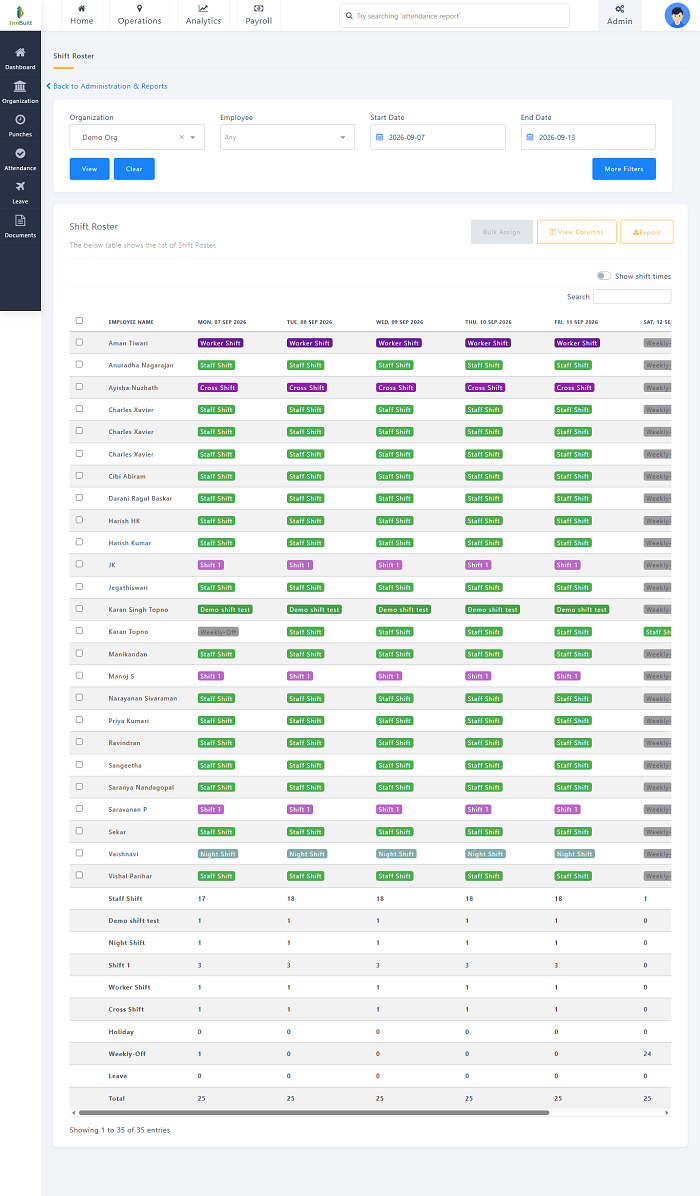
A reliable shift-handover process starts with a clear work schedule. Warehouse managers should know which employees are working, which responsibilities they cover, and when the incoming team is expected to take over.
Depending on operational needs, warehouses may use morning, evening, and night shifts. Distribution centres with high order volumes may also introduce overlapping shifts to support dispatch peaks and inventory transfers.
Recommended shift planning practices
- Define start and end times for each warehouse shift.
- Assign employees to specific zones, functions, and supervisors.
- Identify the employees responsible for receiving, picking, packing, loading, and dispatch.
- Schedule handoff periods so outgoing and incoming teams can exchange information.
- Account for approved breaks and weekly rest periods.
- Maintain a record of planned absences and replacement staff.
- Review staffing requirements during seasonal demand peaks and major delivery periods.
Warehouse managers should publish schedules in advance and communicate changes through an approved system.
A digital workforce scheduling platform can help supervisors identify understaffed shifts, avoid conflicting assignments, and compare scheduled hours with actual attendance.
2. Establish a Standard Shift-Handover Checklist
A formal handover checklist ensures that outgoing employees communicate important operational information before leaving the warehouse.
Without a consistent procedure, the incoming team may not know which orders remain incomplete, which deliveries are delayed, or whether any stock discrepancies require investigation.
What should a warehouse handover include?
| Handover area | Information to record |
|---|---|
| Receiving | Pending inbound deliveries and unloaded goods |
| Inventory | Stock discrepancies, damaged items, and location issues |
| Picking and packing | Orders awaiting completion or quality checks |
| Dispatch | Pending shipments, vehicle loading status, and delivery deadlines |
| Equipment | Forklift, conveyor, scanner, and machinery issues |
| Safety | Hazards, incidents, restricted areas, and maintenance concerns |
| Staffing | Absences, replacements, and reassigned employees |
| Outstanding tasks | Task owner, priority, and expected completion time |
The outgoing supervisor should confirm that critical issues have been communicated and acknowledged by the incoming supervisor.
For high-volume warehouses, handover records can be maintained through warehouse management software, digital forms, or a shared operational dashboard.
3. Use Overlapping Shifts for Critical Handoffs
When the warehouse handles continuous operations, scheduling a short overlap between outgoing and incoming teams can reduce information gaps.
For example, a warehouse may schedule the incoming supervisor to arrive before the outgoing supervisor’s scheduled departure. During the overlap, both supervisors can review pending orders, equipment issues, loading priorities, and staffing requirements.
The overlap should have a defined purpose and duration rather than becoming an informal extension of every employee’s working day.
How to manage overlap time
- Identify the operational tasks that require a direct handover.
- Decide which roles need to overlap, such as supervisors, dispatch coordinators, or inventory controllers.
- Schedule the overlap in advance.
- Record actual attendance and work performed.
- Determine whether the overlap creates additional working time for an employee.
- Apply the relevant overtime and payroll rules where additional hours are payable.
Important: Handover work is still work. Employers should not automatically treat pre-shift briefings, mandatory handovers, or post-shift reporting as unpaid time simply because those activities are labelled as administrative tasks.
4. Record Actual Working Hours at Every Shift
Accurate attendance records allow warehouse managers to compare scheduled hours with the time employees actually spend working.
Paper registers can be useful for backup, but they may be difficult to reconcile when employees change shifts, work at different warehouse zones, or remain late for urgent operational tasks.
Digital attendance systems can capture clock-in and clock-out events and connect them to employee schedules.
Attendance data to capture
- Employee ID and assigned warehouse.
- Scheduled shift start and end times.
- Actual clock-in and clock-out timestamps.
- Approved break periods, where required.
- Shift changes and supervisor authorisations.
- Late arrivals and early departures.
- Additional time worked before or after a shift.
- Corrections to missing or inaccurate punches.
Employers can use access-control terminals, biometric attendance systems, employee cards, or approved mobile attendance tools, depending on the work environment and privacy requirements.
Example: Scheduled versus actual hours
Suppose a warehouse employee is scheduled from 2:00 p.m. to 10:00 p.m. but remains until 10:45 p.m. to finish an urgent loading task.
The attendance record should show the scheduled end time of 10:00 p.m. and the actual clock-out time of 10:45 p.m. The supervisor should then verify whether the additional 45 minutes were spent working and how they should be treated under the applicable working-hours and payroll rules.
The system should not automatically classify every late clock-out as approved overtime. Equally, it should not discard actual working time merely because prior approval was not obtained.
5. Introduce a Formal Extra-Hours Approval Process
Warehouse operations can experience unexpected delays caused by late deliveries, equipment failures, inventory discrepancies, urgent customer orders, or vehicle loading problems.
A formal approval process helps employers distinguish genuine operational requirements from avoidable schedule overruns.
Recommended extra-hours workflow
- Step 1: Identify the operational requirement. The supervisor records why additional work is needed and which employees must stay.
- Step 2: Estimate the additional time. Record the expected duration and tasks to be completed.
- Step 3: Obtain authorisation. The designated manager approves the request through the attendance system, workforce platform, or documented backup process.
- Step 4: Capture actual hours. Employees clock out when their work actually ends.
- Step 5: Verify the work performed. The supervisor compares the approved request with attendance records and completed tasks.
- Step 6: Send verified hours to payroll. Approved and otherwise payable additional hours are categorised using the correct payroll rules.
- Step 7: Review exceptions. Late clock-outs, missing punches, and unauthorised extensions are investigated before payroll is closed.
Employers should maintain a clear policy for emergencies and cases in which prior approval is impractical. A missing approval should trigger a review, not an automatic assumption that no additional work occurred or that the employee forfeits any applicable entitlement.
6. Understand Qatar’s Working-Hours and Overtime Rules
Qatar Labour Law No. 14 of 2004 contains provisions governing working hours and additional work. Warehouse employers should use these provisions as a starting point when designing shift schedules.
Under Article 73, for workers covered by the relevant provision, the maximum ordinary working hours are generally 48 hours per week and eight hours per day. During Ramadan, the limits are generally 36 hours per week and six hours per day.
The article also addresses rest intervals: covered workers should not ordinarily work for more than five consecutive hours without a break, subject to the legal provisions and applicable exceptions.
Article 74 addresses additional hours. For covered workers, actual working hours generally must not exceed ten hours per day, except in specified circumstances involving the prevention of serious loss or a dangerous accident, or the mitigation of their consequences. The provision establishes an overtime premium of at least 25% above the basic wage for additional hours.
The law also provides a separate premium for work between 9 p.m. and 6 a.m., with an exception for shift workers under the provision. Employers must verify the relevant classification rather than assuming that every employee working a night shift automatically qualifies for the same premium.
Article 75 addresses paid weekly rest of at least 24 consecutive hours and compensation arrangements when covered workers are required to work on their weekly rest day.
7. Separate Ordinary Hours, Overtime, and Weekly-Rest Work
Warehouse payroll teams should not treat all additional attendance time as one undifferentiated category.
An employee may work beyond a scheduled shift on an ordinary workday, work at night, or be assigned to work during a weekly rest period. These situations may require different checks and compensation treatment.
Recommended time categories
| Time category | What payroll should verify |
|---|---|
| Ordinary working hours | Scheduled hours and applicable legal limits |
| Additional hours | Actual work performed and the applicable overtime rule |
| Night work | Time worked, employee classification, and applicable premium |
| Weekly-rest work | Rest-day assignment, substitute rest where applicable, and compensation |
| Public-holiday work | Applicable holiday entitlement and compensation rules |
| Handover overlap | Actual time worked by each employee and its correct classification |
The system should use employee category, actual work dates, recorded times, and the applicable policy to determine how hours are classified.
For example, if an employee stays late on an ordinary shift and later works on a weekly rest day, the two entries should remain separate for review. Payroll should apply the appropriate rules to each situation rather than combining them into a single overtime total.
8. Calculate and Reconcile Extra Hours Before Payroll
A reliable reconciliation process connects attendance data, approved overtime requests, supervisor confirmation, and payroll calculations.
The basic process is:
Potential additional time = Actual recorded work time − Applicable ordinary scheduled work time
This is an initial comparison, not a final legal determination of overtime. Payroll must account for working-hour rules, unpaid breaks, shift arrangements, applicable exceptions, and other relevant factors before deciding which hours qualify for additional compensation.
Illustrative example
Assume an employee has a scheduled shift from 2:00 p.m. to 10:00 p.m. and is verified as having worked until 10:45 p.m. after an urgent dispatch delay.
| Record | Time |
|---|---|
| Scheduled shift end | 10:00 p.m. |
| Actual clock-out | 10:45 p.m. |
| Additional recorded time | 45 minutes |
| Supervisor review | Confirmed or pending |
| Payroll treatment | Apply the relevant working-hours and wage rules |
The 45-minute difference should be reviewed against the actual work performed and applicable rules. It should not automatically be treated as 45 minutes of legally payable overtime without the necessary checks.
Payroll reconciliation checklist
- Compare the attendance report with the approved shift schedule.
- Review clock-in and clock-out exceptions.
- Check break records and shift changes.
- Match additional hours with supervisor records.
- Separate ordinary overtime, night work, and weekly-rest work.
- Verify the applicable wage basis and premium.
- Review unusual or repeated extensions.
- Obtain authorisation for payroll adjustments.
- Retain supporting records for audit purposes.
This process reduces payroll errors and helps employees understand how their additional hours were treated.
9. Use Warehouse Management Systems to Support Handoffs
A warehouse management system (WMS) can improve operational continuity by recording the status of inventory, orders, picking activities, packing queues, and dispatch tasks.
When connected with workforce scheduling and attendance systems, these records can help supervisors understand whether a shift extension was linked to a specific operational requirement.
Useful digital capabilities
- Task status tracking: Shows whether orders are pending, in progress, completed, or blocked.
- Inventory exception reporting: Identifies stock shortages, damaged goods, and location discrepancies requiring handover.
- Shift dashboards: Displays staffing levels, open tasks, and upcoming dispatch deadlines.
- Attendance integration: Connects actual working time with scheduled shifts.
- Overtime approval records: Stores the reason for extra hours, approval status, and verification details.
- Payroll export: Sends verified time entries to payroll for processing.
- Audit trails: Records changes to handover notes, attendance entries, and authorisations.
Integration should preserve a distinction between operational evidence and employment-time records. For example, a task completed at 10:40 p.m. may support an investigation into a late departure, but task timestamps alone should not replace reliable attendance records.
10. Manage Handoffs Across Multiple Warehouse Zones
Large distribution centres may operate receiving docks, storage aisles, cold rooms, picking areas, packing stations, and dispatch bays simultaneously.
Each area can have different workload patterns and safety considerations. A generic handover process may not capture the information needed by every team.
Warehouse managers should establish zone-specific handover requirements while maintaining one central record.
Examples of zone-specific handovers
- Receiving: Confirm unloaded quantities, discrepancies, and pending supplier deliveries.
- Storage: Report location changes, stock movements, and equipment restrictions.
- Picking: Identify incomplete orders, urgent picks, and shortages.
- Packing: Report quality checks, packaging shortages, and pending consignments.
- Dispatch: Confirm vehicle assignments, loading status, and shipment deadlines.
- Cold storage: Communicate temperature alerts, access restrictions, and equipment issues.
For each unresolved issue, the handover record should identify the responsible employee or team, the next action, the priority, and the target completion time.
This reduces repeated work and prevents the incoming shift from spending unnecessary time reconstructing the previous shift’s activities.
11. Monitor Fatigue, Rest Periods, and Shift Changes
Repeated overtime and poorly spaced shifts can increase fatigue, reduce concentration, and contribute to warehouse accidents.
Forklift operation, loading activities, high-reach equipment, and manual handling require particular attention to worker alertness and safe staffing.
Employers should monitor not only total overtime but also repeated late finishes, short intervals between shifts, missed rest periods, and excessive consecutive working days.
Practical fatigue-management controls
- Review overtime trends by employee and warehouse zone.
- Avoid scheduling employees for consecutive shifts that leave inadequate recovery time.
- Ensure required breaks and weekly rest are provided.
- Plan relief staff for predictable dispatch peaks.
- Investigate repeated overtime in understaffed departments.
- Train supervisors to identify fatigue-related safety risks.
- Adjust schedules when workload patterns repeatedly require extensions.
A shift schedule should balance operational demand with worker safety and applicable legal requirements. Overtime should not become the default solution to persistent understaffing.
12. Keep Accurate Records for Compliance and Audits
Warehouse employers should retain records that demonstrate how shifts were scheduled, how handoffs were completed, and how additional hours were reviewed and paid.
A consistent recordkeeping approach also helps resolve employee questions about attendance, overtime, and payroll.
Recommended records
- Published shift schedules.
- Employee attendance logs.
- Approved shift swaps and schedule changes.
- Handover checklists and unresolved-task logs.
- Extra-hours requests and approvals.
- Supervisor verification of actual work.
- Break and weekly-rest records.
- Payroll calculations and payment records.
- Corrections to attendance entries.
- Records of employee queries and their resolution.
Article 77 of Qatar Labour Law requires employers covered by the provision to display a schedule showing working hours, rest intervals, and weekly rest arrangements in specified workplace locations and to provide a copy to the relevant department.
Employers should verify the current requirements applicable to their establishment and maintain records in accordance with the relevant legal and internal retention policies.
13. Track Key Performance Indicators for Warehouse Shift Management
Warehouse managers can use operational and workforce metrics to identify recurring handover and overtime problems.
| KPI | What it measures | Operational benefit |
|---|---|---|
| Handover completion rate | Percentage of required handovers completed and acknowledged | Identifies missed handoffs |
| Late clock-out frequency | How often employees finish after scheduled shifts | Highlights workload or scheduling problems |
| Overtime hours by zone | Additional time recorded by warehouse department | Supports staffing decisions |
| Overtime approval compliance | Percentage of extra-hours entries with the required review | Strengthens payroll controls |
| Attendance correction rate | Frequency of missing or amended time records | Identifies data-quality issues |
| Dispatch carryover rate | Orders left incomplete for the next shift | Reveals workflow bottlenecks |
| Handover-related incident rate | Errors or incidents linked to missing information | Supports safety improvements |
| Payroll correction rate | Overtime or attendance entries amended after payroll review | Measures process accuracy |
Review these indicators regularly. If overtime repeatedly occurs in the same area, managers should investigate staffing levels, order cut-off times, equipment reliability, and workload allocation instead of relying solely on overtime approvals.
14. Final Checklist for Qatar Warehouse Employers
Before launching or reviewing a shift-handover and extra-hours process, employers should confirm that:
- Shift start and end times are clearly defined.
- Employees and supervisors know their handover responsibilities.
- Critical operational information is recorded and acknowledged.
- Attendance captures actual clock-in and clock-out times.
- Required handover work is not automatically excluded from working time.
- Extra-hours requests follow a documented approval process.
- Actual time worked is verified even when an approval is missing.
- Ordinary hours, overtime, night work, and weekly-rest work are distinguished.
- Applicable Qatar working-hours and compensation rules are checked.
- Breaks and weekly rest are included in scheduling controls.
- Attendance data is reconciled with payroll before processing.
- Corrections and approvals are retained for audit purposes.
- Overtime trends and operational handover issues are reviewed regularly.
Frequently Asked Questions
1. Why are shift handoffs important in Qatar warehouses?
Shift handoffs transfer information about pending orders, inventory discrepancies, equipment problems, safety issues, and dispatch priorities. A structured process helps the incoming team continue work without delays or repeated investigations.
2. How should warehouses record extra hours when employees stay late?
Employers should record actual clock-out times, identify the reason for the extension, and have a supervisor verify the work performed. Payroll should then apply the relevant working-hours and compensation rules.
3. Does mandatory handover time count as working time?
If employees are required to perform work-related handover activities, employers should not automatically treat that time as unpaid. They should record the actual time and assess its treatment under the applicable legal requirements and employment arrangements.
4. What are the general working-hour limits under Qatar Labour Law?
For workers covered by Article 73 of Qatar Labour Law No. 14 of 2004, ordinary working hours are generally limited to 48 hours per week and eight hours per day, reduced to 36 hours per week and six hours per day during Ramadan. Exceptions and separate rules may apply to particular categories.
5. How is overtime handled under Qatar Labour Law?
Article 74 provides for additional hours subject to applicable limits and requires a premium of at least 25% above the basic wage for covered workers. Different rules may apply to night work, weekly-rest work, and specific employee categories. Employers should confirm the applicable requirements before calculating payment.
6. Can warehouse software automatically calculate overtime?
Software can compare scheduled and actual hours, flag exceptions, store approvals, and transfer verified data to payroll. However, the system must be configured correctly, and payroll should review legal classifications and exceptions before payment.
Conclusion
Qatar warehouses can improve shift continuity and payroll accuracy by combining structured handover checklists, clear shift schedules, reliable attendance tracking, and documented extra-hours reviews.
The most effective process connects operational handovers with workforce records without confusing task completion times with actual working hours. Supervisors should verify additional work, while HR and payroll teams classify hours correctly and apply the relevant legal requirements.
By using digital systems, consistent approval procedures, and regular performance reviews, warehouse operators can reduce missed tasks, improve dispatch continuity, strengthen safety, and make payroll calculations more transparent.
Warehouse handovers and extra hours need a shared record. InnBuilt Shift Management can help Qatar supervisors compare scheduled coverage, actual punches and approved overtime.