Face Attendance vs. Fingerprint Attendance for Workplaces in Saudi Arabia
Face Attendance vs. Fingerprint Attendance for Workplaces in Saudi Arabia
Employee attendance systems have moved from manual registers and paper-based timesheets to biometric and mobile-based solutions. In Saudi Arabia, many organizations use biometric attendance to verify employee identity, record working hours, manage shifts, and connect attendance data with payroll.
Two commonly used biometric methods are face attendance and fingerprint attendance. Both can verify employee identity without requiring traditional ID cards or manual attendance registers, but they differ in enrollment, employee experience, hygiene, hardware requirements, and data-protection considerations.
For Saudi Arabia employers, the privacy aspect is particularly important. Under Saudi Arabia's Personal Data Protection Law (PDPL), biometric data used for identification purposes is classified as sensitive personal data. SDAIA states that sensitive data receives additional safeguards, and if consent is relied upon as the legal basis for processing sensitive data, that consent must be explicit.
This guide explains the differences between face and fingerprint attendance and the factors Saudi Arabia businesses should consider when selecting an attendance system.
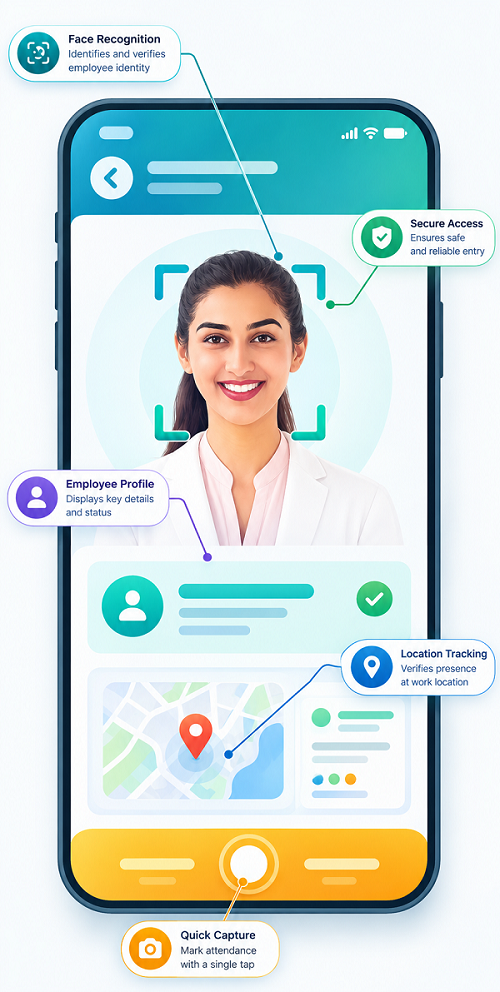
What Is Face Attendance?
Face attendance uses a camera and facial-recognition technology to verify an employee's identity.
An employee generally enrolls their face in the attendance system. During check-in or check-out, the device captures or analyzes facial characteristics and compares them with the enrolled biometric information.
A typical workflow is:
Employee approaches device → Face is detected → Identity is verified → Attendance is recorded
Face attendance can be deployed through:
- Dedicated attendance terminals
- Tablets
- Smartphones
- Cloud attendance applications
- Integrated HR software
- Access-control systems
When facial biometric information is used to identify an employee, the relevant biometric data falls within the PDPL's sensitive-data framework.
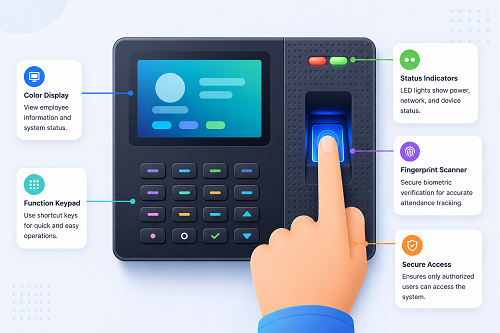
What Is Fingerprint Attendance?
Fingerprint attendance uses a fingerprint scanner to verify an employee.
During enrollment, the employee's fingerprint characteristics are registered by the system. At attendance time, the employee places a finger on the scanner, which compares the presented fingerprint information with the registered biometric information.
A typical workflow is:
Employee places finger on scanner → Fingerprint is read → Identity is verified → Attendance is recorded
Fingerprint systems are commonly used for:
- Office attendance
- Factory attendance
- Warehouse attendance
- Retail locations
- Security operations
- Shift-based workplaces
- Access control
Fingerprint information used for identification is also biometric data and therefore needs to be considered within the applicable Saudi Arabia personal-data protection framework.
Face Attendance vs. Fingerprint Attendance
| Factor | Face Attendance | Fingerprint Attendance |
|---|---|---|
| Identification method | Facial recognition | Fingerprint recognition |
| Employee interaction | Usually touch-free | Requires finger contact |
| Hardware | Camera-based terminal or mobile device | Fingerprint scanner |
| Contact | Generally contactless | Physical contact with scanner |
| Hygiene considerations | Lower physical contact | Requires shared-device contact |
| Mobile deployment | Can work well with supported smartphones | Usually requires compatible fingerprint hardware |
| Outdoor use | Depends on camera and environmental conditions | Depends on scanner and environmental conditions |
| Employee convenience | Employees can generally check in without touching a sensor | Employees must place a finger on the scanner |
| Biometric privacy | Requires protection of facial biometric information | Requires protection of fingerprint biometric information |
| Multi-location use | Can be suitable for mobile and distributed workforces | Often requires installed compatible devices |
| Attendance integration | Can integrate with HR/payroll platforms | Can integrate with HR/payroll platforms |
The appropriate option depends on the organization's workforce, workplace conditions, technology environment, and privacy requirements.
1. Employee Convenience
Face attendance generally requires less physical interaction.
An employee can stand in front of a camera while the system verifies their identity. This can make the process convenient during busy periods.
Fingerprint attendance requires the employee to touch the scanner.
For workplaces where employees frequently enter and leave during shift changes, the interaction model can be an important consideration.
Example
A large warehouse with hundreds of employees starting a shift at the same time may evaluate whether employees can move through a face-recognition terminal efficiently or whether fingerprint devices better suit the site's workflow.
2. Hygiene and Physical Contact
Face attendance is generally contactless.
Fingerprint attendance requires employees to touch the same scanner. This means organizations should consider cleaning and maintaining shared fingerprint devices as part of their workplace procedures.
For businesses that prefer minimizing physical contact with shared attendance equipment, a face-based system may fit the operating environment.
However, hygiene should not be the only selection criterion. Employers should also evaluate biometric-data security, accuracy, system reliability, and privacy controls.
3. Attendance Accuracy
Both technologies can provide automated identity verification, but actual performance depends on the system's hardware, software, configuration, environmental conditions, and enrollment quality.
Face recognition can be affected by factors such as:
- Lighting
- Camera quality
- Camera positioning
- Face coverings
- Changes in appearance
- Poor enrollment images
- Device placement
Fingerprint recognition can be affected by:
- Dirty fingers
- Wet fingers
- Dry skin
- Cuts or injuries
- Damaged fingerprints
- Scanner quality
- Sensor maintenance
Businesses should therefore test the technology under actual workplace conditions instead of relying only on advertised specifications.
4. Suitability for Outdoor Workplaces
Saudi Arabia businesses may operate in construction, logistics, transportation, security, facilities management, and other environments where employees work outdoors.
Face attendance systems deployed outdoors need suitable hardware and installation.
Organizations should evaluate:
- Sunlight exposure
- Camera performance
- Dust
- Temperature
- Device protection
- Network availability
- Power supply
- Weather protection
Fingerprint devices also require appropriate protection from dust, moisture, physical damage, and environmental conditions.
For outdoor or mobile workers, employers may also consider GPS-based mobile attendance instead of relying exclusively on a fixed biometric terminal.
5. Suitability for Construction Sites
Construction businesses often manage employees across multiple projects and locations.
Face attendance can be useful where a camera-equipped terminal or mobile device can verify workers at a project site.
Potential capabilities include:
- Face-based check-in
- GPS verification
- Geofencing
- Project-wise attendance
- Shift management
- Overtime records
- Site-based reporting
- Payroll integration
Fingerprint attendance can also work well at fixed construction-site entrances when a dedicated device is installed and maintained.
The selection depends on whether the company needs fixed-site biometric attendance or mobile and location-based attendance.
6. Suitability for Offices
For conventional office environments, both technologies can be used.
A company might install:
- Face terminal at the entrance
- Fingerprint terminal at reception
- Mobile attendance application
- Integrated access-control system
The decision can depend on employee volume, existing hardware, budget, workplace preferences, and integration requirements.
7. Suitability for Retail and Hospitality
Retail stores, restaurants, hotels, and hospitality businesses frequently manage:
- Multiple shifts
- Part-time workers
- Weekend shifts
- Split shifts
- Late-night operations
- Multiple branches
Face attendance can provide touch-free check-in and can be particularly useful at busy entrances.
Fingerprint attendance can also provide effective fixed-location attendance where employees regularly report to the same location.
For organizations with many branches, centralized cloud attendance management can help HR teams monitor attendance without manually collecting records from each location.
8. Suitability for Hospitals and Healthcare Operations
Hospitals may operate 24 hours a day and manage:
- Doctors
- Nurses
- Technicians
- Administrative staff
- Security personnel
- Support staff
Both face and fingerprint attendance can support shift-based attendance.
However, organizations should evaluate the physical environment and infection-control procedures before deploying shared biometric devices.
A contactless face system may reduce physical interaction with an attendance terminal, while fingerprint systems require shared sensor contact.
9. Multi-Branch Attendance Management
Saudi Arabia businesses may have offices or branches in cities such as Riyadh, Jeddah, Dammam, Khobar, Makkah, Madinah, and Abha.
A centralized attendance platform can connect devices across multiple branches.
For example:
Branch attendance devices → Cloud attendance system → Central HR dashboard → Payroll
Both face and fingerprint devices can potentially participate in such an architecture.
The important question is not simply which biometric technology is used, but how securely the organization collects, transfers, stores, and manages the resulting personal data.
10. Mobile Workforce Considerations
Face attendance can be easier to integrate with mobile attendance applications because smartphones generally contain cameras.
This can make face verification useful for:
- Field employees
- Sales representatives
- Service technicians
- Delivery teams
- Remote employees
- Project-based workers
However, organizations should ensure that location tracking, facial recognition, and other personal-data processing are separately assessed for their applicable legal requirements.
Fingerprint attendance is generally more dependent on dedicated hardware for workplace attendance, although some mobile devices have fingerprint capabilities.
11. Data Privacy Under Saudi Arabia's PDPL
This is one of the most important differences to consider from a compliance perspective: both face and fingerprint identification involve biometric data.
SDAIA's official guidance identifies biometric data used for identification as sensitive data under the PDPL.
Therefore, an employer should not treat face attendance as the only biometric technology requiring privacy controls.
The same principle applies to fingerprint attendance when fingerprint data is used to identify employees.
Organizations should consider:
- Purpose of collection
- Applicable legal basis
- Employee privacy notice
- Data minimization
- Access control
- Security safeguards
- Retention
- Deletion
- Vendor access
- Cross-border processing
- Employee rights
- Incident response
The PDPL requires controllers to comply with applicable requirements when processing personal data, while sensitive data has additional requirements.
12. Consent Considerations
If an organization relies on consent as the legal basis for processing biometric sensitive data, the Implementing Regulations require consent to be explicit. The Regulations also require consent to be appropriately documented and processing purposes to be clear and specific.
HR teams should therefore avoid treating a generic employee acknowledgment as automatically sufficient.
Before deploying either technology, organizations should document:
- What biometric data is collected
- Why it is collected
- How it is used
- How long it is retained
- Who can access it
- Whether it is shared with vendors
- Whether it is transferred outside Saudi Arabia
- What employee rights apply
The exact legal basis should be assessed according to the organization's circumstances and the current PDPL framework.
13. Security Requirements
Whether an organization chooses face or fingerprint attendance, biometric information should be protected throughout its lifecycle.
Important controls include:
Encryption
Protect biometric information during storage and transmission.
Access controls
Restrict access to authorized HR, IT, and system administrators.
Authentication
Use strong authentication for administrators and privileged users.
Logging
Maintain appropriate logs of administrative and security activities.
Vendor controls
Assess third-party attendance providers and processors.
Retention controls
Avoid keeping biometric information longer than necessary or legally permitted.
Secure deletion
Have procedures for deleting biometric information when applicable retention requirements end.
SDAIA guidance states that sensitive data requires additional safeguards because unauthorized access can cause serious harm to individuals.
14. Face Attendance vs. Fingerprint Attendance for Payroll
Neither face nor fingerprint technology directly determines salary.
Instead, the biometric system records attendance information that can then be processed by payroll software.
For example:
Biometric check-in/out → Working hours → Overtime → Leave → Payroll calculation
An integrated payroll platform can use attendance information to calculate:
- Regular working hours
- Overtime
- Late arrivals
- Early departures
- Absences
- Shift allowances
- Attendance-based deductions
This can reduce manual data entry and improve payroll processing.
15. Cost Considerations
The total cost of an attendance system includes more than the initial device price.
Businesses should consider:
- Hardware
- Software subscriptions
- Installation
- Network infrastructure
- Cloud hosting
- Maintenance
- Device replacement
- Support
- Employee enrollment
- Security controls
- Payroll integration
- Multi-branch connectivity
Fingerprint systems may require dedicated scanners at each location.
Face attendance may use dedicated terminals or, depending on the platform, supported smartphones and tablets.
Organizations should compare the total cost of ownership rather than only the initial hardware cost.
16. Which System Is Suitable for Different Workplaces?
The following framework can help organizations identify relevant considerations without treating one technology as universally suitable.
| Workplace | Face Attendance Considerations | Fingerprint Attendance Considerations |
|---|---|---|
| Corporate office | Contactless entry and convenient verification | Simple fixed-location verification |
| Factory | Useful for high-volume entry points | Suitable where fixed scanners are practical |
| Construction site | Useful with suitable site/mobile setup | Suitable where a fixed protected terminal exists |
| Retail | Useful for quick branch check-ins | Suitable for fixed store locations |
| Restaurant | Contactless verification | Suitable where shared-device procedures are manageable |
| Hotel | Useful for multiple shifts | Suitable for fixed staff entrances |
| Hospital | Contactless operation may be useful | Requires attention to shared-device hygiene |
| Security agency | Useful for distributed operations | Useful at fixed posts |
| Field workforce | Potentially suitable with mobile applications | More dependent on dedicated hardware |
| Multiple branches | Centralized face devices can be connected | Centralized fingerprint devices can be connected |
17. Questions to Ask Before Choosing
Before purchasing a biometric attendance system in Saudi Arabia, HR and IT teams should ask:
Technology
- How accurately does the system identify employees?
- What environmental conditions affect performance?
- Does it work offline?
- How quickly does it verify employees?
Security
- Is biometric data encrypted?
- Who can access it?
- Are access logs available?
- How are administrator accounts protected?
Privacy
- What biometric information is stored?
- Is the original image retained?
- Is a biometric template used?
- Where is the data stored?
- How long is it retained?
- How is it deleted?
Compliance
- What is the applicable legal basis?
- If consent is relied upon, how is explicit consent obtained and documented?
- Is there a privacy notice?
- Are vendor and processor responsibilities documented?
- Are cross-border transfers assessed?
Integration
- Does it integrate with payroll?
- Does it support shift management?
- Can it manage multiple branches?
- Does it support overtime?
- Does it support leave management?
- Can HR export attendance reports?
18. Best Practices for Saudi Arabia Employers
Businesses implementing either technology should consider the following practices:
- Define the attendance purpose clearly.
- Identify the applicable legal basis before collecting biometric information.
- Provide employees with appropriate privacy information.
- Collect only information necessary for the defined purpose.
- Protect biometric information with appropriate technical safeguards.
- Restrict access to authorized personnel.
- Assess attendance vendors and processors.
- Review where biometric information is stored and processed.
- Assess international transfers where applicable.
- Establish a documented retention and deletion process.
- Train HR and IT administrators.
- Maintain an incident-response procedure.
- Review the system periodically as technology and legal requirements change.
Face Attendance vs. Fingerprint Attendance: Key Takeaways
The difference between the two systems is primarily the method used to verify employee identity.
Face attendance offers contactless verification and can be useful for mobile, distributed, and high-volume workplaces when the technology is appropriately configured.
Fingerprint attendance provides established biometric verification and can be practical for fixed workplace locations with suitable devices and maintenance procedures.
From a Saudi Arabia privacy perspective, employers should not assume that one is automatically less regulated than the other. When biometric information is used for identification, SDAIA's PDPL guidance treats biometric identifying data as sensitive data.
The decision should therefore consider the organization's operational requirements alongside privacy, security, legal basis, employee transparency, data retention, vendor management, and system integration.
Conclusion
Face attendance and fingerprint attendance can both help Saudi Arabia businesses automate employee attendance and connect working-hour records with payroll systems.
Face attendance provides a contactless approach that can be particularly useful for offices, retail, hospitality, construction projects, and distributed workforces. Fingerprint attendance can be practical for fixed locations where employees regularly use dedicated attendance terminals.
For either approach, Saudi Arabia employers should give particular attention to biometric-data protection. SDAIA's official guidance confirms that biometric data used for identification is sensitive data under the PDPL, with additional safeguards applying to its processing.
A well-designed attendance solution should therefore combine reliable biometric verification, secure data processing, appropriate privacy controls, centralized attendance management, and payroll integration.
Workplaces in Saudi Arabia can choose between InnBuilt Face Attendance Software and supported fingerprint inputs based on workforce size, location, hygiene, mobility, and infrastructure. Both methods can feed centralised attendance and payroll records.