Field Workforce Tracking for Construction, Logistics, and Remote Worksites in Saudi Arabia
Field Workforce Tracking for Construction, Logistics, and Remote Worksites in Saudi Arabia
Managing employees who work outside traditional offices can be challenging for businesses across Saudi Arabia. Construction workers may be distributed across project sites, logistics teams may travel between warehouses and delivery locations, and remote-site employees may work in industrial, infrastructure, or isolated locations.
Traditional attendance registers and manual reporting often provide limited visibility into where employees are working, when they arrive, and whether assigned tasks have been completed.
Field workforce tracking software can help businesses manage these challenges by combining GPS, mobile attendance, geo-fencing, shift management, task assignment, and real-time workforce reporting.
For organizations operating across Riyadh, Jeddah, Dammam, Khobar, Jubail, Mecca, Medina, and other areas of Saudi Arabia, a centralized field workforce system can make it easier to coordinate employees across multiple locations.
At the same time, employee location information needs to be handled carefully. Saudi Arabia's Personal Data Protection Law (PDPL) applies to relevant personal-data processing, so businesses should consider purpose, transparency, data minimization, security, retention, access, and applicable requirements for data transfers outside the Kingdom.
What Is Field Workforce Tracking?
Field workforce tracking is the use of digital tools to manage employees who work away from a fixed office.
Depending on the system, businesses may be able to manage:
- Employee location
- Field attendance
- Check-in and check-out
- Worksite assignments
- Shifts
- Customer visits
- Project assignments
- Service jobs
- Task status
- Travel activity
- Geo-fenced locations
- Overtime
- Leave
- Workforce reports
A typical field workforce platform connects the employee's mobile device with a centralized management dashboard.
For example:
Employee → Assigned Site → Mobile Check-in → Location Verification → Work Assignment → Task Completion → Check-out
This creates a digital record of field activity that can be used by HR, operations, project managers, and supervisors.
Why Field Workforce Tracking Is Important in Saudi Arabia
Saudi Arabia businesses often manage workforces spread across large geographic areas.
A construction company may have employees working at several projects simultaneously. A logistics company may operate warehouses, transportation teams, and delivery personnel across multiple cities. An industrial organization may have employees working at remote facilities far from its main office.
Without a centralized system, managers may rely on:
- Paper attendance registers
- Phone calls
- WhatsApp updates
- Excel spreadsheets
- Manual site reports
- Employee-submitted location information
These processes can make it difficult to obtain timely and consistent information.
Field workforce tracking can centralize this information and give authorized managers a clearer view of workforce activity.
Field Workforce Tracking for Construction Companies
Construction is one of the most important use cases for field workforce tracking.
A construction business may operate multiple projects at the same time, with employees moving between sites according to project requirements.
For example, a company may have:
- Residential construction projects
- Commercial buildings
- Infrastructure projects
- Road projects
- Industrial construction
- Maintenance projects
- Large-scale development sites
Each location may have different employees, shifts, supervisors, and attendance requirements.
Tracking Employees at Construction Sites
A construction company can create a digital profile for each project site.
The profile can include:
- Project name
- Site location
- Geo-fence
- Assigned employees
- Supervisors
- Working hours
- Shifts
- Attendance rules
When an employee reaches the approved site, the mobile attendance system can verify the location before recording attendance.
This provides a stronger connection between:
Employee + Attendance + Project + Location
Managing Multiple Construction Projects
Consider a construction company with projects in Riyadh, Jeddah, and Dammam.
Instead of maintaining separate attendance registers for each site, the company can use a centralized system.
| Location | Example Workforce |
|---|---|
| Riyadh | Civil and electrical teams |
| Jeddah | Construction and maintenance teams |
| Dammam | Engineering and site teams |
| Jubail | Industrial project workforce |
| Mecca | Project and facility teams |
Managers can filter reports by project, employee, location, shift, or date.
Construction Site Geo-fencing
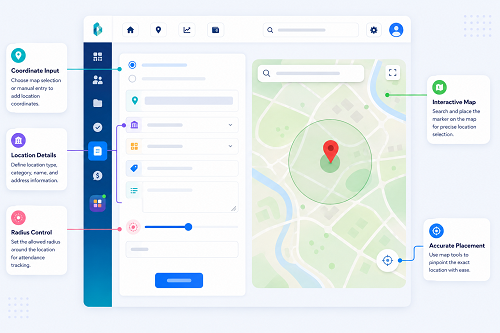
Geo-fencing can create virtual boundaries around construction sites.
For example:
Project Site → 300-metre geo-fence → Authorized employee check-in
If the employee is outside the configured boundary, the application can prevent or flag the attendance event according to company policy.
This can help reduce inaccurate location reporting.
However, businesses should configure boundaries according to the physical characteristics of each site. A large construction project may require a different geo-fence configuration from a small office.
Construction Shift Management
Construction sites may operate:
- Day shifts
- Night shifts
- Extended shifts
- Rotational shifts
- Weekend shifts
- Project-specific schedules
Field workforce software can connect each employee with the appropriate shift and worksite.
Managers can then compare scheduled attendance with actual attendance.
Overtime Management
Construction projects can involve extended working hours.
A field workforce system can record:
- Scheduled hours
- Actual check-in
- Actual check-out
- Breaks
- Overtime
- Approved overtime
The resulting attendance information can be used as an input into payroll processes, subject to company rules and applicable employment requirements.
Field Workforce Tracking for Logistics Companies
Logistics businesses face a different set of workforce-management challenges.
Employees may work across:
- Warehouses
- Distribution centers
- Loading areas
- Delivery routes
- Customer locations
- Transportation hubs
- Regional branches
Drivers, warehouse workers, dispatch teams, delivery personnel, and supervisors may all require different workflows.
Warehouse Workforce Tracking
Businesses can create geo-fences around warehouses and distribution facilities.
Employees can use mobile attendance to record:
- Check-in
- Check-out
- Shift
- Location
- Breaks
- Overtime
Managers can then view attendance information centrally.
Delivery Workforce Tracking
Delivery employees may spend most of their working day outside the warehouse.
A mobile application can connect field activity with:
Employee → Delivery Assignment → Customer Location → Arrival → Delivery → Completion
Depending on the organization's operational model, location information can help dispatch teams coordinate delivery activity.
Dispatch and Workforce Allocation
Live location information can help logistics managers understand which employees are available for field assignments.
For example, a dispatcher receives an urgent delivery request.
The manager can review:
- Available employees
- Current assignments
- Relevant location information
- Shift status
- Delivery workload
The manager can then assign the job according to operational requirements.
Field Workforce Tracking for Remote Worksites
Some Saudi Arabia businesses operate at locations far from major urban centers.
Examples include:
- Oil and gas support sites
- Industrial facilities
- Infrastructure projects
- Remote construction projects
- Mining-related operations
- Utility projects
- Large-scale engineering projects
- Maintenance locations
These environments can make traditional attendance management particularly difficult.
Remote Site Attendance
A remote-site employee may not have access to a conventional attendance machine.
A mobile workforce application can provide an alternative by allowing authorized employees to record attendance through their mobile devices.
Depending on the system, it may combine:
- GPS
- Geo-fencing
- Mobile attendance
- Face verification
- Device authentication
- Shift information
This can create a digital attendance record even when employees are working far from a corporate office.
Managing Remote Worksite Shifts
Remote sites may operate on different schedules from head offices.
For example:
- Remote Site A: 6:00 AM–6:00 PM
- Remote Site B: 7:00 AM–7:00 PM
- Remote Site C: Night shift
A field workforce system can associate employees with the appropriate site and shift.
This can help managers avoid applying a single attendance schedule to every work location.
GPS Tracking and Geo-fencing
GPS and geo-fencing are important technologies in field workforce management, but they serve different purposes.
GPS
GPS provides information about the geographic location of a device.
Geo-fencing
Geo-fencing creates a virtual geographic boundary around an approved location.
For example:
GPS: Employee is at a particular location.
Geo-fence: Employee is inside the approved construction site.
Businesses can use both technologies together.
Should Companies Track Employees Continuously?
Not necessarily.
The appropriate tracking model depends on the business purpose.
A company may need continuous or periodic location information for certain operational activities, while another organization may only need location verification during check-in, check-out, or specific field assignments.
Businesses should consider whether the amount and frequency of location data collected are necessary for the intended purpose.
This is particularly important when employee location data is being processed under a privacy framework.
Field Workforce Tracking and Saudi Arabia PDPL
Employee location data can be associated with an identifiable employee and therefore may constitute personal data under Saudi Arabia's PDPL.
The law establishes requirements governing personal-data processing, while SDAIA provides regulations and guidance for organizations subject to the framework.
Businesses implementing field workforce tracking should consider the following areas.
1. Define the Purpose
The organization should clearly establish why employee location data is being collected.
Possible purposes include:
- Field attendance
- Worksite verification
- Service dispatch
- Delivery management
- Customer visit management
- Workforce coordination
- Safety-related operational processes
The tracking purpose should be documented rather than collecting location information without a defined business need.
2. Collect Only Necessary Data
Businesses should consider what information is actually required.
For example, if location verification at the beginning and end of a shift is sufficient for a particular process, continuous tracking may not be necessary.
Data minimization is also relevant when personal data is transferred outside Saudi Arabia. The PDPL's transfer provisions require transfers to be limited to the minimum amount needed for the applicable purpose.
3. Inform Employees
Employees should receive appropriate information about the processing of their personal data.
A workforce tracking policy can explain:
- What information is collected
- Why it is collected
- When tracking occurs
- Who can access the information
- How long information is retained
- How employees can exercise applicable rights
4. Restrict Access
Location information should not automatically be available to every employee.
Access can be assigned according to job responsibility.
For example:
- Site Supervisor: Assigned site employees
- Operations Manager: Regional field teams
- HR: Attendance-related information
- System Administrator: Technical administration
5. Protect Location Data
Businesses should implement appropriate security measures, such as:
- Strong authentication
- Role-based permissions
- Encryption
- Secure mobile applications
- Secure APIs
- Audit logs
- Access monitoring
- Secure backups
- Controlled exports
- Secure deletion
6. Define Retention Periods
Businesses should determine how long field location and attendance information needs to be retained.
Retention should be linked to legitimate business, legal, contractual, payroll, or reporting requirements.
Old information should not simply remain in the system indefinitely without a defined reason.
Cloud-Based Field Workforce Tracking
Many workforce management platforms are cloud-based.
This can be useful for companies with employees spread across Saudi Arabia because managers can access workforce information from a centralized platform.
Before selecting a cloud provider, businesses should review:
- Hosting location
- Data-storage arrangements
- Data-processing arrangements
- Sub-processors
- Security measures
- Retention policies
- Data deletion
- Backup procedures
- International data transfers
Saudi Arabia has specific rules governing transfers of personal data outside the Kingdom. The applicable regulation requires controllers to consider matters including purpose, legal basis, safeguards, geographic scope, data minimization, and potential risks in specified transfer scenarios.
Live Workforce Dashboards
A centralized dashboard can help managers monitor distributed teams.
Depending on the software, the dashboard may show:
- Employees currently working
- Employees checked in
- Employees absent
- Assigned worksites
- Current field assignments
- Service jobs
- Delivery assignments
- Late employees
- Overtime
- Location-based exceptions
Managers can filter the information by:
- City
- Branch
- Project
- Site
- Department
- Employee
- Supervisor
- Shift
This can be especially useful for businesses with hundreds or thousands of field employees.
Attendance and Payroll Integration
Field workforce tracking becomes more valuable when connected with attendance and payroll systems.
The workflow can be:
Field Check-in → Location Verification → Attendance Record → Shift Calculation → Overtime → Payroll Input
For example, a construction employee works at a remote project site.
The system records the employee's approved check-in and check-out times. Attendance data is then transferred to payroll according to the company's configured rules.
This can reduce manual data entry and help payroll teams work from more consistent attendance records.
Field Workforce Tracking for Employee Safety
Location technology can also support certain operational safety processes.
For remote or isolated worksites, authorized managers may need to know which employees are assigned to a particular location.
During an operational incident, workforce information can help supervisors determine which employees are associated with a worksite.
However, businesses should clearly distinguish legitimate safety use cases from general employee surveillance and define appropriate access and retention controls.
Common Challenges With Field Workforce Tracking
Technology alone does not solve every field workforce problem.
Businesses may encounter:
Poor Mobile Connectivity
Remote locations may have weak network coverage.
GPS Accuracy Issues
Buildings, terrain, device settings, or environmental conditions can affect location accuracy.
Battery Consumption
Frequent location updates can consume mobile-device battery power.
Incorrect Geo-fence Configuration
A boundary that is too small can prevent legitimate check-ins.
Employee Resistance
Employees may have concerns about privacy or continuous monitoring.
Data Overcollection
Collecting more location information than necessary can create unnecessary privacy and security risks.
Multiple Worksites
Employees may move between projects, requiring accurate assignment management.
A good implementation should address these challenges before deployment.
Best Practices for Field Workforce Tracking
Saudi Arabia businesses can improve field workforce management by following practical steps.
1. Map All Worksites
Create an accurate list of:
- Construction projects
- Warehouses
- Customer locations
- Service sites
- Remote facilities
- Branches
2. Assign Employees Correctly
Each employee should have an accurate:
- Worksite
- Department
- Supervisor
- Shift
- Job role
3. Configure Geo-fences Carefully
Use appropriate boundaries based on the physical characteristics of each location.
4. Establish Tracking Rules
Clearly define when location information is collected.
5. Connect Tracking With Workflows
Integrate location with:
- Attendance
- Tasks
- Service jobs
- Delivery assignments
- Project management
6. Train Employees
Employees should understand:
- How to use the application
- When they need to check in
- How GPS works
- What information is collected
- How to report technical issues
7. Review Privacy and Security
Regularly review the organization's processing activities, access permissions, retention policies, vendors, and security controls.
8. Monitor Exceptions
Create clear processes for:
- Missed check-ins
- GPS failures
- Incorrect locations
- Device problems
- Employee transfers
- Site changes
Example: Construction Company in Riyadh
A construction company operates five projects in Riyadh.
Each project has:
- 100–300 workers
- Multiple supervisors
- Different shifts
- Different worksite locations
The company creates a geo-fence for each project and assigns workers to their respective sites.
Employees use a mobile application to record attendance.
Managers can then review:
Project → Employee → Shift → Check-in → Check-out → Attendance
If an employee transfers to another project, the administrator updates the employee's assignment.
The result is a centralized attendance and workforce-management process across all five sites.
Example: Logistics Company in Dammam
A logistics company operates warehouses and delivery teams in Dammam.
Warehouse employees check in at the warehouse geo-fence.
Delivery employees use a mobile application for field assignments.
The operations team can view:
- Warehouse attendance
- Delivery assignments
- Employee availability
- Field activity
- Completed jobs
This allows managers to coordinate warehouse and field operations through one system.
Example: Remote Industrial Worksite
An industrial company has employees working at a remote facility.
The workforce system assigns employees to the site and their respective shifts.
Employees use mobile attendance to record their workday.
Managers can review:
- Site attendance
- Shift status
- Employee assignments
- Overtime
- Exceptions
The company can also use the system to maintain a centralized workforce record without requiring a traditional attendance machine at the remote location.
How to Choose Field Workforce Tracking Software
Before selecting a platform, Saudi Arabia businesses should evaluate:
GPS Capability
Can the platform support the required location model?
Geo-fencing
Can different boundaries be created for different worksites?
Mobile Attendance
Can employees record attendance from approved locations?
Offline Capability
Can the system handle temporary connectivity problems?
Shift Management
Can different work schedules be configured?
Task Management
Can field assignments be created and monitored?
Real-Time Dashboard
Can authorized managers obtain timely operational information?
Payroll Integration
Can approved attendance data be integrated with payroll?
Reporting
Can reports be filtered by employee, site, project, city, and date?
Security
Does the provider explain its technical and organizational security controls?
Privacy
Can administrators configure tracking, access, retention, and other controls according to the organization's requirements?
Cloud and Data Transfers
Does the provider clearly explain where data is stored and whether personal data is transferred outside Saudi Arabia?
Conclusion
Field workforce tracking can help Saudi Arabia businesses manage employees across construction projects, logistics operations, remote facilities, service locations, and other non-office environments.
For construction companies, it can connect workers with projects, sites, shifts, attendance, and overtime. For logistics companies, it can support warehouse attendance, delivery operations, workforce allocation, and field assignments. For remote worksites, it can provide mobile attendance and centralized workforce visibility where conventional attendance systems may not be practical.
The most effective systems combine GPS, geo-fencing, mobile attendance, shift management, task assignment, workforce dashboards, and payroll integration rather than treating employee tracking as an isolated feature.
At the same time, location tracking should be designed around a clearly defined business purpose. Saudi Arabia's PDPL framework requires organizations to consider how personal data is collected, processed, protected, retained, disclosed, and, where applicable, transferred outside the Kingdom. SDAIA's official knowledge center provides the PDPL, implementing regulations, transfer regulations, and related guidelines for controllers and processors.
A well-designed field workforce system can therefore help businesses improve operational visibility while maintaining appropriate controls around employee location information.
Construction, logistics, and remote worksites can be monitored through InnBuilt Field Management Software using mobile attendance, geo-fencing, job assignments, and location-based reports. Verified field activity improves deployment decisions and payroll accuracy.