How to Manage Friday Rest Days and Rotational Shifts in Saudi Arabia
How to Manage Friday Rest Days and Rotational Shifts in Saudi Arabia
Managing employees across rotational shifts requires careful planning, especially for businesses that operate seven days a week or provide continuous services. In Saudi Arabia, employers must organize weekly rest days, working hours, shift schedules, breaks, and attendance in accordance with applicable labor requirements.
Friday is generally the weekly rest day under Article 104 of the Saudi Arabia Labor Law. However, employers may substitute Friday with another day of the week for some workers after notifying the competent Labor Office, while enabling employees to perform their religious obligations. The weekly rest period must be paid and must be at least 24 consecutive hours.
For businesses such as hospitals, security companies, hotels, restaurants, retail stores, logistics companies, manufacturing facilities, and customer-support operations, rotational scheduling can help maintain business continuity while providing employees with their required weekly rest.
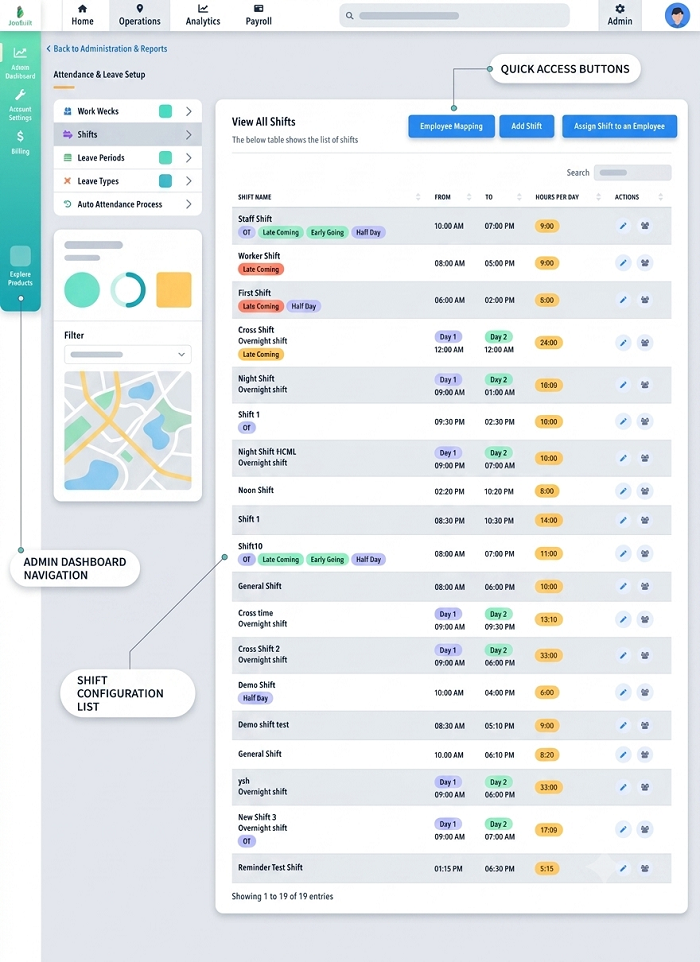
What Is a Rotational Shift?
A rotational shift is a work schedule in which employees move between different shifts according to a planned roster.
For example, employees may rotate between:
- Morning shifts
- Afternoon shifts
- Evening shifts
- Night shifts
- Weekend shifts
- Friday coverage shifts
A company operating 24/7 may divide employees into several teams and rotate their schedules over a defined period.
The objective is to maintain continuous staffing without assigning employees to excessive or poorly coordinated working hours.
What Are the Rules for Friday Rest Days in Saudi Arabia?
Under Article 104, Friday is the weekly rest day for workers. An employer may, after notifying the competent Labor Office, substitute Friday with another day of the week for some workers. The employer must also allow workers to perform their religious obligations.
The weekly rest day:
- Must be fully paid.
- Must be at least 24 consecutive hours.
- Cannot simply be replaced with a cash payment.
- May be scheduled on another day for certain workers when the applicable requirements are met.
This arrangement is particularly relevant to businesses that cannot close on Fridays.
Can Employees Have a Different Weekly Rest Day?
Yes. Businesses that need employees to work on Friday can arrange another weekly rest day for some employees, subject to the applicable notification and other requirements.
For example:
| Employee | Work on Friday | Weekly Rest |
|---|---|---|
| Employee A | No | Friday |
| Employee B | Yes | Saturday |
| Employee C | Yes | Sunday |
| Employee D | No | Friday |
This type of roster allows the business to remain operational while giving employees a weekly rest period.
HR should document the applicable schedule and communicate it clearly to employees.
How to Schedule Rotational Shifts
A good rotational schedule should start with the organization's operating requirements.
Step 1: Identify Business Operating Hours
Determine whether the business operates:
- 8 hours per day
- 16 hours per day
- 24 hours per day
- Seven days per week
- Weekends and public holidays
Next, determine the minimum number of employees required for each period.
For example:
| Shift | Time | Required Employees |
|---|---|---|
| Morning | 6:00 AM–2:00 PM | 10 |
| Afternoon | 2:00 PM–10:00 PM | 10 |
| Night | 10:00 PM–6:00 AM | 6 |
The actual schedule should then be built around applicable working-hour and rest requirements.
Step 2: Create Employee Teams
Divide employees into scheduling groups.
For example:
- Team A – Morning
- Team B – Afternoon
- Team C – Night
- Team D – Relief/backup
Teams can rotate according to a weekly or longer scheduling cycle.
A structured team system makes it easier to manage absences, replacements, and weekly rest days.
Step 3: Assign Friday Coverage
Businesses that operate on Fridays should identify which employees are required to work that day.
For example:
Week 1
- Team A: Friday off
- Team B: Friday working
- Team C: Friday working
Week 2
- Team A: Friday working
- Team B: Friday off
- Team C: Friday working
The weekly rest day can therefore be distributed across the workforce instead of requiring every employee to have Friday off.
Where Friday is replaced by another rest day, employers should follow the applicable notification and religious-obligation requirements.
Step 4: Ensure at Least 24 Consecutive Hours of Weekly Rest
The weekly rest day must not be treated as simply a few hours away from work.
Saudi Arabia Labor Law provides that the weekly rest period must be at least 24 consecutive hours and fully paid.
When designing rotational shifts, HR should therefore examine the actual time between the end of one shift and the beginning of the next.
This is especially important when employees move from night shifts to morning shifts.
Step 5: Plan Shift Rotations Carefully
Rotating employees too quickly between shifts can create scheduling difficulties.
For example, moving an employee directly from Night shift to Morning shift may provide insufficient recovery time.
Instead, businesses can use structured rotation patterns.
Example of a Four-Week Rotation
| Week | Employee Group | Shift |
|---|---|---|
| Week 1 | Team A | Morning |
| Week 2 | Team A | Afternoon |
| Week 3 | Team A | Evening |
| Week 4 | Team A | Night |
The actual rotation should be designed according to the nature of the business and applicable working-hour and rest requirements.
Saudi Arabia Working-Hour Limits and Shift Work
The Saudi Arabia Labor Law generally provides that a worker should not be employed for more than 8 actual working hours per day when the daily standard is used, or 48 hours per week when the weekly standard is used.
There are specific provisions for establishments where the nature of work requires shift work. With Ministry approval, working hours may exceed the ordinary daily or weekly limits in certain circumstances, provided the average working hours over a period of three weeks or less does not exceed the applicable average limits.
Employers should therefore avoid assuming that every shift-based business can automatically schedule longer shifts. The specific legal requirements and approvals applicable to the establishment should be checked before implementing such schedules.
Managing Breaks During Rotational Shifts
Saudi Arabia Labor Law requires working hours and rest periods to be organized so that a worker does not generally work more than five consecutive hours without a break for rest, prayer, and meals of at least 30 minutes. The worker should also not remain at the workplace for more than 12 hours in a single day under the applicable general rule.
Break periods for rest, prayer, and meals are generally not included in actual working hours, and the worker is not under the employer's authority during these periods.
A shift management system should therefore distinguish between:
- Scheduled shift duration
- Actual working hours
- Break duration
- Overtime
- Attendance exceptions
Friday Rest Days for 24/7 Businesses
Hospitals, security agencies, hotels, logistics operations, call centers, and other continuous operations may need employees on duty every day of the week.
Instead of closing on Friday, these businesses can distribute weekly rest days across different employees.
For example:
| Employee | Thursday | Friday | Saturday |
|---|---|---|---|
| A | Working | Rest | Working |
| B | Working | Working | Rest |
| C | Rest | Working | Working |
| D | Working | Rest | Working |
This allows the operation to continue while employees receive scheduled weekly rest.
Managing Friday Shifts in Retail
Retail businesses often remain open on Fridays.
A retail company could create separate teams for:
- Store opening
- Daytime sales
- Evening sales
- Closing
- Inventory
- Security
Friday coverage can then be distributed among employees, with their weekly rest days scheduled on other days where applicable.
The system should clearly identify who is working on Friday and who has Friday as their weekly rest day.
Friday Scheduling for Restaurants and Hospitality
Restaurants and hotels frequently operate during weekends and Fridays.
A restaurant could use:
- Breakfast team
- Lunch team
- Evening team
- Closing team
- Kitchen preparation team
Managers can then create weekly rosters based on expected demand.
A digital shift system can also help managers identify whether enough employees are scheduled for each department.
Friday Scheduling for Hospitals
Hospitals require continuous coverage for departments such as:
- Emergency
- Nursing
- Security
- Pharmacy
- Laboratory
- Facilities
- Patient support
Weekly rest days should be incorporated into the overall staffing plan rather than handled manually after the roster is created.
This helps prevent unexpected understaffing.
Friday Scheduling for Security Companies
Security companies may operate around the clock.
Their scheduling process may include:
- Site assignment
- Shift assignment
- Friday coverage
- Weekly rest
- Relief employees
- Replacement requests
- Attendance verification
Employers should also consider the specific provisions applicable to security guard work because some categories of work have special rules under the labor regulations.
How Attendance Software Helps Manage Friday Rest Days
Attendance software can automatically compare the employee's scheduled shift with actual attendance.
For example:
Scheduled: Saturday rest day
Actual: Employee checked in
The system can flag the attendance record for HR review.
Similarly:
Scheduled: Friday working shift
Actual: No check-in
The system can identify a potential absence.
This creates a direct connection between scheduling and attendance management.
Managing Shift Swaps
Employees may need to exchange shifts because of personal commitments or unexpected circumstances.
A digital workflow can allow employees to:
- View their assigned shift.
- Request a swap.
- Select an eligible colleague.
- Submit the request.
- Obtain manager approval.
- Update the official roster.
- Synchronize the change with attendance.
This reduces the risk of employees informally changing shifts without updating HR records.
Managing Last-Minute Absences
Rotational businesses should maintain backup staffing options.
A workforce management system can help managers identify:
- Available employees
- Employees already scheduled
- Employees on weekly rest
- Employees on leave
- Employees assigned to another location
- Employees with conflicting shifts
This can help managers fill staffing gaps without rebuilding the entire roster.
Overtime and Friday Work
Working on a Friday does not automatically mean that every hour worked should be treated in the same way. The applicable weekly rest arrangements, working-hour standard, overtime provisions, and other circumstances must be considered.
Under Article 107, overtime compensation is generally the hourly wage plus 50% of the basic wage. The law also provides that, where the establishment uses a weekly working-hours standard, hours exceeding that standard are overtime, and hours worked during holidays and official vacations are considered overtime.
HR should therefore review the employee's complete schedule rather than treating every Friday shift as an isolated payroll event.
How Shift Management Software Supports Saudi Arabia Employers
A modern shift management platform can simplify rotational scheduling.
Shift Planning
HR can create:
- Weekly rosters
- Monthly rosters
- Rotational schedules
- Friday coverage schedules
- Night shifts
- Relief shifts
Automated Scheduling
The system can help managers identify scheduling conflicts before publishing a roster.
Employee Self-Service
Employees can access their:
- Shift times
- Weekly rest day
- Work location
- Shift changes
- Leave status
through a web or mobile application.
Attendance Integration
Scheduled hours can be compared with:
- Clock-in time
- Clock-out time
- Late arrivals
- Early departures
- Absences
- Additional working time
Multi-Branch Scheduling
Businesses with locations across Riyadh, Jeddah, Dammam, Makkah, Madinah, and other cities can manage schedules centrally while allowing individual branch managers to manage their teams.
Work Schedule Display Requirements
Employers should clearly communicate working schedules.
HRSD guidance states that employers should keep a schedule in a conspicuous place at the worksite showing work dates, rest periods, weekly rest days, and the start and end times of each shift where shift work is used.
A digital system can supplement this requirement by providing employees with access to their schedules through mobile devices.
Friday Rest Day and Rotational Shift Checklist
Before publishing a roster, HR can check:
- Has each employee received an appropriate weekly rest period?
- Is Friday the employee's scheduled rest day or has another day been designated where applicable?
- Has the required notification been handled where Friday is substituted?
- Are religious obligations being accommodated?
- Does each shift comply with applicable working-hour requirements?
- Are break periods properly scheduled?
- Are night-to-morning transitions reviewed?
- Are shift overlaps sufficient for handovers?
- Are Friday staffing levels adequate?
- Are attendance rules linked to the roster?
- Are overtime calculations reviewed?
- Are employees able to see their schedules?
- Are shift changes approved and documented?
Common Problems With Manual Friday and Rotational Scheduling
Businesses that rely on spreadsheets or paper rosters may encounter:
Conflicting Shifts
An employee may accidentally be assigned to two shifts.
Missing Weekly Rest
Managers may overlook an employee's scheduled rest day when changing the roster.
Incorrect Attendance
An employee may appear absent because the attendance system has not been updated after a shift change.
Uncontrolled Shift Swaps
Employees may exchange shifts without notifying HR.
Payroll Discrepancies
Changes to Friday work or weekly schedules may not reach payroll.
Poor Visibility
HR may not know which branch or department has insufficient Friday coverage.
Automated scheduling can reduce these administrative problems by connecting the roster, attendance, approvals, and payroll data.
Best Practices for Managing Friday Rest Days
Employers can improve workforce scheduling by following these practices:
- Plan weekly rosters in advance.
- Identify employees who need Friday coverage.
- Schedule alternative weekly rest days where applicable.
- Follow the required notification process when Friday is substituted.
- Ensure the weekly rest period is at least 24 consecutive hours.
- Maintain appropriate break periods.
- Avoid unnecessary rapid shift changes.
- Monitor actual working hours.
- Use formal approval for shift swaps.
- Connect scheduling with attendance and payroll.
- Maintain backup employees for critical operations.
- Publish schedules clearly and keep records of changes.
Frequently Asked Questions
Is Friday the weekly rest day in Saudi Arabia?
Yes. Article 104 identifies Friday as the weekly rest day. For some workers, an employer may substitute another day after notifying the competent Labor Office, while enabling the worker to perform religious obligations.
Can an employee work on Friday?
Yes, businesses that require Friday operations can schedule certain employees to work on Friday and provide the applicable weekly rest day on another day, subject to the requirements of the Labor Law.
How long must the weekly rest period be?
The weekly rest period must be at least 24 consecutive hours and is with full pay.
Can Friday be replaced with Saturday as the weekly rest day?
For some employees, Friday can be substituted with another day, including Saturday, subject to the applicable notification and legal requirements.
Can businesses operate 24/7 in Saudi Arabia?
Yes, businesses can operate continuously where their nature requires it, but employee schedules must comply with applicable working-hour, break, weekly-rest, shift-work, and overtime requirements.
Does working a night shift automatically violate weekly rest rules?
Not necessarily. The complete schedule needs to be reviewed, including the employee's actual working hours, shift transitions, weekly rest period, and applicable rules.
Can shift management software track Friday rest days?
Yes. A workforce management platform can assign weekly rest days, identify Friday coverage, track attendance, manage shift changes, and connect scheduling information with payroll.
Conclusion
Managing Friday rest days and rotational shifts requires a structured approach. Saudi Arabia employers need to balance continuous business operations with employees' weekly rest, working-hour limits, break requirements, and applicable overtime rules.
Friday is generally the weekly rest day, but employers may substitute it with another day for some workers after following the applicable notification requirements. The substituted weekly rest must remain a paid rest period of at least 24 consecutive hours.
For organizations operating multiple shifts, a digital shift management system can make scheduling easier by creating rotational rosters, assigning Friday coverage, monitoring attendance, managing shift swaps, identifying conflicts, and supporting payroll processes.
With accurate schedules and clear communication, businesses can maintain continuous operations while providing employees with properly planned weekly rest.
Friday rest days and rotational schedules can be organised through InnBuilt Shift Scheduling Software using weekly-off rules, reusable rotations, and coverage alerts. Managers can maintain operational staffing while avoiding roster conflicts.