GPS Employee Tracking in Saudi Arabia: Privacy and PDPL Compliance Guide
GPS Employee Tracking in Saudi Arabia: Privacy and PDPL Compliance Guide
GPS employee tracking can help Saudi Arabia businesses manage field employees, monitor worksite activity, verify attendance locations, optimize routes, and coordinate mobile teams. Sales representatives, delivery employees, service technicians, construction workers, security personnel, and other field teams can use mobile applications to share their location with authorized managers.
However, GPS tracking also involves the collection and processing of information that can identify an individual. Under Saudi Arabia’s Personal Data Protection Law (PDPL), personal data includes information that can identify an individual directly or indirectly. The PDPL applies to processing of personal data taking place in Saudi Arabia and, in specified circumstances, processing by entities outside the Kingdom relating to individuals residing in Saudi Arabia.
For employers, the challenge is therefore not simply implementing GPS tracking technology. The organization should establish a clear purpose, appropriate legal basis, employee transparency, access controls, retention rules, security measures, and procedures for handling employee data.
This guide explains how Saudi Arabia businesses can approach GPS employee tracking while considering privacy and PDPL compliance.
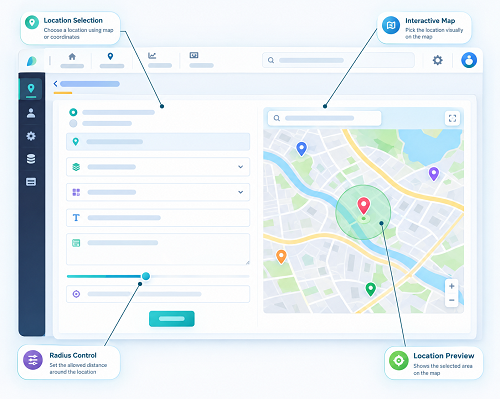
What Is GPS Employee Tracking?
GPS employee tracking uses GPS-enabled devices, usually smartphones or dedicated devices, to determine an employee's location.
Depending on the software, an employer may be able to view:
- Current employee location
- Check-in location
- Check-out location
- Location history
- Route information
- Visit locations
- Worksite arrival and departure
- Geofence entry and exit
- Distance travelled
- Time spent at a location
- Attendance location
- Field-job status
A typical workflow is:
Employee Mobile App → GPS Location → Secure Server → Attendance/Tracking Platform → Authorized Manager Dashboard
The exact information collected depends on how the application is configured.
Is GPS Location Employee Data Covered by the Saudi Arabia PDPL?
When GPS information can be associated with an identifiable employee, it should generally be treated as personal data within the PDPL framework.
The PDPL defines personal data broadly as information that can identify an individual directly or indirectly. SDAIA's guidance also explains that personal data can include information from different sources and in different forms when it enables identification.
For example, a location record such as:
Employee ID 1025 → 10:30 AM → Riyadh customer site
can be personal data when Employee ID 1025 can be linked to a particular employee.
GPS information therefore should not be treated simply as anonymous operational information when it is connected to an employee profile.
When Does GPS Tracking Become Personal Data Processing?
The PDPL defines processing broadly. Activities such as collecting, recording, storing, organizing, using, disclosing, and otherwise handling personal data can constitute processing.
This means GPS tracking can involve several separate processing activities:
- Collecting the employee's location.
- Transmitting the location to the attendance platform.
- Storing location records.
- Displaying location information to managers.
- Using location for attendance verification.
- Generating route or visit reports.
- Sharing information with authorized service providers.
- Retaining or deleting location history.
SDAIA's guidance confirms that storing personal data with a cloud service provider is itself an example of personal-data processing.
Why Employers Should Establish a Clear Purpose
GPS tracking should have a clearly defined business purpose.
Possible purposes include:
- Verifying field attendance
- Confirming worksite presence
- Managing service visits
- Coordinating deliveries
- Protecting employees working in the field
- Monitoring assigned routes
- Managing customer visits
- Coordinating mobile teams
- Supporting operational planning
The organization should avoid collecting continuous location data simply because the technology makes it possible.
A purpose-based approach helps determine:
- What location information is required
- When tracking should be active
- Who can view it
- How long it should be retained
- Whether continuous tracking is necessary
The PDPL requires controllers to inform individuals of the purpose of collection and requires personal data to be handled consistently with the applicable purpose and legal requirements.
GPS Tracking During Working Hours
One important design consideration is when location tracking is active.
For many field-work scenarios, tracking may only be required during working hours or while an employee is performing an assigned job.
For example:
8:00 AM–5:00 PM → Work-related GPS tracking
5:00 PM onward → Tracking disabled
This type of configuration can reduce unnecessary collection.
However, whether tracking should operate continuously depends on the organization's operational purpose and applicable legal requirements. Employers should document why the chosen tracking period is necessary.
Example
A field-service company has technicians visiting customer sites.
The business may need to verify:
- Technician arrival
- Customer-site location
- Job completion
- Departure
It may not need a continuous record of the technician's location outside working hours.
A system designed around the actual business purpose can therefore reduce unnecessary collection.
GPS Tracking and Employee Privacy
Employee privacy should be considered before implementing GPS monitoring.
Employees should receive appropriate information about:
- What location information is collected
- Why it is collected
- When tracking operates
- How the information is used
- Who can access it
- Whether third parties process it
- Whether information is transferred outside Saudi Arabia
- How long information is retained
- Applicable employee rights
- How privacy requests can be submitted
The PDPL requires controllers collecting personal data directly from data subjects to provide information including the legal basis, purpose, data collected, disclosure recipients, potential processing outside the Kingdom, and applicable data-subject rights.
GPS Tracking Policy for Employees
A written GPS tracking policy can make the organization's approach clearer.
The policy can explain:
Purpose
Why the organization uses GPS tracking.
Scope
Which employees and activities are covered.
Tracking Hours
When location tracking is active.
Data Collected
What location information is recorded.
Access
Which managers or HR personnel can see location information.
Retention
How long location records are kept.
Vendor Processing
Whether an external software provider processes the information.
International Processing
Whether data is stored or processed outside Saudi Arabia.
Employee Rights
How employees can exercise applicable rights.
A clear policy can also help managers apply the same rules consistently across departments and locations.
Legal Basis for GPS Employee Tracking
Before implementing GPS monitoring, the employer should identify the applicable legal basis for processing.
The PDPL provides several circumstances under which personal data may be processed. These include consent and certain other situations specified in the law. The PDPL also states that legitimate interests cannot be used as a lawful basis where sensitive data is processed.
Therefore, employers should not assume that "the employee works for the company" automatically establishes the legal basis for every type of location tracking.
The organization should document:
- The processing purpose
- The personal data involved
- The applicable legal basis
- Whether the processing is necessary
- Whether consent is being relied upon
- How employees are informed
- What safeguards apply
The appropriate legal basis can depend on the organization's circumstances and the nature of the tracking activity.
Consent and GPS Tracking
Consent can be one possible legal basis under the PDPL, but employers should not automatically assume that every GPS-tracking activity requires or can be justified by consent.
Where consent is relied upon, organizations should ensure that the applicable PDPL and Implementing Regulations requirements are met.
The Implementing Regulations define explicit consent as direct and explicit acceptance that can be proven.
For organizations considering consent, HR and privacy teams should document:
- What the employee is consenting to
- The specific purpose
- What location information is collected
- How the information is used
- How consent is recorded
- How applicable withdrawal procedures work
For more complex employee-monitoring arrangements, legal or privacy review should be obtained before deployment.
Data Minimization for GPS Tracking
Data minimization is an important part of a privacy-conscious tracking system.
Businesses should ask: Do we need an exact location every minute?
If the business purpose can be achieved using less frequent location updates, collecting location less frequently may reduce unnecessary data processing.
Possible approaches include:
- Check-in location only
- Check-in and check-out locations
- Periodic location updates
- Location updates during assigned jobs
- Geofence entry/exit events
- Route information only during work assignments
The appropriate approach depends on the operational requirement.
The PDPL framework emphasizes limiting personal-data processing to what is appropriate and necessary for the stated purpose.
GPS Tracking and Geofencing
Geofencing creates a virtual geographic boundary around a location.
For example, a company could create a geofence around:
- Construction site
- Customer facility
- Warehouse
- Retail branch
- Office
- Service area
When an employee enters or leaves the defined area, the system can generate an event.
A typical workflow is:
Employee arrives → GPS detects location → Geofence validates location → Check-in recorded
Geofencing can sometimes reduce the need for continuous high-frequency tracking because the business may primarily need to know whether an employee entered or exited an authorized location.
However, the organization should still assess what information is collected and retained.
GPS Attendance vs. Continuous GPS Tracking
These two approaches should not be treated as identical.
GPS Attendance
GPS attendance may collect location when an employee checks in or checks out.
Example: Check-in → Location captured → Attendance recorded
This can be appropriate where the main purpose is verifying attendance location.
Continuous GPS Tracking
Continuous tracking may collect location repeatedly throughout working hours.
Example: 8:00 AM → Location | 8:15 AM → Location | 8:30 AM → Location | 8:45 AM → Location
This provides more operational information but also creates a larger volume of personal-data processing.
Organizations should therefore determine whether continuous monitoring is actually necessary for the stated purpose.
Protecting GPS Employee Data
Security should cover the entire location-data lifecycle.
- Encrypt Data: Location information should be protected during transmission and storage using appropriate technical safeguards.
- Restrict Access: Only authorized personnel should be able to view employee location information.
- Use Role-Based Permissions: A field supervisor may need to view the locations of assigned employees, while a payroll administrator may only need attendance summaries.
- Protect Administrator Accounts: Administrative accounts should have strong authentication and appropriate privilege controls.
- Maintain Audit Logs: Organizations should maintain appropriate records of access and administrative activity.
- Secure Mobile Applications: Mobile apps should use secure authentication, protected communications, and appropriate device-security measures.
- Protect APIs: If GPS information flows between mobile apps, attendance software, HR systems, and payroll platforms, the interfaces should be appropriately secured.
Who Should Have Access to Employee GPS Data?
Access should be based on business responsibilities.
| Role | Possible Access |
|---|---|
| Employee | Own location/attendance information where applicable |
| Field Supervisor | Assigned employees during authorized work periods |
| Branch Manager | Relevant branch employees |
| HR | Required workforce and attendance information |
| Payroll | Attendance information needed for payroll |
| IT Administrator | Technical administration, with access minimized |
| Vendor Support | Controlled access only where necessary |
The exact permissions should be based on the organization's structure.
Managers should not automatically receive unrestricted access to historical location information simply because they manage employees.
GPS Data Retention
Organizations should establish a documented retention period for employee location information.
The retention period should be linked to the purpose for which the data was collected and applicable legal or business requirements.
For example, the organization may distinguish between:
- Current operational location
- Daily attendance location
- Historical route information
- Geofence events
- Payroll-related attendance records
Not every category necessarily needs the same retention period.
The PDPL requires personal data to be destroyed when it is no longer necessary for the purpose for which it was collected, subject to applicable exceptions and retention requirements.
Example Retention Workflow
Location collected → Used for operational purpose → Retention period applied → Data reviewed → Secure deletion or legally permitted retention
Businesses should also consider copies stored in backups and third-party systems.
GPS Tracking When Employees Leave the Company
Employee offboarding should include a review of location data and access.
The organization should:
- Disable the employee's tracking account.
- Revoke application access.
- Remove access to company devices where applicable.
- Review retained location information.
- Apply the applicable retention policy.
- Delete information when it is no longer required.
- Ensure former employees cannot continue to be tracked.
This can be incorporated into the organization's standard HR offboarding checklist.
Cloud GPS Tracking Software
Many GPS employee-tracking platforms operate through cloud infrastructure.
This can simplify management for businesses with employees across Saudi Arabia because location information can be consolidated into a central dashboard.
However, employers should assess:
- Cloud provider
- Data storage location
- Processing location
- Subprocessors
- Security controls
- Access permissions
- Backup arrangements
- Data retention
- Data deletion
- International transfers
SDAIA's guidance specifically recognizes cloud storage of personal data as processing subject to the PDPL.
GPS Data Transfers Outside Saudi Arabia
Cross-border processing deserves particular attention when a GPS platform is hosted internationally.
The PDPL framework includes requirements concerning transfers of personal data outside the Kingdom, and SDAIA separately publishes the Regulation on Personal Data Transfer Outside the Kingdom.
Before selecting a GPS employee-tracking provider, organizations should determine:
- Where employee location data is stored
- Where it is processed
- Which subprocessors have access
- Whether data is transferred outside Saudi Arabia
- What safeguards apply
- What contractual arrangements exist
- Whether the transfer is necessary
- Whether only the minimum required information is transferred
This assessment should be completed before production deployment.
GPS Tracking and Third-Party Vendors
If a company uses third-party tracking software, the employer should understand the relationship between the employer and provider.
The PDPL distinguishes between a controller, which determines the purposes and manner of processing, and a processor, which processes personal data on behalf of the controller.
Vendor due diligence should cover:
- Security architecture
- Data processing responsibilities
- Data location
- Subprocessors
- Access controls
- Incident response
- Retention and deletion
- International transfers
- Contractual obligations
- Support access
A vendor should not automatically receive unrestricted access to employee location information.
Employee GPS Tracking and Payroll
GPS tracking can be integrated with attendance and payroll systems.
For example:
GPS Check-In → Location Verification → Attendance Record → Working Hours → Overtime/Absence Review → Payroll Processing
This can help field-based organizations reduce manual attendance entry.
However, GPS data should not automatically be treated as a direct payroll decision. Organizations should establish rules for reviewing and approving attendance information before payroll processing.
GPS Tracking for Different Saudi Arabia Workforces
Construction Employees
GPS tracking can help companies verify attendance at project sites and understand workforce distribution across multiple projects.
Possible features include:
- GPS check-in
- Geofencing
- Site attendance
- Project assignment
- Shift management
- Overtime records
Sales Teams
Sales representatives can use GPS-enabled mobile applications to record customer visits and work-related attendance.
Service Technicians
Companies can use location information to coordinate technicians with customer assignments.
Delivery Employees
GPS tracking can provide operational visibility into delivery routes and assigned jobs.
Security Personnel
Security agencies may use location and geofencing to monitor assigned posts and attendance.
Field Maintenance Teams
Maintenance organizations can use GPS information to coordinate employees working across multiple locations.
Privacy Risks of GPS Employee Tracking
Organizations should identify potential privacy risks before implementation.
Excessive Tracking
Collecting location more frequently than necessary.
Off-Duty Monitoring
Continuing location tracking outside authorized work periods.
Excessive Manager Access
Allowing managers to view historical location information without a business need.
Long Retention
Keeping detailed location histories indefinitely.
Unclear Purpose
Collecting location without clearly documenting why it is required.
Third-Party Exposure
Allowing vendors or subprocessors unnecessary access.
International Processing
Sending location information to systems outside Saudi Arabia without appropriate assessment.
Security Breaches
Unauthorized access to employee location histories.
A privacy assessment should consider these risks before deployment.
How to Implement GPS Tracking in a PDPL-Conscious Way
- Step 1: Define the Business Purpose - Document exactly why GPS tracking is required.
- Step 2: Identify the Data - List all information collected, such as GPS coordinates, timestamp, employee ID, device information, worksite, and route data.
- Step 3: Determine the Legal Basis - Identify the applicable legal basis for the specific processing.
- Step 4: Minimize Collection - Collect only the information necessary for the defined purpose.
- Step 5: Define Tracking Hours - Determine whether tracking is required continuously, periodically, or only during specific attendance events.
- Step 6: Inform Employees - Provide an appropriate privacy notice before collecting location data.
- Step 7: Configure Access - Give location-data access only to authorized personnel.
- Step 8: Secure the Platform - Implement appropriate technical and organizational security measures.
- Step 9: Assess Vendors - Review cloud providers, processors, subprocessors, and integrations.
- Step 10: Assess International Transfers - Determine whether information is transferred or processed outside Saudi Arabia.
- Step 11: Establish Retention - Define how long different types of location information are kept.
- Step 12: Create a Deletion Process - Securely delete location information when applicable retention requirements end.
- Step 13: Prepare for Incidents - Create procedures for responding to unauthorized access or data breaches.
- Step 14: Review Periodically - Reassess the tracking system when its purpose, technology, vendor, workforce, or legal requirements change.
GPS Employee Tracking Compliance Checklist
| Area | Questions for HR and IT |
|---|---|
| Purpose | Why is GPS tracking necessary? |
| Scope | Which employees are tracked? |
| Timing | When is tracking active? |
| Data | What location information is collected? |
| Legal basis | What legal basis applies? |
| Transparency | Have employees received appropriate information? |
| Minimization | Is only necessary location information collected? |
| Access | Who can view location data? |
| Security | Is the information appropriately protected? |
| Retention | How long is location information retained? |
| Deletion | How is unnecessary data deleted? |
| Vendors | Who processes the location information? |
| Subprocessors | Which third parties can access it? |
| Cloud | Where is the information stored? |
| International transfer | Is information processed outside Saudi Arabia? |
| Employee rights | Can applicable requests be handled? |
| Incident response | Is there a breach-response process? |
| Review | Are privacy controls reviewed periodically? |
GPS Tracking vs. Geofencing
GPS tracking and geofencing can be used together but serve different functions.
| Feature | GPS Tracking | Geofencing |
|---|---|---|
| Primary function | Records or provides location information | Detects entry/exit from defined areas |
| Data volume | Can be high depending on frequency | Can be lower when limited to events |
| Use case | Route and workforce monitoring | Site attendance and location verification |
| Example | Track technician route | Confirm technician entered customer site |
| Privacy consideration | Potentially extensive location history | May reduce unnecessary tracking if configured around events |
A business should choose the least intrusive configuration that still achieves its legitimate operational purpose, while assessing the applicable legal requirements.
Benefits of Responsible GPS Employee Tracking
When appropriately designed and implemented, GPS employee tracking can help businesses:
- Verify field attendance
- Manage distributed employees
- Coordinate field teams
- Confirm worksite presence
- Improve job allocation
- Support route planning
- Reduce manual attendance processes
- Connect location-based attendance with payroll
- Improve operational visibility
- Generate location-based reports
These operational benefits should be balanced with employee privacy and data-protection requirements.
Best Practices for Saudi Arabia Employers
A practical GPS tracking program should:
- Define a specific business purpose.
- Identify the applicable legal basis.
- Provide appropriate privacy information.
- Limit tracking to what is necessary.
- Avoid unnecessary off-duty monitoring.
- Restrict access based on job responsibilities.
- Encrypt and secure location information.
- Review cloud providers and processors.
- Assess cross-border data processing.
- Establish retention and deletion rules.
- Maintain appropriate security and access logs.
- Train HR, IT, and managers.
- Establish a data-breach response procedure.
- Review employee rights and request-handling procedures.
- Periodically reassess whether GPS tracking remains necessary.
Conclusion
GPS employee tracking can be a valuable tool for Saudi Arabia organizations managing field employees, mobile teams, construction projects, service technicians, delivery operations, security teams, and distributed workforces.
However, employee location information should be treated as an important personal-data processing activity when it can identify individual employees. The Saudi Arabia PDPL applies broadly to personal-data processing, and the law requires transparency about the legal basis, purpose, collection, disclosures, processing outside the Kingdom, and applicable data-subject rights.
A responsible GPS employee-tracking system should therefore combine clear business purposes, appropriate legal basis, data minimization, employee transparency, role-based access, strong security, defined retention, secure deletion, vendor controls, and assessment of international data transfers.
For many businesses, the key question is not simply whether GPS tracking can be implemented, but how much location information is actually necessary to achieve the organization's stated purpose. Designing the system around that requirement can help organizations reduce unnecessary data collection while maintaining useful operational visibility.
InnBuilt Employee Tracking App supports authorised GPS-based workforce visibility with configurable working hours, permissions, and role-based access. Businesses in Saudi Arabia can document location-tracking purposes and apply privacy-conscious controls aligned with PDPL practices.