How to Manage Employee Attendance Across Riyadh, Jeddah, Dammam, and Multiple Saudi Branches
How to Manage Employee Attendance Across Riyadh, Jeddah, Dammam, and Multiple Saudi Arabia Branches
Managing employee attendance becomes more challenging when a company operates across multiple locations in Saudi Arabia. Businesses with branches in Riyadh, Jeddah, Dammam, and other cities need to maintain consistent attendance policies while allowing each location to manage its own employees, shifts, and working schedules.
Using centralized attendance management software can help HR teams monitor attendance across branches, reduce manual work, and maintain consistent records. It can also connect attendance information with leave management and payroll processes.
Why Multi-Branch Attendance Management Is Challenging
Employees working across different Saudi Arabia locations may have different:
- Branch assignments
- Working schedules
- Shifts
- Managers
- Departments
- Project responsibilities
- Attendance requirements
- Leave arrangements
When attendance is maintained through spreadsheets, paper registers, or separate systems, HR teams may have difficulty consolidating information.
Common problems include:
- Duplicate attendance records
- Missing check-in or check-out entries
- Incorrect branch assignments
- Delayed attendance reports
- Manual overtime calculations
- Difficulty monitoring remote employees
- Payroll discrepancies
- Limited visibility across branches
A centralized attendance system can help standardize these processes.
1. Create Separate Branch Locations
The first step is to create each business location within the attendance system.
For example, a company may configure:
- Riyadh Branch
- Jeddah Branch
- Dammam Branch
- Khobar Branch
- Makkah Branch
- Madinah Branch
Employees can then be assigned to their respective branches.
This makes it easier for HR managers to filter attendance information by location.
2. Assign Employees to the Correct Branch
Every employee should have an accurate organizational profile containing details such as:
- Employee name
- Employee ID
- Department
- Job role
- Branch
- Reporting manager
- Work schedule
- Assigned shift
When an employee transfers from Riyadh to Jeddah, HR should update the employee's branch and attendance permissions.
Keeping employee assignments updated helps prevent attendance being recorded against the wrong location.
3. Use GPS and Geofencing for Mobile Employees
Companies with employees who work outside traditional offices can use GPS-enabled attendance applications.
A geofence can be created around each authorized workplace. When an employee checks in through the mobile application, the system can verify their location against the configured attendance area.
For example:
- Riyadh → Riyadh branch geofence
- Jeddah → Jeddah branch geofence
- Dammam → Dammam branch geofence
This approach can provide additional location information for organizations managing field employees and distributed teams.
4. Standardize Attendance Rules
Although branches may operate independently, the company should establish consistent attendance policies.
Central HR can define rules for:
- Check-in and check-out
- Late arrival
- Early departure
- Grace periods
- Breaks
- Overtime
- Absence
- Missing punches
- Shift changes
- Attendance corrections
Branch managers can then administer these rules according to their assigned responsibilities.
Any organization-specific rules should also be reviewed against applicable Saudi Arabia employment requirements.
5. Manage Different Shifts
Not every branch necessarily operates on the same schedule.
For example, employees at one location may work a standard daytime schedule while another branch may use multiple shifts.
Attendance software can assign different schedules to different employee groups while keeping all attendance information in one system.
This can be particularly useful for:
- Retail businesses
- Manufacturing companies
- Logistics companies
- Healthcare organizations
- Security services
- Construction businesses
- Customer support operations
6. Monitor Attendance from a Central Dashboard
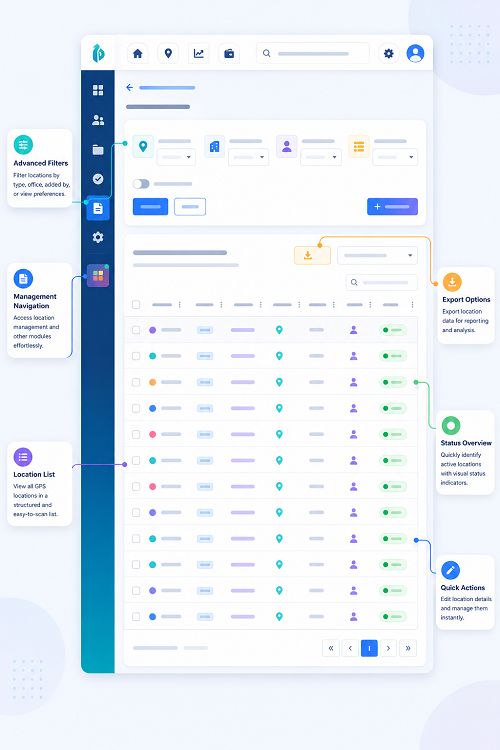
A centralized dashboard allows HR teams to view attendance information across multiple branches.
Managers can monitor information such as:
- Present employees
- Absent employees
- Late arrivals
- Early departures
- Missing attendance
- Overtime
- Leave
- Working hours
HR can filter the information by city, branch, department, employee, or date.
This eliminates the need to collect separate attendance spreadsheets from every location.
7. Give Branch Managers Controlled Access
Centralized attendance does not mean every manager needs access to every employee's information.
Role-based permissions can allow:
- Central HR: Access to all branches
- Riyadh Manager: Access to Riyadh employees
- Jeddah Manager: Access to Jeddah employees
- Dammam Manager: Access to Dammam employees
This structure can help maintain appropriate access controls while allowing local managers to manage their teams.
8. Manage Employee Transfers Between Branches
Employees may move between branches temporarily or permanently.
For example, an employee normally assigned to Riyadh may be temporarily assigned to a project in Dammam.
The attendance system should allow HR administrators to update location assignments or configure temporary attendance permissions.
This helps prevent employees from being incorrectly marked absent simply because they are working at an approved alternative location.
9. Connect Attendance With Leave Management
Attendance and leave records should work together.
If an employee has approved annual leave, the attendance system should reflect the approved absence rather than treating the employee as unexcused.
Similarly, HR teams can identify situations where an employee has no attendance record and no approved leave.
This makes absence management easier across multiple branches.
10. Integrate Attendance With Payroll
Attendance information can be an important input for payroll processing.
A centralized system can provide payroll teams with relevant information such as:
- Attendance days
- Absence
- Approved leave
- Overtime
- Working hours
- Shift information
- Attendance adjustments
Instead of manually combining spreadsheets from Riyadh, Jeddah, Dammam, and other branches, payroll teams can work with consolidated attendance data.
Payroll administrators should still review attendance information and apply the organization's payroll rules before final salary processing.
11. Use Automated Attendance Reports
Automated reports can help HR identify attendance patterns across locations.
Useful reports include:
Branch-Wise Attendance Report
Shows attendance information for each branch.
Employee Attendance Report
Provides individual attendance history.
Late Attendance Report
Identifies employees who repeatedly arrive after their scheduled start time.
Overtime Report
Provides information about recorded additional working hours.
Absence Report
Shows employees without attendance or approved leave.
Missing Punch Report
Identifies employees with incomplete check-in or check-out records.
These reports can help managers investigate attendance exceptions promptly.
12. Protect Employee Attendance Data
Multi-branch systems contain employee information that should be protected through appropriate security controls.
Companies should consider:
- Role-based access
- Strong authentication
- Secure data transmission
- Audit logs
- Controlled administrator permissions
- Regular system reviews
- Appropriate data retention practices
If GPS or biometric attendance is used, organizations should also consider applicable privacy and data-protection requirements.
Example of a Multi-Branch Attendance Structure
A Saudi Arabia company operating across three major cities could organize its attendance system as follows:
| Location | Employees | Attendance Method | Manager Access |
|---|---|---|---|
| Riyadh | Office and field employees | Mobile/GPS/Biometric | Riyadh Manager |
| Jeddah | Office employees | Biometric/Mobile | Jeddah Manager |
| Dammam | Office and field employees | Mobile/GPS | Dammam Manager |
| Central HR | All branches | Central dashboard | HR Administrators |
Best Practices for Multi-Location Attendance
Businesses managing attendance across Saudi Arabia branches should:
- Maintain accurate employee and branch records.
- Standardize core attendance policies.
- Configure branch-specific schedules where necessary.
- Use GPS or geofencing for appropriate mobile and field roles.
- Give managers role-based access.
- Keep attendance and leave records synchronized.
- Review overtime and attendance exceptions before payroll.
- Automate branch-wise attendance reports.
- Maintain an audit trail for attendance changes.
- Regularly review system settings against current company policies and applicable Saudi Arabia requirements.
Conclusion
Managing employee attendance across Riyadh, Jeddah, Dammam, and multiple Saudi Arabia branches requires a combination of standardized policies, accurate employee assignments, appropriate attendance technology, and centralized monitoring.
Attendance management software can bring branch-level attendance into a single system while still allowing each location to maintain its own employees, shifts, managers, and schedules. Features such as GPS attendance, geofencing, mobile check-ins, biometric verification, automated reports, leave integration, and payroll connectivity can make multi-location attendance management more efficient.
For growing Saudi Arabia businesses, a centralized and properly configured attendance system can provide HR teams with clearer workforce visibility while reducing the administrative effort involved in managing attendance across multiple locations.
Attendance across Riyadh, Jeddah, Dammam, and other locations in Saudi Arabia can be centralised using InnBuilt Attendance Management Software. Each branch can follow its own shifts and approvals while head office receives consolidated reports.