Face Attendance Software for Multiple Branches and High-Volume Worksites in Saudi Arabia
Face Attendance Software for Multiple Branches and High-Volume Worksites in Saudi Arabia
Managing employee attendance becomes increasingly difficult when a business operates across multiple branches, project sites, factories, warehouses, retail locations, or large worksites. Manual registers and disconnected attendance devices can make it difficult for HR teams to maintain accurate records and process payroll on time.
Face attendance software provides a centralized way to verify employees, record check-in and check-out times, manage shifts, and monitor attendance across multiple locations.
For Saudi Arabia businesses, face attendance can be particularly useful for organizations with employees distributed across Riyadh, Jeddah, Dammam, Khobar, Makkah, Madinah, and other locations. A cloud-based system can connect attendance devices or mobile applications to a central HR platform, allowing authorized teams to monitor attendance from one place.
However, facial recognition involves biometric data. Under Saudi Arabia's Personal Data Protection Law (PDPL), biometric data used for identification is classified as sensitive personal data and requires additional safeguards.
This makes privacy, security, data access, retention, and vendor management important considerations when deploying face attendance at scale.
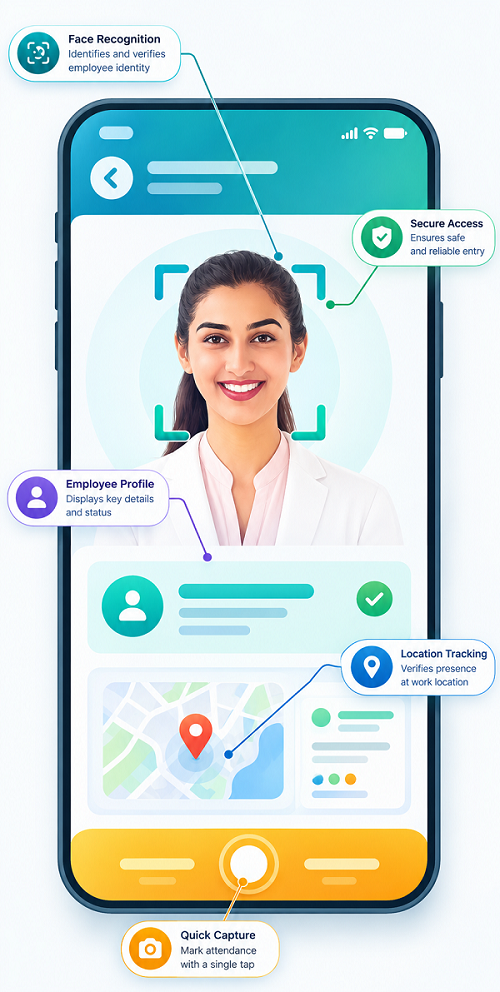
What Is Face Attendance Software?
Face attendance software uses facial-recognition technology to verify an employee's identity and automatically record attendance.
Instead of signing a register or entering an employee ID, the employee can typically stand in front of a supported camera or use a supported mobile application.
The basic process is:
Employee → Face Verification → Identity Confirmation → Check-In/Check-Out → Attendance Record → HR/Payroll System
A business can deploy face attendance through:
- Dedicated face-recognition terminals
- Tablets
- Smartphones
- Kiosks
- Cloud-based attendance systems
- Integrated HR platforms
- Site-based attendance devices
The software can then consolidate records from multiple locations into a centralized dashboard.
Why Large Saudi Arabia Businesses Need Centralized Attendance Management
A company with one office may be able to manage attendance using a single device.
A company with 20, 50, or 100 locations has a different challenge.
HR teams may need to manage:
- Thousands of employees
- Multiple branches
- Different working hours
- Rotational shifts
- Night shifts
- Weekly offs
- Overtime
- Branch transfers
- New employee enrollment
- Employee exits
- Site-based workers
- Remote or field employees
- Payroll integration
A centralized face attendance platform can help bring these records together.
Example
A Saudi Arabia retail company operates 30 branches across Riyadh, Jeddah, and Dammam.
Each branch has its own attendance terminal. Instead of collecting attendance files manually, the terminals synchronize attendance information with a central platform.
The HR team can then view:
All Branches → Regional Dashboard → HR Dashboard → Payroll
This structure can reduce manual consolidation and provide a consistent attendance process across locations.
Key Features of Face Attendance Software for Multiple Branches
1. Centralized Employee Database
A multi-branch system should maintain one centralized employee database. HR administrators can manage employee profiles, IDs, branch assignments, departments, designations, shifts, joining dates, rules, and enrollment statuses. When an employee transfers, HR can update their location without creating a duplicate profile.
2. Multi-Branch Management
The system should allow administrators to manage structured locations across Head Office, Regional Offices, and individual Branches, assigning employees to appropriate sites for targeted attendance views.
3. Centralized Attendance Dashboard
A central dashboard provides HR with a unified overview of present, absent, late, missing, and on-leave employees across branches and departments instead of using separate spreadsheets.
4. Real-Time Attendance Monitoring
Provides live visibility into check-ins, check-outs, absences, and shift activity to quickly spot and fix operational issues at high-volume worksites.
5. High-Volume Check-In
Designed to handle hundreds of peak arrival verification requests efficiently at locations like factories, construction sites, warehouses, stores, and hospitals without causing queues.
6. Multiple Attendance Devices
Allows large facilities to connect multiple terminals across different entrances into the same centralized system to distribute shift traffic.
7. Shift Management
Matches attendance with morning, afternoon, evening, night, rotational, weekend, or split shifts to identify late arrivals, early departures, and absences.
8. Overtime Tracking
Captures precise check-in and check-out timestamps to flag additional hours for review and payroll processing according to company policies.
9. Branch-Level Attendance Rules
Allows configuring unique schedules across different locations while retaining centralized reporting.
| Location | Example Schedule |
|---|---|
| Riyadh Office | 8:00 AM–5:00 PM |
| Jeddah Branch | 9:00 AM–6:00 PM |
| Dammam Warehouse | 7:00 AM–4:00 PM |
| Retail Store | Rotational shifts |
| Factory | Multiple shifts |
10. Employee Transfer Management
Prevents duplicate records by updating branch, shift, policy, and manager assignments within a single profile when employees move between sites.
Face Attendance for High-Volume Saudi Arabia Worksites
Construction Projects
Combines facial verification with GPS, geofencing, project assignments, and mobile attendance for site workforce tracking.
Manufacturing Plants
Supports multi-shift entry points, department reporting, and payroll integration to keep shift changes smooth.
Warehouses and Logistics
Tracks multi-shift workers across warehouses, loading zones, distribution hubs, transport, and offices without manual record pulling.
Retail Chains
Enables store-level tracking, shift management, late alerts, and central HR oversight across widespread branches.
Hotels and Hospitality
Manages continuous schedules across front office, housekeeping, kitchen, maintenance, and administrative staff.
GPS and Geofencing for Distributed Employees
Combines face verification, GPS location, geofencing, and timestamps on mobile devices to confirm field employees check in at authorized locations.
Managing Attendance Across Riyadh, Jeddah, and Dammam
Structures regional operations into dedicated dashboards so central HR can monitor offices, retail branches, projects, and industrial centers without manual spreadsheets.
Face Attendance and Payroll Integration
Automates the data path from check-in to salary calculation:
Face Check-In → Face Check-Out → Working Hours → Late/Early Records → Leave & Absence → Overtime → Payroll Processing → Salary Calculation
Security and PDPL Considerations
Because biometric identification data is classified as sensitive under Saudi Arabia PDPL guidance, organizations must ensure:
- Data encryption during transmission and storage
- Role-based access controls for sensitive records
- Secure administrative authentication and activity audit logs
- Clear retention periods and secure deletion mechanisms
Privacy and Transparency for Employees
Organizations must inform staff on data usage, retention, third-party sharing, and rights. Explicit consent is required if used as the legal basis for processing sensitive data under PDPL.
Cloud-Based vs. On-Premise Face Attendance
| Factor | Cloud-Based | On-Premise |
|---|---|---|
| Centralized management | Strong | Possible |
| Multi-branch access | Convenient | Requires infrastructure |
| Remote HR access | Usually easier | Depends on network setup |
| Hardware infrastructure | Lower local server requirement | Higher |
| Updates | Often centralized | Organization-managed |
| Vendor dependency | Higher | Potentially lower |
| Data-location assessment | Important | Controlled by organization |
| Scalability | Often convenient | Requires infrastructure planning |
How to Choose Face Attendance Software for Multiple Branches
- Employee, branch, and device capacities
- Verification speed and offline operation
- Centralized dashboard and shift flexibility
- Payroll and mobile/GPS integration
- Security, data location, vendor management, retention, and reporting
Implementation Steps for a Large Saudi Arabia Organization
- Map locations, workforce, and specific attendance needs
- Assess PDPL privacy requirements, data flows, and security controls
- Configure location structures, enroll employees, and set shift schedules
- Test peak traffic, integrate payroll, and continuously monitor performance
Common Challenges in High-Volume Face Attendance
- Long Queues: Add terminals to distribute traffic.
- Network Failure: Use offline sync capability.
- Incorrect Enrollment / Poor Placement: Enforce enrollment standards and site testing.
- Duplicate Profiles / Access Risks: Maintain centralized records and apply strict role-based access.
Multi-Branch Face Attendance Checklist
| Area | Questions to Ask |
|---|---|
| Locations | Can the system manage all branches and worksites? |
| Employees | Can it support the organization's employee volume? |
| Devices | Can multiple devices operate together? |
| Peak traffic | Can the system handle shift-change volumes? |
| Offline mode | What happens if connectivity fails? |
| Shifts | Can different shifts be configured? |
| Transfers | Can employees move between branches without duplicate profiles? |
| Mobile workers | Is mobile attendance supported where needed? |
| GPS | Can location controls be used where appropriate? |
| Payroll | Can attendance integrate with payroll? |
| Security | How is biometric information protected? |
| Access | Can permissions be assigned by role and location? |
| Privacy | Is there appropriate employee transparency? |
| Retention | Can applicable retention policies be implemented? |
| Vendors | Are processors and subprocessors assessed? |
| Data location | Where is information stored and processed? |
| Reporting | Are branch and regional reports available? |
Conclusion
Face attendance software provides a scalable solution for managing attendance across distributed, high-volume operations in Saudi Arabia. By pairing system features like multi-branch sync and payroll integration with strict PDPL data privacy safeguards, organizations can streamline operations while remaining compliant.
High-volume workplaces in Saudi Arabia can use InnBuilt Face Attendance Software for rapid identity-verified check-ins across branches, plants, and project sites. Location-wise policies and consolidated reporting help head office manage attendance at scale.