Attendance Management for Oil, Gas, and Industrial Worksites in Saudi Arabia
Attendance Management for Oil, Gas, and Industrial Worksites in Saudi Arabia
Managing attendance at oil, gas, petrochemical, manufacturing, and other industrial worksites in Saudi Arabia is more complex than managing attendance in a standard office. Employees may work across large sites, follow rotating shifts, operate in hazardous environments, travel to remote facilities, and work around the clock.
A reliable attendance management system helps employers track working hours, shifts, overtime, site presence, leave, and workforce movements while supporting payroll accuracy and workplace safety.
1. Manage Multiple Shifts
Oil and gas facilities often operate 24/7 and require continuous staffing. Companies may use:
- Day shifts
- Night shifts
- Rotating shifts
- Split shifts
- Extended shifts
- Emergency or standby shifts
- Camp-to-site rotations
Attendance software can assign employees to specific shifts and automatically compare actual attendance with scheduled working hours.
2. Track Employees Across Large Worksites
Industrial facilities can cover large geographical areas, making conventional attendance registers difficult to manage.
GPS-enabled mobile attendance, geofencing, access-control integration, or biometric devices can help employers verify whether employees are present at an authorized location.
For example, separate attendance zones can be created for:
- Main plant
- Production area
- Warehouse
- Maintenance workshop
- Construction zone
- Accommodation camp
- Security gate
- Remote project site
3. Use Appropriate Attendance Methods
Different areas of an industrial facility may require different attendance technologies.
Companies can combine:
- Biometric attendance
- Face recognition
- RFID cards
- Smart access cards
- Mobile attendance
- GPS verification
- Gate-entry systems
- Turnstile systems
The appropriate method depends on the site's security requirements, environmental conditions, employee population, and operational policies.
4. Connect Site Access With Attendance
Industrial sites often already have access-control systems at security gates. Integrating these systems with attendance software can reduce duplicate data entry.
For example:
Employee enters site → Access system records entry → Attendance system receives data → Shift attendance is updated → Payroll receives approved hours
This creates a more consistent record than maintaining separate gate and HR registers.
5. Handle Remote and Offshore Locations
Oil and gas operations may involve remote fields, drilling locations, offshore facilities, and project camps where internet connectivity may be unreliable.
An attendance solution should ideally support offline or delayed synchronization so that employees can record attendance even when network connectivity is temporarily unavailable.
Once connectivity returns, attendance data can synchronize with the central system.
6. Track Shift Handover
Shift handovers are particularly important in industrial operations because one team may need to replace another without interrupting production.
Attendance management can help supervisors identify:
- Employees who have arrived
- Employees who have not reported
- Late arrivals
- Early departures
- Missing shift coverage
- Employees working beyond scheduled hours
This gives managers better visibility before approving shift handovers.
7. Manage Overtime Accurately
Industrial employees may work additional hours because of production requirements, maintenance activities, emergencies, shutdowns, or project deadlines.
An attendance system can capture:
- Scheduled hours
- Actual hours
- Approved overtime
- Breaks
- Additional shifts
- Holiday work
- Rest-day work
The approved attendance information can then be transferred to payroll for accurate overtime processing according to applicable Saudi Arabia requirements and company policies.
8. Monitor Breaks and Working Hours
Long shifts and physically demanding industrial work require effective scheduling of breaks and rest periods.
Managers can use attendance software to monitor whether employees are following scheduled working patterns and whether excessive working hours require attention.
For outdoor industrial activities, companies should also incorporate heat-safety procedures into their scheduling and attendance policies, particularly during Saudi Arabia's hot summer months.
9. Support Contractor Attendance
Oil, gas, and industrial sites frequently involve contractors, subcontractors, maintenance companies, security providers, and temporary workers.
A centralized system can maintain separate attendance records for:
- Direct employees
- Contractors
- Subcontractors
- Temporary workers
- Visitors
- Project-based workers
Contractor attendance can also be linked to project, company, worksite, or access permissions.
10. Track Site-Specific Workforce Requirements
Different projects may require different employee qualifications or access permissions. Attendance systems can be combined with workforce databases to provide supervisors with a clearer view of who is assigned to each site.
| Workforce Information | Example |
|---|---|
| Employee | Technician |
| Worksite | Industrial plant |
| Shift | Night |
| Department | Maintenance |
| Supervisor | Site manager |
| Assignment | Equipment maintenance |
| Attendance | Present |
This can help organizations manage large and distributed workforces more effectively.
11. Manage Camp and Site Transportation
Remote industrial employees may travel between accommodation camps and worksites using company transportation.
Attendance management can be coordinated with transport schedules to identify:
- Employees assigned to a bus
- Employees boarding transportation
- Employees arriving at the worksite
- Missing employees
- Shift transportation requirements
This can be particularly useful when sites are located far from major cities.
12. Automate Late and Absence Alerts
Supervisors should not have to manually check attendance sheets every shift.
Automated notifications can alert managers when:
- An employee has not clocked in
- A critical position is unfilled
- An employee arrives late
- An employee leaves early
- A worker remains on-site beyond the scheduled shift
- A shift has insufficient staffing
This allows supervisors to respond quickly to staffing gaps.
13. Integrate Leave Management
Industrial operations need to maintain adequate staffing even when employees take annual leave, sick leave, or other approved leave.
An integrated attendance and leave system can show:
Shift roster + Employee leave + Attendance + Available workforce
Managers can then identify potential shortages before approving schedules or assigning replacement employees.
14. Protect Attendance and Biometric Data
Industrial employers increasingly use biometric and location-based technologies. These systems may process sensitive employee information, so organizations should establish appropriate data-protection controls.
Employers should consider:
- Access restrictions
- Data encryption
- Secure authentication
- Limited administrator permissions
- Data-retention policies
- Audit logs
- Employee privacy requirements
- Appropriate use of GPS and biometric information
For organizations operating in Saudi Arabia, attendance technology should be designed with applicable privacy and data-protection obligations in mind.
15. Maintain Accurate Attendance Records
Industrial companies should maintain reliable records of employee working hours, shifts, overtime, leave, and schedule changes.
Digital records can provide HR and payroll teams with a centralized history instead of relying on spreadsheets or paper registers.
Reports can include:
- Daily attendance
- Shift attendance
- Monthly working hours
- Overtime
- Absence
- Late arrivals
- Early departures
- Site-wise attendance
- Department-wise attendance
- Contractor attendance
16. Connect Attendance With Payroll
One of the biggest advantages of integrated attendance management is the connection between workforce data and payroll.
The workflow can be:
Shift planning → Attendance capture → Break calculation → Overtime approval → Leave adjustment → Payroll processing
This reduces manual data entry and helps prevent payroll discrepancies caused by incorrect attendance information.
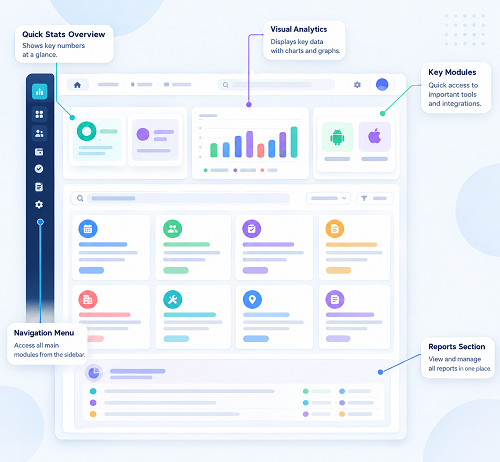
17. Use Real-Time Workforce Dashboards
A dashboard can provide supervisors with an overview of the current workforce.
For example, managers can see:
- Total employees scheduled
- Employees present
- Employees absent
- Employees late
- Employees on leave
- Employees working overtime
- Contractor headcount
- Site-wise attendance
For large oil, gas, and industrial organizations, this visibility can significantly improve workforce coordination.
Conclusion
Attendance management at Saudi Arabia's oil, gas, and industrial worksites requires more than simply recording clock-in and clock-out times. Employers need to manage rotating shifts, remote locations, contractors, overtime, site access, breaks, transportation, leave, and workforce safety within one coordinated process.
A modern workforce management system can connect attendance, scheduling, GPS, access control, leave, overtime, and payroll. This gives HR teams and site managers better visibility into workforce availability while helping organizations maintain accurate records and operate complex industrial sites more efficiently.
Industrial worksites need dependable attendance across controlled locations. InnBuilt Face Attendance Software provides Saudi Arabia employers with shift validation, location-based check-ins, and centralized employee and contractor reporting.