How to Protect Employee Face Recognition Data in Attendance Systems in Saudi Arabia
How to Protect Employee Face Recognition Data in Attendance Systems in Saudi Arabia
Face recognition attendance systems can help Saudi Arabia businesses automate employee check-in and check-out, reduce proxy attendance, and improve attendance accuracy. However, when facial information is used to identify employees, it can fall within the category of sensitive personal data under Saudi Arabia’s Personal Data Protection Law (PDPL).
The Saudi Arabia Data & AI Authority (SDAIA) identifies biometric data used for identification purposes as sensitive data. Sensitive data requires additional safeguards, and organizations processing it must comply with the PDPL and its implementing regulations.
For HR and payroll teams, protecting employee face-recognition data therefore requires more than simply securing the attendance device. Organizations need controls covering collection, consent or another applicable legal basis, storage, access, processing, retention, transfers, breach response, and eventual destruction.
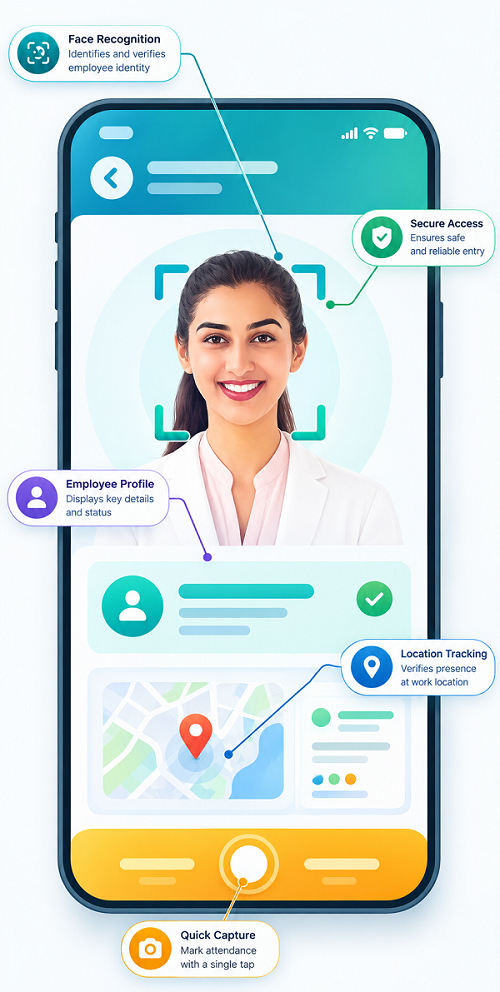
What Is Employee Face Recognition Data?
Face recognition attendance systems generally capture an employee's facial image and use biometric technology to verify the employee's identity.
Depending on the system, the information may include:
- Facial images
- Facial templates
- Biometric identifiers
- Employee ID linked to a facial template
- Attendance timestamps
- Check-in and check-out records
- Device or location information
- Shift and attendance information
Under the Saudi Arabia PDPL, biometric data is specifically treated as sensitive data when it is used for identification purposes.
This means employers should evaluate face-recognition attendance as a personal-data processing activity rather than treating it simply as an attendance-management feature.
Why Face Recognition Data Requires Strong Protection
Unlike an ordinary password, a person's biometric characteristics cannot simply be replaced if compromised.
Unauthorized access to facial or biometric information could create privacy and security risks for employees. SDAIA's guidance explains that sensitive data requires additional safeguards because unauthorized access may cause serious harm to individuals.
A secure attendance system should therefore protect biometric information throughout its lifecycle:
Collection → Enrollment → Storage → Authentication → Attendance Processing → Reporting → Retention → Deletion
Each stage should have appropriate technical and organizational controls.
1. Establish a Clear Purpose for Face Attendance
Before introducing face recognition, the employer should clearly define why facial data is being collected.
For example, the purpose may be:
- Verifying employee identity
- Recording attendance
- Preventing proxy attendance
- Managing working hours
- Supporting payroll calculations
- Generating attendance reports
The purpose should be specific and connected to the organization's legitimate business and legal requirements.
The PDPL requires collection purposes to be directly related to the controller's purposes, and personal data should be limited to what is necessary for the stated purpose.
An employer should therefore avoid collecting facial data for undefined future uses.
Example
If face recognition is implemented only for attendance verification, the organization should not automatically reuse the same biometric information for unrelated employee profiling or marketing activities.
2. Determine the Appropriate Legal Basis
Organizations should identify the applicable legal basis before processing employee biometric data.
The PDPL provides several circumstances in which processing may take place without consent. However, legitimate interest cannot be used as a lawful basis where sensitive data is being processed.
If consent is being relied upon for processing sensitive data, the Implementing Regulations require that consent to be explicit. The consent must also be appropriately documented and linked to a specific processing purpose.
HR teams should therefore work with their privacy or legal teams to document:
- The purpose of processing
- The applicable legal basis
- Whether consent is required
- How consent is obtained
- How consent is recorded
- How employees can exercise applicable rights
3. Provide Employees With Clear Privacy Information
Employees should understand how their facial data is being used.
A privacy notice should explain relevant information such as:
- What personal data is collected
- Why it is collected
- How it is processed
- Where it is stored
- Who can access it
- Whether it is shared with service providers
- Whether it is transferred outside Saudi Arabia
- How long it is retained
- Applicable employee rights
- How employees can raise privacy requests
The PDPL requires controllers to make a privacy policy available before collecting personal data and to provide information concerning collection, processing, storage, destruction, and data-subject rights.
4. Minimize the Biometric Data Collected
A secure attendance system should collect only the information necessary to achieve its stated purpose.
For example, an organization may not need to retain the original high-resolution facial photograph indefinitely if the attendance system can operate using an appropriately protected biometric template.
Data minimization can include:
- Collecting only necessary facial information
- Avoiding unnecessary photographs
- Separating biometric information from unrelated HR information
- Limiting attendance data fields
- Avoiding duplicate biometric records
- Deleting information that is no longer necessary
The PDPL states that personal-data content should be appropriate and limited to the minimum amount necessary for the purpose of collection.
5. Protect Facial Templates During Storage
One of the most important technical controls is protecting biometric information while it is stored.
Organizations should consider security measures such as:
- Encryption at rest
- Encryption during transmission
- Secure databases
- Strong authentication
- Role-based access controls
- Secure key management
- Database monitoring
- Regular security testing
- Backup protection
- Secure device configuration
Where the attendance platform uses a cloud environment, HR teams should understand where biometric information is hosted and which entities have access to it.
The PDPL requires controllers to implement necessary organizational, administrative, and technical measures to protect personal data.
6. Restrict Access to Biometric Information
Not every HR employee or manager should automatically have access to employee biometric data.
A role-based access model can restrict access according to job responsibilities.
| Role | Typical Access |
|---|---|
| Employee | Own attendance records |
| Line Manager | Attendance information for assigned employees |
| HR Team | Attendance and relevant employee records |
| Payroll Team | Attendance information required for payroll |
| System Administrator | Technical administration without unnecessary access to biometric content |
| Vendor Support | Restricted, controlled access only when required |
Organizations should also maintain access logs so that they can identify who accessed sensitive information and when.
7. Separate Biometric Data From General Attendance Reports
Managers generally need attendance information, not unrestricted access to biometric records.
For example, a manager may need to see:
- Employee name
- Date
- Check-in time
- Check-out time
- Late arrival
- Early departure
- Overtime
- Attendance status
The manager may not need access to the employee's facial template.
Separating operational attendance data from biometric information reduces unnecessary exposure.
8. Secure Data Transmission
Face-recognition attendance devices may communicate with:
- Cloud servers
- HR software
- Payroll systems
- Mobile applications
- Branch-level servers
- Central HR databases
Data should be protected while moving between these systems.
Organizations should use secure communication protocols and carefully evaluate integrations and APIs used by their attendance software.
Security should cover the entire data flow:
Attendance Device → Secure Network → Attendance Platform → HR System → Payroll System
Each connection should be reviewed for authentication, encryption, authorization, and logging.
9. Carefully Evaluate Cloud Attendance Vendors
Many Saudi Arabia businesses use cloud-based attendance software rather than hosting systems internally.
Before selecting a vendor, organizations should ask:
- Where is biometric data stored?
- Who owns the data?
- Who can access it?
- Is the data encrypted?
- How is access controlled?
- How are backups protected?
- How are security incidents handled?
- What happens when the contract ends?
- How is biometric data deleted?
- Are subcontractors involved?
- Is data transferred outside Saudi Arabia?
- What security and privacy responsibilities are allocated between the controller and processor?
SDAIA's guidance recognizes cloud storage of employee personal data as processing that falls within the PDPL framework.
10. Pay Special Attention to Cross-Border Data Transfers
A cloud attendance provider may store or process information outside Saudi Arabia.
This is particularly important for biometric attendance because the information may constitute sensitive personal data.
The PDPL contains requirements governing transfers or disclosures of personal data outside the Kingdom, including requirements concerning protection levels and limiting transferred data to what is necessary. The Implementing Regulations also address safeguards and documentation for international transfers.
Before selecting a global attendance provider, Saudi Arabia employers should determine:
- Where the biometric data is stored.
- Where processing takes place.
- Which vendors or subprocessors can access it.
- What legal basis applies to the transfer.
- What safeguards are implemented.
- Whether only the minimum necessary data is transferred.
11. Establish a Retention and Deletion Policy
Organizations should not retain employee biometric information indefinitely without a defined purpose.
The PDPL requires personal data to be destroyed when it is no longer necessary for the purpose for which it was collected, subject to circumstances where retention is legally permitted or required.
A biometric attendance retention policy should define:
- When biometric data is created
- How long it is required
- What happens when an employee leaves
- When attendance records are archived
- When biometric templates are deleted
- How backups are handled
- How deletion is verified
Example
When an employee leaves the organization, the company can trigger an offboarding workflow that reviews the employee's biometric template and determines when it should be securely destroyed according to the applicable retention requirements.
12. Protect Employee Data During Offboarding
Employee departure is an important stage in biometric-data management.
An offboarding checklist should include:
- Disable employee attendance access
- Remove biometric authentication access where appropriate
- Review active devices
- Revoke application access
- Review stored biometric records
- Apply the organization's retention schedule
- Securely destroy data when no longer required
- Document the deletion or retention decision
This prevents former employees' biometric information from remaining unnecessarily accessible.
13. Prepare for Data Breaches
Face-recognition systems should have a documented incident-response process.
Potential incidents include:
- Unauthorized access to biometric databases
- Lost attendance devices
- Compromised administrator accounts
- Malware affecting attendance servers
- Unauthorized vendor access
- Accidental disclosure
- Incorrect sharing of biometric records
The PDPL requires controllers to notify the competent authority upon becoming aware of certain personal-data breaches, damage, or illegal access, and requires notification to the data subject where the incident would cause harm to the data or prejudice the individual's rights and interests, subject to the applicable regulatory requirements.
A response plan should define:
Detect → Contain → Investigate → Assess → Notify where required → Remediate → Document
14. Conduct a Privacy and Security Assessment
Before deploying face-recognition attendance across an organization, businesses should assess the privacy and security risks associated with the processing.
The PDPL provides for impact assessments of personal-data processing in relation to products or services based on the nature of the activity, in accordance with the Implementing Regulations.
An assessment can examine:
- Why facial recognition is necessary
- What information is collected
- Whether collection can be minimized
- Who has access
- Where information is stored
- Cross-border processing
- Security controls
- Retention periods
- Employee rights
- Vendor risks
- Breach scenarios
15. Train HR and System Administrators
Technology alone cannot protect biometric information.
Employees responsible for HR, payroll, IT, and attendance administration should understand:
- What biometric data is
- Why it is sensitive
- Who can access it
- How to handle employee requests
- How to recognize suspicious activity
- How to report security incidents
- How to use administrative privileges securely
- Why biometric information must not be downloaded or shared unnecessarily
Regular awareness training can reduce accidental disclosure and inappropriate access.
16. Use Strong Administrative Controls
Organizations should establish written policies for biometric attendance.
The policy can cover:
- Purpose of face recognition
- Legal basis
- Employee privacy notice
- Access permissions
- Data retention
- Data deletion
- Vendor management
- Security requirements
- Cross-border transfers
- Incident response
- Employee requests
- Periodic security reviews
These controls help convert privacy requirements into practical HR procedures.
17. Avoid Using Biometric Data for Unrelated Purposes
A major privacy risk occurs when information collected for one purpose is reused for another unrelated purpose.
For example, biometric attendance information should not automatically become a source for unrelated employee profiling simply because the organization already possesses it.
The PDPL framework emphasizes purpose limitation and requires personal-data processing to remain consistent with applicable collection purposes and legal requirements.
Any new use should be reviewed separately to determine whether it is permitted and what additional requirements apply.
18. Create a Secure Face Attendance Workflow
A practical Saudi Arabia face-attendance workflow can look like this:
Step 1: Define the purpose
Document why facial recognition is needed for attendance.
Step 2: Identify the data
Determine whether the system stores photographs, facial templates, attendance logs, or other information.
Step 3: Determine the legal basis
Document the applicable lawful basis and whether explicit consent is required.
Step 4: Inform employees
Provide an appropriate privacy notice before collection.
Step 5: Secure enrollment
Register employees using controlled and authorized devices.
Step 6: Encrypt and protect data
Use appropriate technical and organizational safeguards.
Step 7: Control access
Limit biometric access to authorized personnel.
Step 8: Monitor processing
Maintain appropriate logs and review unusual activity.
Step 9: Manage vendors
Review cloud providers, processors, integrations, and sub processors.
Step 10: Apply retention rules
Keep biometric information only as long as permitted or necessary.
Step 11: Securely destroy unnecessary data
Delete biometric information when the applicable retention period ends or the data is no longer required.
Step 12: Review regularly
Update the privacy and security controls when the system, vendor, processing purpose, or legal requirements change.
Face Recognition Attendance Security Checklist
Saudi Arabia employers can use the following checklist when reviewing an attendance system:
| Security Area | Key Question |
|---|---|
| Purpose | Is the reason for collecting facial data clearly documented? |
| Legal basis | Has the applicable legal basis been identified? |
| Consent | If consent is relied upon for sensitive data, is it explicit and documented? |
| Minimization | Is only necessary biometric information collected? |
| Encryption | Is biometric information protected during storage and transmission? |
| Access | Is access restricted according to job responsibilities? |
| Logging | Are administrative and security activities appropriately logged? |
| Vendor | Has the attendance provider been assessed? |
| Cloud storage | Is the storage location known? |
| International transfer | Are cross-border processing requirements assessed? |
| Retention | Is there a documented retention period? |
| Deletion | Is unnecessary biometric data securely destroyed? |
| Breach response | Is there a documented incident-response procedure? |
| Employee rights | Can employees exercise applicable PDPL rights? |
| Assessment | Has the organization assessed privacy and security risks? |
| Training | Are HR and IT administrators trained? |
Conclusion
Face recognition attendance can provide efficient employee attendance verification for Saudi Arabia organizations, but biometric information requires careful protection. Under Saudi Arabia's PDPL, biometric data used for identification is classified as sensitive personal data and receives additional safeguards.
Businesses should approach face attendance security as an end-to-end process covering legal basis, employee transparency, data minimization, encryption, access control, vendor management, retention, deletion, cross-border transfers, breach response, and regular privacy assessments.
For HR and payroll teams, the objective should not simply be to implement a face-recognition attendance device. The attendance system should be designed so that employee biometric information is collected and processed for a clearly defined purpose and protected throughout its entire lifecycle.
Employee face-recognition data can be protected in InnBuilt Face Attendance Software through access controls, limited administrative permissions, defined retention practices, and auditable activity. This balances reliable attendance verification with workforce privacy.