How to Schedule Ramadan Shifts and Reduced Working Hours in Saudi Arabia
How to Schedule Ramadan Shifts and Reduced Working Hours in Saudi Arabia
Ramadan requires employers in Saudi Arabia to adjust work schedules, shift patterns, attendance rules, and workforce planning. For Muslim employees covered by the relevant provisions of the Saudi Arabia Labor Law, actual working hours during Ramadan are reduced to a maximum of 6 hours per day or 36 hours per week.
For businesses operating multiple shifts, extended hours, retail stores, restaurants, hospitals, logistics facilities, construction sites, and other continuous operations, Ramadan scheduling needs careful planning. Employers must maintain business coverage while ensuring that employee schedules, breaks, attendance records, and payroll calculations reflect the applicable Ramadan rules.
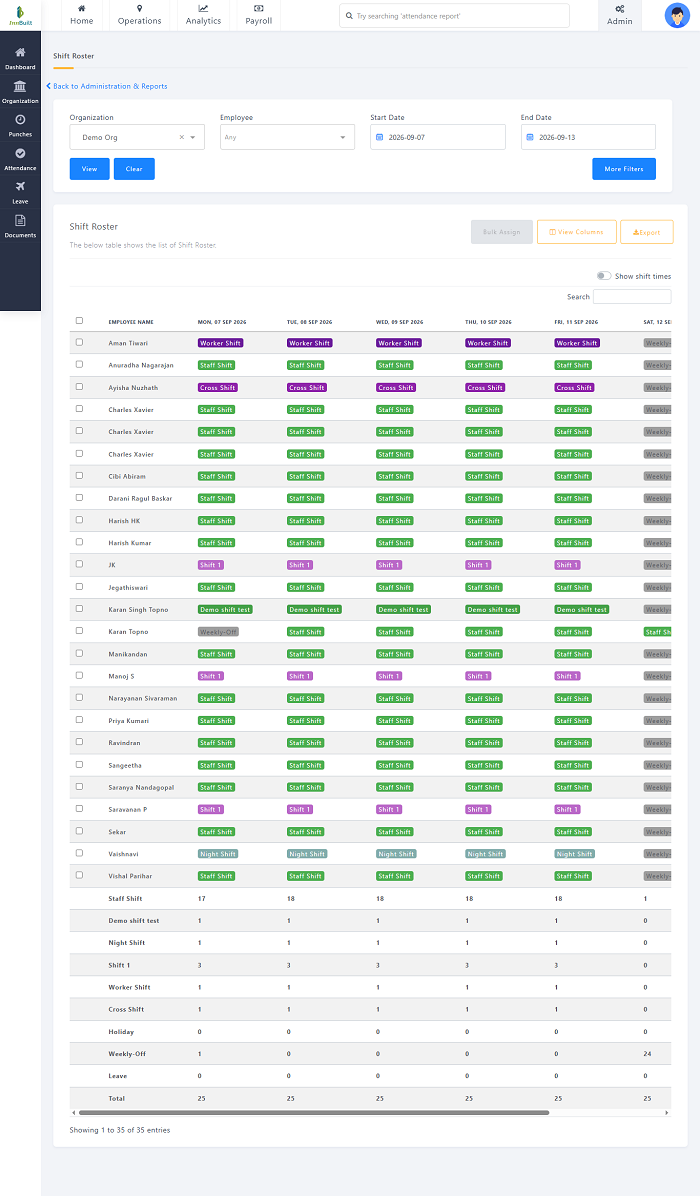
A shift management or workforce management system can make this process easier by allowing HR teams to create Ramadan schedules, monitor attendance, manage shift changes, and identify overtime or scheduling issues.
What Are the Ramadan Working Hours in Saudi Arabia?
Under Article 98 of the Saudi Arabia Labor Law, actual working hours for Muslim workers during Ramadan are reduced to:
- Maximum 6 actual working hours per day
- Maximum 36 actual working hours per week
This is a reduction from the general limits of 8 hours per day or 48 hours per week.
Employers should therefore review their standard schedules before Ramadan and determine how working hours will be redistributed while maintaining operational coverage.
The rules can vary for certain worker categories, industries, or types of work. For example, the implementing regulations contain specific provisions for intermittent work and certain security guard and janitorial roles. Employers should therefore verify the rules applicable to their workforce rather than applying a single schedule to every employee.
Why Ramadan Shift Scheduling Requires Careful Planning
Ramadan can change employee availability, customer demand, operating hours, transportation patterns, and staffing requirements.
Common challenges include:
- Reduced daily working hours
- Increased demand during evening hours
- Changes in retail and restaurant operating patterns
- Night shifts and late-evening operations
- Employee requests for schedule changes
- Maintaining adequate staffing levels
- Preventing excessive overtime
- Updating payroll calculations
- Managing attendance across multiple branches
- Coordinating shift swaps and absences
For businesses that operate beyond normal office hours, simply reducing every employee's shift by two hours may not provide sufficient operational coverage.
Instead, HR teams should redesign the shift structure around the organization's Ramadan operating requirements.
Step 1: Identify Employees Covered by Ramadan Hour Reductions
Before creating the schedule, HR should identify which employees are subject to the Ramadan reduction under the applicable labor rules.
Create employee groups based on:
- Employment category
- Job role
- Work location
- Shift type
- Working pattern
- Muslim/non-Muslim status where relevant to the legal requirement
- Applicable industry or regulatory exceptions
The purpose is to avoid applying an incorrect schedule to employees whose working-hour rules differ.
HR should also review employment contracts, internal work regulations, collective arrangements where applicable, and current Saudi Arabia regulatory guidance.
Step 2: Calculate the Available Ramadan Working Hours
For covered Muslim workers, the standard Ramadan limit is 6 actual working hours per day or 36 hours per week.
For example, a business operating five working days could create a schedule such as:
| Day | Actual Working Hours |
|---|---|
| Sunday | 6 hours |
| Monday | 6 hours |
| Tuesday | 6 hours |
| Wednesday | 6 hours |
| Thursday | 6 hours |
| Total | 30 hours |
The remaining weekly capacity would depend on the organization's working pattern and weekly rest arrangements.
The important point is that HR should monitor both daily and weekly limits, rather than checking only the number of hours shown on an individual shift.
Step 3: Design Ramadan Shift Patterns
Businesses can use different shift patterns depending on their operating hours.
Example: Office-Based Business
A company could move from a normal daytime schedule to a shorter Ramadan schedule.
Normal operation: 8:00 AM – 5:00 PM
Ramadan example: 9:00 AM – 3:00 PM
The exact schedule should be determined by the employer based on applicable requirements and business needs.
Example: Retail Business
A retail business may need employees across daytime and evening periods.
Possible structure:
- Morning shift
- Afternoon/evening shift
- Late-evening shift
The goal is to distribute employees across peak customer periods without exceeding applicable working-hour limits.
Example: Restaurant
Restaurants may experience relatively different demand patterns during Ramadan, with significant customer activity around iftar and later in the evening.
A restaurant may therefore need:
- Preparation staff before iftar
- Service staff around iftar
- Evening service teams
- Closing teams
Each employee's actual working hours should still be tracked against the applicable Ramadan limits.
Step 4: Separate Shift Duration From Break Time
HR teams should distinguish actual working hours from breaks.
Saudi Arabia HRSD guidance states that workers should generally not work more than five consecutive hours without a break for rest, prayer, and meals of at least 30 minutes, subject to applicable rules and exceptions. These break periods are not counted as actual working hours, and the worker should not remain under the employer's authority during the break.
For example, a scheduled period from 9:00 AM to 3:30 PM could contain a break. HR should not automatically treat the entire 6.5-hour span as six or 6.5 actual working hours without checking how the break is structured.
A workforce management system should record:
- Shift start
- Shift end
- Break start
- Break end
- Actual worked hours
- Overtime
- Absence
Step 5: Plan Around Iftar and Peak Business Hours
Ramadan changes customer and employee activity patterns.
For businesses such as:
- Retail stores
- Restaurants
- Hotels
- Delivery companies
- Shopping centers
- Customer service operations
- Logistics businesses
demand may increase at particular times before or after iftar.
Instead of scheduling the largest workforce uniformly throughout the day, businesses can analyze historical demand and assign employees according to expected workload.
For example, a retail store could schedule additional employees during evening peak periods while using a smaller daytime team.
Step 6: Manage Ramadan Shift Rotations
Organizations with continuous operations should create Ramadan-specific shift templates.
A shift management system can maintain templates such as:
- Ramadan Morning Shift
- Ramadan Afternoon Shift
- Ramadan Evening Shift
- Ramadan Night Shift
- Weekend Shift
- Holiday Coverage Shift
Each template can contain:
- Start time
- End time
- Break period
- Location
- Department
- Required employee count
- Eligible employees
This allows HR to reuse approved schedules rather than creating every shift manually.
Step 7: Use Employee Availability Data
Employee availability becomes particularly important during Ramadan.
Employees may have different commuting, family, religious, or personal scheduling requirements. HR can collect availability preferences before publishing the Ramadan roster.
For example:
| Employee | Preferred Shift | Alternative |
|---|---|---|
| Employee A | Morning | Afternoon |
| Employee B | Evening | Night |
| Employee C | Afternoon | Morning |
Availability data can then be considered when assigning shifts while ensuring business coverage.
Step 8: Manage Shift Swaps
Employees may request shift changes during Ramadan.
A digital shift management system can allow employees to:
- View their assigned shift
- Request a shift swap
- Select an eligible colleague
- Submit the request
- Obtain manager approval
- Automatically update the roster
This reduces the risk of informal shift changes that are not reflected in attendance or payroll records.
Step 9: Connect Ramadan Shifts With Attendance
Scheduling and attendance should work together.
If an employee is scheduled for a six-hour Ramadan shift, the attendance system should compare actual attendance against that schedule.
The system can identify:
- Late arrivals
- Early departures
- Absences
- Missing check-ins
- Missing check-outs
- Extra working time
- Shift deviations
This creates a more accurate record for payroll processing.
Step 10: Track Overtime Carefully
Reducing standard Ramadan working hours does not mean employers should simply add additional hours to compensate for the reduction without considering the applicable rules.
If employees work beyond their applicable working hours, HR should review whether the additional time constitutes overtime under Saudi Arabia Labor Law and applicable regulations.
Saudi Arabia HRSD states that overtime compensation is generally based on the hourly wage plus 50% of the basic wage, subject to the applicable legal provisions.
A payroll-integrated attendance system can flag additional working time for HR review.
Step 11: Display the Ramadan Work Schedule
Employers should clearly communicate the Ramadan schedule to employees.
HRSD's recent awareness guide states that employers should place a visible work-hours schedule at the worksite, including rest periods and the start and end times of each shift when shift work is used.
A good Ramadan schedule should clearly show:
- Department
- Employee name or ID
- Shift date
- Start time
- End time
- Break period
- Work location
- Weekly rest day
Employees should receive the schedule before the Ramadan shift cycle begins whenever practicable.
Ramadan Shift Scheduling for Multiple Branches
Businesses with branches in Riyadh, Jeddah, Dammam, Makkah, Madinah, or other Saudi Arabia locations may need centralized scheduling.
A centralized system can help HR:
- Create branch-specific Ramadan schedules
- Assign employees to locations
- Monitor staffing levels
- Track attendance
- Approve shift swaps
- Compare scheduled versus actual hours
- Identify understaffed branches
Managers can manage their own locations while HR maintains overall visibility.
Ramadan Scheduling for Different Industries
Retail
Retail businesses can use demand-based scheduling to increase staffing during expected evening peaks.
Restaurants and Hospitality
Restaurants and hotels can create separate preparation, service, and closing shifts to support changing Ramadan demand.
Healthcare
Hospitals and healthcare providers may require continuous staffing. Scheduling should account for coverage requirements, handovers, rest periods, and applicable working-hour rules.
Security
Security operations often require 24/7 coverage. Employers should check the special rules applicable to security guards and the specific nature of the work. The implementing regulations contain special provisions for certain security and janitorial roles.
Construction
Construction companies can review site operating hours and schedule work during periods that support operational requirements while complying with applicable working-hour and safety requirements.
Logistics
Warehouses and delivery operations can use shift-based workforce planning to maintain coverage across loading, dispatch, transportation, and customer service functions.
How Shift Management Software Helps During Ramadan
Ramadan scheduling becomes easier when businesses use dedicated workforce management software.
Important features include:
Ramadan Shift Templates
HR can create reusable templates for different departments and locations.
Automated Hour Calculation
The system can calculate scheduled and actual working hours and highlight employees approaching applicable limits.
Attendance Integration
Clock-in and clock-out information can be connected directly with shift schedules.
Mobile Access
Employees can view their schedules through a mobile application.
Shift Notifications
Employees can receive notifications about new shifts, shift changes, schedule approvals, shift swaps, and location changes.
Manager Approvals
Managers can approve schedule changes without maintaining spreadsheets or paper forms.
Payroll Integration
Approved attendance and overtime information can flow into payroll processing.
Ramadan Scheduling and Payroll
Incorrect shift scheduling can create payroll problems.
For example, if a Ramadan schedule is not updated in the attendance system, payroll may continue calculating employees against the normal working schedule.
This can result in:
- Incorrect overtime flags
- Attendance discrepancies
- Incorrect absence calculations
- Payroll adjustments
- Employee complaints
- Additional HR work
A connected HR and payroll system helps maintain consistency between the roster, attendance records, and payroll calculations.
Best Practices for Ramadan Shift Scheduling
Employers can follow these practices:
- Start planning before Ramadan begins.
- Identify employees covered by the Ramadan working-hour reduction.
- Create dedicated Ramadan shift templates.
- Check both daily and weekly working hours.
- Separate actual working hours from break periods.
- Plan staffing around expected customer demand.
- Allow controlled shift-swap requests.
- Track actual attendance against scheduled hours.
- Review additional working time for overtime treatment.
- Publish schedules clearly to employees.
- Monitor staffing across all branches.
- Integrate attendance data with payroll.
- Review applicable exceptions for specific employee categories and industries.
- Keep records of approved schedule changes.
Ramadan Shift Scheduling Checklist
Before Ramadan:
- Review applicable Saudi Arabia working-hour requirements
- Identify employees covered by Ramadan reductions
- Review employment categories and exceptions
- Create Ramadan shift templates
- Update attendance rules
- Update payroll settings
- Review branch operating hours
- Collect employee availability
- Publish the Ramadan roster
- Train managers on schedule changes
During Ramadan:
- Monitor attendance daily
- Track actual working hours
- Monitor weekly totals
- Manage shift swaps through approval workflows
- Review additional working time
- Monitor staffing levels
- Correct attendance exceptions promptly
After Ramadan:
- Restore applicable standard schedules
- Review attendance records
- Reconcile overtime
- Check payroll calculations
- Archive Ramadan schedules and approvals
- Review scheduling issues for future planning
Frequently Asked Questions
How many hours can Muslim employees work during Ramadan in Saudi Arabia?
Under Article 98, actual working hours for Muslim workers during Ramadan are reduced to a maximum of 6 hours per day or 36 hours per week, subject to applicable provisions and exceptions.
Does the Ramadan reduction apply to every employee?
The specific statutory Ramadan reduction in Article 98 is stated for Muslim workers. Employers should also consider whether special rules apply to particular categories, industries, or jobs.
Can businesses operate more than six hours per day during Ramadan?
A business may operate for longer than six hours through appropriate staffing and shift arrangements. The key issue is the actual working hours of employees covered by the Ramadan reduction and the rules applicable to their work category. Special shift-work provisions and Ministry approval requirements may apply in certain circumstances.
Are Ramadan breaks counted as working hours?
Rest, prayer, and meal periods are generally not included in actual working hours under the Saudi Arabia Labor Law, subject to the applicable rules.
Can shift management software calculate Ramadan working hours?
Yes. A properly configured system can assign Ramadan schedules, calculate scheduled and actual hours, monitor attendance, flag deviations, and provide payroll-ready records.
Should Ramadan schedules be different for every department?
Not necessarily. Businesses can use standardized templates while adapting them to different departments, locations, operating hours, and staffing requirements.
Conclusion
Scheduling employees during Ramadan requires more than simply reducing normal working hours. Employers need to coordinate legal working-hour requirements with business demand, shift coverage, employee availability, attendance, overtime monitoring, and payroll.
For Muslim workers covered by Article 98, Saudi Arabia Labor Law provides for reduced actual working hours during Ramadan of no more than 6 hours per day or 36 hours per week.
A modern shift management system can help businesses create Ramadan rosters, automate attendance tracking, manage shift changes, monitor working hours, and connect approved attendance information with payroll.
When Ramadan schedules are planned in advance and supported by accurate workforce data, employers can maintain operational continuity while managing employee working hours in a structured and transparent way.
Ramadan schedules can be configured in InnBuilt Shift Management Software with reduced working hours, staggered timings, and employee-specific rosters. Notifications and attendance matching help managers implement changes consistently.