Employee Contract Termination and Notice Periods in Saudi Arabia: Payroll Checklist
Employee Contract Termination and Notice Periods in Saudi Arabia: Payroll Checklist
Employee contract termination in Saudi Arabia requires coordination between HR, payroll, managers, and employees. When an employment relationship ends, employers need to review the termination reason, contract type, notice requirements, final working date, outstanding salary, unused leave, end-of-service benefits, and other amounts that may be payable.
The process becomes more complex when an organization has employees working across multiple branches, departments, shifts, or employment arrangements.
A structured termination checklist helps payroll teams avoid missed payments, incorrect notice calculations, incomplete employee records, and delays in final settlement.
Under Saudi Arabia's Labor Law, an employment contract may end for several reasons, including expiry of a fixed-term contract, mutual agreement, termination in certain circumstances, death of the worker, or other statutory grounds. The applicable rules depend on the contract and reason for termination.
What Is Employee Contract Termination in Saudi Arabia?
Employee contract termination is the formal ending of the employment relationship between an employer and worker.
Termination may occur because:
- A fixed-term contract expires
- The parties mutually agree to end the relationship
- An indefinite-term contract is terminated with the required notice
- The employee resigns
- The employer terminates the contract for a lawful reason
- The employee reaches a relevant retirement situation
- The employee dies
- A statutory ground for termination applies
- The employment relationship ends during a valid probation period
The correct payroll treatment depends on the reason for termination and the employee's contractual and statutory circumstances.
First Step: Identify the Contract Type
Before calculating notice or final settlement, payroll should confirm whether the employee has:
- A fixed-term contract
- An indefinite-term contract
- A contract containing a probation clause
- Another legally recognized employment arrangement
This matters because notice requirements can differ.
For example, expiry of a fixed-term contract is treated differently from termination of an indefinite-term contract.
What Is the Notice Period in Saudi Arabia?
For an indefinite-term contract, Article 75 provides notice rules based on the method and frequency of wage payment.
Where the employee's wage is paid monthly:
- If the employer terminates the contract, written notice must generally be given at least 60 days in advance.
- If the employee terminates the contract, written notice must generally be given at least 30 days in advance.
For workers whose wages are not paid monthly, the statutory notice period is generally 30 days, subject to the applicable provisions.
The contract and current law should always be reviewed before applying a notice period.
What Happens If Notice Is Not Given?
Article 76 provides that if the required notice is not observed, the party terminating the contract must pay the other party compensation equal to the worker's wage for the notice period, unless the contract or circumstances are governed by a different applicable rule.
Payroll should therefore distinguish between:
Notice actually served
and
Notice not served / notice compensation
This distinction can materially affect the final settlement.
Notice Period Example
Suppose a monthly-paid employee has an indefinite-term contract.
The employer decides to terminate the contract and provides the required written notice.
The employee continues working during the notice period.
Payroll should:
- Record the notice date.
- Calculate the notice end date.
- Continue normal salary processing.
- Record attendance and leave.
- Process applicable deductions.
- Calculate final settlement after the last working date.
If the employer instead ends employment immediately without requiring the employee to work the notice period, payroll should assess whether compensation in lieu of notice is payable under the applicable rules.
Notice Period for Employee Resignation
When an employee resigns from an indefinite-term contract, the applicable notice period should be reviewed based on the wage payment arrangement and current law.
For monthly-paid employees, Article 75 generally provides a 30-day written notice period when the employee terminates the contract.
HR should record the resignation date and calculate the employee's final working date.
Fixed-Term Contract Termination
A fixed-term contract generally ends when its specified term expires, unless it is renewed or otherwise terminated under the applicable rules.
However, an employer should not assume that every early termination of a fixed-term contract has the same consequences as contract expiry.
Payroll should first identify:
- Contract start date
- Contract end date
- Renewal provisions
- Early termination clause
- Termination reason
- Applicable compensation provisions
Article 77 provides compensation rules where a contract is terminated for an invalid reason and the parties do not have a specific compensation provision applicable to the situation.
Mutual Termination
An employment relationship may end by mutual agreement between the employer and employee.
The agreement should be documented clearly.
HR should record:
- Mutual termination date
- Final working date
- Agreed settlement terms
- Outstanding salary
- Leave balance
- End-of-service benefit treatment
- Any other agreed amounts
Payroll should only process amounts supported by the applicable agreement and law.
Termination During Probation
Probationary employment has separate rules.
Under Article 53, if a probation period is included in the contract, either party may have the right to terminate during the probation period, subject to the applicable contractual terms.
Article 54 provides that when employment is terminated during probation, neither party is entitled to compensation and the worker is not entitled to an end-of-service award for that period.
Payroll should nevertheless process salary and other amounts already earned up to the termination date.
Termination for a Lawful Cause
Saudi Arabia Labor Law provides specific circumstances in which an employer may terminate a contract without notice or compensation, subject to the statutory requirements.
Article 80 lists circumstances that may permit termination without award, advance notice, or compensation, while requiring the worker to be given an opportunity to state objections to the termination. These cases should be handled carefully.
HR should maintain supporting documentation, investigation records, notices, and the employee's response where required.
Payroll should not independently determine whether an Article 80 termination is legally justified.
What Should Be Included in the Final Payroll?
A termination payroll calculation may include several components.
1. Outstanding Salary
Calculate salary earned up to the final working date.
2. Overtime
Include approved overtime that remains unpaid.
3. Unused Annual Leave
Review the employee's accrued and unused leave balance and process the applicable payment.
4. End-of-Service Benefit
Calculate the applicable end-of-service award where the employee qualifies.
5. Notice Compensation
Where applicable, calculate compensation for an unserved notice period.
6. Other Contractual Payments
Review:
- Allowances
- Commissions
- Bonuses
- Reimbursements
- Other approved contractual amounts
7. Authorized Deductions
Process only deductions that are legally or contractually permissible.
Final Salary Payment Timing
Saudi Arabia Labor Law provides rules concerning payment of wages following termination.
Where the employer terminates the contract, the employer must settle the worker's wages and entitlements within the period specified by the Labor Law. Where the worker terminates the contract, the law provides a separate period for settlement.
Payroll teams should therefore create a termination workflow that triggers the final-settlement process immediately after the termination date is confirmed.
End-of-Service Benefit Calculation
End-of-service benefit is an important part of final payroll for eligible employees.
Article 84 generally provides:
- Half a month's wage for each of the first five years of service
- One month's wage for each subsequent year
The calculation is based on the last wage, with the statutory rules determining the applicable amount and circumstances.
For example, a simplified illustration for an eligible employee could be:
First 5 years:
5 × 0.5 month's wage = 2.5 months' wage
Additional years:
Each additional completed year = 1 month's wage
The actual entitlement can differ depending on the reason for termination, resignation, service duration, contract circumstances, and other statutory provisions.
End-of-Service Benefit on Resignation
Resignation can affect the amount of end-of-service benefit.
Article 85 provides specific rules for resignation based on the employee's length of service. For example, the law provides different entitlement levels after service of between two and five years, more than five but less than ten years, and ten years or more.
Payroll should therefore never calculate resignation settlements using the same formula automatically applied to every termination.
The system should first identify the termination reason.
Annual Leave on Termination
Employees are entitled to payment for accrued annual leave when the employment relationship ends, subject to the applicable rules.
Article 111 provides that when employment ends, the worker is entitled to receive wages for accrued annual leave that has not been used. Payroll should therefore check:
- Opening leave balance
- Leave accrued
- Leave taken
- Approved pending leave
- Final unused balance
before calculating the final settlement.
Notice Period and Annual Leave
If an employee is serving a notice period, HR should carefully coordinate annual leave requests with the notice timeline.
The leave record should clearly show:
- Notice start date
- Leave dates
- Final working date
- Remaining leave balance
HR should not simply remove unused leave from the system without checking whether payment is required at termination.
Notice Period and Attendance
Attendance continues to matter during the notice period.
Payroll should monitor:
- Working days
- Absences
- Late arrivals
- Early departures
- Approved leave
- Overtime
- Shift attendance
This ensures that final payroll reflects actual employment records.
Termination for Shift-Based Employees
For employees working rotational shifts, termination calculations can become more complex.
HR may need to account for:
- Night shifts
- Weekend shifts
- Holiday shifts
- Overtime
- Shift allowances
- Site allowances
- Attendance adjustments
The final payroll should use approved attendance data rather than relying only on the employee's standard schedule.
Termination Across Multiple Saudi Arabia Branches
Large organizations may have employees working in:
- Riyadh
- Jeddah
- Dammam
- Makkah
- Madinah
- Khobar
- Other Saudi Arabia locations
A centralized HR system allows payroll to standardize the termination workflow.
For example:
| Branch | Pending Terminations | Notice Ending |
|---|---|---|
| Riyadh | 8 | 4 |
| Jeddah | 5 | 2 |
| Dammam | 4 | 3 |
| Other Branches | 7 | 4 |
This allows payroll teams to identify upcoming settlements before the final working date.
Employee Termination Payroll Workflow
A structured process can look like this:
Termination Request → Contract Review → Termination Reason → Notice Period Calculation → Final Working Date → Attendance & Leave Reconciliation → Salary Calculation → Overtime Calculation → Leave Encashment → End-of-Service Calculation → Deductions Review → Final Settlement → Employee Record Closure
This workflow reduces the risk of missing a payroll component.
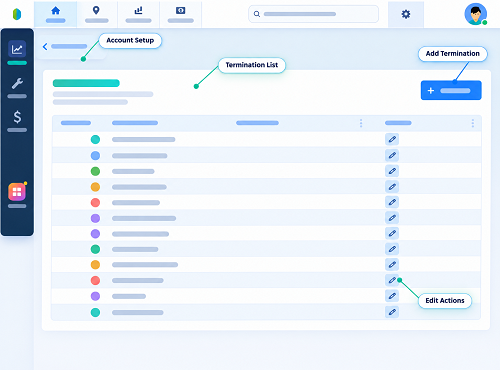
How Payroll Software Helps With Termination
A modern payroll system can automate several parts of the process.
Notice Period Alerts
HR can receive notifications when:
- Notice begins
- Notice is approaching its end
- Final working date is approaching
Contract Data
The system can display:
- Contract type
- Start date
- End date
- Notice terms
- Salary
- Allowances
Leave Reconciliation
The system can automatically retrieve the employee's leave balance.
Attendance Integration
Final payroll can use actual attendance information.
End-of-Service Calculation
The system can calculate the applicable benefit based on:
- Service period
- Final wage
- Termination reason
- Applicable statutory formula
Payroll Approval
HR and finance can review the settlement before payment.
Employee Termination Payroll Checklist
Before Termination
- Confirm termination reason
- Review employment contract
- Confirm contract type
- Determine applicable notice period
- Document termination decision
- Record termination date
During Notice Period
- Track attendance
- Process salary normally
- Record approved leave
- Record overtime
- Monitor changes to the final working date
- Prepare final settlement
Final Payroll
- Calculate outstanding salary
- Calculate approved overtime
- Reconcile annual leave
- Calculate applicable leave payment
- Calculate end-of-service benefit
- Calculate notice compensation where applicable
- Review authorized deductions
- Check allowances and other outstanding payments
After Termination
- Process final payment
- Provide required documentation
- Update employee status
- Complete applicable statutory processes
- Archive payroll records
- Close the employee profile
Frequently Asked Questions
What is the notice period for an employee paid monthly in Saudi Arabia?
For an indefinite-term contract, Article 75 generally provides 60 days' written notice when the employer terminates the contract and 30 days' written notice when the employee terminates the contract.
What happens if the required notice is not provided?
Article 76 generally requires the terminating party to compensate the other party with an amount equivalent to the worker's wage for the notice period, subject to the applicable legal and contractual provisions.
Does every termination require a notice period?
No. The applicable requirement depends on the contract type and reason for termination. Certain statutory situations allow termination without notice or compensation, subject to the conditions in the Labor Law.
Is unused annual leave paid when an employee leaves?
Generally, yes. Article 111 provides for payment of wages for accrued annual leave that has not been used when the employment relationship ends.
Is end-of-service benefit always payable?
Not necessarily. Entitlement depends on factors including length of service and the reason and manner in which the employment relationship ends. Saudi Arabia Labor Law contains specific provisions for calculation and resignation cases.
Can payroll software calculate final settlements?
Yes. A properly configured payroll system can combine contract information, attendance, leave, salary, overtime, notice dates, and end-of-service rules to support final-settlement calculations.
Conclusion
Employee contract termination in Saudi Arabia requires careful coordination between HR and payroll. The correct process begins by identifying the contract type and termination reason, followed by determining the applicable notice period and final working date.
Payroll should then reconcile salary, attendance, overtime, unused annual leave, end-of-service benefit, notice compensation where applicable, and other outstanding amounts.
A structured termination workflow supported by HR and payroll software can help employers track notice periods, calculate final settlements, maintain accurate records, and reduce payroll errors.
With InnBuilt Payroll Software, Saudi Arabia businesses can coordinate notice periods, attendance cut-offs, pending leave, deductions, and final payroll approvals to create a clear and auditable employee exit process.