What Should Singapore Employers Know Before Using Facial Attendance?
What Should Singapore Employers Know Before Using Facial Attendance?
Facial attendance systems are becoming an option for Singapore employers looking to automate employee check-ins, reduce manual timekeeping, and improve attendance accuracy. These systems use facial recognition technology to verify an employee's identity and record their working hours.
They can be useful for offices, factories, retail outlets, warehouses, healthcare facilities, and businesses with employees working across multiple locations. However, implementing facial attendance involves more than installing a camera or purchasing biometric software.
Employers need to understand how facial recognition works, what employee information is collected, how the system should be secured, and what obligations apply under Singapore's employment and personal data protection frameworks.
In particular, facial recognition involves biometric information, which requires careful handling. Employers should assess whether collecting this information is necessary and proportionate, explain the process to employees, and implement appropriate safeguards.
This article explains what Singapore employers should know before introducing facial attendance, including technology considerations, PDPA responsibilities, implementation challenges, and practical steps for selecting a suitable system.
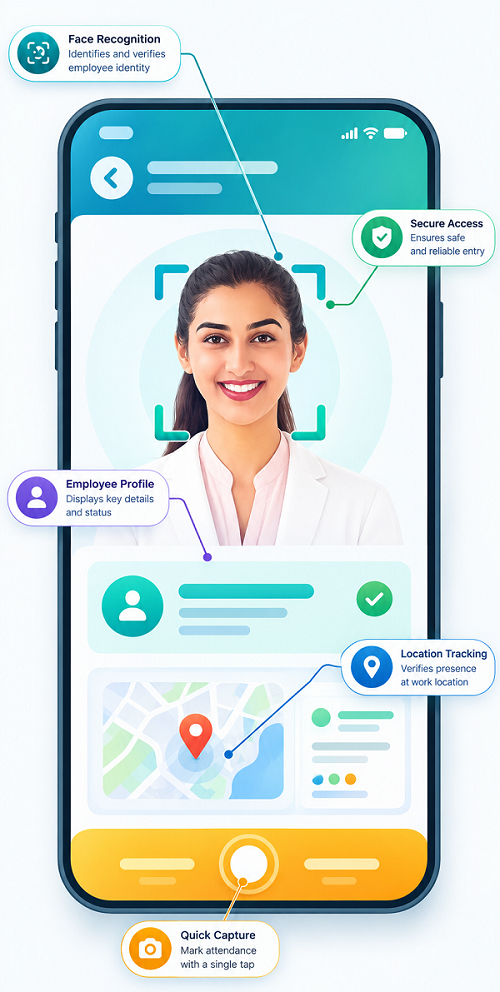
1. Understand How Facial Attendance Systems Work
Facial attendance systems use facial recognition technology to verify an employee's identity when they check in or check out.
A typical process involves the following steps:
- Employee registration: The employee's face is enrolled in the attendance system through an authorised registration process.
- Facial capture: A camera captures the employee's face when they approach the attendance terminal or use an approved application.
- Identity verification: The software compares the captured facial features with the registered facial template.
- Attendance recording: Once verification succeeds, the system records the check-in or check-out time.
- Data synchronisation: Attendance information is transferred to the central HR or attendance platform.
- Reporting: HR teams and managers can review attendance records, late arrivals, absences, and working hours.
Some systems use one-to-one facial verification, where the employee claims an identity and the system checks the face against that employee's registered template. Others use one-to-many identification, where the system searches a database to identify the person.
Employers should understand which method a vendor uses and whether it is appropriate for the intended workplace.
2. Recognise That Facial Information Is Biometric Data
One of the most important considerations is the type of information collected by facial attendance software.
A facial attendance system may process:
- Facial photographs or camera images.
- Facial feature measurements.
- Biometric templates or facial embeddings.
- Employee identification details.
- Check-in and check-out timestamps.
- Device and location information.
- Records of successful and unsuccessful verification attempts.
A facial image and a biometric template are not necessarily the same thing. A photograph may be captured as part of the enrolment or verification process, while a template represents facial characteristics in a format used for comparison.
Employers should ask vendors exactly what information is collected, whether original images are retained, how templates are generated, and when the information is deleted.
Under Singapore's Personal Data Protection Act (PDPA), biometric information that can identify an individual is personal data. Employers must assess the applicable PDPA obligations when collecting, using, or disclosing it.
The fact that a system converts a facial image into a digital template does not automatically remove the need to protect that information.
3. Understand Singapore's PDPA Requirements Before Implementation
Singapore employers should assess facial attendance arrangements against the PDPA before introducing the technology.
The PDPA governs the collection, use, and disclosure of personal data by organisations, subject to its scope and applicable exceptions.
Employers should pay particular attention to the following obligations.
Notification and Purpose
Employees should be informed about why facial information is being collected and how it will be used.
For example, an organisation may explain that facial recognition is used to verify employee identity and record attendance at designated workplace entrances.
The notification should describe relevant purposes clearly rather than using vague statements such as "for security and administration."
Consent and Applicable Exceptions
Employers should assess the appropriate basis for collecting, using, and disclosing employee personal data.
Consent may be relevant, but it is not the only possible basis under the PDPA. Certain exceptions may apply in employment-related circumstances, subject to specific conditions.
Employers should not assume that employees' employment status automatically permits any form of biometric monitoring. They should review the relevant PDPA provisions and obtain advice where necessary.
Purpose Limitation
Facial data collected for attendance verification should not automatically be reused for unrelated purposes.
For example, an employer should separately assess whether it is appropriate to use attendance facial data for employee productivity monitoring, behavioural analysis, or other workplace surveillance purposes.
Protection Obligation
Organisations must make reasonable security arrangements to protect personal data against unauthorised access, collection, use, disclosure, copying, modification, disposal, or similar risks.
For facial attendance systems, this may include encryption, access restrictions, secure storage, and vendor security assessments.
Retention Limitation
Personal data should not be retained longer than necessary for the purposes for which it was collected, or for legal or business purposes permitted under the PDPA.
Employers should establish a retention policy for facial images, biometric templates, verification logs, and attendance records. These categories may require different retention periods.
4. Inform Employees How Facial Attendance Will Be Used
Introducing facial attendance without clear employee communication can create concerns about privacy, surveillance, and the use of biometric information.
Employees should understand what the system does and what it does not do.
Before implementation, employers should explain:
- Why facial attendance is being introduced.
- Which employees are required or permitted to use it.
- What facial information is collected.
- Whether images or biometric templates are stored.
- Whether the system operates only during check-in and check-out.
- Whether location information is also collected.
- Who can access the information.
- How long different types of data are retained.
- Whether information is shared with a software vendor or other service provider.
- How employees can raise questions or report problems.
- What alternative attendance arrangements are available, where applicable.
This information can be communicated through an employee privacy notice, HR policy, staff briefing, or formal implementation announcement.
Employers should also provide a clear explanation of how attendance corrections and failed facial verification attempts will be handled.
5. Check Whether Facial Recognition Is Necessary for Your Workplace
Facial recognition is not automatically the best attendance method for every organisation.
Employers should first identify the attendance problems they are trying to solve and consider whether a less intrusive technology can achieve the same objective.
For example:
- An office with controlled entry may be able to use employee access cards.
- A small retail outlet may only need a PIN-based attendance terminal.
- A business with mobile employees may benefit from an application with location verification.
- A factory with a large workforce may consider biometric terminals if other methods do not provide sufficient identity verification.
Before choosing facial recognition, employers should compare the benefits with the privacy, security, financial, and operational implications.
A practical assessment should consider:
- The number of employees who will use the system.
- The number and location of attendance terminals.
- The risk of employees recording attendance for colleagues.
- Whether employees have suitable alternatives.
- The sensitivity of the information being collected.
- The cost of installation, maintenance, and software subscriptions.
- Whether the system can integrate with existing HR and payroll platforms.
The objective should be to select an attendance method that is effective without collecting more personal information than necessary.
6. Evaluate Facial Recognition Accuracy and Reliability
Not all facial attendance systems provide the same level of accuracy. Employers should evaluate how reliably the technology identifies employees under actual workplace conditions.
Factors that can affect facial recognition include:
- Poor lighting.
- Camera positioning.
- Changes in facial appearance.
- Face coverings or protective equipment.
- Reflections from glasses.
- Camera quality.
- Background movement.
- Network connectivity.
- Differences in the system's performance across demographic groups.
For example, a facial recognition terminal installed near a brightly lit glass entrance may perform differently from one installed in an indoor staff area.
Employers should ask vendors to explain how their systems handle these conditions.
Important evaluation questions include:
- What is the system's false acceptance rate?
- What is its false rejection rate?
- Does it support liveness detection?
- Can it detect photographs or video presented to the camera?
- Does it work in different lighting conditions?
- How does it handle employees wearing masks or safety equipment?
- Can employees retry verification when recognition fails?
- How are failed verification attempts recorded?
- Has the system been tested in environments similar to the employer's workplace?
A system should not automatically mark an employee absent simply because facial verification fails. Employers need a manual correction or alternative check-in process for genuine technical and recognition problems.
7. Check for Liveness Detection and Anti-Spoofing Controls
One risk associated with facial attendance is attendance fraud through photographs, videos, or other attempts to impersonate employees.
Liveness detection is a technology designed to help determine whether the camera is capturing a real person rather than a static image or artificial representation.
Depending on the system, liveness checks may use:
- Facial movement detection.
- Head movement instructions.
- Eye movement analysis.
- Depth sensing.
- Infrared camera technology.
- Other anti-spoofing techniques.
Employers should ask vendors which liveness detection methods are included and whether they are enabled by default.
They should also test whether the system can identify common spoofing attempts without making the check-in process unnecessarily difficult.
However, liveness detection does not guarantee that attendance fraud is impossible. Employers should combine technology with suitable supervision, audit trails, and attendance exception reviews.
8. Protect Facial Images and Biometric Templates
Facial attendance systems create security responsibilities because biometric information can be difficult to replace if it is compromised.
Unlike a password or access card, an employee cannot simply change their face after a data breach.
Employers should therefore examine how the software stores and protects facial information.
Important security features include:
- Encryption of data during transmission.
- Encryption of stored biometric templates.
- Restricted administrative access.
- Multi-factor authentication for privileged accounts.
- Secure employee enrolment procedures.
- Access and activity logs.
- Regular security updates.
- Backup and recovery arrangements.
- Secure deletion procedures.
- Protection against unauthorised data exports.
Employers should also determine whether biometric templates are stored locally on attendance devices, centrally on company servers, or in a vendor-managed cloud environment.
The storage arrangement affects how data is accessed, secured, backed up, and deleted.
Companies should avoid selecting a system based solely on recognition speed or price. The vendor's information security practices are equally important.
9. Understand Where Employee Facial Data Is Stored
Before signing a software agreement, employers should understand the system's data storage and hosting arrangements.
Some attendance platforms store biometric information on local devices, while others use centralised servers or cloud infrastructure.
Employers should ask vendors:
- Where are facial images and biometric templates stored?
- Are the images retained after enrolment?
- Are templates encrypted?
- Can the employer choose the hosting location?
- Which vendor employees can access the information?
- Is data transferred outside Singapore?
- Which subcontractors or cloud providers process the information?
- What happens to employee data when the contract ends?
- Can the employer obtain confirmation of data deletion?
Where personal data is transferred outside Singapore, organisations must assess the PDPA's Transfer Limitation Obligation and ensure that the applicable protection requirements are met.
The contract should also explain the vendor's responsibilities, security arrangements, incident reporting procedures, and data return or deletion obligations.
10. Review the Attendance Software Vendor's Responsibilities
Many employers use third-party attendance software providers to operate facial recognition systems.
Depending on the arrangement, the vendor may process employee personal data on behalf of the employer. Under the PDPA, an organisation's obligations and a data intermediary's obligations differ, but an organisation remains responsible for personal data in its possession or under its control.
Employers should conduct due diligence before giving a vendor access to employee biometric information.
Review the following areas:
| Vendor Area | What Employers Should Check |
|---|---|
| Security controls | Encryption, authentication, access restrictions, and security testing |
| Data storage | Storage location and hosting arrangements |
| Data processing | How facial images and templates are collected and used |
| Subcontractors | Whether third parties have access to employee data |
| Data retention | Retention periods and deletion procedures |
| Incident response | How security incidents are reported and managed |
| Data portability | Ability to export required attendance records |
| Contract termination | Return or deletion of biometric information |
| Technical support | Access controls for vendor support personnel |
| Compliance support | Documentation and assistance with data protection obligations |
The service agreement should clearly define which party is responsible for employee notifications, system security, incident management, and data deletion.
11. Provide an Alternative for Employees Who Cannot Use Facial Recognition
Some employees may be unable to use facial recognition reliably or may have concerns about biometric attendance.
Possible reasons include:
- Facial recognition difficulties caused by lighting or camera limitations.
- Medical or physical conditions affecting recognition.
- Religious or personal considerations involving face coverings.
- Workplace protective equipment.
- Temporary injuries or changes in appearance.
- Accessibility requirements.
- Technical problems with the attendance device.
Employers should establish an alternative attendance procedure.
Possible alternatives include:
- Employee access cards.
- PIN-based attendance.
- Supervisor-verified check-in.
- Web-based attendance.
- An authorised mobile attendance application.
- Manual attendance correction with approval.
The alternative process should be documented and applied consistently.
Employees should not lose pay or be unfairly treated simply because a facial recognition device fails to identify them. Attendance records should be reviewed using reliable supporting information before any decision is made.
12. Integrate Facial Attendance with HR and Payroll Systems
Facial recognition only verifies identity at the point of attendance. Employers still need to convert the recorded timestamps into useful working-hour and payroll information.
The attendance platform should integrate with the company's HR and payroll systems or provide reliable data exports.
Important integration capabilities include:
- Employee identification and department mapping.
- Check-in and check-out timestamps.
- Shift schedules.
- Break and meal-period information.
- Late arrival and early departure records.
- Absence and leave information.
- Overtime records.
- Outlet or department information.
- Attendance correction approvals.
- Payroll-ready reports.
For example, if an employee records attendance at 9:00 AM and checks out at 6:00 PM, the system should compare these timestamps with the assigned schedule and applicable break arrangements.
It should then transfer approved attendance information to payroll for processing.
Employers should test whether the system can handle overnight shifts, missing punches, duplicate entries, and employee transfers without creating incorrect working-hour calculations.
13. Ensure Attendance Records Meet Employment Recordkeeping Requirements
Facial attendance software can help Singapore employers maintain reliable working-hour records, but the system must be configured to capture the information required under applicable employment rules.
The Ministry of Manpower (MOM) requires employers to maintain detailed employment records for employees covered by the Employment Act.
These records include relevant working hours, meal and tea break durations, leave information, and overtime hours and pay.
MOM generally requires employers to retain the latest two years of records for current employees. For former employees, the last two years of records must generally be kept for one year after they leave employment.
Employers should therefore check whether the attendance platform can:
- Store daily attendance records.
- Record working hours and relevant break durations.
- Identify missing check-in and check-out entries.
- Maintain approved attendance corrections.
- Generate employee-level attendance reports.
- Export records for payroll and compliance reviews.
- Retain required employment records for the applicable period.
Facial recognition data and employment attendance records should not automatically have identical retention periods. Employers should define separate retention rules based on the purpose and applicable requirements.
For working-hour and overtime rules, employers must also identify which employees are covered by Part 4 of the Employment Act. Its provisions do not apply to managers and executives, and eligibility depends on the statutory criteria.
14. Test the System Before Introducing It Across the Organisation
Employers should conduct a pilot before deploying facial attendance throughout the workplace.
Testing should include different employee groups, operating conditions, and attendance scenarios.
| Test Scenario | Expected Result |
|---|---|
| Employee registers for the first time | System securely enrols the employee |
| Employee checks in under normal lighting | Correct identity and timestamp are recorded |
| Employee checks in under poor lighting | System handles the attempt reliably or provides an alternative |
| Employee wears a mask or safety equipment | System follows its documented recognition process |
| Photograph is presented to the camera | Anti-spoofing controls respond as designed |
| Employee cannot be recognised | Alternative attendance procedure is available |
| Internet connection is interrupted | System follows its documented offline process, if supported |
| Employee checks in twice | Duplicate or unusual entries are flagged |
| Manager corrects attendance | System records the correction and approval history |
| HR exports attendance | Data is transferred accurately to payroll |
| Employee leaves the organisation | Access is revoked and data is handled under the retention policy |
The pilot should involve HR, IT, payroll, managers, and employees.
Feedback should be collected on recognition speed, ease of use, accuracy, privacy concerns, and the availability of alternative attendance procedures.
15. Calculate the Total Cost of Facial Attendance Implementation
The cost of facial attendance includes more than the initial purchase price of biometric terminals.
Employers should estimate the total cost of ownership before choosing a solution.
Potential costs include:
- Facial recognition attendance devices.
- Cameras and supporting hardware.
- Software subscription fees.
- Employee enrolment and configuration.
- Installation and network setup.
- Integration with HR and payroll systems.
- Cloud hosting and storage.
- Maintenance and technical support.
- Security upgrades.
- Employee training.
- Replacement devices and repairs.
For businesses with several outlets, the number of devices and locations can significantly affect implementation costs.
Employers should compare the full cost of facial attendance with alternative methods such as RFID, PIN-based, or mobile attendance.
The evaluation should consider operational benefits, privacy implications, reliability, and long-term maintenance rather than focusing only on the initial price.
16. Common Mistakes Singapore Employers Should Avoid
Facial attendance can create operational and privacy problems when it is introduced without adequate planning.
Common mistakes include:
- Assuming facial attendance automatically ensures compliance: The technology records identity and timestamps, but employers remain responsible for applicable employment and data protection obligations.
- Collecting more biometric information than necessary: Employers should understand whether the system needs to retain original facial images or whether a more limited data approach can meet the attendance objective.
- Failing to explain the system to employees: Employees should receive clear information about the collection, use, storage, and retention of facial information.
- Ignoring failed recognition attempts: A failed facial scan should not automatically be treated as an absence or misconduct.
- Choosing software without testing accuracy: Employers should test the system under actual workplace conditions rather than relying only on vendor demonstrations.
- Overlooking vendor security: Companies should review data storage, access permissions, encryption, subcontractors, and incident response arrangements.
- Using facial data for unrelated purposes: Information collected for attendance should not be repurposed without assessing the applicable legal basis and notifying employees where required.
- Not providing alternative check-in methods: A backup process is essential for employees who cannot use facial recognition or when the device fails.
- Retaining biometric data indefinitely: Employers should establish and enforce suitable retention and deletion practices.
Conclusion
Facial attendance can help Singapore employers automate employee identity verification, reduce proxy attendance, and improve the accuracy of working-hour records. However, the technology also introduces important responsibilities involving biometric information, employee privacy, information security, and system reliability.
Before implementation, employers should assess whether facial recognition is necessary, understand the information being collected, review their PDPA obligations, and evaluate the vendor's security and data handling practices.
They should also provide clear employee communication, alternative attendance methods, reliable correction procedures, and appropriate integration with HR and payroll systems.
The best facial attendance solution is not simply the one that recognises faces quickly. It is one that supports the organisation's operational requirements while treating employee information responsibly and maintaining accurate attendance records.
Review consent and notice processes, access rights and biometric data handling before deployment. Request InnBuilt's documented controls for the intended Singapore use case.