What Are the Total Costs of Payroll Software in Singapore?
What Are the Total Costs of Payroll Software in Singapore?
Choosing payroll software is an important investment for Singapore businesses. The right system can automate monthly salary calculations, CPF contributions, payslip generation, leave deductions, overtime payments and annual employment income reporting. However, the total cost involves more than the monthly subscription fee.
Depending on the provider and the features selected, employers may also need to pay for implementation, employee data migration, training, additional HR modules, integrations, customer support and year-end reporting services. Some vendors charge a fixed monthly subscription, while others calculate fees according to the number of employees or modules used.
Businesses should also distinguish between payroll software costs and statutory employment expenses. Employer CPF contributions, Skills Development Levy (SDL), salary payments and other employment obligations are not software subscription charges, even though payroll software may help calculate and administer them.
Understanding these cost components helps Singapore employers prepare realistic budgets and compare vendors more effectively.
This article explains the main costs of payroll software in Singapore, the factors that influence pricing and how businesses can calculate the total cost of ownership before selecting a system.
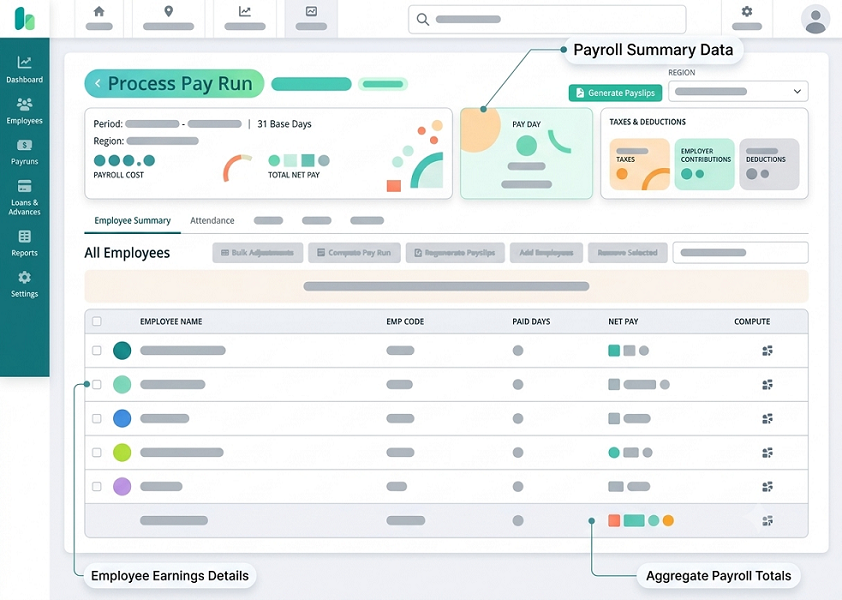
1. Understand the Main Payroll Software Pricing Models
Payroll software providers in Singapore generally use different pricing structures. Understanding the model is the first step in estimating the total cost.
Per-employee pricing
Under this model, the employer pays a monthly or annual fee for each employee included in the payroll system.
For example, if a provider charges S$5 per employee per month and the company has 30 employees, the basic monthly subscription would be:
30 × S$5 = S$150 per month.
The fee may increase when the organisation hires more employees. Some vendors also apply minimum employee counts or minimum monthly charges.
This model can be suitable for businesses with predictable headcounts that want subscription costs to scale with their workforce.
Fixed monthly subscription
Some providers charge a flat monthly fee for a particular employee-count range.
For example, a plan may cover up to 20 employees for a fixed monthly amount. The subscription may remain unchanged as long as the company stays within that limit.
This approach can help employers forecast expenses, particularly when their workforce changes regularly.
Base fee plus employee charges
Some vendors combine a monthly account fee with an additional charge for each employee.
For example:
- Monthly base fee: S$30.
- Employee charge: S$4 per employee.
- Employee count: 25.
The monthly cost would be:
S$30 + (25 × S$4) = S$130.
This model may include account administration or core functionality in the base fee, with employee charges increasing according to headcount.
Modular pricing
Under modular pricing, businesses pay separately for different features.
A company may purchase payroll processing first and add other modules when required, such as:
- Leave management.
- Attendance tracking.
- Employee self-service.
- Expense claims.
- Shift scheduling.
- Performance management.
- HR document management.
Modular pricing can be useful for businesses that need only a few features. However, the total cost can rise significantly when several modules are added.
2. Estimate the Monthly Payroll Software Subscription
The monthly subscription is usually the most visible cost.
As a broad budgeting reference, Singapore payroll software may cost approximately S$5 to S$10 per employee per month for common SME plans, although some products use flat fees, minimum charges or higher-priced bundles. Enterprise solutions and specialised configurations may cost more.
These are indicative budgeting ranges, not fixed market rates or guaranteed vendor quotations.
The actual price depends on:
- Number of employees.
- Full-time and part-time employee categories.
- Payroll frequency.
- Number of legal entities.
- Available statutory reporting features.
- Included HR modules.
- Vendor support arrangements.
- Annual or monthly billing.
For example, Talenox publishes a Singapore payroll plan priced at S$21.80 monthly minimum covering the first five employees. Its published prices include GST. This is one vendor's published rate, not an industry-wide price.
Before comparing subscription fees, employers should confirm whether the quoted price includes GST, the minimum employee charge and any limits on payroll processing.
3. Calculate the Cost According to Employee Headcount
Employee count has a direct impact on payroll software expenses, particularly when vendors charge per employee.
The following illustration uses an assumed subscription rate of S$5 per employee per month.
| Number of employees | Monthly subscription | Annual subscription |
|---|---|---|
| 5 | S$25 | S$300 |
| 10 | S$50 | S$600 |
| 25 | S$125 | S$1,500 |
| 50 | S$250 | S$3,000 |
| 100 | S$500 | S$6,000 |
| 200 | S$1,000 | S$12,000 |
These figures are illustrative and exclude implementation, additional modules, integrations and other charges. Actual invoices may also be affected by minimum fees, employee-count definitions and GST.
Employers should ask vendors whether inactive employees, employees on unpaid leave, former employees and temporary workers count towards the billable headcount.
This is particularly important for businesses with seasonal staffing or frequent employee movements.
4. Include One-Time Implementation and Setup Fees
Payroll software implementation can involve more than creating an administrator account.
The vendor may need to configure the organisation's payroll structure, employee records, salary components, statutory settings and approval workflows.
Possible setup activities include:
- Company and legal entity configuration.
- Employee profile creation.
- Payroll calendar setup.
- Salary component configuration.
- CPF and SDL settings.
- Leave and attendance configuration.
- Bank payment file setup.
- User access permissions.
- Approval workflow configuration.
- Initial payroll testing.
Some vendors include basic onboarding in the subscription, while others charge a separate implementation fee.
For budgeting purposes, employers may use an indicative allowance of S$300 to S$1,500 or more for implementation, depending on the complexity of the project. This is a planning estimate rather than a verified standard market tariff.
A small company with straightforward monthly salaries may require minimal setup. A business with multiple entities, different pay groups, complex overtime arrangements and historical data migration may need a more extensive implementation.
Ask vendors to provide a written breakdown of included and chargeable setup activities.
5. Account for Employee Data Migration Costs
Businesses replacing an existing payroll system may need to transfer historical information into the new platform.
Data migration can include:
- Employee personal details.
- Employment start and end dates.
- Salary information.
- Allowance and deduction records.
- CPF contribution history.
- Leave balances.
- Historical payslips.
- Tax reporting information.
- Bank payment details.
- Previous payroll adjustments.
Some providers include basic employee imports through spreadsheets. Others charge for data cleaning, custom templates, historical record conversion or migration support.
The cost depends on the volume, quality and format of the existing information.
For example, transferring 20 employee records from a standard spreadsheet may be relatively straightforward. Migrating several years of payroll data from a customised legacy system may require additional technical work.
Before signing a contract, employers should ask:
- Is employee data migration included?
- Are historical payslips included?
- How many years of records can be imported?
- Are there additional charges for data cleaning?
- Can the vendor migrate leave balances and CPF history?
- Who verifies the migrated information?
A low subscription price may not represent good value if migration is expensive or incomplete.
6. Consider the Cost of Additional HR Modules
Many payroll platforms offer additional HR features as separate modules or part of higher-priced bundles.
These features can improve operational efficiency, but employers should evaluate whether they genuinely need them.
| Additional module | Main purpose | Possible cost impact |
|---|---|---|
| Leave management | Tracks annual, sick and other leave | Additional subscription or bundle fee |
| Attendance management | Records working hours and attendance | May require separate licensing |
| Mobile attendance | Supports employee check-ins through mobile devices | May involve per-user charges |
| Overtime management | Calculates and approves overtime | May be included or charged separately |
| Expense claims | Manages reimbursements | Often an additional module |
| Employee self-service | Provides access to payslips and employee information | May be included in higher plans |
| Shift scheduling | Manages rosters and working schedules | May require a separate subscription |
| Performance management | Tracks goals and appraisals | Usually part of an HR bundle |
| Recruitment | Manages job applications and hiring | Often priced separately |
For example, a company may initially purchase payroll software for salary calculations and CPF administration. Later, it may add leave management and expense claims to reduce manual work.
The additional subscription should be compared against the time and administrative effort saved.
A bundled HR and payroll solution may be more economical than purchasing several separate applications, but employers should compare the actual features and employee limits rather than assuming that a bundle is automatically cheaper.
7. Check the Cost of CPF and Statutory Reporting Features
Singapore payroll software should support relevant statutory payroll calculations and reporting.
Important features include:
- CPF contribution calculations.
- Skills Development Levy calculations.
- Applicable Self-Help Group contribution handling.
- CPF submission support.
- IRAS employment income reporting.
- AIS submission support, where available.
- Itemised payslip generation.
- Payroll record management.
Some vendors include these functions in their standard payroll subscription. Others may charge for specific reporting services, direct submissions or advanced compliance features.
Employers should ask whether the subscription includes:
- CPF calculations and submission support.
- SDL calculations.
- Applicable SHG contribution handling.
- IR8A generation.
- Appendix 8A and Appendix 8B support, where applicable.
- AIS electronic submission.
- Amendment support.
- Year-end reporting assistance.
A software provider may generate IR8A information without supporting direct AIS submission. These are different capabilities and should be evaluated separately.
Also, CPF contributions and SDL are employer statutory costs, not payroll software fees. The software calculates or facilitates these obligations; it does not absorb the amounts payable to the authorities.
8. Include Integration and API Costs
Payroll software may need to exchange information with other business systems.
Common integrations include:
- Accounting software.
- HR management systems.
- Attendance applications.
- Leave management systems.
- Expense management platforms.
- CRM and commission systems.
- Banking and payment platforms.
- ERP applications.
Some vendors provide standard integrations at no additional charge. Others charge for premium connectors, API access, custom development or third-party applications.
For example, a company may want attendance records transferred automatically into payroll so that approved overtime hours can be included in salary calculations.
If the integration is not included in the subscription, the business may need to pay for:
- API access.
- Connector licensing.
- Integration setup.
- Custom development.
- Ongoing technical maintenance.
Employers should confirm whether integrations are included, whether they have transaction limits and who is responsible for resolving integration failures.
9. Evaluate Training and Employee Support Costs
Training is another cost that may be overlooked during software selection.
Payroll administrators need to understand how to configure salary components, run payroll, manage statutory submissions and resolve errors.
Training may cover:
- Employee record management.
- Monthly payroll processing.
- CPF configuration.
- Salary adjustments.
- Leave and attendance integration.
- IRAS reporting.
- Payroll approvals.
- Report generation.
- System administration.
Some providers include basic online training and support in their subscription. Others charge for dedicated training sessions, on-site assistance or advanced implementation workshops.
Employers should also understand the vendor's support model.
Ask whether the contract includes:
- Email support.
- Telephone support.
- Live chat.
- Remote troubleshooting.
- Dedicated account management.
- Payroll-period priority support.
- Response-time commitments.
- Additional charges for on-site assistance.
A payroll system with a lower subscription fee may become more expensive if every training session or technical support request is billed separately.
10. Account for Additional Payroll Runs and Special Processing
Most payroll subscriptions are designed around a standard payroll cycle. Businesses with frequent off-cycle payments may need to check whether additional processing is included.
Additional payroll runs may be required for:
- Final salary payments.
- Urgent salary corrections.
- Commission payments.
- Bonus payments.
- Salary adjustments.
- Special incentive payments.
- Payroll corrections after approval.
Some vendors allow unlimited payroll runs under the subscription. Others may charge for additional processing or require a higher-tier plan.
The cost can be particularly important for businesses with frequent joiners and leavers, variable pay arrangements or multiple salary groups.
Ask the vendor whether off-cycle processing, supplementary payroll runs and corrected payslips are included.
11. Review Year-End Reporting and Tax Filing Charges
Annual employment income reporting is an important part of Singapore payroll administration.
Employers may need software support for:
- Form IR8A.
- Appendix 8A.
- Appendix 8B.
- AIS electronic submission.
- Annual payroll reconciliation.
- Correction of submitted records.
- Historical employment income reports.
Some vendors include these services in the regular subscription, while others charge separately for year-end reporting or assisted filing.
Employers should clarify whether the quoted price includes direct AIS submission or only report generation.
Also check whether additional charges apply for:
- Each employee included in the annual report.
- Amended employment income records.
- Tax reporting for former employees.
- Appendix preparation.
- Assisted annual reconciliation.
- Form IR21 tax clearance workflows.
For non-Singapore Citizen employees, employers may need to complete tax clearance where required. Payroll software may provide reminders or prepare information, but a separate service fee may apply if the vendor offers assisted processing.
12. Understand the Difference Between Software Costs and Payroll Outsourcing Costs
Payroll software and payroll outsourcing are not the same service.
With payroll software, the employer generally uses the application to manage payroll internally. The organisation remains responsible for entering data, reviewing calculations, approving payments and completing the necessary compliance activities.
With payroll outsourcing, an external provider performs some or all payroll administration activities on the employer's behalf.
| Cost or service | Payroll software | Payroll outsourcing |
|---|---|---|
| Software subscription | Usually applicable | May be included in service fee |
| Employee data entry | Usually handled internally | May be handled by provider |
| Salary calculations | Automated by software | Performed or reviewed by provider |
| CPF preparation | Software-assisted | Often handled by provider |
| IRAS reporting | Depends on software features | May be included as a service |
| Payroll approvals | Employer-controlled | Employer usually retains final approval |
| Payroll queries | Vendor provides technical support | Provider may handle payroll administration queries |
| Implementation | May be charged separately | May include onboarding and data setup |
Outsourced payroll services in Singapore can have substantially different pricing from software subscriptions. Published service guides show that managed payroll fees may be charged per employee, with minimum monthly fees and additional charges for setup, year-end reporting and tax clearance.
Employers should compare the complete service scope rather than comparing a software subscription directly with a managed payroll fee.
13. Check GST and Contract-Related Charges
When reviewing vendor quotations, employers should confirm whether the quoted prices include Goods and Services Tax (GST).
Singapore's prevailing standard GST rate is 9%. If a quoted price excludes GST, the final invoice will be higher for a GST-taxable supply made by a GST-registered provider.
For example:
| Item | Amount |
|---|---|
| Annual software subscription before GST | S$1,200 |
| GST at 9% | S$108 |
| Total including GST | S$1,308 |
This is an illustrative calculation. Confirm the vendor's GST registration and the tax treatment of the actual supply.
Employers should also review contract terms that can affect total costs:
- Minimum contract period.
- Annual versus monthly billing.
- Early termination fees.
- Renewal price increases.
- Minimum employee commitments.
- Charges for adding legal entities.
- Data export fees.
- Contract cancellation procedures.
- Charges for retaining historical records after termination.
A lower annual subscription may require a longer commitment. Businesses should compare the savings with the flexibility of monthly billing.
14. Calculate the Total Cost of Ownership
The total cost of ownership (TCO) includes recurring and one-time expenses associated with implementing and operating payroll software.
A useful calculation is:
Total Cost of Ownership = Subscription Fees + Implementation + Migration + Modules + Integrations + Training + Support + Other Charges
For example, consider a Singapore company with 50 employees evaluating a payroll system.
The following is an illustrative first-year budget using assumed costs, not a quotation from a specific provider.
| Cost component | Estimated amount |
|---|---|
| Payroll subscription: S$5 × 50 employees × 12 months | S$3,000 |
| Implementation and setup | S$800 |
| Employee data migration | S$300 |
| Leave management module | S$600 |
| Accounting integration setup | S$400 |
| Training | S$300 |
| Additional support allowance | S$200 |
| Estimated first-year cost before GST | S$5,600 |
The estimated recurring annual cost after the initial setup and migration activities would be:
S$3,000 + S$600 + S$200 = S$3,800.
The actual recurring amount depends on whether modules, integrations and support are billed annually or as one-time services.
Employers should calculate both the first-year cost and the expected recurring cost. This provides a more realistic basis for comparing vendors.
15. Compare the Costs of Different Payroll Software Options
A practical vendor comparison should include more than the advertised subscription rate.
For example, a business evaluating three hypothetical payroll solutions could prepare the following table.
| Cost component | Vendor A | Vendor B | Vendor C |
|---|---|---|---|
| Monthly subscription | S$150 | S$180 | S$130 |
| Annual subscription | S$1,800 | S$2,160 | S$1,560 |
| Setup fee | S$500 | S$300 | S$800 |
| Migration fee | S$200 | Included | S$300 |
| Additional HR modules | S$400 | S$600 | S$500 |
| Integration costs | S$200 | S$100 | S$400 |
| First-year total | S$3,100 | S$3,160 | S$3,560 |
These are fictional figures designed to illustrate how a comparison should be structured.
Vendor C has the lowest monthly subscription but the highest first-year total because of its setup and integration costs.
Vendor B has a higher subscription but includes data migration.
This demonstrates why employers should evaluate the total package rather than selecting software based only on the lowest monthly price.
16. Check Whether Government Grants or Support Schemes Apply
Businesses may also investigate whether government support is available for eligible digitalisation or productivity investments.
However, employers should not assume that every payroll software product or subscription qualifies for a grant.
Eligibility may depend on:
- The business's size and registration.
- The type of solution.
- The vendor's current approval status.
- The grant's application requirements.
- Whether the business applies before committing to the purchase.
- The eligible cost categories and funding limits.
Employers should check current requirements through official Singapore government channels, such as Enterprise Singapore and IMDA.
Do not include an unconfirmed grant in the payroll software budget. Treat potential funding as a separate possibility until eligibility and approval have been verified.
17. Identify Hidden Payroll Software Costs
Some costs become visible only after the organisation starts using the system.
Common charges to investigate include:
- Minimum monthly billing.
- Additional employee licences.
- Charges for inactive employee records.
- Extra legal entities.
- Additional payroll runs.
- Year-end reporting.
- AIS submission or amendment services.
- Advanced reporting.
- API access.
- Custom integrations.
- Dedicated account management.
- Historical data export.
- On-site training.
- Premium technical support.
- Contract termination or migration assistance.
Employers should request a complete price schedule before signing the contract.
The vendor should identify which services are included, which are optional and which are charged separately.
A written quotation is more useful than relying on an introductory demonstration or a headline starting price.
Conclusion
The total cost of payroll software in Singapore depends on more than the monthly subscription. Businesses should consider employee licensing, implementation, data migration, HR modules, integrations, training, technical support and annual reporting charges.
A basic payroll subscription may be sufficient for a small company with straightforward monthly salary arrangements. Businesses with larger workforces, multiple legal entities, shift schedules, variable pay and complex reporting needs may require additional modules or a more comprehensive platform.
The best approach is to calculate the first-year cost and recurring annual cost separately. Employers should also confirm whether CPF administration, AIS reporting, additional payroll runs and employee support are included in the quoted price.
By comparing the complete cost of ownership, Singapore employers can select payroll software that fits their workforce requirements, supports statutory payroll administration and delivers measurable operational value.
Compare licence charges, implementation, migration, support and integration fees across bids. Request a Singapore-specific InnBuilt proposal with your entity and employee counts.