How Can UAE Home Healthcare Providers Verify Nurse Visits at Patient Homes?
How Can UAE Home Healthcare Providers Verify Nurse Visits at Patient Homes?
Introduction
Home healthcare services play an important role in the UAE by helping patients receive nursing care, medical support, and recovery assistance in the comfort of their homes. However, managing nurses who travel between multiple patient locations creates operational challenges for home healthcare providers.
Care coordinators need to know whether a nurse arrived at the assigned address, completed the scheduled visit, delivered the required services, and documented the patient's condition. Without a reliable verification process, providers may struggle with inaccurate visit records, missed appointments, delayed patient updates, billing disputes, and payroll discrepancies.
Manual attendance registers, phone calls, and messaging applications can help with basic coordination, but they may not provide a consistent record of every visit.
A digital nurse visit verification system can help UAE home healthcare providers record arrival and departure times, confirm assigned locations, capture care documentation, and monitor visit completion. When implemented with appropriate privacy safeguards and clinical oversight, it can improve accountability without creating unnecessary administrative work for nurses.
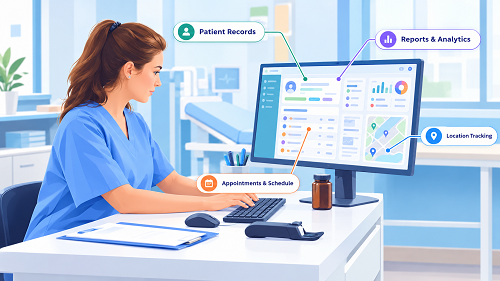
1. Create a Digital Schedule for Every Patient Visit
The first step is to establish a centralized scheduling process for all home healthcare visits. Each scheduled visit should be connected to a specific patient, assigned nurse, address, time window, and care plan.
A digital schedule should contain:
- Patient identification using a secure internal reference.
- Assigned nurse and relevant professional qualifications.
- Approved patient address and visit instructions.
- Scheduled arrival time and expected visit duration.
- Required nursing services or procedures.
- Special equipment or supplies needed.
- Contact details for authorised patient representatives.
- Escalation instructions for missed visits or urgent concerns.
For example, a home healthcare provider operating across Dubai, Sharjah, and Abu Dhabi may have nurses completing several visits each day. A centralised schedule helps coordinators see which nurse is assigned to each patient and identify potential delays before they affect subsequent appointments.
The system should also prevent overlapping assignments and allow realistic travel time between patient homes.
2. Verify Arrival at the Correct Patient Address
One of the most important controls is confirming that a nurse has arrived at the correct location.
Providers can use a mobile application with location-based check-in to record a nurse's position at the start of a visit. When the nurse reaches the authorised patient address, the application can allow a check-in within a defined geographical area.
Useful verification methods include:
- GPS-based check-in at the assigned address.
- A timestamped mobile check-in record.
- A location match against the scheduled visit.
- A one-time verification code shared with the authorised patient or representative, where appropriate.
- A coordinator-approved exception process when location services fail.
A GPS check-in can help establish that a nurse's device was near the assigned location at a particular time. However, it does not independently prove that the nurse entered the home, met the patient, or delivered the prescribed care.
For this reason, providers should combine location verification with visit documentation and, where suitable, patient or representative confirmation.
3. Record Actual Arrival and Departure Times
Scheduled appointment times and actual visit times may differ because of traffic, emergencies, patient availability, or changes in the care plan.
A digital system should record the actual start and end of each visit rather than relying exclusively on the planned schedule.
For every visit, providers should capture:
- Scheduled arrival and departure times.
- Actual check-in and check-out timestamps.
- Any delay or early departure.
- The reason for a significant schedule deviation.
- The person who approved an exception, when approval is required.
- Any follow-up action needed.
For example, a nurse may be scheduled to arrive at 10:00 a.m. but reach the patient's home at 10:15 a.m. because of traffic. The system should retain the actual arrival time and record the delay according to the provider's policy.
If the nurse must leave early because of an urgent clinical situation, the record should explain the reason and identify any handover or follow-up arrangements.
Accurate timestamps help managers understand service delivery patterns and distinguish genuine operational delays from incomplete attendance records.
4. Confirm That the Visit Was Completed
Arrival alone is not enough to establish that a home healthcare visit was completed.
Providers should define a clear visit-completion workflow that requires nurses to document the service delivered and close the visit only after the necessary records are completed.
Depending on the care plan, the workflow may include:
- Confirmation that the nurse attended the patient.
- A record of the nursing assessment.
- Documentation of the care or procedures performed.
- Relevant observations and measurements.
- Medication-related documentation, where applicable and within the nurse's authorised scope.
- Patient education or caregiver instructions.
- Details of any issue requiring clinical escalation.
- Follow-up recommendations or the next scheduled visit.
The exact documentation should depend on the service provided and the applicable clinical requirements.
A visit can be flagged as incomplete if required fields are missing. However, the system should allow authorised staff to correct legitimate documentation errors through an auditable process rather than encouraging nurses to enter inaccurate information simply to close a task.
Digital completion records help supervisors identify visits that require review and ensure that clinical documentation remains separate from basic attendance data.
5. Use Patient or Caregiver Confirmation Where Appropriate
Patient confirmation can provide an additional layer of assurance that a scheduled visit took place.
Depending on the patient's circumstances, a provider may allow the patient or an authorised caregiver to confirm that the nurse attended. Suitable methods can include a secure in-app confirmation, a one-time code, or a follow-up call from the coordination team.
A confirmation process should be simple enough for elderly patients and people who may not be comfortable using smartphones.
Providers should establish clear procedures for situations where:
- The patient is unable to use a mobile device.
- The patient has cognitive or communication difficulties.
- The caregiver is unavailable.
- The patient is asleep or receiving urgent care.
- The nurse completed the visit but the patient cannot confirm it digitally.
Patient confirmation should supplement professional documentation and supervisory review, not replace clinical records. Providers should never require a patient to disclose sensitive information through an insecure channel merely to verify attendance.
6. Manage Missed Visits, Delays, and Location Exceptions
Home healthcare teams often work across wide geographical areas, and unexpected problems can disrupt schedules.
A visit verification system should flag exceptions automatically so that coordinators can respond promptly.
| Exception | Recommended action |
|---|---|
| Nurse has not checked in within the expected window | Contact the nurse and assess whether the visit is delayed |
| Check-in is outside the assigned location | Verify the address and investigate the discrepancy |
| GPS is unavailable or inaccurate | Use an approved alternative verification process |
| Patient is not available | Record the outcome and follow the rescheduling policy |
| Nurse leaves before the planned end time | Record the reason and arrange any required follow-up |
| Visit documentation is incomplete | Request completion or supervisor review |
| Patient reports that the nurse did not attend | Investigate using available records and contact the relevant parties |
| Urgent clinical concern arises | Follow clinical escalation and emergency procedures |
Not every exception indicates misconduct. A nurse may encounter poor mobile coverage, an incorrect address, a patient emergency, or an application failure.
Managers should investigate exceptions fairly, considering the available evidence and the clinical circumstances.
7. Protect Patient Privacy During Visit Verification
Home healthcare involves sensitive medical information and private residential locations. Verification technology must therefore be designed to protect both patients and nurses.
Providers should establish controls such as:
- Collecting only the location and attendance data needed for legitimate operational purposes.
- Restricting patient information to authorised personnel.
- Using secure authentication and access permissions.
- Protecting data during transmission and storage.
- Maintaining audit logs for access and changes.
- Defining retention periods and secure deletion procedures.
- Explaining the purpose of location verification to staff.
- Avoiding continuous tracking when a visit-based check-in is sufficient.
- Establishing procedures for lost devices and suspected data breaches.
The UAE's health information framework requires healthcare providers to protect health data and control access and disclosure. Providers should review the applicable federal and emirate-specific requirements when selecting or configuring a digital system.
The UAE Government's official guidance on health information and privacy is available through its health policy and law resources.
8. Integrate Visit Verification With Attendance and Payroll
Home healthcare providers often need to coordinate field attendance, patient visit records, staff working hours, and payroll. Keeping these records in separate systems can lead to duplicate entry and inconsistent information.
Integration can help transfer verified attendance data into workforce management and payroll workflows.
For example, a system may compare the nurse's planned schedule with recorded check-in and check-out times, flag missing records, and send approved attendance exceptions for review.
Important integration capabilities include:
- Nurse shift scheduling.
- Mobile attendance and visit timestamps.
- Approved overtime and additional assignments.
- Leave and absence management.
- Travel or expense records, where applicable.
- Supervisor approval of exceptions.
- Payroll export and audit reports.
However, a patient visit should not automatically be treated as proof of every paid working hour. Travel between patients, documentation, approved breaks, training, emergency assignments, and other duties may also form part of a nurse's working time under the applicable arrangements.
Providers should apply documented attendance and payroll policies and ensure that disputed records can be reviewed before salary calculations are finalised.
9. Choose Suitable Nurse Visit Verification Software
The right software should support field operations as well as clinical documentation. Providers should evaluate systems based on the number of nurses, patient locations, types of care, connectivity conditions, and existing healthcare applications.
Look for features such as:
- Mobile check-in and check-out.
- Location verification at scheduled patient addresses.
- Offline functionality with secure synchronisation, where available.
- Patient visit scheduling and route planning.
- Digital care documentation.
- Patient or caregiver confirmation options.
- Alerts for missed visits and unusual records.
- Supervisor dashboards and exception reports.
- Role-based access controls and audit trails.
- Integration with clinical, attendance, and payroll systems.
Before implementation, conduct a pilot with a small group of nurses and coordinators. Test location accuracy, usability, battery consumption, offline workflows, and the time required to complete documentation.
Training should explain not only how to use the application but also what to do when the technology fails or a clinical emergency takes priority.
10. Monitor Visit Verification Performance
Once the process is in place, managers should review performance indicators to identify recurring problems and improve service quality.
Useful metrics include:
- Percentage of visits with complete check-in and check-out records.
- Percentage of visits completed within the agreed time window.
- Number of missed or delayed visits.
- Number of location mismatches.
- Number of incomplete clinical records.
- Time taken to resolve attendance exceptions.
- Patient complaints relating to missed appointments.
- Frequency of schedule changes.
- Staff feedback on the verification process.
These metrics should be interpreted in context. A location mismatch may result from GPS inaccuracies, while a delayed visit may reflect a clinical emergency or longer-than-expected care requirements.
The purpose of reporting should be to improve reliability and patient safety, not to penalise nurses automatically for every deviation.
Example: Verifying Daily Visits for a UAE Home Healthcare Team
Consider a provider with nurses serving patients in several Dubai neighbourhoods. Each nurse receives a daily schedule through a mobile application.
When a nurse reaches the assigned patient's home, the application records a timestamp and checks the device location against the authorised address. The nurse then completes the required clinical documentation and records the end of the visit.
If location verification fails because of poor connectivity, the application allows the nurse to follow the provider's approved exception process. A coordinator reviews the record and confirms the appropriate outcome.
If a visit is delayed, the system alerts the coordination team, which contacts the nurse and updates the patient's expected arrival time. At the end of the day, supervisors review incomplete visits and outstanding documentation.
This approach creates a clearer record of attendance, visit completion, and exceptions while preserving clinical judgement and patient privacy.
Frequently Asked Questions
1. How can UAE home healthcare providers verify that a nurse reached the patient's home?
Providers can use timestamped mobile check-ins, GPS-based location matching, patient or caregiver confirmation, and coordinator review. Multiple methods provide stronger evidence than relying on a single location signal.
2. Does GPS check-in prove that a nurse completed the visit?
No. GPS can help confirm that a device was near the assigned location at a particular time, but it cannot independently prove that care was delivered. Visit documentation and suitable confirmation procedures are also important.
3. What should providers do if a nurse cannot check in because of poor network coverage?
Providers should establish an approved fallback procedure, such as recording the issue in the application, contacting the coordinator, and submitting supporting information for review. The system should retain an auditable record of any manual correction.
4. Can visit verification help reduce payroll errors?
Yes. Verified timestamps and approved exception records can help reconcile scheduled shifts with actual attendance. Providers must still account for travel, documentation, other duties, and applicable payroll rules rather than treating patient visit duration as the nurse's entire working time.
5. How can providers protect patient privacy when tracking nurse visits?
They should limit data collection to legitimate purposes, restrict access, secure records, maintain audit trails, and avoid unnecessary continuous location tracking. The system must be configured in accordance with applicable UAE health data and privacy requirements.
6. What should home healthcare providers look for in visit verification software?
Important capabilities include mobile check-in and check-out, location verification, patient visit scheduling, clinical documentation, exception alerts, offline support, access controls, reporting, and integration with relevant healthcare and workforce systems.
Conclusion
Verifying nurse visits at patient homes requires more than recording a location or marking an appointment as complete. UAE home healthcare providers need a consistent process that combines accurate timestamps, location checks, clinical documentation, patient communication, and supervisor review.
A well-designed digital verification system can help providers identify missed visits, respond to delays, maintain reliable records, and reconcile attendance with payroll. Most importantly, it should support safe and timely patient care while respecting the privacy and professional responsibilities of nurses.
By combining suitable technology with clear policies and fair exception handling, home healthcare providers can improve accountability and build a more dependable service for patients and their families.
Home visits need a reliable record without a fixed attendance device. InnBuilt Field Management can help UAE care coordinators compare assigned nurse visits, arrival check-ins and completion updates while limiting access to patient details.