Attendance Software for Companies With Multiple Branches
Attendance Software for Companies With Multiple Branches
Managing employee attendance becomes more challenging when a company operates across multiple branches, offices, stores, factories, warehouses, or service locations. HR teams may need to collect attendance data from different locations, manage different shifts, monitor employee transfers, process leave, and prepare payroll using information from multiple branches.
Using paper registers or separate Excel files for every branch can lead to duplicate data, delayed reports, inconsistent attendance rules, and payroll errors.
Attendance Software for Companies With Multiple Branches provides a centralized platform for managing employee attendance across different locations while allowing branch managers and HR teams to access information according to their responsibilities.
What Is Multi-Branch Attendance Software?
Multi-branch attendance software is a centralized attendance management system designed for organizations with employees working at multiple locations.
For example, a company may have:
- Head office
- Regional offices
- Branch offices
- Retail outlets
- Warehouses
- Factories
- Service centres
- Project locations
Instead of maintaining separate attendance records, the organization can manage them through one system.
A typical workflow is:
Employee → Branch → Attendance → Working Hours → Leave/Overtime → Approval → Payroll
Why Companies With Multiple Branches Need Attendance Software
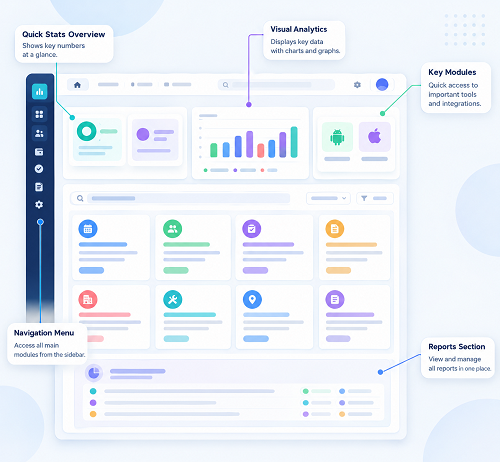
A company with 10 branches may have 10 different attendance registers or Excel files.
A company with 100 branches may have hundreds of attendance records that need to be consolidated.
Common challenges include:
- Collecting attendance from every branch
- Maintaining employee records
- Managing different shifts
- Monitoring late coming
- Tracking leave
- Handling transfers
- Calculating working hours
- Managing overtime
- Preparing payroll
- Generating branch-wise reports
Centralized attendance software can simplify these processes.
1. Centralized Attendance Management
The biggest advantage of multi-branch attendance software is centralized data.
For example:
Head Office → Branch A / Branch B / Branch C / Branch D → Central Attendance Dashboard
HR can access attendance information from different branches through a single platform, subject to role-based permissions.
2. Branch-Wise Attendance
HR can view attendance according to the branch.
For example:
| Branch | Employees | Present | Absent |
|---|---|---|---|
| Chennai | 50 | 47 | 3 |
| Bengaluru | 40 | 38 | 2 |
| Hyderabad | 35 | 33 | 2 |
| Coimbatore | 25 | 24 | 1 |
This gives management a quick overview of workforce attendance.
3. Branch-Specific Access
Not every user needs access to every branch.
A good attendance system should support role-based access.
For example:
- Branch Manager → Own Branch
- Regional Manager → Assigned Branches
- HR Manager → All Branches
- Employee → Own Attendance
This improves both usability and access control.
4. Multiple Attendance Devices
Different branches may use different attendance methods.
For example:
- Branch A → Fingerprint Device
- Branch B → Face Recognition
- Branch C → Mobile Attendance
- Branch D → Web Attendance
A flexible attendance platform can integrate supported attendance methods into one centralized system.
Businesses should confirm hardware and software compatibility before implementation.
5. Mobile Attendance for Branch Employees
Mobile attendance can be useful when employees work away from a fixed attendance machine.
It may be suitable for:
- Field employees
- Sales teams
- Service engineers
- Project teams
- Employees visiting branches
- Regional managers
Depending on the software, employees can use mobile applications to record check-in and check-out.
6. GPS and Geofencing
Some organizations use GPS or geofencing to help verify attendance locations.
For example:
Branch Location → Approved Geofence → Employee Check-In
This can be useful for mobile employees working at branch or field locations.
Companies should establish clear policies for location tracking and comply with applicable privacy requirements.
7. Branch-Wise Shift Management
Different branches may operate different working hours.
For example:
- Branch A → 9 AM–6 PM
- Branch B → 10 AM–7 PM
- Branch C → 8 AM–5 PM
Attendance software can assign employees to branch-specific shifts.
This allows attendance to be calculated according to the relevant schedule.
8. Multiple Shift Management
Large companies may operate several shifts across branches.
For example:
- Morning Shift
- General Shift
- Evening Shift
- Night Shift
A branch may have one shift while another branch may have three.
Centralized software allows HR to manage different schedules without maintaining separate systems.
9. Rotating Shifts
Some businesses use rotating schedules.
For example:
- Week 1 → Morning
- Week 2 → Evening
- Week 3 → Night
Attendance software can help managers assign and update shift schedules.
This reduces manual attendance adjustments.
10. Employee Transfer Between Branches
Employees may move from one branch to another.
For example:
Employee A: Branch A → Branch B
Instead of creating a completely new employee record, a centralized HR system can update the employee's branch assignment where supported.
This helps maintain continuous attendance history.
11. Temporary Branch Transfers
An employee may temporarily work at another branch.
For example:
- Original Branch: Chennai
- Temporary Location: Bengaluru
- Duration: 15 Days
The attendance system should ideally support temporary location or schedule assignments where required.
This is particularly useful for companies with mobile management teams.
12. Working-Hour Calculation
Attendance software can calculate working hours automatically.
For example:
- Check-In: 9:30 AM
- Check-Out: 6:30 PM
The system calculates working hours based on configured break and attendance rules.
This avoids manually calculating hours from branch-level attendance sheets.
13. Late Coming and Early Leaving
HR can monitor attendance exceptions across branches.
For example:
| Branch | Late Employees |
|---|---|
| Branch A | 5 |
| Branch B | 2 |
| Branch C | 8 |
| Branch D | 3 |
Management can identify branches with recurring attendance issues.
14. Leave Management Across Branches
Employees can apply for leave through the centralized system.
A typical workflow is:
Employee Applies Leave → Branch Manager Approves → Leave Balance Updated → Attendance Updated
This allows HR to maintain leave information without collecting separate branch spreadsheets.
15. Branch Manager Approval
Branch managers can be given access to their own employees.
They can review:
- Attendance
- Leave requests
- Missing punches
- Attendance corrections
- Overtime
- Late coming
This allows HR to delegate routine attendance approvals to branch managers.
16. Attendance Regularization
Employees may occasionally miss a punch.
For example:
Employee Worked Full Day → Missing Check-Out
The employee can submit a regularization request.
The workflow can be:
Request → Branch Manager Approval → Attendance Updated
An audit trail can record the change.
17. Overtime Management
Some branches may have employees working additional hours.
For example:
- Scheduled Hours: 8
- Actual Hours: 10
- Potential Additional Hours: 2
Attendance software can identify additional working hours and send them for approval.
Actual overtime eligibility and payment should follow the organization's policies and applicable employment requirements.
18. Payroll Integration
Companies with multiple branches often face challenges when consolidating attendance for payroll.
A centralized system can support a workflow such as:
Branch Attendance → Central Attendance Processing → Leave & Overtime → Approval → Payroll
This can reduce manual consolidation.
Businesses should verify how attendance data integrates with their particular payroll system.
19. Branch-Wise Payroll Data
Although payroll may be processed centrally, HR may need branch-wise attendance information.
For example:
| Branch | Employees | Paid Days | Leave |
|---|---|---|---|
| Branch A | 50 | 1,120 | 30 |
| Branch B | 40 | 890 | 25 |
| Branch C | 35 | 760 | 20 |
Reports like these can help payroll teams review attendance data before processing salaries.
20. Multi-Location Employee Dashboard
A centralized dashboard can display:
- Total employees
- Total branches
- Present employees
- Absent employees
- Employees on leave
- Late employees
- Missing punches
- Overtime
- Branch-wise attendance
This gives HR a real-time or near-real-time overview, depending on the system.
21. Branch-Wise Attendance Reports
Useful reports include:
Daily Branch Attendance
Shows attendance for a selected branch and date.
Monthly Branch Attendance
Provides monthly attendance summaries.
Employee Attendance
Shows individual attendance history.
Shift-Wise Report
Shows attendance by shift.
Late Coming Report
Identifies late employees.
Early Leaving Report
Shows employees leaving early.
Leave Report
Provides leave information.
Overtime Report
Shows overtime records.
22. Regional Attendance Management
Large organizations may have several branches under a regional manager.
For example:
South Region → Chennai / Coimbatore / Madurai / Bengaluru
North Region → Delhi / Noida / Jaipur
A centralized attendance system can provide region-wise reporting where supported.
This gives regional managers visibility into their assigned locations.
23. Cloud-Based Attendance Software
Cloud-based systems are particularly useful for companies with geographically distributed branches.
Potential benefits include:
- Centralized access
- Multi-branch management
- Remote access
- Centralized reporting
- Automatic software updates
- Employee self-service
Before selecting a cloud solution, organizations should evaluate security, backup, availability, access controls, and data handling.
24. Offline Attendance Support
Branches may occasionally experience internet connectivity problems.
Companies should ask: What happens if a branch loses internet connectivity?
Some attendance systems or devices can temporarily store attendance data and synchronize it when the connection is restored.
This capability should be tested in real operating conditions.
25. Data Security and Access Control
A multi-branch system can contain attendance information for the entire organization.
Access should therefore be carefully controlled.
For example:
- Employee → Own Records
- Branch Manager → Branch Records
- Regional Manager → Regional Records
- HR → Organization Records
A suitable system should provide:
- Authentication
- Role-based access
- Permissions
- Audit logs
- Secure data transmission
- Data backups
26. Attendance Audit Trail
Attendance corrections should be traceable.
For example:
Original Record → Regularization Request → Manager Approval → Updated Record
The system can maintain:
- Requester
- Approver
- Date
- Time
- Change details
This helps improve accountability.
27. Employee Self-Service
Employees across branches can use a centralized portal or mobile app to:
- View attendance
- Check working hours
- Apply for leave
- View leave balance
- Request regularization
- Review attendance history
This reduces dependency on branch HR teams.
28. Attendance for Field Employees
Companies with multiple branches often have employees who work outside branch offices.
Examples include:
- Sales representatives
- Service engineers
- Delivery employees
- Installation teams
- Field executives
Mobile attendance can help track their attendance according to company policy.
29. Attendance for Remote Employees
Some employees may work remotely even though they belong to a branch.
For example:
- Employee Location: Home
- Assigned Branch: Chennai
A flexible attendance system can support different work modes where required.
30. Temporary and Contract Employees
Companies may employ:
- Contract workers
- Temporary staff
- Interns
- Seasonal workers
Attendance software can help maintain attendance records for these workforce categories according to configured rules.
31. Attendance During Branch Opening
When a company opens a new branch, HR may need to create:
- Branch profile
- Employee assignments
- Shift schedules
- Attendance devices
- User permissions
A centralized system can make it easier to add new locations without creating an entirely separate attendance process.
32. Branch Performance and Attendance Trends
Attendance data can help management identify trends.
For example:
- Branch A → 96% attendance
- Branch B → 91% attendance
- Branch C → 87% attendance
Management can investigate recurring attendance issues and review staffing requirements.
Attendance data should be used as an operational input rather than the sole measure of branch performance.
Best Features to Look for in Multi-Branch Attendance Software
| Feature | Importance |
|---|---|
| Multi-branch management | Very High |
| Centralized dashboard | Very High |
| Branch-wise reports | Very High |
| Role-based access | Very High |
| Multiple shifts | Very High |
| Employee transfer support | High |
| Mobile attendance | High |
| Biometric integration | High |
| GPS/geofencing | Useful |
| Leave management | Very High |
| Attendance regularization | High |
| Overtime tracking | High |
| Payroll integration | Very High |
| Employee self-service | High |
| Regional management | High |
| Audit trail | High |
| Offline support | Useful |
| Cloud access | High |
| Scalability | Very High |
Biometric vs. Mobile Attendance for Multiple Branches
Different branches may require different attendance methods.
| Requirement | Biometric | Mobile |
|---|---|---|
| Fixed branch office | Excellent | Good |
| Factory/warehouse | Excellent | Good |
| Field employees | Limited | Excellent |
| Sales employees | Limited | Excellent |
| Branch managers | Good | Excellent |
| Temporary locations | Limited | Excellent |
| Fingerprint | Yes | No |
| Face recognition | Supported devices | Some apps |
| GPS | Not primary | Available in some systems |
A hybrid model can be useful:
- Branch Employees → Biometric
- Field Employees → Mobile
- Regional Managers → Mobile
- Temporary Locations → Mobile
Common Attendance Challenges for Multi-Branch Companies
Separate Excel Files
Every branch may maintain its own spreadsheet, making consolidation difficult.
Delayed Data
HR may receive attendance information late from branches.
Different Attendance Rules
Branches may follow inconsistent attendance processes.
Employee Transfers
Moving employees between branches can complicate attendance history.
Multiple Shifts
Different locations may operate different shifts.
Manual Payroll Consolidation
HR may spend significant time combining attendance data before payroll.
Limited Visibility
Management may not have a centralized view of attendance.
Attendance Corrections
Manual changes may be difficult to track.
A centralized attendance system can help standardize and automate these processes.
Example of Multi-Branch Attendance Workflow
Consider a company with four branches.
Step 1: Employee Assignment
Each employee is assigned to a branch.
Step 2: Shift Assignment
The employee receives the appropriate working schedule.
Step 3: Attendance
The employee records attendance through biometric, mobile, or web attendance.
Step 4: Branch Review
The branch manager reviews attendance exceptions.
Step 5: Leave and Overtime
Approved leave and overtime are recorded.
Step 6: Central HR Review
HR reviews consolidated attendance information.
Step 7: Payroll
Approved attendance data is used for payroll processing.
The entire process can be managed through one centralized system.
How Multi-Branch Attendance Software Helps HR
A centralized attendance system can help HR:
- Reduce manual data collection
- Standardize attendance processes
- Monitor multiple branches
- Track working hours
- Manage shifts
- Process leave
- Track overtime
- Manage employee transfers
- Generate branch-wise reports
- Improve payroll preparation
- Provide employee self-service
Conclusion
Attendance Software for Companies With Multiple Branches provides a centralized way to manage employee attendance across geographically distributed locations.
The most important features include multi-branch management, branch-wise attendance, centralized dashboards, role-based access, multiple shift management, biometric and mobile attendance, employee transfer support, leave management, overtime tracking, attendance regularization, payroll integration, and detailed reporting.
A typical workflow can be:
Employee → Branch → Shift → Attendance → Leave/Overtime → Manager Approval → Central HR → Payroll
For growing organizations, centralized attendance software can eliminate the need to maintain separate attendance processes for every branch and provide HR with better visibility across the workforce.
The right system should be selected based on the company's number of branches, employee strength, shift structure, attendance methods, workforce mobility, payroll process, security requirements, connectivity, and expansion plans.
Before implementation, companies should test real-world situations such as employee transfers, temporary branch assignments, multiple shifts, missing punches, mobile attendance, branch-level approvals, internet interruptions, and payroll integration. This helps ensure the attendance system can support the organization's actual multi-location operations.
Companies with multiple branches can use InnBuilt Attendance Software to apply location-specific shifts and approvals while maintaining one consolidated head-office dashboard.