Face Attendance vs. Biometric Attendance: Which Is Better?
Face Attendance vs. Biometric Attendance: Which Is Better?
Accurate employee attendance is essential for effective HR and payroll management. Businesses traditionally use attendance registers, ID cards, fingerprint scanners, and other biometric systems to record employee working hours. With advances in technology, face attendance has also become a popular option for organizations looking for contactless attendance management.
But how does face attendance compare with other biometric attendance methods? Face attendance is itself a form of biometric attendance, but it uses facial features for identification, while other biometric systems may use fingerprints, iris patterns, or other biological characteristics.
Understanding the differences can help businesses choose the right attendance solution based on their workforce, operating environment, security requirements, and budget.
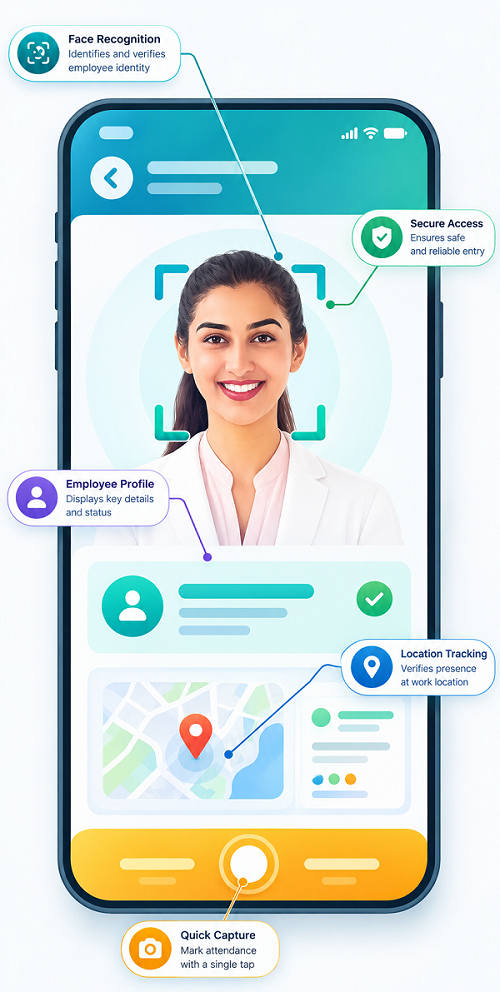
What Is Face Attendance?
Face attendance is an attendance method that uses facial recognition technology to identify or verify employees and record their attendance.
Employees typically stand in front of a camera or use a supported mobile application. The system analyzes relevant facial features and compares them with the employee's enrolled profile.
After successful verification, the system records the attendance event.
Depending on the solution, the record may include:
- Employee identity
- Date
- Time
- Attendance status
- Device information
- Location, where applicable
- Assigned shift
What Is Biometric Attendance?
Biometric attendance refers to attendance systems that use unique biological characteristics to identify or verify employees.
Common biometric attendance technologies include:
- Fingerprint recognition
- Facial recognition
- Iris recognition
- Other biometric identification methods
Therefore, face attendance is a type of biometric attendance.
When businesses compare "face attendance vs. biometric attendance," they usually mean facial recognition vs. fingerprint-based or other biometric attendance systems.
How Face Attendance Works
A typical face attendance process involves the following steps:
1. Employee Enrollment
The employee's facial information is registered in the system.
2. Face Detection
The camera detects the employee's face when attendance is being recorded.
3. Face Verification
The system compares the captured facial information with the employee's enrolled profile.
4. Attendance Recording
After successful verification, the system records the employee's attendance time.
5. Attendance Processing
The attendance information can then be used for working-hour, shift, leave, overtime, and payroll processes according to company rules.
How Fingerprint Biometric Attendance Works
Fingerprint attendance uses the unique patterns of an employee's fingerprint for identification.
The employee places a finger on a biometric scanner. The device captures the fingerprint and compares it with the employee's registered fingerprint template.
If the system finds a valid match, attendance is recorded.
This method has been widely used in offices, factories, schools, retail businesses, and other organizations.
Face Attendance vs. Fingerprint Attendance
| Feature | Face Attendance | Fingerprint Attendance |
|---|---|---|
| Identification method | Facial features | Fingerprint |
| Contactless | Yes | No |
| Shared surface contact | No | Yes |
| Mobile implementation | Possible | Less common |
| Suitable for field employees | Yes, with mobile support | Generally less practical |
| Attendance speed | Depends on system | Depends on system |
| Proxy attendance control | Stronger than manual methods | Stronger than manual methods |
| Shift integration | Possible | Possible |
| Payroll integration | Possible | Possible |
| Employee self-service | Possible | Possible |
Both technologies can be effective. The better option depends on the organization's specific requirements.
1. Contactless Attendance
One of the biggest differences between face and fingerprint attendance is physical contact. Face attendance can identify employees without requiring them to touch an attendance device. Fingerprint attendance requires employees to place their finger on a scanner.
Advantage: Face Attendance
2. Ease of Use
Face attendance can be convenient because employees generally only need to position themselves correctly in front of the camera. Fingerprint systems require employees to place their finger correctly on the scanner. Both systems can be easy to use once employees are familiar with the process.
Advantage: Face Attendance for Contactless Convenience
3. Attendance for Field Employees
Fingerprint devices are generally installed at fixed locations, making them less convenient for employees who frequently work outside the office. Mobile face attendance can allow authorized field employees to record attendance using supported smartphones. Businesses may also use GPS or location-based controls where appropriate.
Advantage: Face Attendance
4. Proxy Attendance
Manual registers and cards can make proxy attendance easier because another person may record attendance on behalf of an employee. Both fingerprint and face recognition provide biometric verification, making proxy attendance more difficult. The effectiveness depends on the technology, implementation, and anti-spoofing controls.
Advantage: Both
5. Speed of Attendance
Both face and fingerprint systems can record attendance quickly. However, actual performance depends on factors such as device quality, number of employees, network connectivity, recognition technology, device placement, and environmental conditions. Therefore, businesses should evaluate the specific system rather than assuming one technology is always faster.
Advantage: Depends on the System
6. Hygiene and Shared Devices
Fingerprint scanners require employees to touch the same sensor throughout the day. Face attendance is contactless, which can be preferable for organizations that want to reduce shared physical contact.
Advantage: Face Attendance
7. Accuracy
Both facial recognition and fingerprint recognition can provide accurate employee identification when properly implemented. Performance can be influenced by environmental and technical conditions. For face recognition, factors such as lighting, camera quality, camera positioning, and facial visibility can affect performance. For fingerprint systems, factors such as sensor quality and the condition of the employee's finger can influence recognition.
Advantage: Depends on the System
8. Shift Management Integration
Both face and fingerprint attendance systems can be integrated with shift management software. For example, an employee assigned to a 9:00 AM–6:00 PM shift can have attendance compared with the assigned schedule. The system can help identify late arrivals, early departures, absences, overtime, and shift deviations.
Advantage: Both
9. Payroll Integration
Attendance data from either technology can be integrated with payroll software. A typical workflow is:
Biometric Verification → Attendance → Working Hours → Leave & Overtime → Payroll
The technology used to record attendance does not by itself determine payroll accuracy. The quality of attendance processing and payroll integration is also important.
Advantage: Both
10. Cost and Infrastructure
The cost of implementation depends on the technology, number of employees, number of locations, hardware, software, licensing, and integration requirements. Fingerprint attendance may require dedicated biometric devices at entry points. Face attendance can also require dedicated terminals, cameras, or mobile devices depending on the deployment model. Therefore, businesses should compare the total cost of ownership rather than only the initial device price.
Advantage: Depends on Business Requirements
Advantages of Face Attendance
Face attendance can offer several benefits:
- Contactless identification
- Convenient attendance recording
- Mobile attendance possibilities
- Suitable for field employees
- Reduced dependency on physical attendance cards
- Integration with attendance software
- Integration with shift management
- Payroll integration
- Centralized attendance reporting
Advantages of Fingerprint Attendance
Fingerprint attendance also has several advantages:
- Established biometric technology
- Familiar to many employees
- Effective for fixed workplace environments
- Can provide quick employee verification
- Supports attendance and payroll integration
- Suitable for offices, factories, and other fixed locations
Which Is Better for Different Businesses?
Office-Based Companies
Both technologies can work well. Face attendance may be preferable if the company wants a contactless experience.
Manufacturing Companies
Fingerprint and face attendance can both be suitable for factory environments. Businesses should consider shift volumes, workplace conditions, device placement, and employee usage.
Retail Businesses
Face attendance can be useful for organizations managing multiple branches, particularly when centralized attendance reporting is required.
Construction Companies
Mobile face attendance can be useful for project-based employees working at different locations.
Field-Service Companies
Face attendance with mobile support can be particularly useful for employees who do not regularly report to a fixed office.
Hospitals
Contactless face attendance may be attractive in environments where reducing shared-device contact is a priority.
Security Agencies
Both technologies can be used, but organizations managing employees across multiple client locations may benefit from mobile face attendance solutions where appropriate.
Face Attendance and Mobile Employee Apps
One of the major advantages of face attendance is the possibility of integrating it with an employee mobile application.
Employees may be able to:
- Mark attendance
- Verify their identity
- View attendance records
- Check shift schedules
- Apply for leave
- Submit attendance corrections
- Receive notifications
For field employees, mobile attendance can reduce the need to travel to a fixed biometric device solely to record attendance.
Security and Privacy Considerations
Both face and fingerprint attendance systems involve biometric information. Businesses should therefore carefully consider how biometric data is collected, processed, stored, accessed, protected, and retained.
For face attendance in particular, organizations should evaluate:
- Facial-data storage methods
- Access controls
- Encryption and security measures
- Retention periods
- Employee communication
- Anti-spoofing capabilities
- Data deletion processes
- Applicable privacy and data-protection requirements
Organizations should establish appropriate policies before deploying biometric attendance technology.
Face Attendance vs. Biometric Attendance: Which Should You Choose?
There is no universal winner because face attendance is itself a biometric attendance technology.
If a business wants contactless attendance, mobile attendance, and support for field employees, face recognition may be a strong choice.
If a business operates primarily from a fixed location and already has suitable fingerprint infrastructure, fingerprint attendance may continue to be a practical option.
Businesses should consider:
- Workforce size
- Number of locations
- Fixed vs. field employees
- Shift requirements
- Attendance volume
- Hardware requirements
- Software integration
- Security
- Privacy
- Total cost
Conclusion
Face attendance and fingerprint attendance are both biometric approaches to employee attendance management. Face attendance uses facial features, while fingerprint attendance uses fingerprint patterns.
Face attendance can provide advantages such as contactless identification and mobile deployment, making it particularly useful for field and distributed employees. Fingerprint attendance can remain a practical choice for organizations operating from fixed locations.
For businesses looking to modernize workforce management, the most important consideration is not simply choosing between face and fingerprint technology. The attendance system should also integrate effectively with shift management, leave management, employee self-service, and payroll software.
The right solution is the one that provides reliable attendance tracking while meeting the organization's operational, security, privacy, and workforce-management requirements.
InnBuilt Face Attendance Software works through supported cameras or mobile devices and stores records in the cloud. Organisations can use face verification alongside other biometric methods where appropriate.