Face Attendance vs. Fingerprint Attendance: Key Differences
Face Attendance vs. Fingerprint Attendance: Key Differences
Accurate employee attendance is important for HR management, payroll processing, workforce planning, and compliance. Businesses traditionally use methods such as attendance registers, ID cards, fingerprint scanners, and other biometric systems to track employee attendance.
Today, face attendance is becoming an increasingly popular alternative to fingerprint-based attendance. Both methods use biometric identification, but they work differently and offer different advantages depending on the workplace.
So, what are the key differences between face attendance and fingerprint attendance, and which option is better for your business?
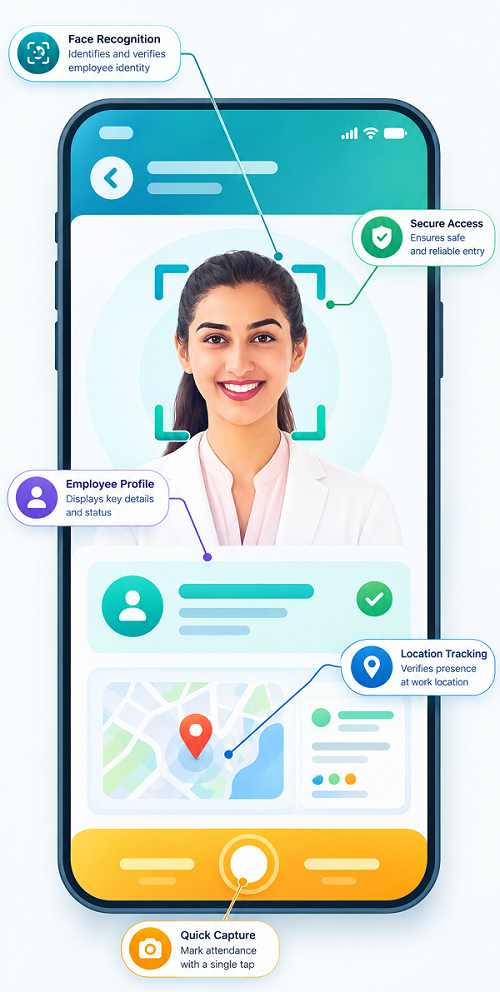
What Is Face Attendance?
Face attendance is a biometric attendance system that uses facial recognition technology to identify or verify employees.
An employee's facial information is registered in the system during enrollment. When the employee arrives at the workplace or records attendance through a supported mobile application, a camera captures the face and compares it with the enrolled profile.
After successful verification, the system records the employee's attendance.
Depending on the solution, the attendance record may include:
- Employee name or ID
- Date and time
- Attendance status
- Location
- Device information
- Assigned shift
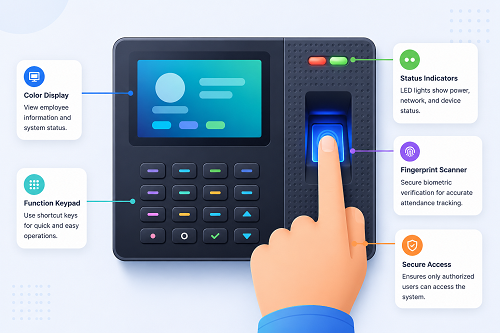
What Is Fingerprint Attendance?
Fingerprint attendance is a biometric attendance method that uses an employee's fingerprint pattern for identification or verification.
The employee places a registered finger on a fingerprint scanner. The device compares the captured fingerprint with the employee's stored biometric template.
If the fingerprint matches, attendance is recorded.
Fingerprint attendance systems are commonly used in offices, factories, schools, retail stores, warehouses, and other fixed workplaces.
Face Attendance vs. Fingerprint Attendance: Key Differences
| Feature | Face Attendance | Fingerprint Attendance |
|---|---|---|
| Biometric used | Facial features | Fingerprint |
| Physical contact | Contactless | Requires touch |
| Hardware | Camera/device | Fingerprint scanner |
| Mobile attendance | Possible | Less common |
| Field employees | More suitable with mobile support | Less suitable |
| Hygiene | No shared surface contact | Requires contact with scanner |
| Recognition conditions | Can depend on lighting/camera | Can depend on finger condition/sensor |
| Proxy attendance | Helps reduce proxy attendance | Helps reduce proxy attendance |
| Shift integration | Possible | Possible |
| Payroll integration | Possible | Possible |
| Multiple locations | Possible | Possible |
| Employee self-service | Possible | Possible |
1. Identification Method
The most obvious difference is the biometric technology used.
Face attendance identifies employees using facial characteristics.
Fingerprint attendance identifies employees using fingerprint patterns.
Both are biometric methods and can provide stronger employee identification than manual registers or card-based attendance.
2. Contactless vs. Physical Contact
Face attendance is generally contactless. Employees do not need to touch an attendance device to record their attendance.
Fingerprint attendance requires employees to place a finger on a scanner.
For businesses that prefer contactless attendance, face recognition may be more convenient.
Advantage: Face Attendance
3. Employee Convenience
With face attendance, employees can generally record attendance by looking toward a supported camera.
Fingerprint attendance requires the employee to position a finger correctly on the scanner.
Both methods can be convenient once employees are familiar with the system, but face attendance provides a touch-free experience.
Advantage: Face Attendance
4. Attendance for Field Employees
Fingerprint attendance devices are generally installed at fixed locations. This can make them less practical for employees who regularly work outside the office.
Face attendance can be implemented through mobile applications on supported smartphones. This can allow authorized field employees to record attendance from different work locations.
For example, mobile face attendance can be useful for:
- Sales representatives
- Service technicians
- Construction workers
- Delivery teams
- Field executives
- Project-based employees
Location-based features such as GPS may also be available in some systems.
Advantage: Face Attendance for Mobile Use
5. Hygiene
Fingerprint attendance requires employees to touch the same biometric scanner.
Face attendance does not require physical contact with the attendance device.
This makes face attendance attractive for businesses looking for a contactless attendance experience.
Advantage: Face Attendance
6. Recognition Accuracy
Both face and fingerprint systems can provide reliable biometric identification when properly implemented.
However, their performance can be affected by different factors.
Face recognition can be influenced by:
- Lighting conditions
- Camera quality
- Camera positioning
- Face visibility
- Environmental conditions
Fingerprint recognition can be influenced by:
- Sensor quality
- Wet fingers
- Very dry skin
- Dirt or dust
- Minor finger injuries
- Worn fingerprint patterns
The actual performance depends heavily on the hardware and software being used.
Advantage: Depends on the System
7. Speed of Attendance
Both face and fingerprint systems can record attendance quickly.
The actual speed depends on factors such as:
- Device performance
- Number of employees
- Recognition technology
- Network connectivity
- Device placement
- Software configuration
Businesses should test the specific system with their workforce rather than choosing based solely on the technology type.
Advantage: Depends on the System
8. Proxy Attendance
Proxy attendance occurs when one employee attempts to record attendance on behalf of another.
Both face and fingerprint biometrics can help reduce this problem because attendance is associated with a person's biometric characteristics.
However, the effectiveness depends on the security and anti-spoofing features of the system.
Advantage: Both
9. Mobile Attendance
Mobile attendance is an important difference between the two technologies.
Face recognition can be integrated with smartphone cameras, making mobile face attendance possible.
Fingerprint attendance is generally associated with dedicated biometric hardware, although mobile biometric capabilities may vary by device and software.
For businesses with field employees, mobile face attendance can therefore be more practical.
Advantage: Face Attendance
10. Shift Management Integration
Both face and fingerprint attendance can be connected with shift management software.
For example, an employee may be assigned a shift from 9:00 AM to 6:00 PM. The attendance system can compare the actual attendance time with the assigned schedule.
This can help businesses identify:
- Late arrivals
- Early departures
- Absences
- Overtime
- Shift deviations
Advantage: Both
11. Payroll Integration
Attendance information is often used as an input for payroll processing.
Both face and fingerprint attendance systems can integrate with payroll software, depending on the platform.
A typical workflow is:
Biometric Attendance → Working Hours → Leave & Overtime → Payroll
Integration reduces the need to manually transfer attendance records into payroll systems.
Advantage: Both
12. Multiple-Location Attendance
Businesses with multiple branches, factories, stores, offices, or project sites may need centralized attendance management.
Both face and fingerprint systems can support multiple-location deployments, depending on the software architecture.
However, mobile face attendance can provide additional flexibility for employees who work at changing locations.
Advantage: Depends on Business Requirements
13. Infrastructure Requirements
Fingerprint attendance usually requires a fingerprint scanner or biometric terminal installed at the attendance location.
Face attendance may require a dedicated facial-recognition terminal, camera-enabled device, tablet, or smartphone depending on the implementation.
Businesses should consider:
- Hardware requirements
- Network connectivity
- Device maintenance
- Software licensing
- Number of locations
- Integration costs
The total implementation cost depends on the selected solution rather than the biometric method alone.
14. Employee Self-Service
Modern attendance platforms can provide employee self-service features regardless of whether attendance is recorded through face or fingerprint recognition.
Employees may be able to:
- View attendance
- Check working hours
- View shift schedules
- Apply for leave
- Request attendance corrections
- Check overtime
- Receive notifications
Therefore, employee self-service depends more on the software platform than on the biometric technology.
Advantages of Face Attendance
Face attendance can be particularly useful for businesses that need:
- Contactless attendance
- Mobile attendance
- Field employee attendance
- Multi-location workforce management
- Integration with shift management
- Employee self-service
- Centralized attendance reporting
Advantages of Fingerprint Attendance
Fingerprint attendance may be suitable for businesses that:
- Operate from fixed locations
- Already have fingerprint devices
- Want established biometric attendance technology
- Have employees regularly reporting to a common workplace
- Need integration with attendance and payroll systems
Which Is Better for Your Business?
There is no single biometric technology that is best for every organization.
Choose Face Attendance If:
- You prefer contactless attendance.
- You have field or mobile employees.
- Employees work across multiple locations.
- You want smartphone-based attendance.
- You need a modern employee attendance experience.
- You want to combine face verification with location features where appropriate.
Choose Fingerprint Attendance If:
- Employees work primarily from a fixed location.
- You already have fingerprint infrastructure.
- Your workforce is comfortable using fingerprint devices.
- Mobile attendance is not a major requirement.
- You want a straightforward biometric attendance setup.
Face Attendance vs. Fingerprint Attendance for Different Industries
Manufacturing
Both systems can work well in factories. Businesses should consider employee volume, shift patterns, environmental conditions, and device placement.
Retail
Face attendance can be useful for businesses managing employees across multiple stores, especially when centralized reporting is required.
Construction
Mobile face attendance may be more practical for employees working across project sites.
Hospitals
Face attendance provides a contactless option for employees working across different departments and shifts.
Security Agencies
Organizations managing employees across client locations may benefit from mobile attendance capabilities.
Offices
Both technologies can work effectively in office environments. The choice depends on employee preferences, infrastructure, and business requirements.
Face Attendance and Payroll Software
Regardless of whether a company uses face or fingerprint attendance, connecting attendance data with payroll software can improve payroll workflows.
Attendance information can be used to support:
- Working-day calculations
- Leave deductions
- Overtime
- Late-coming rules
- Early-leaving rules
- Attendance-based salary calculations
The quality of payroll processing depends on accurate attendance data, correctly configured rules, and proper integration.
Security and Privacy Considerations
Both face and fingerprint attendance systems process biometric information. Businesses should therefore establish appropriate policies for collecting, storing, accessing, protecting, and retaining biometric data.
For face attendance, organizations should consider:
- Facial data storage
- Access controls
- Security measures
- Retention periods
- Employee communication
- Anti-spoofing technology
- Data deletion procedures
- Applicable privacy and data-protection requirements
Similar considerations apply to fingerprint biometric information.
Conclusion
Face attendance and fingerprint attendance are both biometric methods for recording employee attendance, but they offer different experiences and use cases.
Face attendance provides a contactless approach and can be particularly useful for field employees and businesses that want mobile attendance. Fingerprint attendance remains a practical option for organizations operating from fixed locations and already using fingerprint-based systems.
The best choice depends on the organization's workforce, locations, shift structure, attendance requirements, infrastructure, security needs, privacy responsibilities, and budget.
For businesses looking for a complete workforce management solution, the biometric attendance system should ideally work with shift management, leave management, employee self-service, and payroll software. This creates a more connected process from employee attendance through payroll.
Compared with fingerprint devices, InnBuilt Face Attendance Software provides touch-free verification and supports mobile or multi-location workforces with fewer shared-device queues.