How Face Attendance Software Works: Features, Benefits, and Uses
How Face Attendance Software Works: Features, Benefits, and Uses
Managing employee attendance manually can be time-consuming, especially for businesses with large teams, multiple shifts, and multiple locations. Traditional methods such as attendance registers, ID cards, and manual spreadsheets can also make it difficult to maintain accurate attendance records.
Face attendance software provides a digital solution by using facial recognition technology to identify employees and record their attendance. It can help businesses automate attendance tracking while providing HR teams with centralized attendance information.
From offices and factories to retail stores, hospitals, and field operations, face attendance software can be used in different workforce environments.
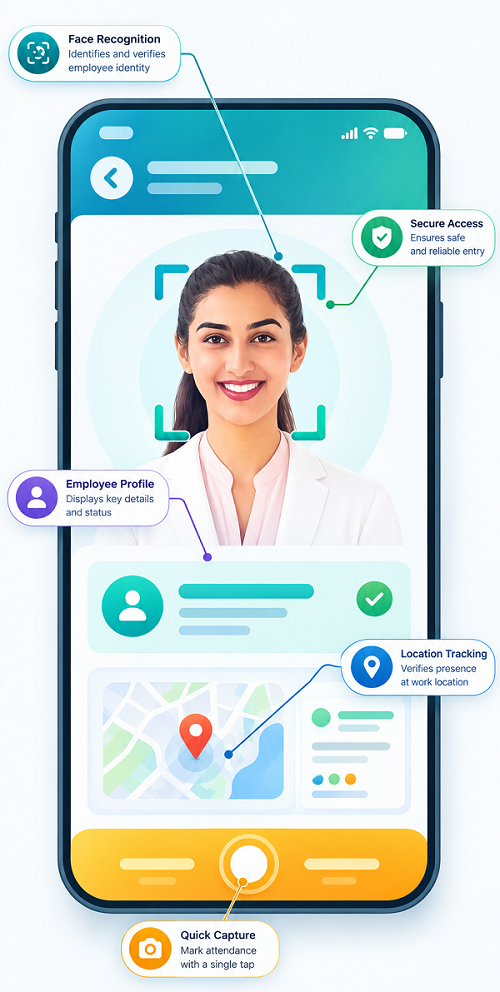
What Is Face Attendance Software?
Face attendance software is an employee attendance solution that uses facial recognition technology to identify or verify employees and record their attendance.
Instead of requiring employees to enter a PIN, carry an attendance card, or touch a fingerprint scanner, the system uses a camera to capture facial information and match it with an enrolled employee profile.
Once verification is successful, the system records the attendance event along with information such as date and time. Depending on the solution, additional information such as location, device, shift, or attendance type may also be recorded.
How Does Face Attendance Software Work?
The face attendance process generally consists of several stages.
1. Employee Registration
Employees are first registered in the attendance system. During enrollment, the system captures facial information according to the software's enrollment process. The system then creates a digital representation that can be used for future identification or verification.
2. Face Detection
When an employee attempts to record attendance, the camera detects the person's face. The software analyzes the image to identify the facial features needed for the recognition process.
3. Face Recognition
The system compares the captured facial information with the enrolled employee profiles. If a valid match is found, the system identifies or verifies the employee. The exact recognition method and accuracy depend on the technology and implementation used.
4. Attendance Recording
After successful verification, the system records an attendance event. Depending on the solution, the record may include:
- Employee ID
- Date
- Time
- Attendance status
- Location
- Device information
- Assigned shift
5. Attendance Processing
The attendance record can then be processed according to the organization's rules. The system may help calculate or identify:
- Present days
- Absences
- Late arrivals
- Early departures
- Working hours
- Overtime
- Missed punches
- Shift deviations
6. Reports and Payroll Processing
HR teams can access attendance reports through a centralized dashboard. When the system is integrated with payroll software, relevant attendance information can be transferred into the payroll process according to the organization's configuration.
Key Features of Face Attendance Software
Facial Recognition
The core feature is facial identification or verification. Employees can record attendance using their face instead of traditional attendance credentials.
Contactless Attendance
Employees can record attendance without physically touching a shared biometric device.
Real-Time Attendance
Many systems can provide near real-time attendance information to HR and managers when devices have an active network connection.
Mobile Face Attendance
Some platforms allow employees to record attendance using a smartphone camera through a mobile application. This can be useful for field employees and distributed teams.
GPS-Based Attendance
Some mobile attendance solutions can combine face verification with GPS or location information. This can help organizations confirm that attendance was recorded from an authorized location, subject to company policies and applicable privacy requirements.
Shift Management
Face attendance software can be integrated with shift management features to compare employee attendance with assigned shifts.
Attendance Reports
HR teams can generate reports related to employee attendance, working hours, late arrivals, absences, and overtime.
Payroll Integration
Attendance data can be connected with payroll software to support salary processing.
Employee Self-Service
Employees may be able to view attendance records, working hours, leave balances, and related information through a mobile application or employee portal.
Benefits of Face Attendance Software
1. Reduces Manual Attendance Work
Digital attendance eliminates much of the manual effort involved in maintaining registers and transferring attendance information into spreadsheets.
2. Helps Improve Attendance Accuracy
Automated identification and digital time recording can reduce common manual data-entry errors.
3. Helps Prevent Proxy Attendance
Because attendance is associated with facial verification, it can make it more difficult for another person to record attendance on an employee's behalf. The level of protection depends on the recognition and anti-spoofing technology used.
4. Provides Contactless Attendance
Face recognition allows employees to record attendance without touching a common fingerprint scanner or attendance terminal.
5. Saves HR Time
Automating attendance collection and reporting can reduce repetitive HR tasks and allow teams to focus on other workforce activities.
6. Supports Multiple Locations
Businesses with several offices, branches, factories, or stores can use centralized face attendance systems to manage attendance data across locations, depending on the software.
7. Supports Payroll Accuracy
Accurate attendance records can provide better input for working-hour, leave, overtime, and payroll calculations.
8. Improves Employee Transparency
Employees can access their attendance information through a self-service portal or mobile app, where available. This can help employees identify attendance discrepancies and submit corrections according to company procedures.
Uses of Face Attendance Software
Face attendance software can be used in a wide range of business environments.
Office Attendance
Companies can use face recognition to record employee arrival and departure times at office premises.
Factory Attendance
Manufacturing companies can use face attendance across different departments and shifts.
Retail Stores
Retail organizations can manage attendance across multiple stores and branches.
Hospitals
Hospitals can use face attendance for employees working across day, evening, and night shifts.
Construction Sites
Construction companies can use mobile or site-based face attendance to maintain workforce attendance records at project locations.
Field Employees
Mobile face attendance can provide a way for sales teams, service technicians, delivery employees, and other field workers to record attendance outside a traditional office environment.
Educational Institutions
Schools, colleges, and training organizations can use face recognition technology for staff attendance, subject to their operational and privacy requirements.
Face Attendance for Field Employees
Traditional biometric attendance devices require employees to be physically present at a particular device. This may not be practical for field employees.
A mobile face attendance application can allow authorized employees to record attendance using their smartphones.
Depending on the solution, the application may combine: Face Verification + GPS + Time + Employee ID.
This can provide businesses with additional information about where and when attendance was recorded. Organizations should implement such features with clear policies and appropriate privacy safeguards.
Face Attendance and Shift Management
Face attendance becomes more useful when integrated with employee shift management.
For example, an employee may be assigned to an evening shift from 2:00 PM to 10:00 PM. When the employee records attendance at 2:05 PM, the system can compare the actual attendance time with the assigned shift.
This can help HR teams monitor:
- Late arrivals
- Early departures
- Absences
- Working hours
- Overtime
- Shift deviations
This integration reduces the need to manually compare attendance records with shift rosters.
Face Attendance and Payroll Integration
Attendance information is often an important input for payroll processing.
When face attendance software is connected with payroll, the system can provide attendance information required for salary calculations.
A typical workflow can be: Face Recognition → Attendance → Working Hours → Leave & Overtime → Payroll.
This can reduce duplicate data entry and help payroll teams process attendance-related salary information more efficiently.
Face Attendance vs. Fingerprint Attendance
Both face and fingerprint systems can provide biometric attendance, but they use different identification methods.
| Feature | Face Attendance | Fingerprint Attendance |
|---|---|---|
| Identification method | Facial features | Fingerprint |
| Contactless | Yes | No |
| Shared surface contact | No | Yes |
| Mobile implementation | Possible | Less common |
| Suitable for field employees | Yes, with mobile support | Generally less practical |
| Proxy attendance control | Stronger than manual methods | Stronger than manual methods |
| Attendance integration | Possible | Possible |
The right option depends on business requirements, employee environment, budget, and privacy considerations.
Security and Privacy Considerations
Face attendance involves biometric information, so businesses should carefully evaluate how employee data is collected, processed, stored, protected, and deleted.
Before implementing the system, organizations should consider:
- What facial data is collected?
- Where is it stored?
- Who can access it?
- How is it protected?
- How long is it retained?
- How are employees informed?
- What happens when an employee leaves?
- What applicable privacy and data-protection requirements need to be followed?
Businesses should select solutions with appropriate security controls and establish clear internal policies for biometric data management.
Challenges of Face Attendance Software
While face attendance provides several advantages, businesses should also consider potential limitations.
Environmental Conditions
Lighting, camera positioning, and other environmental factors can affect recognition performance depending on the technology.
Device Requirements
Businesses may need compatible cameras, terminals, smartphones, network connectivity, or other hardware.
Privacy Concerns
Employees may have concerns about biometric data collection. Transparent communication and appropriate safeguards are important.
Implementation and Integration
Organizations should ensure that the face attendance system works with their existing HR, attendance, leave, shift, and payroll processes.
How to Choose Face Attendance Software
Before selecting a solution, businesses should evaluate:
- Recognition performance
- Anti-spoofing capabilities
- Mobile application support
- GPS/location features, if required
- Shift management integration
- Payroll integration
- Multiple-location support
- Attendance reporting
- Employee self-service
- Security and privacy controls
- Ease of implementation
- Customer support
The solution should match the organization's workforce size, attendance process, operating locations, and data-management requirements.
Conclusion
Face attendance software uses facial recognition technology to identify employees and record attendance digitally. It can help businesses reduce manual attendance work, improve attendance visibility, support contactless attendance, and reduce the risk of proxy attendance.
Its usefulness increases when it is integrated with employee shift management, leave management, attendance, and payroll software. Businesses can create a more connected workforce management process while giving employees convenient access to their attendance information.
However, organizations should evaluate security, privacy, recognition performance, integration capabilities, and operational requirements before implementing a face attendance solution.
Face verification, mobile access, geolocation, real-time records, and policy validation come together in InnBuilt Face Attendance Software. Verified entries connect to shifts, leave, and payroll.