How to Manage Employee Shifts in Manufacturing Companies
How to Manage Employee Shifts in Manufacturing Companies
Manufacturing companies often operate with multiple shifts to keep production lines running efficiently. Unlike traditional office environments, manufacturing businesses need to coordinate employees, machines, production targets, maintenance activities, and safety requirements across different working hours.
Managing employee shifts manually can become difficult as the number of workers, departments, and shifts increases. Poor scheduling can result in understaffing, excessive overtime, production delays, attendance problems, and employee dissatisfaction.
A structured employee shift management system helps manufacturing companies create accurate rosters, assign employees based on skills and availability, track attendance, manage overtime, and maintain adequate staffing throughout the production cycle.
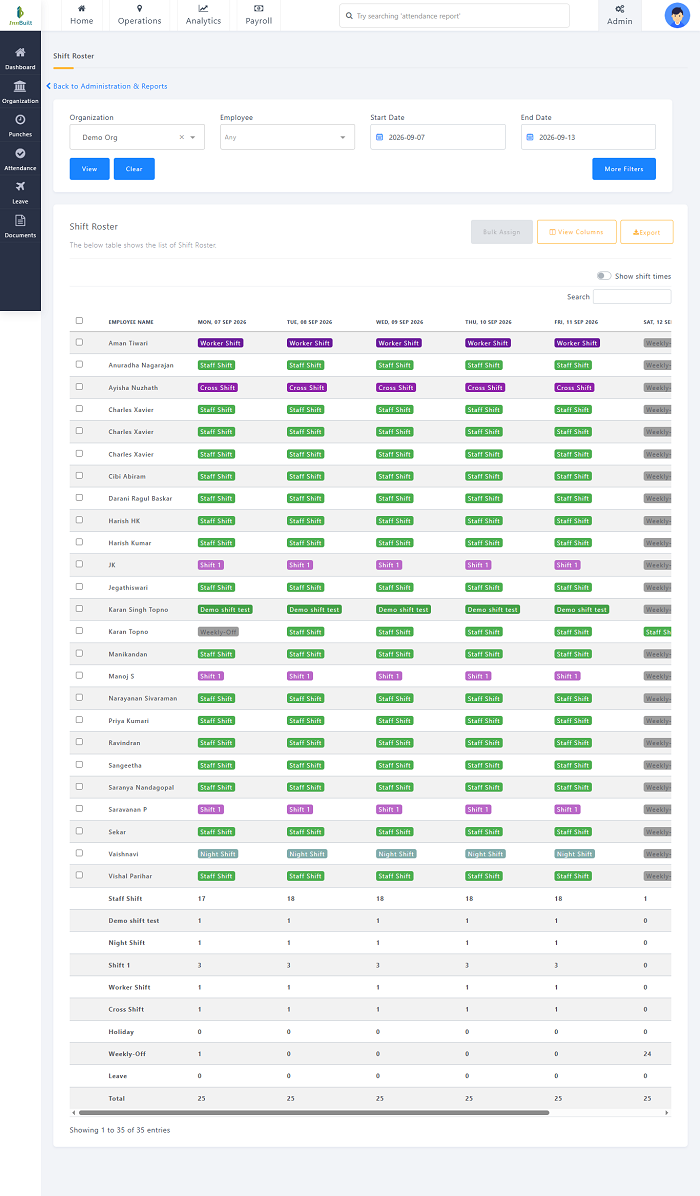
What Is Employee Shift Management in Manufacturing?
Employee shift management is the process of planning, assigning, monitoring, and adjusting employee working schedules according to production and operational requirements.
A manufacturing company may operate:
- Morning shifts
- General shifts
- Evening shifts
- Night shifts
- Rotational shifts
- Split shifts
- Weekend shifts
- Overtime shifts
An effective shift management process ensures that the right number of employees with the right skills are available at the right time.
Why Is Shift Management Important for Manufacturing Companies?
Manufacturing operations depend heavily on workforce availability. A production line may require machine operators, supervisors, quality-control employees, maintenance staff, warehouse workers, and other personnel.
If an important position is left vacant, production can be affected.
Effective shift management helps companies:
- Maintain production continuity
- Reduce staffing shortages
- Improve workforce utilization
- Control overtime
- Reduce scheduling conflicts
- Improve attendance monitoring
- Manage rotational shifts
- Coordinate multiple departments
- Improve payroll accuracy
- Support employee productivity
Common Shift Management Challenges in Manufacturing
Manufacturing companies often face several scheduling challenges.
1. Multiple Shifts
Managing two, three, or more shifts requires accurate scheduling. Managers need to ensure that employees are distributed properly across every shift.
2. Employee Absences
Unexpected absence can create staffing gaps. Managers may need to find replacement employees without disrupting production.
3. Skill-Based Staffing
Not every employee can perform every manufacturing task. Certain machines, production processes, or quality-control activities may require specific skills or training.
4. Rotational Shifts
Employees may rotate between morning, evening, and night shifts. Poorly planned rotations can create scheduling difficulties and affect employee satisfaction.
5. Overtime
Production requirements, urgent orders, machine breakdowns, and staffing shortages can increase overtime. Businesses need accurate records of additional working hours.
6. Shift Changes
Employees may request shift swaps or changes. Without an approval process, unauthorized changes can create staffing problems.
How to Manage Employee Shifts Efficiently
1. Understand Production Requirements
Start by identifying how many employees are required for each production line and shift.
Consider:
- Production targets
- Number of machines
- Operating hours
- Required employee skills
- Maintenance schedules
- Quality-control requirements
- Expected workload
This provides a foundation for creating an effective shift roster.
2. Create a Structured Shift Pattern
Manufacturing companies should establish consistent shift patterns wherever possible.
For example:
| Shift | Timing |
|---|---|
| Morning Shift | 6:00 AM – 2:00 PM |
| Evening Shift | 2:00 PM – 10:00 PM |
| Night Shift | 10:00 PM – 6:00 AM |
The exact timings can be customized according to the company's production requirements and applicable policies.
3. Prepare Shift Rosters in Advance
Employees should receive their schedules in advance.
A shift roster should clearly show:
- Employee name
- Department
- Assigned shift
- Work location
- Shift date
- Weekly off
- Approved leave
- Shift changes
Advance scheduling allows both employees and supervisors to plan better.
4. Assign Employees Based on Skills
A manufacturing shift should not simply contain the required number of employees. It should contain employees with the appropriate skills.
For example, a production line may require:
- Machine operator
- Production supervisor
- Quality inspector
- Maintenance technician
- Material handler
Skill-based scheduling ensures that critical roles are covered during every shift.
5. Maintain Backup Employees
Unexpected absences can disrupt production.
Manufacturing companies should maintain a list of trained employees who can provide backup coverage when required.
A backup plan can help managers respond quickly to:
- Sick leave
- Emergency leave
- Unplanned absence
- Increased production demand
- Employee turnover
6. Manage Rotational Shifts Carefully
Rotational shifts are common in manufacturing. Employees may move between different shifts according to a defined rotation.
Companies should establish clear rotation patterns and avoid unnecessary last-minute changes.
A well-planned rotation can make staffing more predictable and easier to manage.
7. Track Attendance Against the Shift Roster
Attendance should be compared with the employee's assigned shift.
For example:
Scheduled: 6:00 AM – 2:00 PM
Actual: 6:08 AM – 2:15 PM
The system can record the actual attendance and identify relevant exceptions according to company policy.
This is more reliable than maintaining separate attendance and shift records.
8. Manage Night Shifts Properly
Night shifts require special attention because working hours may cross midnight.
For example, an employee working from 10:00 PM to 6:00 AM should have the complete overnight period treated as one scheduled shift.
An automated attendance system can help simplify overnight attendance calculations and reduce manual corrections.
9. Create an Approval Process for Shift Swaps
Employees may occasionally need to exchange shifts.
Instead of allowing informal swaps, companies can use an approval process.
A typical workflow is:
Employee Request → Supervisor Review → Approval → Roster Update → Attendance Update
This ensures that shift changes are properly recorded.
10. Monitor Overtime
Manufacturing businesses often use overtime to meet production requirements.
Managers should monitor:
- Scheduled working hours
- Actual working hours
- Overtime hours
- Approved overtime
- Department-wise overtime
This helps businesses control unnecessary overtime while maintaining accurate payroll records.
11. Integrate Leave With Shift Scheduling
Leave management and shift scheduling should work together.
If an employee applies for leave, the system should make it easier for managers to identify the affected shift and arrange replacement staffing.
This prevents situations where a shift appears fully staffed on the roster even though several employees are on approved leave.
12. Use Mobile Access for Employees
A mobile employee application can make shift management more convenient.
Depending on the software, employees may be able to:
- View upcoming shifts
- Check attendance
- Apply for leave
- Request shift changes
- Request shift swaps
- Receive notifications
This improves communication between employees, supervisors, and HR teams.
How Shift Management Software Helps Manufacturing Companies
Manual scheduling through Excel or paper registers becomes increasingly difficult as workforce size grows.
Shift management software can centralize scheduling and attendance information.
Automated Shift Rostering
Managers can create schedules and assign employees based on departments, roles, locations, availability, and other business requirements.
Attendance Integration
Employee attendance can be compared with assigned shifts to identify late arrivals, early departures, absences, and missing punches.
Leave Integration
Approved leave can be considered when planning workforce schedules.
Overtime Tracking
Actual working hours can be used to identify overtime according to company rules and approval workflows.
Shift Notifications
Employees can receive updates when their schedules are created or changed.
Multiple Department Management
Large manufacturing organizations can manage different departments and production units from a centralized system.
Example of a Manufacturing Shift Roster
Consider a manufacturing facility operating three shifts.
| Employee | Department | Shift |
|---|---|---|
| Employee A | Production | Morning |
| Employee B | Production | Evening |
| Employee C | Quality | Morning |
| Employee D | Maintenance | Night |
| Employee E | Warehouse | Evening |
The HR or operations team can use a digital roster to track who is assigned to each shift.
If Employee D is absent, the supervisor can identify an appropriately trained backup employee and update the roster after approval.
Best Practices for Manufacturing Shift Management
Manufacturing companies can improve scheduling by following these practices:
- Plan shifts according to production demand.
- Publish schedules in advance.
- Assign employees according to skills.
- Maintain trained backup employees.
- Keep shift patterns consistent where possible.
- Avoid unnecessary last-minute schedule changes.
- Integrate leave with shift planning.
- Establish clear shift-swap rules.
- Track attendance against scheduled shifts.
- Monitor overtime regularly.
- Give employees access to their schedules.
- Review staffing data to identify recurring shortages.
- Maintain accurate records for payroll processing.
- Review shift performance and employee feedback periodically.
Benefits of Effective Shift Management
A well-managed shift system can provide several benefits to manufacturing businesses:
Better Production Continuity
Proper staffing helps production lines operate according to planned schedules.
Reduced Scheduling Errors
Digital rosters reduce the risk of duplicate assignments, missed shifts, and manual scheduling mistakes.
Improved Attendance Accuracy
Attendance can be matched with assigned shifts for better visibility.
Better Overtime Control
Managers can identify departments or employees with consistently high overtime.
Improved Employee Communication
Employees can receive their schedules and shift updates through centralized systems.
More Efficient Payroll Processing
Accurate shift, attendance, leave, and overtime data can support more efficient payroll processing.
Conclusion
Managing employee shifts in manufacturing companies requires careful coordination between production requirements and workforce availability. Companies need to consider employee skills, shift patterns, attendance, leave, overtime, and backup staffing when preparing schedules.
Manual methods may work for smaller teams, but they can become difficult to maintain as the workforce and number of shifts increase.
A shift management software solution can help manufacturing companies automate employee scheduling, manage shift rosters, track attendance, handle leave and overtime, and connect workforce data with payroll.
By moving from manual shift planning to a structured and technology-enabled process, manufacturing companies can improve workforce visibility, reduce scheduling problems, and support more efficient day-to-day operations.
Manufacturing teams can use InnBuilt Shift Management Software to plan manpower across plants, production lines, departments, and rotating shifts. Real-time coverage visibility and attendance integration help prevent understaffing and production delays.