What Attendance and Payroll Reports Help Bahrain Employers Prepare for Audits?
What Attendance and Payroll Reports Help Bahrain Employers Prepare for Audits?
Preparing for an audit requires Bahrain employers to demonstrate that employee attendance, working hours, leave records, salary calculations and wage payments are accurate and properly documented. When these records are scattered across spreadsheets, attendance devices, email approvals and payroll software, HR and finance teams may struggle to explain discrepancies or produce supporting evidence quickly.
A well-organised reporting process helps businesses identify errors before an audit, verify that payroll calculations match approved attendance records and demonstrate how salary payments were calculated and processed.
Bahrain’s Labour Law for the Private Sector, Law No. 36 of 2012, includes requirements for maintaining employee records. Article 68 specifies information to be included in an individual worker’s file, including employment details, wages and wage changes, leave taken, disciplinary measures and employment termination details. It also requires the file to be retained for at least two years after the employment contract ends. Employers should check the current amended legislation and any additional recordkeeping requirements that apply to their business.
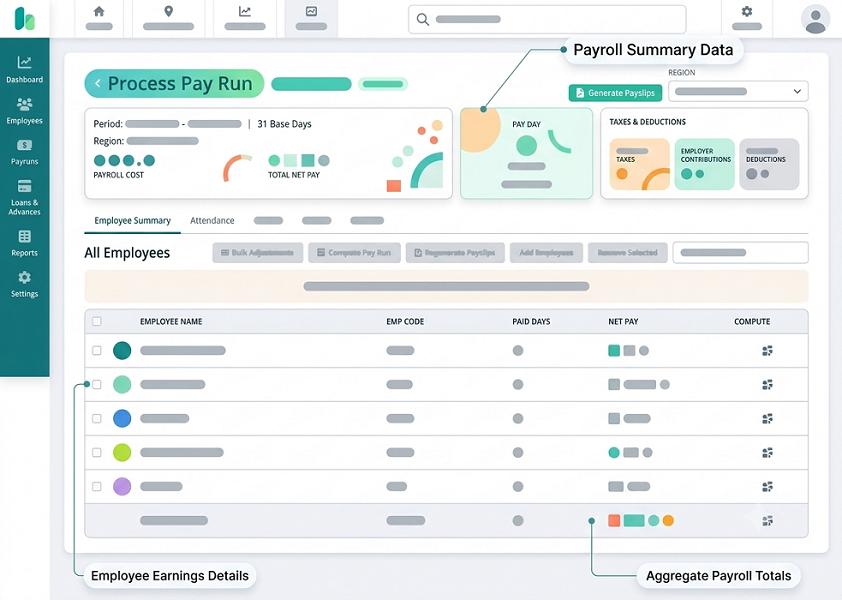
1. Employee Master Data Report
An employee master data report provides the basic information needed to connect attendance, payroll and employment records. It serves as the starting point for most internal reviews and audit requests.
The report should contain relevant fields such as:
- Employee name and unique employee ID.
- Job title, department and work location.
- Employment start date and, where applicable, end date.
- Contract type and current employment status.
- Agreed salary and relevant allowances.
- Normal working schedule or assigned shift.
- Payroll category and payment method.
- Relevant social insurance registration information.
- Links to the current employment contract and approved amendments.
The report should be checked against signed contracts, approved amendments and the employee information held in HR and payroll systems.
For example, if the employee master report shows a monthly salary of BHD 700 but the current signed contract specifies a different amount, HR should investigate the discrepancy before using the report as audit evidence.
Businesses should also maintain a record of changes to employee information. This helps reviewers understand when salary, job title, work location or employment status changed and whether the change was reflected in the correct payroll period.
2. Daily Attendance and Working-Hour Report
A daily attendance report shows when employees were scheduled to work and what the attendance system recorded.
It is particularly useful for employers with shift workers, manufacturing teams, security personnel, hospitality employees, retail staff and employees working across multiple locations.
The report should include:
| Field | What it helps verify |
|---|---|
| Employee ID | Links attendance to the correct payroll record |
| Work date | Identifies the day being reviewed |
| Scheduled shift | Shows the expected working period |
| Clock-in and clock-out | Records the actual attendance events |
| Total recorded hours | Supports working-hour calculations |
| Late arrival or early departure | Highlights attendance exceptions |
| Missing punches | Identifies incomplete records |
| Supervisor correction | Documents approved changes |
| Exception reason | Explains why recorded hours differ from the schedule |
Attendance reports should distinguish between raw clocking data and corrected attendance records. If a missing punch is corrected, the original record, reason for correction and approval should remain traceable.
Employers should also check whether their attendance systems correctly handle overnight shifts, approved off-site work, split shifts and other arrangements that could otherwise produce misleading totals.
A daily attendance report is most useful when it can be traced to the relevant employee, shift schedule and approval history.
3. Monthly Attendance Summary Report
A monthly attendance summary consolidates daily attendance information into a report that HR and payroll can review before salaries are finalised.
It should show total scheduled days, days attended, approved leave, recorded absences, late arrivals, early departures, missing check-ins and unresolved exceptions, as relevant to the employer’s working arrangements.
The report helps answer questions such as:
- Did the employee attend the scheduled shifts?
- Were absences supported by approved leave records?
- Were working hours corrected after a supervisor review?
- Were all attendance exceptions resolved before payroll closed?
- Were any attendance adjustments carried into the following month?
A monthly summary should not automatically classify every missing clock-in as an absence or treat every late arrival as a salary deduction. HR must investigate the circumstances and apply the appropriate policy and legal requirements.
The report should be reconciled with approved leave records and the final payroll input file. Any unresolved differences should be listed separately with a responsible owner and a resolution deadline.
4. Overtime and Extra-Hours Report
Overtime reports help employers demonstrate how additional working hours were identified, approved, calculated and included in payroll.
A useful report records:
- Employee and department.
- Date and duration of extra work.
- Normal scheduled hours.
- Recorded additional hours.
- Supervisor approval.
- Applicable overtime category.
- Calculation basis and rate used.
- Amount payable.
- Payroll period in which payment was processed.
- Any rejected, corrected or disputed hours.
The report should distinguish ordinary additional hours from work on weekly rest days, public holidays or night shifts, because the applicable treatment may differ.
Bahrain’s Labour Law contains provisions governing additional working hours and related compensation, including Articles 54 and 57. Employers should verify the applicable provisions and current amendments before configuring payroll calculations.
For audit preparation, payroll should be able to trace an overtime payment from the attendance record to the approval, calculation and payslip. If overtime was approved but not paid in the expected period, the discrepancy should be documented and investigated.
5. Leave and Absence Reconciliation Report
Leave records are important audit evidence because approved leave may affect attendance summaries, salary calculations and final settlements.
A leave reconciliation report should bring together:
- Opening leave balances, where applicable.
- Leave accrued during the period.
- Leave requested and approved.
- Leave actually taken.
- Sick-leave records and relevant supporting documentation.
- Unpaid leave and associated payroll adjustments.
- Cancelled or amended leave requests.
- Closing leave balances.
- Outstanding discrepancies requiring HR review.
The report should distinguish paid annual leave, sick leave, unpaid leave, public holidays and other categories rather than grouping every absence into one total.
For example, if an employee was recorded as absent for two days but had approved annual leave for those dates, HR should correct the attendance classification before payroll is finalised.
For audit purposes, the leave summary should link to the underlying request and approval. Where a leave balance has been adjusted manually, the report should explain the reason and identify the authorised reviewer.
6. Payroll Register and Salary Calculation Report
The payroll register is one of the most important reports for an audit because it summarises how each employee’s pay was calculated for a particular period.
A monthly payroll register should include:
- Employee ID and payroll period.
- Basic salary and applicable allowances.
- Overtime and other earnings.
- Paid and unpaid absence adjustments.
- Applicable deductions.
- Gross pay, total deductions and net pay.
- Payment status and relevant payment reference.
- Payroll adjustments or corrections.
- Approval status and processing date.
Payroll should retain the calculation details behind the reported amounts. A summary total alone may not be sufficient to explain how an employee’s final pay was determined.
How to review the payroll register
- Compare salary and allowance amounts with the current approved contract terms.
- Verify that overtime and attendance adjustments match approved records.
- Review deductions for accuracy and legal or contractual validity.
- Confirm that changes to salary or employment status were applied from the correct effective date.
- Compare net pay with the payment records.
- Investigate unusual changes against the previous payroll period.
For example, if an employee’s net pay decreases significantly from one month to the next, payroll should be able to identify whether the change resulted from unpaid leave, a change in allowances, an adjustment or another documented reason.
7. Payslip and Wage Payment Reconciliation Report
A payslip report helps employers verify that the employee-level payroll calculation agrees with the amount communicated to the employee. A separate wage payment report confirms whether the amount was actually paid.
The reconciliation should compare three records:
- The approved payroll register.
- The employee’s payslip.
- The bank or other authorised wage payment confirmation.
The report should flag differences between net pay calculated, net pay shown on the payslip and net pay paid.
Bahrain’s enhanced Wages Protection System (WPS) is intended to support transparent electronic wage payments through banks and financial institutions approved by the Central Bank of Bahrain. The LMRA announced the enhanced system in October 2025 and described its role in documenting wage payments and supporting timely payment of wages. Employers should confirm the latest implementation instructions and requirements that apply to their establishment.
For audit preparation, retain payment confirmations, payroll approval records, relevant bank transaction references and explanations for any delayed, returned or partially completed payments. If a payment differs from the approved payroll amount, record the reason and the corrective action taken.
8. Social Insurance Contribution Reconciliation Report
Social insurance records should be reviewed alongside payroll because the salary information used for contribution purposes and the contribution amounts reported to the Social Insurance Organization (SIO) must be accurate under the applicable rules.
The SIO’s employer e-services allow employers to review monthly contribution invoices, account statements, insured-worker records, monthly additions and terminations, and adjustments affecting contribution calculations. The insured-worker list can be exported for reconciliation with employee and payroll records.
A contribution reconciliation report should include:
- Employee reference and applicable insurance category.
- Salary information relevant to the contribution calculation.
- Contribution amounts recorded in payroll.
- Contribution amounts shown in the SIO records or invoice.
- Employee additions, terminations and salary changes.
- Adjustments or corrections.
- Invoice reference and payment status.
- Differences identified and the action taken.
The report should not assume that every employee category has the same contribution rate or calculation basis. Payroll should validate the applicable rules and effective dates before investigating differences.
A useful audit trail connects the payroll calculation to the SIO record, the invoice, the payment confirmation and any subsequent adjustment.
9. Employee Joiner and Leaver Report
Changes in employment status can affect attendance, salary calculations, leave balances, insurance records and final settlement amounts.
A joiner and leaver report helps HR and payroll confirm that employees entering or leaving the organisation have been processed consistently across all relevant systems.
For new employees, verify:
- Employment start date and signed contract.
- Employee master data.
- Attendance system activation.
- Payroll registration and salary details.
- Applicable insurance registration.
- Relevant work authorisation records, where applicable.
For departing employees, verify:
- Confirmed final working date.
- Contract termination or resignation documentation.
- Final attendance and leave balances.
- Outstanding salary, overtime or other payable amounts.
- Applicable deductions and settlement calculations.
- Required insurance or employment-status updates.
- Final payment evidence and closure of access to company systems.
The report should show the status of each task and identify unresolved items. A termination recorded in HR should not automatically be treated as proof that every payroll, insurance or regulatory update has been completed.
10. Payroll Adjustment and Exception Report
An exception report highlights records that require investigation before, during or after payroll processing. It is especially valuable during an audit because it demonstrates how the business identifies and resolves inconsistencies.
Examples of exceptions include:
- Missing attendance punches.
- Unapproved overtime.
- Leave records that conflict with attendance.
- Salary changes without complete supporting documents.
- Duplicate or unusual payroll entries.
- Differences between payroll and wage payment records.
- Incorrect employee status or missing registration details.
- Social insurance invoice discrepancies.
- Manual payroll adjustments.
- Reversed, delayed or incomplete wage payments.
For each exception, record the employee reference, payroll period, issue description, amount affected where relevant, responsible person, resolution, approval and closure date.
Do not delete the original record when a correction is made. Preserve the original value, the corrected value and the reason for the change so the reviewer can reconstruct the decision.
Management should also review recurring exceptions. Repeated missing punches or salary adjustments may indicate a need to improve system configuration, approval workflows or employee training.
11. Build an Audit Evidence Pack
Instead of collecting documents from different departments after an audit request arrives, Bahrain employers should maintain a standard evidence pack for each payroll period.
The pack can include:
| Evidence category | Supporting records |
|---|---|
| Employee information | Employee master report and relevant contract records |
| Attendance | Daily attendance logs and monthly summaries |
| Working hours | Shift schedules, overtime records and approvals |
| Leave | Leave register, requests, approvals and balance reconciliation |
| Payroll | Approved payroll register and salary calculation reports |
| Employee communication | Payslips and relevant payroll explanations |
| Wage payments | Bank confirmations and applicable WPS records |
| Social insurance | SIO invoices, insured-worker reports, payment records and reconciliations |
| Changes and corrections | Approved salary amendments and payroll adjustment logs |
| Audit follow-up | Exception register, corrective actions and closure evidence |
Bahrain Labour Law Article 68 specifies key information to be maintained in each worker’s file and requires retention for at least two years after the employment contract ends. Employers should check the current law and any other applicable requirements before setting retention schedules for all payroll and audit evidence.
Evidence should be organised by payroll period and employee reference, with access limited to authorised staff. If a report is exported from a system, retain its reporting period and extraction date so that the source and scope are clear.
12. Use a Monthly Audit Readiness Checklist
An audit-readiness checklist helps HR, payroll and finance complete essential checks before closing each payroll period.
Before finalising the monthly records, confirm that:
- Employee master data matches current employment records.
- Attendance exceptions have been reviewed and resolved or documented.
- Overtime hours have the required approvals and correct payroll treatment.
- Leave records agree with attendance and leave balances.
- Payroll calculations match approved salary and allowance information.
- Deductions have been reviewed and supported.
- Payslips agree with the approved payroll register.
- Wage payment records agree with net pay amounts.
- Applicable WPS records and submission evidence have been retained.
- Social insurance records and invoices have been reconciled.
- Employee joiners and leavers have been processed across relevant systems.
- Manual adjustments and unresolved exceptions have documented explanations.
- Reports and supporting records are stored securely and can be retrieved.
Assign a responsible owner and deadline to each incomplete item. This makes audit preparation a routine control activity rather than a last-minute exercise.
Frequently Asked Questions
1. Which attendance report is most useful for an audit in Bahrain?
A monthly attendance summary supported by daily clock-in and clock-out records is a strong starting point. It should show scheduled shifts, actual attendance, absences, leave, exceptions and approved corrections, with enough detail to trace the reported totals back to the underlying records.
2. Which payroll reports should employers prepare first?
Employers should start with the employee master data report, monthly payroll register, payslip and wage payment reconciliation, attendance summary, leave report and overtime report. Social insurance reconciliations and employee joiner and leaver reports should also be included where relevant.
3. How can employers demonstrate that wages were paid correctly?
Compare the approved payroll register with payslips and actual payment records. Retain the relevant bank confirmations, transaction references and applicable WPS evidence, and investigate differences between calculated net pay and the amount paid.
4. What should HR do if attendance records do not match payroll?
HR should investigate the difference using raw attendance data, shift schedules, approved leave and supervisor corrections. Any change should be authorised, documented and traceable. Payroll should process a correction only after the underlying facts and appropriate treatment have been confirmed.
5. How long should Bahrain employers keep employee records?
Article 68 of Bahrain’s Labour Law requires the individual worker file to be retained for at least two years after the employment contract ends. Other records may be subject to additional requirements, so employers should confirm the applicable retention rules and maintain records securely.
6. How often should audit reports be prepared?
Attendance and payroll reports should generally be reviewed each payroll period, with reconciliations completed before payroll is finalised wherever practical. Employers should also conduct periodic internal reviews and prepare additional reports when requested by an auditor or relevant authority.
Conclusion
Bahrain employers can improve audit readiness by maintaining reliable attendance, leave, overtime, payroll, wage payment and social insurance reports. The key is not simply to generate reports, but to ensure that each report agrees with its supporting records and that discrepancies are investigated and documented.
A consistent monthly process helps HR, payroll and finance teams identify errors early, explain salary calculations and retrieve supporting evidence quickly. With clear responsibilities, controlled access and a complete audit trail, businesses can strengthen payroll governance and respond more efficiently to internal and external audit requests.
An audit is less disruptive when attendance decisions and pay calculations can be traced. InnBuilt attendance and payroll workflows can help Bahrain employers collect timesheets, approvals and payroll summaries for review.