What Working-Hour Records Should Bahrain Employers Maintain for Shift Workers?
What Working-Hour Records Should Bahrain Employers Maintain for Shift Workers?
Introduction
Managing shift workers requires more than preparing a weekly roster. Employers in Bahrain need reliable records showing when employees were scheduled to work, when they actually worked, how rest breaks were handled, whether overtime was approved, and how working hours were reflected in payroll.
Accurate working-hour records help employers monitor attendance, calculate wages, identify scheduling problems, investigate discrepancies, and demonstrate compliance with applicable labour requirements. They are particularly important for businesses that operate around the clock, including factories, hospitals, hotels, retail stores, security companies, logistics providers, and facilities management organisations.
Bahrain’s Labour Law for the Private Sector, Law No. 36 of 2012, as amended, contains provisions governing working hours, rest periods, overtime, weekly rest, and employee records. Employers should use these requirements as a starting point when designing their attendance and recordkeeping procedures. The exact rules applicable to an employee may depend on their role, employment category, and any relevant legal exceptions.
This guide explains the key working-hour records Bahrain employers should maintain for shift workers and how to organise them for reliable payroll and compliance management.
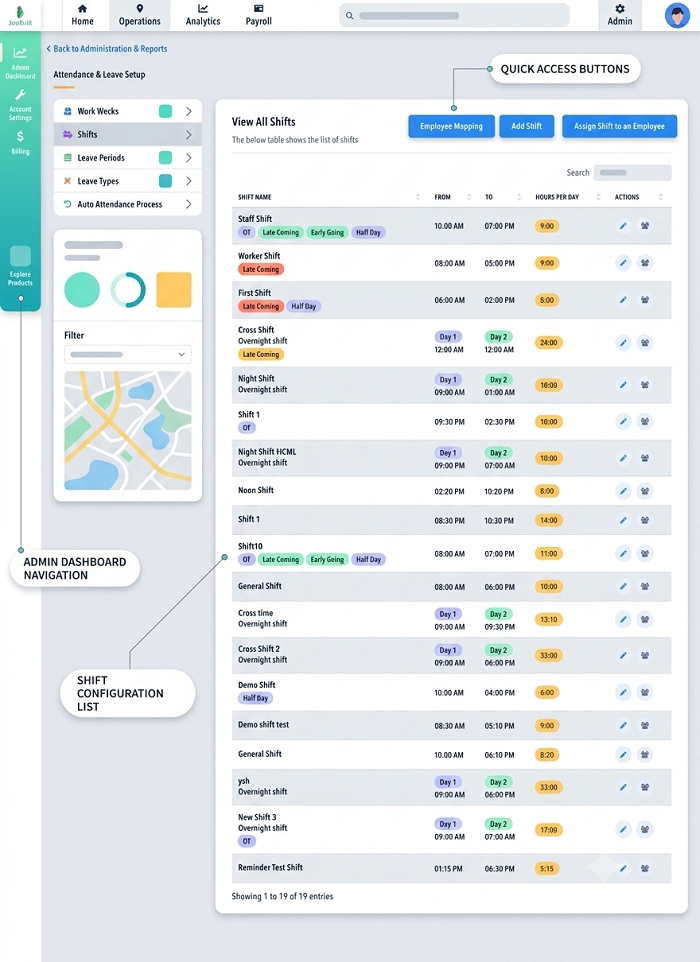
1. Employee and Shift Assignment Records
Before recording actual attendance, employers should maintain accurate employee information and the shift arrangements applicable to each worker.
A central employee record should include:
- Employee name and identification or personnel number.
- Job title, department, and work location.
- Employment start date and employment status.
- Contractual working hours and applicable work pattern.
- Assigned shift type, such as day, evening, night, rotating, or split shift.
- Designated supervisor or department manager.
- Applicable rest-day arrangements.
- Approved changes to the employee’s normal working pattern.
These details help HR and payroll teams determine which working schedule applies to each employee. They also reduce errors when employees transfer between branches, departments, projects, or work locations.
Best practice: Maintain one central employee record and connect it to the scheduling, attendance, and payroll systems. Avoid maintaining separate, inconsistent employee lists in individual departments.
2. Planned Shift Rosters and Schedule Changes
A shift roster records when employees are expected to work. It provides the baseline against which actual attendance can be compared.
Employers should retain records showing:
- The scheduled start and end time of each shift.
- The employee assigned to the shift.
- The work location and department.
- Planned breaks and rest periods.
- Weekly rest days.
- Rotating shift patterns.
- Shift swaps and employee-requested changes.
- Supervisor-approved schedule adjustments.
- The date and reason for each change.
Keep both the original roster and the approved revised version. If a manager changes an employee's shift after the roster has been published, the system should record who approved the change and when it took effect.
This is especially important when employees work overnight or move between different shifts during the same week.
Under Article 55 of Bahrain’s Labour Law, employers must display a schedule at the workplace showing each worker’s weekly rest day, working hours, and rest periods, including amendments to that schedule. Employers should ensure their posted schedules and retained roster records remain consistent.
3. Daily Attendance and Actual Working-Hour Records
Attendance records show when an employee actually reports for work and when they finish. They should be distinct from planned schedules so that differences can be identified rather than overwritten.
For every shift, employers should capture, where applicable:
- Actual clock-in time.
- Actual clock-out time.
- Attendance date.
- Work location or assigned site.
- Late arrival or early departure.
- Missing or duplicated punches.
- Approved attendance corrections.
- The person authorising a correction.
- The reason for a manual adjustment.
Employers can collect this information through biometric terminals, access cards, attendance kiosks, mobile applications, or electronic timesheets. Paper registers may be appropriate in some environments, but they should have clear completion, review, and approval procedures.
A record that simply states “present” may not be sufficient for accurate payroll calculations when employees work different shifts, overtime, or variable hours.
Example of a daily attendance record
| Employee | Scheduled shift | Actual start | Actual finish | Exception |
|---|---|---|---|---|
| Employee A | 7:00 AM–3:00 PM | 7:04 AM | 3:02 PM | Late arrival |
| Employee B | 3:00 PM–11:00 PM | 2:55 PM | 11:10 PM | Early arrival and late finish |
| Employee C | 11:00 PM–7:00 AM | 11:00 PM | 7:00 AM | Overnight shift |
These examples illustrate the fields a record may contain; they do not determine whether an exception is payable or constitutes a legal violation. Employers should apply their approved policies and relevant legal requirements.
4. Records for Overnight and Cross-Midnight Shifts
Night shifts often begin on one calendar day and finish on the next. If an attendance system records only the date on which the shift started, it can create errors in daily totals, overtime calculations, and payroll reporting.
For overnight shifts, maintain:
- Shift start date and time.
- Shift end date and time.
- The employee’s scheduled shift identifier.
- Actual start and finish timestamps.
- Breaks taken during the shift.
- Any extension beyond the scheduled finish.
- Overtime approval and classification, where applicable.
- The payroll period to which the hours are allocated.
For example, a shift scheduled from 10:00 PM on Monday until 6:00 AM on Tuesday should be stored as one clearly identifiable shift with separate start and end timestamps.
Do not automatically split a shift at midnight for payroll purposes without checking the applicable calculation rules and company policy. The system should preserve the actual timestamps and allow authorised payroll staff to apply the correct treatment.
Employers should also review consecutive shift assignments to identify insufficient recovery time, unplanned extensions, and scheduling conflicts.
5. Rest Break and Meal-Period Records
Break records help employers establish how scheduled working time was organised and whether employees received the appropriate rest periods.
For each relevant shift, record:
- Planned break start and finish times.
- Actual break times, where tracked.
- Break duration.
- Whether the break was taken, shortened, delayed, or missed.
- Whether the employee remained at the workplace or was required to remain available.
- The reason for any missed or interrupted break.
- Any authorised exception and the responsible manager.
Article 52 of Bahrain’s Labour Law generally provides for one or more intervals for prayer, meals, and rest totalling at least half an hour, arranged so that a worker is not employed for more than six consecutive hours. The law also provides for ministerial decisions addressing certain operational or technical exceptions and certain demanding jobs. The applicable treatment should therefore be checked against the current rules for the particular work.
Article 53 also addresses the organisation of working hours and rest periods, including the daily span between the start and end of work. Employers should distinguish between actual hours worked, time present at the workplace, and break time counted for legal or payroll purposes; these concepts are not always identical.
For example, a break during which an employee must remain at the workplace may be treated differently for attendance-span calculations than a break during which the employee is free from work obligations. Employers should not assume every break is automatically unpaid or automatically excluded from every calculation.
6. Overtime Requests, Approvals, and Actual Extra Hours
Shift workers may stay beyond their scheduled finish, start early, cover an absent colleague, or be called in on a rest day. Employers should maintain records that explain why the additional hours occurred and how they were authorised and paid or otherwise treated.
An overtime record should include:
- Employee name and personnel number.
- Date and shift concerned.
- Scheduled working hours.
- Additional hours requested.
- Reason for the overtime.
- Requesting manager and approving authority.
- Actual additional hours worked.
- Whether the work was during the day, at night, or on a weekly rest day.
- Applicable rate or compensatory arrangement.
- Amount calculated and payroll period.
- Any adjustment or dispute.
Under Article 54 of Bahrain’s Labour Law, overtime remuneration is generally subject to a minimum increase of 25% for additional hours worked during the day and 50% for those worked at night, subject to the law’s scope and applicable exceptions. Article 57 addresses work on the weekly rest day and the relevant additional remuneration or compensatory-rest treatment. Special rules can apply to particular worker categories, so employers should verify the current legal treatment before configuring payroll.
Important: A supervisor’s approval is useful evidence, but it should not be used to erase additional hours that were actually worked. If an employee worked beyond the roster without prior approval, record the actual time, investigate the circumstances, and apply the relevant legal and company procedures.
7. Weekly Rest-Day and Public-Holiday Work Records
Employers operating continuously may schedule employees on different weekly rest days. They should maintain records that distinguish an ordinary shift from work performed on a designated rest day or public holiday.
Useful fields include:
- Employee’s designated weekly rest day.
- Published roster and any amendments.
- Actual hours worked on the rest day.
- Reason for requiring the employee to work.
- Approval details.
- Alternative rest day, if provided.
- Applicable additional payment or compensatory arrangement.
- Payroll calculation and payment status.
Article 57 of Bahrain’s Labour Law generally requires a weekly rest period of at least 24 consecutive hours. It also addresses working on the weekly rest day and the employee’s applicable compensation or alternative-rest entitlement.
Public holidays may be subject to separate statutory rules. Employers should maintain a distinct holiday-work code and check the applicable legal requirements rather than automatically treating every holiday shift as ordinary overtime.
8. Absence, Late Arrival, Early Departure, and Missed Punches
Attendance exceptions should be documented rather than silently corrected or deleted. A clear exception history helps employers distinguish legitimate leave, approved schedule changes, system errors, and unexplained absences.
Record the following:
- Type of exception.
- Date and affected shift.
- Scheduled and actual times.
- Employee explanation, where appropriate.
- Supporting documentation, if required.
- Supervisor’s review and decision.
- Whether leave, unpaid absence, or another code applies.
- Any adjustment passed to payroll.
- Date the exception was resolved.
Common exception types include sickness-related absence, approved leave, late arrival, early departure, missed clock-in, missed clock-out, device malfunction, and unauthorised absence.
HR should ensure that a missed punch is not automatically treated as absence or unpaid time without review. Similarly, an employee’s attendance record should not be changed solely to make it match the planned roster.
9. Shift Handover and Work-Extension Records
In hospitals, factories, hotels, security operations, warehouses, and other continuous-service environments, an employee may remain at work because the next shift has not arrived or an urgent task must be completed.
Employers should record:
- Scheduled handover time.
- Actual end of the outgoing employee’s shift.
- Actual start of the incoming employee’s shift.
- Any period of overlapping coverage.
- Reason for delayed handover or extended duty.
- Supervisor authorisation or incident reference.
- Additional hours worked and payroll treatment.
This information is important when staffing shortages, delayed relief, emergency maintenance, or operational incidents cause employees to work beyond their rostered hours.
A handover log can also help operations managers identify recurring coverage problems. For example, repeated extensions at the same site may indicate that the incoming shift begins too late or that the staffing plan needs revision.
10. Timesheet Review and Payroll Reconciliation
Attendance data should be checked before it is transferred to payroll. A shift may include ordinary hours, overtime, unpaid absence, approved leave, or work on a rest day. Payroll should not rely on a single total without understanding how it was produced.
The timesheet should show, where relevant:
- Ordinary hours worked.
- Approved overtime hours.
- Night-shift hours or applicable allowances.
- Weekly rest-day or public-holiday work.
- Paid and unpaid absence.
- Break adjustments.
- Manual corrections.
- Employee or supervisor confirmation, where required.
- Payroll review status.
- Final approved hours and the relevant pay period.
A useful monthly reconciliation process compares:
- The published roster.
- Actual attendance records.
- Approved overtime and schedule changes.
- Leave and absence records.
- The final timesheet.
- Payroll calculations and payslip data.
Investigate discrepancies before payroll is finalised. If an adjustment is made after payroll processing, retain the original record, the correction, its reason, and the approval trail.
11. Employee Files and Supporting Documents
Working-hour records should be linked to the employee’s personnel file or an authorised recordkeeping system. Bahrain’s Labour Law, Article 68, requires employers to maintain a file for each worker containing specified employment information, including details about the worker’s job, wages, leave, and service history.
Depending on the employee and work arrangement, relevant supporting documents may include:
- Employment contract and amendments.
- Applicable working schedule.
- Approved shift changes.
- Attendance exception forms.
- Overtime requests and approvals.
- Leave and absence documentation.
- Timesheets and payroll adjustments.
- Records of employee queries or disputes about hours.
- Relevant incident or handover reports.
Keep only information that is relevant and appropriate to the employment record. Restrict access to authorised personnel, and use a defined retention schedule that reflects applicable legal requirements and legitimate business needs.
12. Digital Attendance Systems and Record Integrity
A digital system can make shift records easier to retrieve, compare, and audit. However, technology alone does not guarantee accurate records. Employers should establish controls over data entry, corrections, access, and reporting.
Consider the following controls:
- Unique employee IDs: Prevent one employee’s hours from being attributed to another.
- Timestamped entries: Preserve the original time an attendance event occurred.
- Audit trails: Record who changed a time entry, when it changed, and why.
- Role-based permissions: Allow employees, supervisors, HR, and payroll staff to perform only authorised actions.
- Shift-aware calculations: Correctly handle overnight shifts and daylight-saving or time-zone issues where relevant to the system configuration.
- Exception alerts: Flag missing punches, excessive hours, short turnaround periods, and unapproved extensions.
- Approval workflows: Route corrections and overtime for review.
- Secure backups: Protect records against accidental deletion or system failure.
- Payroll integration: Transfer approved hours without repeated manual re-entry.
- Privacy controls: Limit the collection and use of personal data, including biometric or location data, to authorised and justified purposes.
If biometric attendance, GPS, or mobile geolocation is used, employers should separately assess applicable personal-data protection requirements, explain the relevant workplace process to employees, and restrict access to sensitive information.
13. Who Should Review Working-Hour Records?
Clear ownership prevents gaps between operations, HR, and payroll.
| Responsible role | Main responsibility |
|---|---|
| Employee | Follow the attendance procedure and report errors promptly |
| Shift supervisor | Review attendance, handovers, and exceptions |
| Department manager | Approve schedules and authorised overtime |
| HR team | Maintain employee and schedule records and review policy compliance |
| Payroll team | Reconcile approved hours and apply correct pay treatment |
| IT or system administrator | Maintain system access, data integrity, and audit logs |
| Senior management | Review recurring risks and ensure appropriate controls |
For small organisations, one person may perform more than one of these roles. Even then, employers should separate the entry of working hours from their final approval where practical.
14. How Long Should Bahrain Employers Retain Working-Hour Records?
Employers should establish a documented retention policy rather than retaining every record indefinitely or deleting records as soon as payroll is completed.
The policy should address:
- Applicable statutory retention periods for each record type.
- Employee-file retention requirements.
- Wage and overtime dispute risks.
- Inspection and audit requirements.
- Pending complaints or legal proceedings.
- Access restrictions and secure disposal.
- Retention of original records and correction histories.
Article 68 is particularly relevant to individual employee files, while Articles 177 and 178 give authorised labour inspectors powers to inspect workplaces and request relevant records, information, and documents. Employers should therefore be able to retrieve reliable records promptly when lawfully requested.
Do not assume that one retention period applies to every category of employment, payroll, attendance, and personal-data record. Confirm the current legal requirements for each record type with qualified Bahrain labour-law advice or the relevant authority.
15. Common Working-Hour Recordkeeping Mistakes
Bahrain employers should watch for the following problems:
- Keeping only the planned roster without recording actual hours.
- Overwriting original attendance entries after a correction.
- Treating all breaks as unpaid without checking the applicable rules.
- Failing to distinguish overnight shifts from two separate shifts.
- Paying overtime from informal messages without reconciling actual hours.
- Recording work on rest days as ordinary hours.
- Allowing supervisors to make undocumented manual changes.
- Failing to track employees transferred between branches or sites.
- Ignoring delayed shift handovers and emergency call-outs.
- Retaining records in disconnected spreadsheets with inconsistent totals.
- Giving broad access to employee attendance and biometric data.
- Deleting records without checking legal retention requirements.
The solution is to standardise attendance codes, define approval responsibilities, preserve audit trails, and review discrepancies before each payroll close.
16. Practical Checklist for Bahrain Employers
Use this checklist to assess whether the organisation’s records are complete.
- Employee profiles include the correct work pattern and assigned location.
- Published rosters show working hours, rest periods, and weekly rest days.
- Changes to shifts are documented and approved.
- Actual clock-in and clock-out times are captured.
- Overnight shifts are recorded using accurate start and end timestamps.
- Breaks and relevant exceptions are recorded consistently.
- Overtime requests, actual hours, and approvals are traceable.
- Weekly rest-day and public-holiday work are separately identified.
- Absences, missed punches, and manual adjustments have explanations.
- Supervisors review timesheets before payroll close.
- Payroll totals can be reconciled to underlying attendance records.
- Original records and correction histories are protected.
- Access to employee records is restricted to authorised personnel.
- Record retention and retrieval procedures are documented.
- The organisation periodically checks applicable legal requirements.
Frequently Asked Questions
1. What working-hour records should Bahrain employers maintain for shift workers?
Employers should maintain employee and shift details, planned rosters, actual start and finish times, break records, overtime approvals, weekly rest-day work, absences, attendance corrections, approved timesheets, and related payroll records.
2. Must employers record actual working hours as well as scheduled hours?
Recording both is a strong compliance and payroll-control practice. The roster shows the planned schedule, while actual attendance records show what happened. Comparing the two helps identify overtime, absences, missed punches, and schedule changes.
3. What are the general working-hour limits under Bahrain’s Labour Law?
Article 51 generally sets a limit of 48 actual working hours per week, subject to the law’s provisions and exceptions. Article 53 generally provides for no more than eight actual working hours per day unless otherwise agreed, with a maximum of ten actual hours daily under that provision. Special categories and circumstances may be treated differently, so employers should verify the rules applicable to each employee.
4. How should employers record overnight shifts?
Record the full start and finish timestamps, including the date change at midnight, and link both timestamps to the same shift identifier. Record breaks, extensions, and any overtime separately so the payroll system can apply the appropriate rules.
5. Should overtime be recorded if it was not approved in advance?
Employers should retain an accurate record of hours actually worked and document the circumstances, even if advance approval was missing. They should investigate the exception and apply the relevant legal and internal procedures rather than altering the attendance record to conceal the extra hours.
Conclusion
Bahrain employers managing shift workers should maintain a clear record of scheduled shifts, actual attendance, breaks, overtime, rest days, absences, shift handovers, timesheet approvals, and payroll adjustments. These records should be connected, traceable, and easy to retrieve.
The most effective approach combines accurate attendance capture with documented approvals, reliable payroll reconciliation, secure data access, and periodic compliance reviews. By establishing these controls, employers can reduce payroll errors, resolve attendance disputes more efficiently, and demonstrate how working hours were recorded and processed.
Employers should verify the current version of Bahrain’s Labour Law and any applicable ministerial decisions before finalising internal rules, particularly where special worker categories, night work, overtime, or operational exceptions are involved.
Shift records need to show both the planned roster and actual hours. InnBuilt Shift Management can help Bahrain employers retain check-in times, shift changes and approved exceptions for review.