What Is the Difference Between GPS Tracking and Geo-Fenced Attendance in Bahrain?
What Is the Difference Between GPS Tracking and Geo-Fenced Attendance in Bahrain?
Introduction
Managing a mobile workforce can be challenging for businesses in Bahrain. Employees may travel between customer locations, construction projects, warehouses, service centres, and other workplaces throughout the day. Employers need reliable information about where work takes place, when employees arrive, and whether attendance records match their assigned schedules.
GPS tracking and geo-fenced attendance are two technologies that help businesses manage these activities. Although both can use location information from mobile devices, they serve different purposes.
GPS tracking focuses on determining or monitoring a device's location over time, while geo-fenced attendance focuses on verifying a check-in or check-out against a predefined geographical boundary.
Understanding this difference helps Bahrain employers select the right system for field attendance, delivery operations, maintenance visits, construction projects, and payroll management.
1. What Is GPS Tracking?
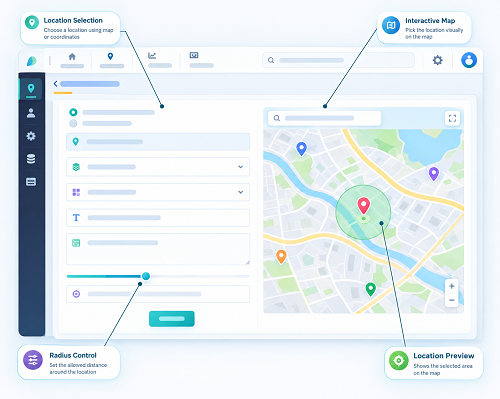
GPS tracking uses location information, commonly derived from a device's Global Positioning System (GPS) receiver and potentially other location services, to estimate where a person, vehicle, or device is located.
Depending on the application, the system may record a single location, periodically update a position, or display a route over time.
Businesses may use GPS tracking to:
- Monitor the location of company vehicles.
- Review delivery routes and vehicle movements.
- Coordinate field service teams.
- Understand travel between customer appointments.
- Locate mobile assets.
- Support dispatching and operational planning.
- Investigate route deviations or unexpected delays.
For example, a Bahrain logistics company may use GPS tracking to view the progress of delivery vehicles travelling between a distribution centre and customer destinations.
A maintenance business may use location updates to coordinate technicians who are attending several service calls throughout the day.
GPS tracking can provide useful operational visibility, but it does not automatically establish that an employee has started work, completed a shift, or performed a particular task. Those conclusions require appropriate attendance records and operational evidence.
2. What Is Geo-Fenced Attendance?
Geo-fenced attendance uses a virtual geographical boundary around an approved workplace or other designated location to help validate attendance events.
The employer defines a location, such as a construction site, customer facility, office, warehouse, or service location. The system uses configured geographical boundaries to determine whether a reported device location falls within the permitted area.
When an employee attempts to check in or check out through an attendance application, the system evaluates the location against the configured rules.
A typical process includes:
- The employer creates an approved worksite in the attendance system.
- The system assigns the relevant location to an employee or shift.
- The employee arrives at the site and opens the mobile application.
- The application checks the device's reported location.
- The system accepts, rejects, or flags the attendance attempt according to its rules.
- The attendance event is recorded for supervisor review and timesheet processing.
For example, a facilities management company in Bahrain may create separate geo-fences for each client property. Employees can use the mobile application to record their arrival at their assigned properties.
Geo-fenced attendance is primarily an attendance-control mechanism. It does not necessarily track an employee continuously between check-ins.
3. GPS Tracking vs. Geo-Fenced Attendance: Key Differences
| Comparison factor | GPS tracking | Geo-fenced attendance |
|---|---|---|
| Primary purpose | Determine or monitor location | Validate attendance events against an approved area |
| Main question answered | Where is the device, or where has it travelled? | Was the reported check-in or check-out within the permitted area? |
| Location data | May be collected once or repeatedly | Usually collected or evaluated when attendance is recorded, depending on system design |
| Route visibility | Can show movement and routes if location updates are collected | Does not inherently provide continuous route visibility |
| Attendance records | May need integration with an attendance system | Directly supports location-based attendance records |
| Worksite boundaries | Not essential to basic GPS tracking | Central to geo-fenced attendance |
| Common use cases | Fleet management, dispatching, field operations | Employee check-ins, worksite attendance, service-visit verification |
| Payroll usefulness | Provides supplementary location evidence | Can provide check-in and check-out events for timesheet reconciliation |
| Privacy considerations | Can be more extensive if continuous monitoring is enabled | Can limit collection to attendance events if configured that way |
| Main limitation | Location does not prove that work was performed | A location match does not independently prove identity or work performed |
The distinction is about the system's purpose and configuration, not necessarily its hardware. Both systems may use the same mobile device and location technology.
4. How GPS Tracking Works for Bahrain Businesses
GPS tracking is useful when an employer needs to understand movement or coordinate field operations.
For example, a delivery company operating across Bahrain may need to know whether a vehicle is travelling towards its next destination, has stopped unexpectedly, or has deviated from its planned route.
The company may use a GPS-enabled device or mobile application to collect location updates at configured intervals. Managers can then view available positions on a map and compare them with delivery schedules.
Common applications include:
- Fleet and vehicle monitoring.
- Delivery route management.
- Field service dispatching.
- Travel coordination between customer sites.
- Mobile asset monitoring.
- Route and operational performance analysis.
However, businesses should distinguish between vehicle tracking and employee tracking. A vehicle's location does not necessarily establish the location of every employee assigned to it.
Employers should also decide whether continuous or periodic location collection is genuinely necessary for the intended purpose. Collecting more detailed location histories can increase privacy, security, and data-management responsibilities.
5. How Geo-Fenced Attendance Works for Bahrain Businesses
Geo-fenced attendance is especially useful when the employer needs a reliable record that an employee attempted to check in at an assigned workplace.
Consider a maintenance company with technicians assigned to customer facilities in Manama, Muharraq, and Riffa.
The company can configure approved locations in its attendance application and assign each technician a daily schedule. When the technician arrives at a customer site, the application checks whether the device's reported location falls within the permitted boundary.
The system can then record the check-in and associate it with the employee, assigned location, and scheduled appointment.
Typical applications include:
- Construction-site attendance.
- Attendance at customer premises.
- Facilities management shift verification.
- Mobile service and repair visits.
- Field sales visit records.
- Attendance at warehouses and branches.
- Check-in and check-out at temporary work locations.
Geo-fenced attendance can reduce reliance on paper registers and help identify attendance events that require review. It should still include a fallback procedure for inaccurate GPS readings, device problems, and approved changes to work locations.
6. Which System Is Better for Attendance Management?
The right choice depends on what the business needs to verify.
GPS tracking is generally more suitable when location visibility, route monitoring, dispatching, or vehicle coordination is the main objective.
Geo-fenced attendance is generally more suitable when the main requirement is to record arrivals and departures at approved work locations.
For many Bahrain businesses, geo-fenced attendance is the more direct option for field employee attendance because it connects a location check with a specific attendance event.
However, neither system is universally better. A logistics operator may need GPS tracking for vehicles and geo-fenced attendance for employee shifts. A maintenance company may need geo-fenced check-ins for customer visits and limited location updates for dispatching.
The employer should begin by defining the operational question it needs to answer, then select the least intrusive system that meets that requirement.
7. When Should Bahrain Employers Use GPS Tracking?
GPS tracking may be appropriate when businesses need to coordinate movement or monitor mobile assets as part of their operations.
Logistics and delivery companies
GPS tracking can help dispatchers understand vehicle locations, coordinate deliveries, and respond to route delays.
Field service companies
Managers may use location updates to coordinate technicians between appointments and allocate urgent service calls.
Construction and project operations
Location information may support vehicle and equipment coordination across project locations. Employee attendance, however, should still be recorded through an appropriate attendance process.
Sales and distribution teams
Limited location verification or route information may help coordinate customer visits where it is operationally justified.
Fleet management
GPS tracking can support vehicle utilisation, route review, and fleet planning without automatically treating vehicle location as proof of employee attendance.
Employers should establish clear purposes and access rules, particularly where tracking information can be linked to identifiable employees.
8. When Should Bahrain Employers Use Geo-Fenced Attendance?
Geo-fenced attendance is useful when the employer needs a structured attendance record tied to a designated location.
Construction sites
Project managers can configure site boundaries and compare employee check-ins with approved project rosters.
Facilities management
Employers can verify attendance at client properties and reconcile recorded visits with assigned shifts.
Maintenance and repair services
Technicians can check in at approved customer locations, with the attendance event linked to a work order or appointment.
Field sales operations
Businesses can use location-based check-ins to support visit records, subject to appropriate privacy safeguards and verification procedures.
Multi-branch businesses
Employees assigned to different branches can record attendance at the relevant location rather than relying exclusively on a central office terminal.
Geo-fenced attendance works best when the system has accurate site information, clear check-in rules, individual employee accounts, and an exception-review process.
9. Can Businesses Combine GPS Tracking and Geo-Fenced Attendance?
Yes. Businesses with more complex field operations may use both technologies because they solve different problems.
For example, a Bahrain logistics company may use GPS tracking to monitor delivery vehicles and geo-fenced attendance to record employees' arrivals at depots or designated facilities.
A maintenance business may use GPS tracking for dispatching and route coordination while requiring technicians to check in at assigned customer locations.
A combined workflow might look like this:
- The employee receives an approved work schedule.
- GPS-based location information supports dispatching or route coordination, where necessary.
- The employee checks in at an assigned location through the attendance application.
- Geo-fence rules evaluate whether the check-in falls within the permitted boundary.
- The supervisor reviews exceptions and confirms any required corrections.
- Verified attendance is reconciled with shifts, approved overtime, leave, and payroll.
The two systems should not be treated as interchangeable evidence. A GPS route may support an investigation into a disputed visit, but it does not automatically replace an approved attendance record.
Integration should also avoid duplicating location collection when one system can meet the stated business need.
10. Understand the Limitations of Both Systems
Both technologies can provide useful information, but neither should be treated as infallible.
| Potential issue | GPS tracking | Geo-fenced attendance |
|---|---|---|
| Poor location accuracy | Can produce inaccurate positions or route estimates | May reject a legitimate check-in near a boundary |
| Weak connectivity | May delay location updates | May delay check-in submission or synchronisation |
| Shared mobile devices | May not establish which employee is carrying the device | May allow another person to submit a check-in using shared credentials |
| Incorrect configuration | Can assign a device or vehicle to the wrong record | Can associate employees with the wrong site or boundary |
| Device or application failure | Can interrupt location reporting | Can prevent or delay attendance recording |
| Incomplete evidence | Location alone does not prove work performed | A successful check-in alone does not prove the full shift was worked |
Employers should configure alerts and review processes that distinguish suspicious activity from ordinary technical problems.
A check-in outside a geo-fence should not automatically be treated as absence or misconduct. Supervisors should check approved schedule changes, location accuracy, and the employee's explanation before correcting or escalating the record.
11. Consider Bahrain's Employee Privacy and Data Protection Requirements
GPS tracking and geo-fenced attendance may both involve personal data when location information can be linked to an identifiable employee.
The privacy impact depends partly on how much information is collected. Continuous GPS tracking may create a detailed movement history, while geo-fenced attendance can be configured to collect location information primarily when employees check in or out.
Bahrain's Personal Data Protection Law No. 30 of 2018 provides the legal framework for personal data processing. Employers should assess the applicable requirements before deploying either technology.
Practical safeguards include:
- Defining the purpose for collecting location information.
- Explaining the system and its use to affected employees.
- Limiting collection to what is necessary for the intended purpose.
- Restricting access to authorised personnel.
- Setting appropriate retention and deletion rules.
- Securing mobile devices, accounts, and stored records.
- Reviewing vendor access, hosting arrangements, and international data transfers.
- Providing a documented process for challenging inaccurate records.
Employers should not assume that using a geo-fence automatically makes a system privacy-compliant. They must assess the actual data collected, processing purposes, legal basis, and any applicable notification, authorisation, or transfer requirements.
12. Connect Location-Based Attendance With Payroll
Neither GPS tracking nor geo-fencing should automatically determine an employee's pay without reviewing the relevant employment and attendance information.
A reliable attendance-to-payroll process should consider:
- The employee's assigned shift.
- Check-in and check-out timestamps.
- Approved changes to the work location.
- Recorded working hours and applicable breaks.
- Approved overtime.
- Leave and absence records.
- Missing or disputed attendance events.
- Authorised manual corrections.
For example, if an employee checks in at 8:00 a.m. and checks out at 4:00 p.m., the timestamps provide useful attendance evidence. The employer must still apply the relevant working-hour rules, break arrangements, overtime approvals, and employment terms.
Bahrain's Labour Law for the Private Sector, Law No. 36 of 2012, covers working hours, rest periods, and other employment matters. Employers should refer to the current applicable legislation when designing attendance and payroll procedures.
The payroll system should preserve an audit trail showing the original attendance record, any correction, the reason for the change, and the person who approved it.
13. How to Choose the Right Solution
Bahrain employers should evaluate the following questions before purchasing location-based workforce software:
- Is the main goal to monitor movement or record attendance at approved locations?
- Does the business need continuous location updates, or are check-in and check-out events sufficient?
- Are employees assigned to fixed sites, changing customer locations, or multiple sites in one shift?
- Does the system support accurate boundary configuration?
- Can it link each attendance event to an individual employee and an approved schedule?
- How does it handle GPS inaccuracies and poor connectivity?
- Can supervisors review and approve exceptions?
- Does it integrate with the existing timesheet and payroll process?
- Can location collection be limited to the stated business purpose?
- Has the employer assessed applicable Bahrain data protection and employment requirements?
A pilot at one branch, project, or field team can help evaluate accuracy, usability, and operational impact before a wider rollout.
14. Implementation Checklist for Bahrain Businesses
Before launching GPS tracking or geo-fenced attendance, employers should:
- Document the business purpose and required outcomes.
- Identify the employees, devices, vehicles, and locations involved.
- Decide whether continuous tracking is necessary.
- Configure approved work locations and attendance rules.
- Test location accuracy at actual worksites.
- Establish individual authentication and access controls.
- Create a process for failed check-ins and missing records.
- Explain the system and relevant privacy practices to employees.
- Review vendor security, data storage, and transfer arrangements.
- Integrate verified attendance with shifts and payroll.
- Train supervisors to review exceptions consistently.
- Monitor system accuracy and employee feedback after deployment.
Frequently Asked Questions (FAQs)
1. What is the main difference between GPS tracking and geo-fenced attendance?
GPS tracking determines or monitors location, potentially over time. Geo-fenced attendance uses location information to help validate an attendance event against a predefined geographical boundary.
2. Is geo-fenced attendance a type of GPS tracking?
Geo-fenced attendance can use GPS data, but it applies that data to an attendance rule. The system checks whether the reported location meets the conditions for recording a check-in or check-out.
3. Which is better for field employees in Bahrain?
Geo-fenced attendance is often more suitable when the main objective is to record arrivals and departures at assigned customer sites or worksites. GPS tracking is more suitable when route visibility, dispatching, or vehicle monitoring is the primary need.
4. Can GPS tracking prove that an employee attended work?
GPS data may provide supporting evidence of a device's location, but it does not independently prove the employee's identity, confirm that work was performed, or establish total working hours.
5. Can geo-fenced attendance prevent proxy check-ins?
It can reduce some inaccurate check-ins, particularly when combined with individual employee accounts and suitable authentication. However, geo-fencing alone cannot prove who is using a device.
6. Does geo-fenced attendance require continuous tracking?
No. It can be configured to evaluate location primarily when an employee checks in or out. Whether additional location collection is necessary should be assessed against the actual business purpose.
Conclusion
GPS tracking and geo-fenced attendance both use location information, but they address different workforce management needs.
GPS tracking helps businesses understand device or vehicle locations and movement over time. Geo-fenced attendance helps validate check-in and check-out events against approved geographical boundaries.
For Bahrain employers managing construction crews, delivery teams, maintenance technicians, field sales representatives, and facilities management employees, geo-fenced attendance is often the more direct tool for recording attendance at assigned work locations. GPS tracking may be more useful for route coordination and fleet operations, while businesses with broader operational requirements may combine both.
The right solution should be selected according to the actual business objective, configured for reliable attendance, integrated with payroll, and implemented with appropriate employee privacy safeguards.
GPS route visibility and geo-fenced attendance answer different questions: where work happened and whether a check-in met site rules. InnBuilt field tools can help Bahrain teams use each record appropriately.