How Can Bahrain Logistics Firms Track Drivers Across Delivery Routes?
How Can Bahrain Logistics Firms Track Drivers Across Delivery Routes?
Introduction
Logistics companies in Bahrain manage deliveries across commercial districts, warehouses, retail outlets, industrial facilities, residential neighbourhoods, and customer locations. As delivery volumes increase, tracking drivers across multiple routes becomes essential for maintaining visibility, meeting delivery commitments, controlling operating costs, and responding quickly to unexpected delays.
Traditional methods such as telephone updates, paper delivery sheets, and manual spreadsheets can make it difficult for dispatchers to determine a driver's current status, identify route deviations, verify deliveries, and communicate accurate arrival estimates to customers.
A digital fleet tracking and delivery management system can help logistics firms monitor vehicle locations, assign delivery routes, record stop arrivals and departures, capture proof of delivery, and identify exceptions as they occur.
For Bahrain logistics businesses, effective driver tracking should combine GPS-based vehicle visibility, route planning, mobile delivery applications, customer notifications, and reliable delivery records. These systems should also support road safety, appropriate employee privacy, and accurate working-time records.
1. Why Is Driver Tracking Important for Bahrain Logistics Firms?
Driver tracking provides dispatchers with visibility into the movement of vehicles and the progress of assigned deliveries. It helps logistics businesses understand whether deliveries are proceeding according to plan and where intervention may be needed.
A structured tracking process can help companies:
- Monitor vehicle locations during authorised delivery operations.
- Compare planned routes with actual journeys.
- Estimate delivery arrival times.
- Identify unexpected delays and missed delivery windows.
- Coordinate deliveries across multiple drivers and vehicles.
- Confirm arrival at customer locations.
- Record successful, failed, or rescheduled deliveries.
- Reduce unnecessary mileage and repeat delivery attempts.
- Improve customer communication.
- Review fleet utilisation and delivery performance.
For example, a logistics company transporting goods from a warehouse in Hidd to customers in Manama, Riffa, and Muharraq may have several vehicles operating simultaneously. A central dashboard can show each vehicle's delivery status and help dispatchers identify which assignments are complete, delayed, or awaiting action.
This visibility allows supervisors to make informed decisions rather than repeatedly contacting drivers for manual updates.
2. Use GPS Tracking to Monitor Vehicles on Delivery Routes
GPS tracking is a common starting point for improving fleet visibility. A vehicle tracking device or an authorised mobile application can provide location information to a central fleet management platform.
The system can display vehicle positions on a map and associate each vehicle with its assigned driver, delivery route, and current job status.
Useful tracking information may include:
- Vehicle identification.
- Assigned driver.
- Current or most recently reported location.
- Timestamp of the location update.
- Planned delivery route.
- Current delivery status.
- Estimated arrival time, where supported.
- Relevant route exceptions.
- Last successful connection with the tracking system.
Companies should configure location updates according to operational needs. High-frequency updates may be useful for time-sensitive distribution, while less frequent updates may be sufficient for some routine operations.
Dispatchers should also be able to identify when a vehicle's location has not been updated recently. A stale location should not be presented as though it were a live position.
GPS provides a useful indication of vehicle movement, but it does not independently prove that a driver entered a customer facility, unloaded the correct goods, or obtained delivery confirmation.
3. Plan Delivery Routes Before Dispatch
Effective tracking starts with a clear delivery plan. Without an assigned route and stop sequence, dispatchers may struggle to distinguish a legitimate change from an unnecessary detour.
A route plan should identify:
| Route Information | Purpose |
|---|---|
| Route identifier | Connects the driver's journey to the delivery schedule |
| Assigned driver and vehicle | Establishes responsibility for the route |
| Starting location | Identifies the warehouse, depot, or collection point |
| Delivery stops | Lists the intended customer destinations |
| Planned stop sequence | Defines the expected delivery order |
| Delivery time windows | Identifies customer availability and delivery commitments |
| Shipment details | Connects each stop to the relevant consignment |
| Access instructions | Helps drivers reach the correct entrance or loading area |
| Special handling requirements | Highlights fragile, temperature-sensitive, or restricted goods |
| Return or collection stops | Records reverse logistics and collection tasks |
Route planning software can help arrange stops according to location, delivery priority, vehicle capacity, and customer time windows.
However, the optimal route may change during the day. A customer may request a new delivery time, a road may be congested, or an urgent shipment may need priority handling.
The system should therefore allow authorised dispatchers to update routes and preserve a record of significant changes.
4. Create a Centralised Fleet Tracking Dashboard
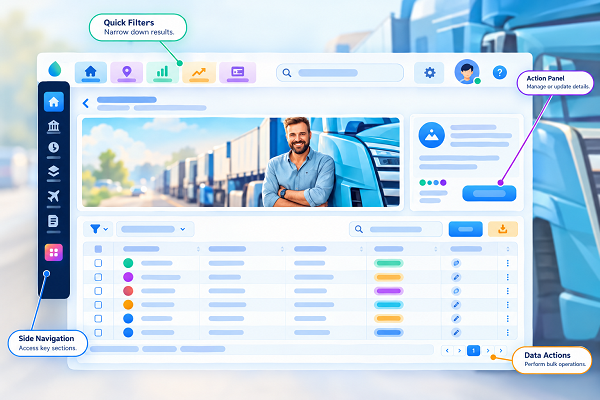
A central dashboard gives dispatchers a consolidated view of active routes, vehicles, deliveries, and exceptions.
Instead of checking separate spreadsheets or contacting individual drivers, the operations team can review the latest available information in one place.
A useful dashboard may display:
- Vehicles currently assigned to routes.
- Deliveries completed during the shift.
- Stops still awaiting service.
- Vehicles running behind schedule.
- Failed or disputed delivery attempts.
- Routes requiring dispatcher intervention.
- Drivers awaiting updated instructions.
- Vehicles with missing or stale location data.
- Collections and return-to-warehouse tasks.
For example, if a vehicle has completed most of its assigned deliveries but is significantly delayed at the next stop, the dispatcher can contact the driver, check whether there is an access issue, and update the customer if necessary.
Dashboard alerts should be based on meaningful operational conditions rather than every minor variation. Excessive alerts can distract dispatchers and make important exceptions harder to identify.
5. Monitor Route Deviations and Unexpected Stops
A route deviation occurs when a vehicle's actual movement differs materially from its planned route. Some deviations are legitimate, while others may require investigation.
Common reasons include:
- Traffic congestion.
- Road closures or diversions.
- Customer-requested changes.
- Incorrect delivery addresses.
- Fuel or vehicle maintenance stops.
- Safety-related interruptions.
- Vehicle breakdowns.
- Unplanned stops requiring dispatcher approval.
Fleet systems can compare reported vehicle positions with the planned route and flag significant deviations or prolonged stops.
For example, if a driver is scheduled to deliver goods to three customers in Manama before proceeding to Muharraq, the system may alert the dispatcher when the vehicle takes a substantial detour that affects the expected delivery schedule.
The alert should trigger verification rather than an automatic accusation of misconduct. The dispatcher can contact the driver, check traffic or customer information, and record the reason for the change.
Companies should define what constitutes a meaningful deviation based on route length, delivery urgency, vehicle type, and operating conditions.
6. Track Every Delivery Stop Separately
A vehicle's location alone does not provide a complete delivery record. Logistics firms should connect route tracking with individual delivery stops.
Each stop should have its own record linked to the relevant customer, shipment, and delivery instruction.
A delivery stop record may include:
- Customer or delivery location.
- Shipment or consignment reference.
- Planned arrival window.
- Actual arrival time.
- Delivery attempt status.
- Actual departure time, where needed.
- Recipient details appropriate to the transaction.
- Delivery outcome.
- Reason for a failed attempt.
- Proof-of-delivery reference.
The system should distinguish between a vehicle reaching a location and the delivery being successfully completed.
For instance, a driver may arrive at a retail outlet but be unable to unload because the receiving area is closed. The system should record the arrival and the failed attempt separately, including the reason and the next action.
This distinction improves delivery reporting and reduces disputes over whether a shipment was actually handed over.
7. Use Mobile Applications to Update Delivery Status
A driver mobile application can connect route assignments with real-time operational updates. It should be easy to use, especially for drivers handling many stops in a single shift.
Typical delivery statuses include:
- Assigned.
- Ready for dispatch.
- In transit.
- Arrived at destination.
- Delivery in progress.
- Delivered successfully.
- Delivery attempted but unsuccessful.
- Awaiting customer instructions.
- Returned or rescheduled.
Drivers should be able to select the appropriate status and provide supporting information when required.
For example, when a driver cannot deliver because the recipient is unavailable, the application may request a failure reason, a short note, and a proposed follow-up action.
Status updates should be associated with the relevant delivery rather than stored as disconnected messages.
Businesses should avoid requiring drivers to interact with mobile applications while driving. Updates should be completed when safely stopped, through suitable hands-free methods where appropriate, or by a dispatcher using information communicated safely by the driver.
8. Capture Proof of Delivery Digitally
Proof of delivery (POD) provides evidence that a shipment was delivered, collected, or handed over according to the applicable process.
Digital proof of delivery can reduce reliance on paper forms and help logistics teams resolve disputes more quickly.
Depending on the type of shipment, a POD record may include:
- Shipment or order reference.
- Delivery timestamp.
- Recipient acknowledgement or electronic signature.
- Quantity delivered.
- Damaged or missing items.
- Relevant delivery photographs.
- Notes about exceptions.
- The identity of the employee recording the outcome.
For business-to-business deliveries, the recipient may confirm the quantities received or identify discrepancies. For residential deliveries, a suitable acknowledgement method may be used according to the delivery service and customer agreement.
Photographs should be collected only when appropriate and should avoid unnecessary personal information or images of unrelated people.
A complete POD record should be connected to the correct shipment and customer order so that customer service, billing, and warehouse teams can retrieve the same information.
9. Notify Customers About Delivery Progress
Customers often want to know when a shipment will arrive, particularly when someone must be present to receive it.
A logistics management system can use delivery milestones to provide relevant updates.
Customer notifications may include:
- Confirmation that an order has been dispatched.
- An estimated delivery window.
- Notice that the vehicle is approaching.
- Notification of a delay.
- A failed delivery attempt.
- Confirmation of successful delivery.
- Instructions for rescheduling or collection.
Estimated arrival times should be updated using the latest available route and delivery information. Companies should avoid promising exact arrival times when traffic, loading delays, or other conditions create significant uncertainty.
If a delivery is delayed, the system should help customer service explain the issue and provide the next realistic update.
Clear communication can reduce inbound enquiries, missed handovers, and unnecessary repeat delivery attempts.
10. Integrate Driver Tracking with Warehouse Operations
Delivery route tracking is more effective when connected with warehouse dispatch and inventory processes.
Before a vehicle leaves the warehouse, the company should confirm that the correct shipments have been loaded and associated with the route.
Useful warehouse-to-route checks include:
- Matching each shipment to the assigned vehicle.
- Verifying package or pallet counts.
- Recording loading completion.
- Confirming route departure.
- Recording returns and undelivered goods.
- Reconciling collected items.
- Updating inventory after delivery or return.
For example, if a driver has ten deliveries on the route but only nine shipments were scanned onto the vehicle, the system should flag the discrepancy before dispatch.
Similarly, goods returned after failed delivery attempts should be recorded against the original shipment and the relevant delivery reason.
Integration between warehouse management, fleet tracking, and proof of delivery helps create a consistent record from loading through final delivery.
11. Plan for Traffic, Delays, and Route Changes
Bahrain logistics operations can be affected by congestion, customer availability, loading queues, roadworks, vehicle issues, and changing delivery priorities.
An effective tracking process should allow dispatchers to respond to these disruptions without losing visibility over the original route.
A practical delay-management process should:
- Detect or receive a report of the delay.
- Identify which deliveries may be affected.
- Confirm the reason where possible.
- Estimate the likely impact on arrival times.
- Notify affected customers.
- Reorder stops or reassign deliveries when appropriate.
- Record the reason for the route change.
- Review whether the revised plan remains achievable.
Route optimisation software may help calculate alternative stop sequences, but dispatchers should also consider vehicle capacity, delivery commitments, special handling requirements, and customer opening hours.
The system should retain the revised plan and relevant changes so that managers can distinguish planned adjustments from unexplained deviations.
12. Manage Failed Deliveries and Return Logistics
Failed deliveries can increase operating costs and reduce customer satisfaction. Logistics firms should record the reason for every unsuccessful attempt and use that information to plan the next action.
Common failure reasons include:
- Recipient unavailable.
- Incorrect or incomplete address.
- Customer refused the shipment.
- Site access restricted.
- Shipment damaged.
- Quantity discrepancy.
- Payment or documentation issue.
- Vehicle or route disruption.
Each failed delivery should have a defined outcome, such as rescheduling, customer contact, return to warehouse, transfer to another delivery route, or collection by the recipient.
The system should also record whether the driver returned the shipment to the depot and whether warehouse staff confirmed receipt.
Tracking failed deliveries separately helps businesses identify recurring address problems, customer availability issues, and avoidable repeat journeys.
13. Protect Driver Safety and Personal Data
Fleet tracking should improve delivery operations without encouraging unsafe driving or unnecessary employee surveillance.
Bahrain's Traffic Law, Law No. 23 of 2014, and subsequent amendments provide the framework for road traffic regulation. Logistics companies should ensure that route planning, dispatch instructions, and driver monitoring support safe and lawful driving practices.
Recommended operational safeguards include:
- Do not require drivers to type or interact with tracking applications while moving.
- Allow sufficient time for routes, loading, unloading, and breaks.
- Avoid performance targets that reward unsafe driving.
- Provide a clear process for reporting fatigue, vehicle problems, and safety concerns.
- Use location alerts to support operations rather than encourage speeding.
- Restrict access to tracking dashboards to authorised personnel.
Location records associated with an identifiable driver may constitute personal data. Bahrain's Personal Data Protection Law, Law No. 30 of 2018, establishes a framework for handling personal information. Businesses should assess the applicable requirements for their tracking arrangements, including the purpose of collection, access controls, retention, and any relevant data-transfer obligations. Companies should explain how and when driver location information is collected, limit collection to defined operational purposes, secure records, and establish suitable retention and access policies.
14. Integrate Route Records with Attendance and Payroll
Driver tracking can support attendance and working-time reconciliation, but vehicle movement alone should not be treated as a complete record of payable hours.
A driver's shift may include warehouse preparation, loading, waiting, unloading, customer handovers, vehicle checks, breaks, and return-to-depot duties. Some of these activities may occur while the vehicle is stationary.
Logistics firms should reconcile route records with the appropriate attendance and working-time system.
Relevant records may include:
- Scheduled shift and actual attendance.
- Vehicle and route assignment.
- Departure from the depot.
- Delivery and collection activity.
- Loading and unloading duties.
- Relevant breaks and waiting periods.
- Return-to-depot time.
- Approved overtime or schedule adjustments.
The purpose of integration is to provide a fuller operational record. Employers should assess working-time and payroll treatment under the applicable legal requirements, employment arrangements, and company policies rather than automatically interpreting engine or GPS timestamps as payable hours.
15. Measure Delivery and Driver Performance
Once route and delivery information is captured consistently, logistics firms can monitor service quality and identify opportunities to improve route planning.
| KPI | What it measures | Why it matters |
|---|---|---|
| On-time delivery rate | Percentage of deliveries completed within the agreed window | Measures delivery reliability |
| Route completion rate | Percentage of planned stops completed during the route | Highlights incomplete routes |
| Average delivery time | Average time taken for a defined delivery activity | Supports capacity planning |
| Failed delivery rate | Percentage of delivery attempts that are unsuccessful | Identifies avoidable repeat journeys |
| Route deviation rate | Frequency of defined, material deviations from planned routes | Helps investigate operational exceptions |
| Vehicle utilisation | How effectively available vehicles are used | Supports fleet planning |
| Delivery cost per stop | Relevant delivery operating costs divided by completed stops | Helps assess route efficiency |
| Proof-of-delivery completion | Percentage of applicable deliveries with complete POD records | Improves accountability |
| Customer complaint rate | Delivery-related complaints relative to a defined volume | Highlights service problems |
| Location-data availability | Percentage of required periods with usable tracking updates | Measures tracking-system reliability |
KPIs should have consistent definitions. For example, on-time delivery should be calculated against the agreed delivery window, while route deviation should account for approved changes and legitimate diversions.
Performance data should be interpreted alongside route complexity, traffic conditions, customer access restrictions, vehicle type, and delivery volume. A single late delivery should not automatically be treated as evidence of poor driver performance.
Frequently Asked Questions
1. How can Bahrain logistics firms track drivers in real time?
They can use GPS-enabled vehicle tracking devices or authorised mobile applications connected to a fleet management dashboard. The system should show the latest available location, timestamp, route assignment, and delivery status.
2. Can GPS tracking confirm that a delivery was completed?
No. GPS can help verify that a vehicle reached a delivery area, but successful delivery generally requires additional evidence, such as recipient acknowledgement, a digital proof-of-delivery record, or a documented delivery outcome.
3. How can logistics companies detect route deviations?
Fleet software can compare reported vehicle locations with planned routes and flag significant deviations or unexpected stops. Dispatchers should investigate the reason before deciding whether any corrective action is necessary.
4. How can companies reduce failed deliveries?
They can validate delivery addresses, confirm customer availability where appropriate, provide accurate arrival estimates, record access instructions, and notify customers about delays. Recording failure reasons also helps identify recurring problems.
5. What should a digital proof-of-delivery record include?
Depending on the shipment, it may include the order reference, delivery timestamp, recipient acknowledgement, quantity received, condition or discrepancy notes, and relevant supporting evidence.
Conclusion
Bahrain logistics firms can track drivers across delivery routes more effectively by combining GPS-based fleet visibility, planned routes, mobile delivery updates, stop-level tracking, digital proof of delivery, customer notifications, and structured exception management.
The most useful system connects vehicle movement with actual delivery outcomes. It helps dispatchers identify delays, support drivers, communicate with customers, and reconcile shipments without relying entirely on phone calls or paper records.
When implemented with appropriate road-safety practices, employee privacy safeguards, and reliable working-time records, route tracking can improve delivery reliability, fleet utilisation, customer service, and operational accountability.
Route managers need a practical view of deliveries in progress. InnBuilt Employee Tracking App can help Bahrain logistics teams review driver locations, assigned stops and visit updates during a shift.