How Can Indian Security Agencies Prove Guard Coverage During Shift Changes?
How Can Indian Security Agencies Prove Guard Coverage During Shift Changes?
Introduction
Security agencies in India are responsible for maintaining uninterrupted guard coverage at client locations such as factories, corporate offices, residential complexes, hospitals, warehouses, shopping malls, construction sites, and educational institutions. For these agencies, shift changes are among the most critical periods of security operations because an incomplete handover can leave an entry gate, patrol route, control room, or restricted area temporarily unattended.
Proving guard coverage during shift changes is not simply a matter of maintaining an attendance register. Security agencies must demonstrate that the outgoing guard completed the assigned duty, the incoming guard reported to the correct post, the handover took place, and the required security responsibilities remained covered throughout the transition.
Manual registers and supervisor phone calls may be insufficient when agencies manage dozens or hundreds of client sites across multiple cities. Missing signatures, late arrivals, unauthorized substitutions, incomplete handover notes, and inaccurate attendance records can create operational gaps and disputes with clients.
Indian security agencies can address these challenges through digital attendance systems, post-wise deployment records, guard handover checklists, supervisor verification, GPS-enabled check-ins where appropriate, and centralized coverage dashboards. By combining these controls, agencies can establish a reliable audit trail showing who was assigned to each post, when the shift changed, and whether the required coverage was maintained.
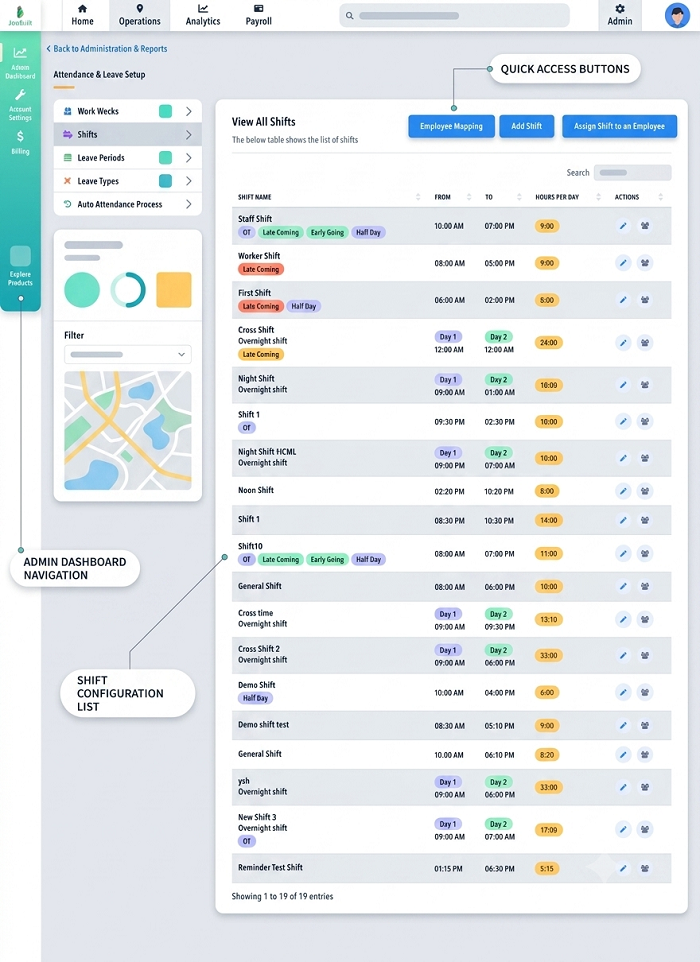
1. Why Is Shift-Change Verification Important?
A shift change is the transition between two duty periods. During this time, the outgoing guard transfers responsibility to the incoming guard, including information about incidents, visitors, keys, equipment, access permissions, and pending security tasks.
Without a structured process, several problems can occur:
- A guard leaves before the replacement arrives.
- The incoming guard reports late or goes to the wrong post.
- A supervisor deploys a substitute without updating the duty roster.
- Both guards record attendance, but neither properly assumes responsibility for the post.
- A gate or control room is temporarily left unattended.
- Security equipment, keys, or incident records are not handed over correctly.
- The agency cannot demonstrate actual coverage when a client raises a complaint.
Shift-change verification helps agencies prevent avoidable gaps, investigate incidents, meet contractual obligations, and maintain client confidence.
It also helps distinguish an attendance problem from a deployment problem. A guard may be present at the client site but assigned to a different post, which does not necessarily satisfy the coverage requirement for the original location.
2. Create a Post-Wise Duty Roster
The foundation of reliable shift verification is a duty roster that identifies the required staffing level at every client site.
Instead of recording only the total number of guards assigned to a location, security agencies should define the coverage requirements for each post and shift.
The roster should include:
- Client name and site address.
- Unique site and security-post IDs.
- Post location, such as main gate, loading bay, reception, or control room.
- Required number of guards per shift.
- Shift start and end times.
- Assigned guard IDs and names.
- Designated relief or replacement guards.
- Supervisor responsible for the site.
- Required handover activities.
- Special instructions for restricted areas or sensitive posts.
For example, a manufacturing facility may require two guards at the main gate, one at the vehicle entrance, and one in the control room during every shift. A roster that lists only four guards at the site does not establish that all three locations were properly staffed.
Post-wise assignments make it easier to verify whether each required position was covered during the transition.
3. Record Attendance at the Actual Security Post
Security agencies should capture attendance in a way that connects each guard to the assigned site, shift, and post.
Depending on the client's environment, this may involve biometric devices, RFID cards, mobile applications, QR-code check-ins, or authorized attendance terminals.
A useful attendance record should capture:
- Guard ID and name.
- Client site and post ID.
- Scheduled shift.
- Actual check-in time.
- Actual check-out time.
- Device or verification method.
- Supervisor confirmation, where required.
- Attendance corrections and their approval history.
For example, if a guard is assigned to the main gate, a check-in recorded at the site's administrative office may confirm presence at the premises but may not establish that the guard reached the main gate.
Post-level verification is therefore important when the client contract requires guards to remain at specific locations.
Agencies should also define what happens when a device fails, a guard forgets to check in, or a site has poor network connectivity. Manual corrections should require a reason, supporting evidence where available, and authorization from the designated supervisor.
4. Use a Structured Guard Handover Checklist
Attendance records confirm that guards checked in or out, but they do not prove that responsibility was properly transferred.
A standardized handover checklist provides evidence that the outgoing and incoming guards exchanged essential information and equipment.
A checklist may cover the following items:
| Handover item | Verification requirement |
|---|---|
| Guard identity | Confirm the outgoing and incoming guards |
| Post responsibility | Confirm the exact post being transferred |
| Keys and access cards | Record the transfer of authorized items |
| Communication equipment | Check radios, phones, or other assigned devices |
| Security equipment | Verify relevant equipment and report defects |
| Visitor and vehicle logs | Confirm that required records are updated |
| Incident status | Communicate ongoing incidents and unresolved issues |
| Patrol status | Record completed and pending patrols |
| Restricted areas | Communicate relevant access or security instructions |
| Handover confirmation | Record acknowledgements from both guards |
The checklist should be appropriate to the site. A residential entrance may require visitor-register and access-card checks, while an industrial site may also require equipment-status reports, permit information, or details of restricted work areas.
The handover should be recorded at the time it occurs. Reconstructing a handover after an incident is less reliable than maintaining a contemporaneous record.
5. Maintain a Clear Record of Overlapping Coverage
One practical way to reduce shift-change risk is to schedule a reasonable overlap between outgoing and incoming guards where the contract, staffing plan, and operational requirements permit it.
During this overlap, both guards can be present while the handover is completed. The required duration should reflect the complexity of the post, the site's risk level, and the client's operating procedures.
For example, a control room with several communication systems and ongoing incidents may require a more detailed handover than a simple reception post.
Agencies should distinguish between scheduled overlap and actual overlap. A roster may show that the incoming guard was supposed to arrive before the outgoing guard left, but the actual attendance records must establish whether this happened.
The system can compare:
- Scheduled arrival of the incoming guard.
- Actual check-in time of the incoming guard.
- Actual check-out time of the outgoing guard.
- Recorded handover completion time.
- Any supervisor-approved exception.
If the outgoing guard leaves at 6:00 p.m. and the incoming guard arrives at 6:12 p.m., the agency should investigate whether the post was covered by an authorized relief guard during those 12 minutes.
If an overlapping shift is not required or commercially provided for, the agency should still ensure that the post remains covered according to the agreed deployment plan.
6. Introduce Digital Shift-Change Records
A digital handover system can bring attendance, post assignments, checklist completion, and supervisor approvals into one record.
A typical workflow includes:
- The outgoing guard opens the assigned post's handover record.
- The outgoing guard records the duty status and any pending issues.
- The incoming guard verifies the post, equipment, and relevant instructions.
- Both guards acknowledge the handover using their authorized credentials.
- The system records timestamps and links the handover to the site and post.
- The supervisor reviews incomplete or unusual handovers.
Digital records should identify the person making each entry. A shared device or generic account that allows one person to acknowledge a handover on behalf of another weakens the evidence.
Agencies should also preserve a history of corrections rather than allowing users to silently overwrite earlier records.
For sites with limited connectivity, the system may support offline entry and later synchronization. The record should distinguish the actual event time from the time the data reached the central system.
7. Use GPS, QR Codes, or RFID for Additional Verification
Location-based verification can strengthen the evidence that a guard reached the assigned site or post.
Different technologies are suitable for different operating environments.
GPS-enabled mobile check-ins: Useful for confirming that a guard's device was near the designated site. GPS is less reliable for proving presence at a specific indoor post.
QR-code checkpoints: A guard scans a site- or post-specific code to record a checkpoint visit. Codes should be controlled to reduce the risk of copying or unauthorized sharing.
RFID or NFC checkpoints: A guard taps an authorized tag at a designated location. This can provide stronger post-specific evidence than GPS alone, depending on the implementation.
Biometric attendance: Can help verify the identity of the person recording attendance, subject to applicable privacy and employment requirements.
No single technology proves every aspect of coverage. A GPS check-in may show that a device was near the site, while a biometric record may confirm identity but not necessarily the exact post. Combining identity verification, post-level records, and handover acknowledgement provides more complete evidence.
Security agencies should choose technologies based on the site's risk level, connectivity, client requirements, and cost.
8. Track Replacement Guards and Emergency Deployments
Unexpected absences, illness, transport delays, and emergency requirements can disrupt planned shift changes. Security agencies need a documented process for deploying replacement guards without creating gaps in accountability.
When a replacement is assigned, the system should record:
- The original guard's scheduled assignment.
- The reason for the change, where appropriate.
- The replacement guard's identity.
- The post and shift covered.
- The authorization for the substitution.
- Actual arrival and departure times.
- Completion of the required handover.
- Any effect on contractual staffing requirements.
For example, if a guard assigned to a warehouse gate cannot report for duty, the supervisor may deploy an approved relief guard. The relief guard's check-in should be associated with the warehouse gate and relevant shift, rather than being recorded as an unexplained extra attendance entry.
The agency should also prevent the same guard from being recorded as covering two physically separate posts at the same time unless the duties and contract genuinely permit the arrangement.
Emergency substitutions should follow a defined approval process, with retrospective documentation only where prior authorization is impractical and the agency's policy permits it.
9. Verify Coverage Through Supervisor Checks
Digital records are valuable, but supervisory verification remains important for high-risk sites and unusual exceptions.
Supervisors can conduct scheduled or risk-based checks to confirm that:
- The assigned guard is physically present.
- The guard is at the correct post.
- The guard understands the current duty instructions.
- The post has the required equipment.
- The handover was completed.
- The attendance record reflects actual deployment.
- Any temporary staffing changes are authorized.
Supervisor checks can be recorded through a mobile application, inspection checklist, or site report.
For sensitive locations, agencies may also conduct periodic client-witnessed checks or joint reviews with the client's authorized representative.
The objective is not to duplicate every attendance check manually. It is to validate the reliability of the system and investigate situations where the available evidence is incomplete or inconsistent.
10. Establish Automated Alerts for Coverage Gaps
A centralized security workforce platform can compare scheduled staffing with actual attendance and handover records.
Useful alerts include:
- Incoming guard has not checked in by the expected time.
- Outgoing guard is preparing to leave before relief arrives.
- A required post has no active guard assignment.
- Handover acknowledgement is missing.
- A substitute guard has not been approved.
- Two guards are assigned to incompatible posts at the same time.
- A check-in occurs outside the permitted location tolerance.
- A shift has missing attendance records.
- A post has not completed its required inspection or handover checklist.
Alerts should be routed to the site supervisor, control room, or operations manager according to the urgency of the situation.
For example, an uncovered main gate may require immediate intervention, while a missing equipment acknowledgement may be routed for prompt review.
Agencies should define escalation rules, including who is contacted if the first supervisor does not acknowledge the alert. A dashboard that identifies gaps but does not trigger action is unlikely to prevent operational failures.
11. Maintain a Centralized Coverage Dashboard
A coverage dashboard provides a consolidated view of guard deployment across client sites, branches, and regions.
Useful indicators include:
| KPI | Purpose |
|---|---|
| Scheduled posts | Total posts requiring coverage during the period |
| Covered posts | Posts with verified guard assignments |
| Shift-change compliance | Percentage of transitions completed according to the defined process |
| Handover completion rate | Percentage of shifts with required handover records |
| Coverage gap duration | Total time required posts remained uncovered |
| Late relief arrivals | Number of incoming guards who arrived after the expected time |
| Unauthorized substitutions | Replacement assignments without the required approval |
| Attendance exception rate | Percentage of records requiring correction or investigation |
| Supervisor verification rate | Percentage of required checks completed |
| Incident-linked handover exceptions | Number of handover issues associated with reported incidents |
A simple shift-change compliance rate can be calculated as:
Shift-Change Compliance Rate = (Compliant Shift Changes ÷ Total Shift Changes) × 100
For example, if 196 out of 200 shift changes meet the agency's defined requirements, the compliance rate is 98%.
The agency should define compliance clearly. A transition may require an incoming guard's attendance, a completed handover checklist, and confirmation that the post remained covered. Counting a transition as compliant based only on two attendance punches may overstate actual performance.
Coverage dashboards should allow filtering by client, site, post, shift, region, and reporting period.
12. Connect Shift Records With Incident and Visitor Logs
Shift-change records become more valuable when they are linked with other security operations data.
Relevant records may include:
- Visitor and contractor entry logs.
- Vehicle movement records.
- Patrol checkpoint reports.
- Incident and near-miss reports.
- Key and access-card registers.
- Equipment inspection records.
- Emergency response logs.
- Control-room communication records.
Suppose a client reports that a delivery vehicle entered a restricted area during a shift change. The agency should be able to identify which guards were assigned to the relevant post, when responsibility transferred, whether the handover was acknowledged, and what the visitor or vehicle records show.
This linkage supports incident investigations and helps managers identify whether a problem arose from a staffing gap, a procedural failure, incomplete information, or another cause.
Records should be linked through consistent site, post, shift, and incident identifiers. Unstructured notes scattered across different messaging groups make investigations more difficult and less reliable.
13. Prepare Evidence for Client Audits and Contract Reviews
Clients may ask security agencies to demonstrate that contracted guard coverage was maintained, especially after an incident, complaint, or service-level review.
Agencies should maintain an organized evidence package for each site and billing period.
It may include:
- Approved duty rosters.
- Post-wise deployment records.
- Guard attendance and shift timestamps.
- Handover checklists and acknowledgements.
- Replacement and relief guard approvals.
- Supervisor inspection reports.
- Coverage-gap alerts and resolution records.
- Relevant incident and visitor logs.
- Client communications and approved exceptions.
- Monthly coverage summaries.
The agency should be able to trace each report back to its underlying records. Summary dashboards are useful, but they should not replace the supporting evidence.
Where a client contract specifies particular reporting formats, approval timelines, or record-retention periods, the agency should incorporate those requirements into its process.
Evidence should be protected against unauthorized changes and shared only with authorized client representatives.
14. Protect Guard Data and Maintain Reliable Records
Security agencies often handle employee identity details, attendance information, location data, and incident records. These records should be managed carefully.
Good practices include:
- Informing guards about attendance and location-verification procedures.
- Limiting location collection to legitimate operational purposes.
- Restricting access to employee records and sensitive site information.
- Using individual accounts and role-based permissions.
- Maintaining logs of changes to attendance and handover records.
- Establishing retention and secure deletion procedures.
- Providing a process for correcting inaccurate records.
- Applying suitable safeguards to mobile devices and centralized systems.
Continuous location tracking should not be adopted automatically when post-based check-ins and targeted verification can meet the operational requirement. The monitoring approach should be proportionate to the security risk and consistent with applicable Indian legal requirements and client policies.
Agencies should also ensure that digital records remain accessible for authorized audits without exposing sensitive security information to unnecessary users.
15. Common Challenges and Practical Solutions
| Challenge | Recommended solution |
|---|---|
| Incoming guard arrives late | Set automated alerts and maintain an approved relief arrangement |
| Outgoing guard leaves early | Require confirmation that the replacement has assumed responsibility |
| Wrong post recorded | Use unique post IDs and post-specific check-ins |
| Shared attendance credentials | Require individual accounts and appropriate identity verification |
| Poor network connectivity | Enable offline records with controlled synchronization |
| Incomplete handover notes | Use mandatory fields for critical handover items |
| Unauthorized replacement guards | Require documented substitution approval |
| Inconsistent supervisor checks | Define inspection schedules and escalation rules |
| Missing records after an incident | Maintain an organized, access-controlled audit trail |
| Excessive manual reporting | Integrate attendance, rosters, handovers, and incident logs |
| False confidence in GPS data | Combine location evidence with identity, post, and handover verification |
The most effective process combines technology with clear responsibilities, realistic staffing plans, and consistent supervisory controls.
16. Implementation Roadmap for Indian Security Agencies
Security agencies can introduce shift-change verification in stages.
Phase 1: Standardize site and post information
Create unique site and post IDs, define staffing requirements, and establish approved shift schedules.
Phase 2: Digitize attendance and deployment records
Introduce reliable check-in and check-out records linked to individual guards and assigned posts.
Phase 3: Implement handover checklists
Standardize the transfer of keys, equipment, incident information, and post responsibility.
Phase 4: Add alerts and escalation procedures
Identify late arrivals, missing handovers, uncovered posts, and unauthorized substitutions.
Phase 5: Launch coverage dashboards
Monitor coverage gaps, handover compliance, attendance exceptions, and supervisor checks.
Phase 6: Integrate supporting security records
Link shift information with visitor logs, patrol reports, incident records, and client reporting systems.
Phase 7: Review and improve
Analyze recurring coverage gaps, collect supervisor and client feedback, and refine staffing plans and verification rules.
A pilot at a small number of sites can help the agency test the process before expanding it across the organization.
Conclusion
Indian security agencies can prove guard coverage during shift changes by maintaining accurate post-wise duty rosters, recording individual attendance, documenting handovers, verifying relief guard arrivals, and monitoring coverage gaps through centralized dashboards.
The key is to establish a clear connection between the guard assigned to a post, the time responsibility changes, and the evidence that the handover was completed. Attendance records alone may show that guards were present, but reliable coverage verification also requires post-level deployment records, handover acknowledgements, and documented exception handling.
By combining digital tools with structured procedures and supervisor oversight, security agencies can reduce uncovered periods, improve accountability, strengthen client relationships, and provide a dependable audit trail demonstrating that contracted security coverage was maintained.
Guard handovers need a clear record of outgoing and incoming cover. InnBuilt Attendance Software can help Indian security agencies review shift punches and site exceptions.