How Can Solar EPC Companies in India Track Installation Crews Across Project Sites?
How Can Solar EPC Companies in India Track Installation Crews Across Project Sites?
Introduction
Solar Engineering, Procurement, and Construction (EPC) companies in India often manage multiple solar installation projects across different locations, including industrial rooftops, commercial buildings, residential properties, and utility-scale solar parks. Coordinating installation crews across these sites can be challenging because employees, subcontractors, electrical technicians, civil workers, and commissioning teams may work at different locations and follow varying project schedules.
Accurate workforce tracking helps solar EPC companies confirm crew attendance, monitor site deployment, allocate skilled workers, control labour costs, and maintain project timelines. Without a structured tracking system, companies may face unreported absences, delayed site mobilisation, duplicate attendance entries, inaccurate timesheets, and difficulties verifying contractor working hours.
By integrating mobile attendance, GPS-based site verification, project scheduling, crew allocation, and payroll systems, solar EPC companies can establish a reliable process for tracking installation crews across multiple project sites in India.
1. Establish a Centralised Workforce Tracking System
The first step is to create a centralised workforce management system that consolidates attendance and deployment information from all active solar projects.
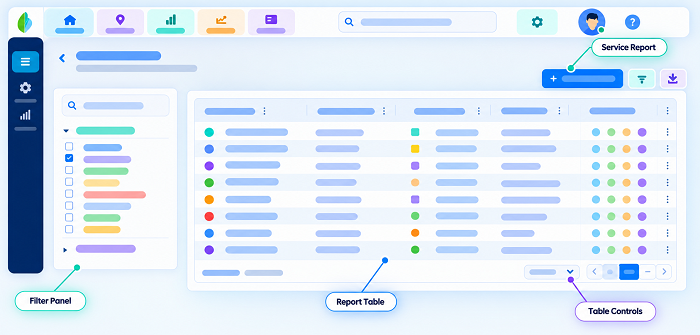
When project managers rely on separate spreadsheets, paper registers, or messaging applications, head-office teams may struggle to obtain an accurate picture of workforce availability. A centralised platform enables authorised managers to monitor attendance, project assignments, working hours, and deployment status in one place.
The system should maintain the following information:
- Employee or contractor ID.
- Project code and installation site.
- Assigned role, trade, and skill category.
- Scheduled working hours and shift.
- Actual check-in and check-out timestamps.
- Site supervisor and reporting manager.
- Attendance status and approved leave.
- Overtime and travel assignments.
- Project-wise labour cost allocation.
- Attendance corrections and approval history.
For example, an EPC company managing rooftop installations in Chennai, Bengaluru, and Hyderabad should be able to review workforce attendance at all three locations through a common dashboard.
Each project should retain its own workforce records while allowing authorised regional managers to review the entire project portfolio.
2. Assign Unique IDs to Employees, Contractors, and Project Sites
Solar EPC projects often involve a combination of permanent employees, temporary workers, specialist technicians, and subcontracted installation crews.
A standard identification system helps companies track these different groups without creating duplicate records or confusing one project's workforce with another's.
Each worker should have a unique employee or contractor ID, while every installation site should have a unique project code.
For example, a company could use project codes such as SOL-CHN-001 for a rooftop installation in Chennai and SOL-KA-014 for a commercial installation in Karnataka.
The workforce database should record:
| Data field | Purpose |
|---|---|
| Worker ID | Identifies the employee or contractor |
| Employment category | Distinguishes employees, contract workers, and subcontractors |
| Project code | Identifies the assigned solar installation |
| Site location | Records the designated project site |
| Skill category | Identifies electricians, installers, technicians, or other specialists |
| Shift schedule | Defines planned working hours |
| Supervisor ID | Identifies the responsible site supervisor |
| Cost centre | Allocates labour expenditure to the correct project |
When a worker moves from one site to another, the system should record the approved reassignment and its effective date rather than creating a second worker profile.
This structure improves attendance reconciliation, project costing, and workforce planning.
3. Use Mobile Attendance Applications for Remote Project Sites
Solar installations frequently take place at locations where permanent attendance infrastructure is unavailable. Installing biometric devices at every rooftop or temporary project site may be expensive and operationally impractical.
Mobile attendance applications offer a flexible alternative by allowing authorised crew members to record their attendance through a smartphone.
Depending on the company's requirements, the application may support:
- Employee login and identity verification.
- Mobile check-in and check-out.
- Project-specific attendance.
- GPS-based site verification.
- Supervisor approval.
- Offline attendance capture.
- Shift and overtime records.
- Attendance correction requests.
For example, an electrical installation crew assigned to a warehouse rooftop in Chennai can check in through the company's application after reaching the designated site.
The system records the timestamp and, where enabled, the location associated with the attendance event.
GPS information should support attendance verification rather than act as the sole proof that work was performed. Location accuracy, network availability, shared devices, and authorised off-site duties should be considered during verification.
Companies should also establish an alternative process for workers who do not have suitable smartphones or reliable mobile connectivity.
4. Create GPS-Based Project Geofences
Geofencing allows companies to define a virtual geographic boundary around a project site. When an authorised device records a location-based event within that boundary, the attendance system can flag the event for verification.
Solar EPC companies can configure geofences around:
- Rooftop installation projects.
- Utility-scale solar parks.
- Inverter and electrical installation areas.
- Project warehouses and material storage facilities.
- Commissioning and testing locations.
For example, if a solar installation site has an approved geofence, the attendance application can compare the worker's reported location with the designated project boundary.
If an employee checks in outside the expected area, the system can flag the record for supervisor review instead of automatically rejecting it.
Geofencing should account for GPS accuracy, nearby buildings, large project boundaries, and work conducted at adjacent facilities.
Because solar sites may cover large areas, companies should configure location rules according to actual site conditions rather than applying the same radius to every project.
5. Link Crew Attendance With Project Scheduling and Deployment Plans
Attendance data becomes more useful when it is connected to project schedules and daily crew deployment plans.
Solar EPC companies need different combinations of workers at different stages of a project. Civil workers may be required during site preparation, while electricians, module installers, and commissioning technicians may be needed at later stages.
A workforce planning system should connect:
- Project milestones.
- Daily work schedules.
- Required crew size.
- Worker skill requirements.
- Site attendance.
- Material availability.
- Supervisor assignments.
- Planned completion dates.
For example, a project may require 12 module installers, four electricians, and two supervisors on a particular day. If attendance records show that only nine installers and three electricians are available, the project manager can arrange replacement staff or revise the work plan.
This integration helps prevent situations in which workers report to a site but cannot proceed because the necessary skilled personnel, equipment, or materials are unavailable.
It also helps managers deploy available workers to projects where their skills are most urgently needed.
6. Track Inter-Site Crew Transfers and Temporary Deployments
Solar EPC companies frequently move installation crews between project sites to meet deadlines, address labour shortages, or support commissioning activities.
Without proper transfer records, a worker may be marked absent at the original site even though the employee has been assigned to another project.
A centralised system should record:
- Original project assignment.
- Destination project or site.
- Transfer approval.
- Effective transfer date and time.
- Travel and reporting arrangements.
- Receiving supervisor.
- Attendance at the destination site.
- Project cost allocation.
For example, an installation crew completing work at a rooftop project in Coimbatore may be reassigned to another site in Bengaluru.
The system should close or update the original assignment and create the new deployment record with the appropriate effective time.
Travel time, site working hours, and any applicable allowances should be handled according to company policy and applicable employment requirements.
Proper transfer records prevent duplicate attendance, improve labour cost allocation, and help project managers understand the actual availability of workers at each site.
7. Monitor Subcontractor and Contract Labour Attendance
Many solar EPC companies engage subcontractors for civil works, module mounting, cable installation, electrical work, and other specialised activities.
Tracking subcontractor attendance is important for coordinating work packages, verifying manpower deployment, and reconciling contractor invoices.
Companies should establish a standard process requiring subcontractors to submit worker details and daily deployment information.
The process should include:
- Registration of the subcontractor and authorised representative.
- Submission of worker identification and relevant skill information.
- Assignment of workers to approved project sites.
- Recording of daily attendance.
- Verification by the site supervisor.
- Reconciliation of approved manpower with contractor invoices.
- Retention of supporting records.
For example, if a subcontractor bills for 25 workers but the verified daily attendance shows 21 workers, the project team should investigate the discrepancy before approving the invoice.
However, attendance records alone may not establish whether a contractual milestone or work package has been completed. Invoice verification should also consider the applicable contract terms, work completion evidence, and approved measurement records.
EPC companies should clearly define attendance verification, statutory compliance responsibilities, and record-sharing obligations in subcontractor agreements.
8. Reconcile Attendance With Actual Installation Progress
A crew being present at a site does not necessarily mean that the planned installation work has been completed.
Solar EPC companies should therefore connect attendance records with daily progress reports and approved work activities.
Useful operational records include:
- Solar modules installed.
- Mounting structures completed.
- Cable routes installed.
- Inverters positioned and connected.
- Electrical testing completed.
- Quality inspection results.
- Safety observations.
- Work delays and equipment downtime.
- Commissioning milestones.
For example, a project may record 15 installers present for a shift but report lower-than-expected module installation progress because of high winds, unavailable materials, or restricted site access.
The project manager can compare attendance, planned tasks, and progress records to determine whether the delay resulted from workforce shortages or another operational constraint.
Productivity indicators should be interpreted in context. Different installation tasks require different skill levels and working conditions, so companies should not use attendance or output alone to judge individual performance.
9. Integrate Safety and Site Access Verification
Solar installation activities may involve working at heights, electrical systems, heavy components, and specialised tools. Workforce tracking should support safe site operations without replacing formal safety procedures.
Where appropriate, the attendance system can be linked to site access controls and safety authorisation records.
Before assigning workers to relevant activities, companies should verify applicable requirements, such as:
- Site induction completion.
- Required safety training.
- Valid work authorisations.
- Role-specific qualifications.
- Personal protective equipment requirements.
- Approved access to restricted work areas.
For example, an electrician assigned to inverter commissioning may need to satisfy the project's applicable qualification and safety authorisation requirements.
A workforce system can flag missing records for review, while the site safety team remains responsible for confirming that the worker is authorised to perform the activity.
Attendance data can also support emergency accountability by helping supervisors identify which crew members were recorded at a site during a given period. Because attendance records may be incomplete or delayed, they should not be the sole source used to determine who is physically present during an emergency.
10. Automate Attendance Exceptions and Notifications
Manual attendance verification across multiple project sites can create administrative delays and inconsistent records.
An automated exception management process can notify supervisors when attendance records require investigation.
Common exceptions include:
- Workers missing scheduled check-ins.
- Attendance recorded at the wrong project site.
- Duplicate attendance entries.
- Missing check-out timestamps.
- Workers assigned to overlapping project shifts.
- Unapproved transfers between sites.
- Attendance recorded outside the configured site boundary.
- Overtime exceeding approved hours.
- Missing subcontractor attendance records.
- Attendance entries awaiting supervisor approval.
Each exception should have an assigned owner and a defined resolution procedure.
For example, if a crew member's GPS check-in fails because of poor network coverage, the worker may submit an offline attendance record or request supervisor verification using approved supporting evidence.
The system should retain the original entry, correction details, approval timestamp, and reason for any change.
Automated alerts help companies resolve discrepancies early, before they affect payroll, contractor billing, or project reporting.
11. Use a Central Dashboard to Monitor All Project Sites
A central dashboard provides head-office and regional teams with a consolidated view of workforce deployment across active solar projects.
The dashboard should support filters for project, state, district, site supervisor, department, skill category, and employment type.
Useful key performance indicators include:
| KPI | Purpose |
|---|---|
| Crew attendance rate | Measures attendance against scheduled deployment |
| Site staffing coverage | Shows whether the required number of workers is available |
| Skill coverage | Tracks availability of required specialist personnel |
| Attendance exception rate | Measures records requiring investigation |
| Inter-site transfer rate | Tracks movement of workers between projects |
| Overtime hours | Measures additional working hours |
| Project labour cost | Tracks workforce expenditure by site |
| Attendance closure time | Measures how quickly daily records are finalised |
| Planned versus actual manpower | Compares deployment plans with actual attendance |
For example, if one project repeatedly operates below its required crew strength, management can review recruitment, subcontractor capacity, transfer planning, and project scheduling.
Dashboard metrics should be considered alongside weather conditions, material availability, site access restrictions, and project complexity to avoid drawing misleading conclusions about workforce performance.
12. Integrate Workforce Tracking With HRMS, Payroll, and Project Management Systems
Using separate applications for attendance, project scheduling, payroll, and contractor management can result in inconsistent information.
An integrated workforce management system can connect these records and reduce repetitive data entry.
A suitable integration should support:
- Employee and contractor master-data synchronisation.
- Project-wise attendance collection.
- Shift and leave management.
- Overtime approval and verification.
- Inter-site transfer records.
- Project cost-centre allocation.
- Contractor attendance reconciliation.
- Payroll data export.
- Attendance correction approvals.
- Audit trails and reporting.
For example, verified attendance from a solar project in Rajasthan can be transferred to the central HRMS and allocated to the correct project cost centre.
Before payroll is finalised, HR and payroll teams should review missing punches, approved leave, transfers, overtime, and unresolved attendance disputes.
Contractor invoices should be reconciled separately against the relevant contract and work completion records.
13. Maintain Records for Labour Compliance and Audits
Solar EPC companies should maintain accurate records of working hours, attendance, overtime, leave, contractor deployment, and relevant wage calculations in accordance with the legal requirements applicable to their establishments and workforce.
The applicable requirements may depend on employment arrangements, state-specific rules, establishment type, and the labour legislation and provisions in force.
Companies should retain relevant records such as:
- Daily attendance registers or digital equivalents.
- Project and site assignment records.
- Shift schedules and approved changes.
- Overtime approvals and verified working hours.
- Leave and absence records.
- Contractor workforce and invoice reconciliation records.
- Attendance corrections and supporting evidence.
- Safety training and authorisation records where required.
- Payroll reconciliation reports.
For projects involving subcontractors, EPC companies should establish clear procedures for verifying relevant compliance documents and defining the responsibilities of the contracting parties.
Employee and contractor information should be protected through appropriate access controls, secure storage, retention policies, and procedures for correcting inaccurate records.
14. Define Responsibilities for Project Managers, Site Supervisors, and HR Teams
Effective workforce tracking requires clear accountability across project sites.
Project managers should plan workforce requirements, coordinate deployments, and monitor manpower availability against project milestones.
Site supervisors should verify attendance, confirm daily crew assignments, and resolve local exceptions.
HR teams should maintain worker records, attendance policies, leave rules, and correction procedures.
Payroll teams should process verified working hours and applicable overtime payments.
Contractor managers should reconcile subcontractor attendance, deployment records, and contractual claims.
Safety teams should verify relevant site access, training, and work authorisations.
IT administrators should maintain system integrations, device reliability, access permissions, and audit trails.
A written policy should establish check-in procedures, missed-punch reporting, transfer approvals, overtime authorisation, attendance closure deadlines, and escalation responsibilities.
Conclusion
Solar EPC companies in India can track installation crews across project sites effectively by combining centralised workforce management, mobile attendance, GPS-based site verification, shift scheduling, and project-wise deployment records.
Unique worker IDs and project codes provide consistent identification, while integration with project management, HRMS, and payroll systems improves visibility into staffing, working hours, and labour expenditure. Subcontractor reconciliation and automated exception alerts further strengthen operational control.
The most effective approach is to connect each worker's attendance to the correct project, site, shift, and authorised assignment while maintaining reliable records of transfers and corrections. With clear responsibilities, appropriate technology, and consistent verification procedures, solar EPC companies can improve workforce coordination, reduce administrative errors, support safety management, and keep installation projects on schedule.
Solar EPC crews often move between projects. InnBuilt Field Management can help Indian installation managers connect crew assignments with site check-ins and recorded project hours.