What Location Data Controls Should Malaysia Businesses Consider for Field Employees?
What Location Data Controls Should Malaysia Businesses Consider for Field Employees?
Businesses in Malaysia increasingly rely on GPS-enabled attendance systems, mobile workforce applications, and field service platforms to manage employees who work outside traditional offices. These tools help managers verify customer visits, monitor work-related check-ins, coordinate assignments, and maintain accurate attendance records.
However, collecting employee location information also creates responsibilities around privacy, security, transparency, and data retention. Without suitable controls, businesses may collect more information than necessary, expose sensitive location records, or use tracking data for purposes employees were not informed about.
For HR teams, payroll managers, operations leaders, and business owners, the objective should be to use location information responsibly while maintaining reliable field workforce records.
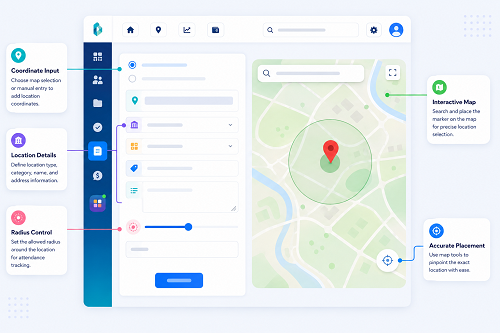
1. Define the Purpose of Location Data Collection
Before introducing GPS tracking or mobile attendance applications, businesses should clearly identify why they need employee location information.
Common business purposes include:
- Verifying employee check-ins at assigned customer locations.
- Confirming attendance at project sites and branches.
- Supporting field sales visit records.
- Coordinating maintenance and service assignments.
- Confirming delivery or job completion locations.
- Reviewing attendance exceptions and disputed check-ins.
Employers should distinguish between collecting a location at the time of a work-related check-in and continuously tracking an employee throughout the day.
For example, a company may need a GPS location when a field technician starts a scheduled service job. It may not need to collect the technician's location during personal time or after the employee has completed the working shift.
A clearly defined purpose helps businesses determine which location controls are necessary.
2. Limit Location Collection to Working Requirements
One of the most important controls is data minimisation. Businesses should collect only the location information required for their stated operational purposes.
For example, an attendance application may record:
- Employee identification.
- Check-in and check-out timestamps.
- GPS coordinates at the time of attendance.
- Assigned worksite or customer location.
- GPS accuracy information, where available.
- The reason for an approved location exception.
Continuous GPS tracking may be appropriate for certain operational activities, such as coordinating deliveries or responding to field service requests, but it should not automatically be enabled for every employee.
Businesses should consider role-based requirements. A delivery coordinator, mobile sales representative, and office-based employee may have very different location-data needs.
3. Establish Clear On-Duty and Off-Duty Tracking Rules
Employees should understand when location collection begins and ends.
A well-designed system should provide clear tracking rules for:
- Starting a scheduled shift.
- Recording attendance at a customer site.
- Travelling between approved assignments.
- Taking breaks.
- Completing a job.
- Ending a shift.
- Working outside normal hours under an approved arrangement.
For example, a field sales representative may need to record customer visits during working hours. The application should not continue collecting location information after the employee has clocked out unless there is a separately justified and properly communicated requirement.
Businesses should also provide clear instructions for employees who work overnight shifts or assignments that cross midnight.
4. Provide Employees With a Transparent Location Privacy Notice
Employees should know what location information the business collects and how it is used.
A location privacy notice should explain:
- What location information is collected.
- Whether the system records occasional check-ins or continuous location updates.
- Why the information is required.
- When location collection takes place.
- Who can access the records.
- Whether third-party technology providers process the information.
- How long location records are retained.
- How employees can raise questions or challenge inaccurate records.
The notice should be written in clear language rather than relying entirely on technical descriptions of GPS functionality.
For example, employees should understand whether the application records their location only when they press the attendance button or whether it periodically collects location updates during an active assignment.
Employers should also consider applicable notice and consent requirements under Malaysian data protection law.
5. Apply Role-Based Access Controls
Not every manager or employee needs access to every location record.
Businesses should establish permissions based on job responsibilities.
| User role | Suggested access |
|---|---|
| Field employee | Own attendance and relevant location records |
| Team supervisor | Location exceptions for assigned employees |
| HR team | Attendance records needed for HR administration |
| Payroll team | Approved attendance information relevant to payroll |
| Regional manager | Relevant team or regional attendance summaries |
| System administrator | Technical access required to maintain the application |
Access should be reviewed when employees change roles, transfer departments, or leave the organisation.
Businesses should also maintain access logs showing who viewed, exported, or modified location records. This makes it easier to investigate inappropriate access and maintain accountability.
6. Secure GPS Records and Mobile Attendance Devices
Location information should be protected against unauthorised access, alteration, disclosure, and loss.
Businesses should evaluate the security features of their attendance applications and mobile devices.
Important safeguards include:
- Encryption of location information during transmission and storage.
- Strong authentication for managers and administrators.
- Multi-factor authentication where appropriate.
- Secure application access on employee devices.
- Regular security updates.
- Restrictions on downloading or exporting location records.
- Secure backups and recovery procedures.
- Remote access revocation when an employee leaves the company.
For example, if a supervisor downloads employee location reports onto an unsecured personal device, the business may lose control over where those records are stored or shared.
A secure attendance platform should allow authorised users to review records without unnecessary copying or distribution.
7. Set Location Data Retention and Deletion Periods
Businesses should not retain employee location information indefinitely simply because their attendance system can store it.
A retention policy should explain how long different categories of information are kept.
| Data category | Suggested control |
|---|---|
| GPS check-in records | Retain according to documented attendance and legal requirements |
| Location exception explanations | Retain while needed for attendance review and applicable recordkeeping |
| Customer visit records | Follow relevant operational and contractual requirements |
| Temporary location logs | Delete when no longer needed for the stated purpose |
| Access and audit logs | Retain according to security and compliance requirements |
| Former employee records | Apply the organisation's approved retention schedule |
Retention periods should be determined by business needs and applicable legal obligations rather than using one period for every type of record.
Businesses should also ensure that deleted information is removed from relevant systems and handled appropriately in backups, subject to documented backup and recovery procedures.
8. Use Geofencing Without Treating Every Mismatch as Misconduct
Geofencing allows businesses to define approved geographical areas around offices, customer sites, warehouses, and project locations.
When an employee checks in outside an assigned area, the attendance system can flag the record for review.
However, a location mismatch does not automatically prove that an employee was absent or engaged in unauthorised activity.
Possible explanations include:
- A customer requested a different meeting location.
- A supervisor changed the employee's assignment.
- GPS accuracy was affected by nearby buildings.
- The employee was sent to an emergency service location.
- The assigned geofence was outdated or incorrectly configured.
Managers should review the employee's explanation and supporting work records before making an attendance decision.
A fair process should allow employees to challenge inaccurate location records.
9. Establish Controls for Location Data Shared With Vendors
Many businesses use third-party attendance software, cloud platforms, mobile applications, or workforce management providers.
These providers may process employee location information on behalf of the employer. Businesses should understand how these vendors handle the data.
Before selecting a provider, employers should review:
- What location information the provider collects.
- Where the information is hosted.
- Which subcontractors may access it.
- Whether information is transferred outside Malaysia.
- What security measures protect the records.
- Whether the provider uses location data for additional purposes.
- How data is returned or deleted when the contract ends.
- How security incidents are reported to the employer.
Contracts should clearly define each party's responsibilities for protecting employee information.
Where location information is transferred internationally, businesses should assess the applicable Malaysian cross-border personal data transfer requirements.
10. Review Automated Location Alerts and Decisions
Attendance systems may automatically flag unusual locations, repeated geofence mismatches, or check-ins outside scheduled working hours.
These alerts can help managers identify records requiring attention. However, businesses should avoid allowing automated location results to become the sole basis for disciplinary or payroll decisions.
A useful review process should include:
- The system identifies a location exception.
- The employee receives an opportunity to explain the mismatch.
- The manager checks the schedule and relevant assignment records.
- The system's GPS accuracy and geofence settings are reviewed.
- An authorised manager records the decision.
- HR reviews disputed or serious cases where necessary.
Businesses should also periodically assess whether automated rules are producing inaccurate or unfair results.
11. Maintain an Audit Trail for Location Data Access and Changes
An audit trail helps businesses understand how location information has been accessed and used.
The attendance system should record relevant activities, such as:
- Employee check-in and check-out events.
- Location exception submissions.
- Supervisor approvals and rejections.
- Changes to assigned work locations.
- Changes to geofence boundaries.
- Location report exports.
- Access by administrators and managers.
- Corrections to attendance records.
For example, if an employee disputes a rejected check-in, HR should be able to review the original GPS record, the employee's explanation, and the supervisor's decision.
An audit trail supports accountability and reduces the risk of undocumented attendance changes.
12. Include Location Data in the Company's Privacy and Security Reviews
Location tracking should be reviewed as part of the organisation's wider data protection programme.
Businesses should assess whether their tracking arrangements create privacy risks, especially when they involve continuous monitoring, large numbers of employees, detailed movement histories, or automated decision-making.
Practical review activities include:
- Conducting a data protection impact assessment where appropriate.
- Reviewing the location privacy notice.
- Checking whether access permissions remain appropriate.
- Testing security controls.
- Reviewing vendor arrangements.
- Checking retention and deletion practices.
- Training managers on responsible location-data use.
- Reviewing employee complaints and disputed records.
Malaysia's Personal Data Protection Department publishes guidance on data protection by design, data protection impact assessments, data breach notification, and the appointment of Data Protection Officers. Businesses should consult the relevant current guidance when designing their location-data controls.
13. Connect Location Controls With Attendance and Payroll Processes
Location data can support attendance verification, but it should not be treated as a complete record of working time.
A GPS check-in confirms where a device recorded an event. It does not necessarily establish the full duration of work, overtime eligibility, or whether a particular assignment was completed.
HR and payroll teams should use approved attendance records alongside relevant working-hour information.
Before payroll processing, businesses should review:
- Confirmed check-in and check-out times.
- Approved alternative work locations.
- Corrected attendance exceptions.
- Supervisor-approved overtime.
- Unresolved attendance disputes.
- Applicable working-hour and rest-day records.
For example, a technician may check in at an alternative customer location after receiving an approved assignment change. The location exception should be reviewed and corrected where appropriate, rather than automatically treating the employee as absent.
Best Practices for Malaysia Businesses
Businesses can strengthen location-data controls by following these practical steps:
- Document the purpose: Define why each employee group needs location tracking.
- Minimise collection: Collect only the information needed for attendance or operational activities.
- Set tracking boundaries: Explain when location collection starts and stops.
- Inform employees: Provide a clear privacy notice and explain how location records are used.
- Restrict access: Give managers and HR staff access only to records required for their roles.
- Secure the information: Use appropriate encryption, authentication, and device-security measures.
- Define retention periods: Delete records when they are no longer required, subject to applicable obligations.
- Review vendors: Check how attendance providers store, process, and transfer location information.
- Keep human oversight: Require appropriate review before taking action based on location exceptions.
- Maintain audit records: Document access, approvals, corrections, and other important changes.
Conclusion
Malaysia businesses should treat employee location information as personal data that requires clear purpose limitations, appropriate access controls, secure storage, defined retention periods, and transparent handling practices.
GPS attendance systems and geofencing can improve field workforce coordination, but their value depends on how responsibly the information is collected and used. Employers should avoid unnecessary continuous monitoring, give employees clear information about tracking practices, and ensure that location exceptions receive fair managerial review.
By combining privacy safeguards with reliable attendance and payroll procedures, businesses can maintain operational visibility while protecting the information of their field employees.
Location records should support a defined work purpose rather than unrestricted monitoring. Malaysia teams evaluating InnBuilt Employee Tracking App can review notice, access permissions and retention with their privacy advisers.