How Can Malaysia Teams Track Overnight Shifts That Cross Midnight?
How Can Malaysia Teams Track Overnight Shifts That Cross Midnight?
Overnight shifts are common in Malaysian industries such as manufacturing, healthcare, logistics, security, hospitality, customer support and business process outsourcing. These shifts often begin on one calendar day and finish the next morning. For example, an employee may start work at 10:00 p.m. on Monday and finish at 6:00 a.m. on Tuesday.
Although this arrangement may appear straightforward, it can create attendance and payroll complications. If an attendance system treats midnight as the end of a workday, it may record an incomplete shift, calculate working hours incorrectly or assign overtime to the wrong date.
Malaysian employers need a consistent method for recording shift start and end times, identifying the correct roster date, calculating working hours and reconciling attendance with payroll. The process should also comply with applicable employment legislation, including rules on working hours, rest periods, overtime and recordkeeping.
This article explains how Malaysian businesses can accurately track overnight shifts that cross midnight and reduce errors in attendance management and payroll processing.
1. Understand Why Overnight Shifts Need Special Tracking
A shift that crosses midnight belongs to two calendar dates but may represent one continuous scheduled shift.
For example:
| Attendance detail | Example |
|---|---|
| Roster date | Monday |
| Shift starts | Monday, 10:00 p.m. |
| Shift ends | Tuesday, 6:00 a.m. |
| Scheduled duration | 8 hours |
| Calendar dates involved | Monday and Tuesday |
If the attendance system separates the two dates without recognising the overnight roster, it may show the first part as an incomplete attendance record and the second part as an unmatched clock-in or clock-out.
Common problems include:
- Clock-out records being assigned to the wrong workday.
- Attendance systems automatically closing shifts at midnight.
- Incorrect calculation of daily working hours.
- Overtime being allocated to the wrong date or payroll period.
- Missing or duplicated attendance records.
- Confusion over rest days and public holidays.
- Incorrect late-arrival or early-departure calculations.
Employers should configure their attendance systems to recognise overnight shifts as continuous work periods rather than treating midnight as an automatic shift boundary.
2. Create a Clear Overnight Shift Roster
The first step is to establish a roster that identifies the scheduled start and end time of every overnight shift.
Each shift should have a unique identifier, a roster date, an assigned employee and a defined schedule. The roster date should generally refer to the date on which the shift begins, while the actual clock-in and clock-out timestamps should retain their full calendar dates.
For example:
| Shift ID | Roster date | Start time | End time |
|---|---|---|---|
| N-01 | Monday | Monday, 10:00 p.m. | Tuesday, 6:00 a.m. |
| N-02 | Tuesday | Tuesday, 10:00 p.m. | Wednesday, 6:00 a.m. |
| N-03 | Wednesday | Wednesday, 10:00 p.m. | Thursday, 6:00 a.m. |
This approach helps HR teams distinguish between the roster date and the actual date on which an attendance event occurs.
Employers should also document:
- Scheduled working hours.
- Meal and rest breaks.
- Shift handover arrangements.
- Permitted grace periods.
- Overtime approval procedures.
- Rules for shift swaps and extensions.
- The person responsible for approving attendance corrections.
A consistent roster makes it easier to compare scheduled hours with actual attendance.
3. Record Full Date-and-Time Stamps for Every Punch
An attendance system should store the complete date and time for every clock-in and clock-out event. Recording only the time, such as 10:00 p.m. or 6:00 a.m., is insufficient for reliable overnight-shift tracking.
For example, the system should record:
| Event | Date and time |
|---|---|
| Clock-in | Monday, 10:00 p.m. |
| Break begins | Tuesday, 2:00 a.m. |
| Break ends | Tuesday, 2:30 a.m. |
| Clock-out | Tuesday, 6:00 a.m. |
The system can then calculate the elapsed period between the first and last attendance events.
For an eight-hour shift with a 30-minute unpaid break, the calculation would be:
- Total elapsed time: 8 hours.
- Unpaid break: 30 minutes.
- Net working time: 7 hours and 30 minutes.
The payroll team must use the correct treatment of paid and unpaid breaks under the applicable employment arrangements and legislation. A system should not automatically deduct breaks that employees did not actually take.
4. Configure the System to Recognise Shifts That Cross Midnight
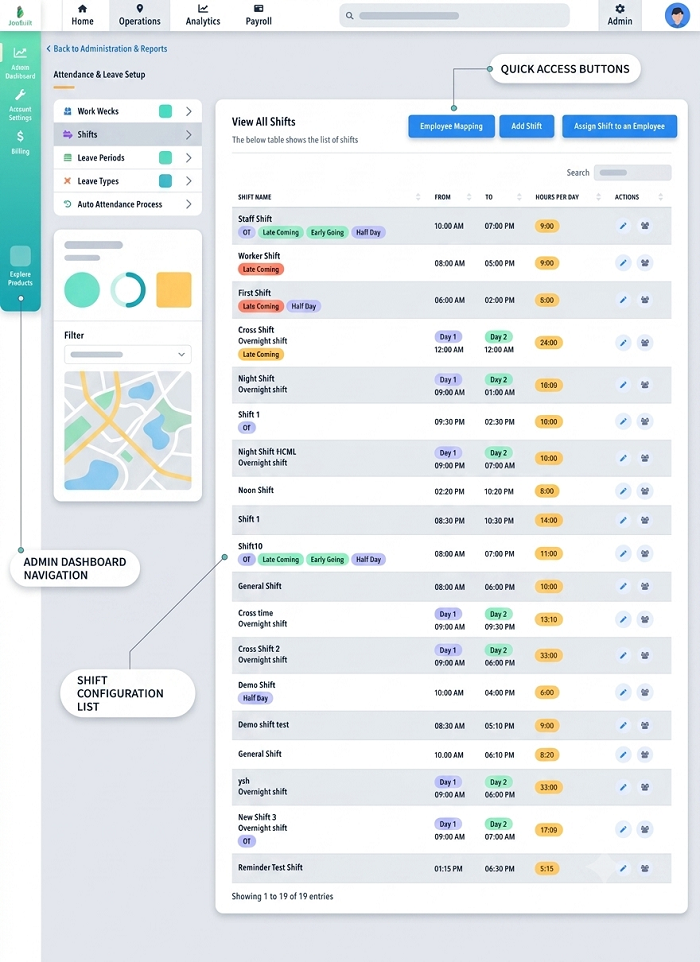
Attendance software should allow employers to define overnight shifts with an end time on the following calendar day. It should not assume that every shift ends at 11:59 p.m.
Useful system settings include:
- Overnight shift configuration: Allow the end date to fall one day after the start date.
- Roster-date assignment: Link both clock-in and clock-out records to the same scheduled shift.
- Automatic shift matching: Match an employee's next-day clock-out with the previous night's shift.
- Break management: Record break start and end times separately.
- Exception alerts: Flag missing punches, unusually long shifts and overlapping attendance records.
- Payroll integration: Transfer approved working hours and overtime to the correct payroll calculation.
For example, if an employee clocks in at 9:55 p.m. on Monday and clocks out at 6:05 a.m. on Tuesday, the system should match both records to Monday's overnight shift, provided that this is the assigned roster.
Employers should also configure a reasonable matching window. A clock-out several hours after the scheduled end should be flagged for review rather than automatically accepted as normal attendance.
5. Calculate Working Hours Across Midnight Correctly
The calculation should use complete date-and-time values, not just the difference between clock-in and clock-out times.
A simple example:
| Attendance item | Time |
|---|---|
| Clock-in | Monday, 10:00 p.m. |
| Clock-out | Tuesday, 6:30 a.m. |
| Total elapsed time | 8 hours 30 minutes |
| Unpaid break | 30 minutes |
| Net working time | 8 hours |
For a basic overnight shift, the formula is:
Net working time = Clock-out timestamp − Clock-in timestamp − qualifying unpaid breaks
The attendance system should also compare actual hours against the employee's scheduled hours. If an employee is scheduled to work from 10:00 p.m. to 6:00 a.m. but clocks out at 7:00 a.m., the additional hour should be recorded as an exception for review.
HR should not automatically classify every additional minute as approved overtime. The employer should check whether the additional work was required, permitted or otherwise compensable under the applicable employment arrangements and law.
6. Apply Malaysia's Working-Hour Rules to Overnight Shifts
Employers should review the Employment Act 1955 when designing overnight schedules for employees covered by the Act in Peninsular Malaysia and Labuan.
Section 60A generally sets limits that include:
- No more than five consecutive hours of work without a leisure period of at least 30 minutes, subject to statutory exceptions.
- Generally no more than eight hours of work in one day.
- Generally no more than a 10-hour spread-over period in one day.
- Generally no more than 45 working hours in one week.
The Act also contains exceptions and special arrangements, including provisions for certain continuous operations and shift work. Employers should not assume that a standard eight-hour shift pattern automatically complies in every situation.
Special treatment for shift workers
Section 60C provides a framework for employees engaged in shift work. Under the provision, shift workers may work more than eight hours in a day or 45 hours in a week, provided that their average working hours over a period of three weeks do not exceed 45 hours per week, subject to the statutory conditions and exceptions.
This means employers should assess the full shift cycle rather than looking only at one overnight shift in isolation. They should retain rosters and actual attendance records to demonstrate how working hours are distributed across the relevant period.
Important: The Act's definition of a “day” for Part XII includes a continuous 24-hour period beginning at a point other than midnight for employees engaged in shift work or whose normal working hours extend beyond midnight. This is relevant when assessing working hours and rest-day arrangements.
7. Identify Overtime Without Confusing It With the Next Calendar Day
Overtime calculations can become complicated when a shift begins on one date and ends on another. The system should identify the employee's normal working hours, actual hours worked, applicable legal limits and approved additional hours.
For example:
| Item | Time |
|---|---|
| Scheduled shift | Monday, 10:00 p.m. – Tuesday, 6:00 a.m. |
| Actual clock-out | Tuesday, 7:00 a.m. |
| Scheduled duration | 8 hours |
| Additional time | 1 hour |
The additional hour should be sent to the supervisor or HR team for verification. The reviewer should check:
- Whether the employee was required or permitted to continue working.
- Whether the additional time was actually worked.
- Whether the employee's job category and wages place them within the statutory overtime-payment provisions.
- Whether the hours fall under ordinary-day, rest-day or public-holiday work.
- Whether the correct rate and payroll period have been selected.
Under Section 60A(3), eligible employees are generally entitled to at least 1.5 times their hourly rate for overtime worked beyond normal hours on an ordinary working day. However, statutory overtime-payment coverage depends on the First Schedule of the Employment Act. Employees earning more than RM4,000 per month are generally excluded from these particular statutory overtime provisions unless they fall within specified categories, such as certain manual workers and other listed occupations. Contractual or collective-agreement benefits may provide additional rights.
Overtime worked on rest days and public holidays is subject to separate statutory provisions. Employers should therefore avoid applying one overtime formula to every additional hour.
8. Check Rest Days When Shifts Continue Into the Next Day
An overnight shift may begin before an employee's scheduled rest day and finish during that rest day. Employers should not decide the rest-day treatment solely by looking at the calendar date shown on the clock-out record.
Under Section 59 of the Employment Act 1955, employees covered by the provision must generally receive one whole rest day in each week. For shift workers, a continuous period of at least 30 hours constitutes a rest day under Section 59(1A). Employers must also prepare the applicable rest-day roster before the beginning of the month, subject to the statutory provisions.
For example, an employee may finish a night shift at 6:00 a.m. on Sunday and then have a scheduled rest period. HR should assess the roster and the actual continuous rest period to determine whether the statutory requirement has been met.
The attendance system should record:
- The employee's designated rest day.
- The start and end of the overnight shift.
- The actual rest period before the next shift.
- Any work performed during the scheduled rest period.
- The applicable rest-day payment treatment.
This is especially important in factories, hospitals, transport operations and security services where employees may work rotating shifts.
9. Review Public Holidays That Fall During Overnight Shifts
Public holidays create another tracking challenge. An overnight shift may start on an ordinary working day and continue after midnight into a gazetted public holiday.
For example:
- Shift starts: Wednesday at 10:00 p.m.
- Public holiday begins: Thursday at 12:00 a.m.
- Shift ends: Thursday at 6:00 a.m.
The employer should preserve the actual timestamps and identify the relevant holiday date. It should then assess the applicable public-holiday entitlement and payment requirements under the law, employment contract and any valid arrangements.
Section 60D of the Employment Act 1955 governs paid holidays and work performed on qualifying public holidays for employees within its scope. The payroll team should not automatically treat the entire overnight shift as ordinary-day work simply because the employee clocked in before midnight. Equally, it should not automatically apply a holiday rate to every hour without checking the statutory rules and the employee's applicable arrangements.
A good attendance system should flag shifts that overlap with:
- Federal public holidays.
- State public holidays.
- Replacement or substituted holidays.
- Employer-designated holidays under applicable arrangements.
HR should review these exceptions before payroll is finalised.
10. Set Up Alerts for Missing Punches and Unusual Attendance
Overnight shifts are more likely to produce attendance exceptions because employees may forget to clock out early in the morning or may encounter technical issues during shift changes.
Automated alerts can help HR identify problems before payroll processing.
| Attendance exception | Recommended action |
|---|---|
| Missing next-day clock-out | Request employee confirmation and supervisor verification |
| Duplicate clock-in | Check whether the first record was accidental |
| Clock-out after scheduled time | Review additional hours and overtime approval |
| Clock-in before rostered time | Verify whether early work was authorised |
| Unusually long shift | Check fatigue, safety and attendance accuracy |
| Break not recorded | Confirm whether the break was taken and how it should be treated |
| Shift assigned to wrong date | Correct the roster-date association with an audit trail |
Employees should be able to submit correction requests through a standard process. Supervisors should verify the actual working period before HR changes an attendance record.
A correction should never silently overwrite the original punch. The system should retain the original entry, corrected value, reason, approver and date of approval.
11. Connect Overnight Attendance With Payroll Software
Attendance and payroll systems should use the same shift information. If the two systems interpret overnight hours differently, employees may receive incorrect wages or overtime payments.
A reliable integration should transfer:
- Employee identification and assigned shift.
- Roster date and actual clock-in and clock-out timestamps.
- Paid and unpaid break details.
- Approved additional working hours.
- Ordinary-day, rest-day and public-holiday classifications.
- Attendance corrections and approval records.
- Payroll-period allocation.
For example, a shift beginning on the final day of a month and ending on the first day of the following month should retain both timestamps. Payroll should apply the organisation's documented wage-period rules and the applicable legal requirements rather than simply assigning every hour to the date on which the shift began.
Section 19 of the Employment Act 1955 generally requires wages to be paid within seven days after the end of the wage period. Payments for overtime and work on rest days or qualifying public holidays are generally due no later than the last day of the next wage period.
12. Maintain Attendance Records for Audit and Compliance
Employers should retain reliable attendance records to support payroll calculations, employee queries and labour inspections.
Section 61 of the Employment Act 1955 requires employers to maintain prescribed employee registers. The particulars recorded must be preserved so they remain available for inspection for at least six years after recording. Section 59 also contains specific retention requirements for rest-day rosters.
A useful overnight-shift record should include:
- Employee name or identification number.
- Department and work location.
- Shift ID and roster date.
- Scheduled start and end times.
- Actual clock-in and clock-out timestamps.
- Break records.
- Total working hours.
- Overtime and holiday classifications.
- Attendance exceptions and explanations.
- Supervisor approvals.
- Payroll processing status.
Employers operating in Sabah and Sarawak should also check the applicable state Labour Ordinances and their current amendments. The Employment Act 1955 is not the only source of employment-law obligations across Malaysia.
13. Use Technology to Improve Overnight Shift Management
The right attendance solution can reduce manual work and improve payroll accuracy. Employers should choose software that supports overnight scheduling rather than relying on basic daily attendance calculations.
Important features include:
| Software feature | Business benefit |
|---|---|
| Overnight shift configuration | Connects clock-in and clock-out across two dates |
| Biometric or mobile attendance | Captures actual attendance events |
| GPS or location verification | Supports attendance validation for field teams |
| Automated break tracking | Helps calculate net working hours |
| Shift-roster management | Connects attendance to the correct scheduled shift |
| Overtime approval workflow | Separates approved additional hours from exceptions |
| Public-holiday calendar | Flags shifts overlapping with holidays |
| Payroll integration | Reduces manual transfer and calculation errors |
| Audit logs | Tracks changes and approvals |
| Employee self-service | Allows employees to review and correct attendance records |
Employers should also consider data protection when collecting biometric or location information. Access should be restricted to authorised personnel, and the organisation should collect and retain only information needed for legitimate employment purposes.
14. Follow a Consistent Overnight Attendance Review Process
A standard review process helps HR, supervisors and payroll teams work with the same attendance information.
Recommended workflow:
- Publish the monthly shift roster.
- Assign each overnight shift a unique ID and roster date.
- Record clock-in, break and clock-out events with full timestamps.
- Match next-day clock-outs to the correct overnight shift.
- Calculate actual working time after applying the correct break treatment.
- Flag missing punches, extended shifts and other exceptions.
- Obtain supervisor verification and employee clarification where necessary.
- Check working-hour limits, rest days, public holidays and overtime eligibility.
- Transfer approved attendance data to payroll.
- Retain the original records, corrections and approvals.
This process gives employers a consistent record of the hours employees actually worked and makes it easier to investigate discrepancies.
Conclusion
Malaysia teams can track overnight shifts that cross midnight accurately by using full date-and-time attendance records, clear roster dates, automated shift matching and properly configured payroll integration. Employers should also review breaks, overtime, rest days and public holidays carefully instead of relying on calendar-date calculations alone.
A well-configured attendance system should treat an overnight shift as one scheduled work period while preserving the actual timestamps of every attendance event. Combined with supervisor verification and proper recordkeeping, this approach helps businesses reduce payroll errors, improve employee confidence and manage overnight operations more effectively.
An overnight assignment should remain understandable when its check-out falls on the next date. InnBuilt Shift Management can help Malaysia teams compare night-shift punches with the intended roster.