How Can Malaysia Businesses Reduce Proxy Attendance Across Multiple Shifts?
Introduction
Managing employee attendance across multiple shifts can be challenging for businesses in Malaysia. Manufacturing facilities, warehouses, retail outlets, hospitals, and service organisations often operate with morning, evening, night, and rotating shifts. When employees work different schedules, HR teams may find it difficult to verify whether the person recording attendance is actually the employee assigned to that shift.
One common problem is proxy attendance, where an employee records attendance on behalf of another employee. This practice can lead to inaccurate working-hour records, incorrect overtime calculations, payroll discrepancies, and difficulties in workforce planning.
For Malaysian businesses, reducing proxy attendance requires more than simply introducing an attendance machine. Employers need reliable employee verification, clear shift schedules, supervisor monitoring, and accurate integration between attendance and payroll systems.
Face recognition attendance software, biometric verification, and automated shift management can help organisations improve attendance accuracy while reducing manual intervention.
1. Use Face Recognition Attendance Systems
One of the most effective ways to reduce proxy attendance is to introduce face recognition attendance technology.
Traditional attendance methods, such as paper registers, manual timesheets, and shared access cards, may allow employees to record attendance for colleagues. Face recognition systems help address this issue by verifying an employee's identity using facial characteristics.
Malaysia businesses can use face attendance systems to:
- Verify employees during shift check-in and check-out.
- Reduce attendance marking through shared employee cards.
- Match attendance records with registered employee profiles.
- Capture accurate timestamps for every attendance transaction.
- Reduce manual attendance corrections.
For example, when a manufacturing employee arrives for the evening shift, the system verifies their identity before recording the check-in time.
This makes it more difficult for another employee to mark attendance on their behalf.
2. Assign Unique Employee Identification Profiles
Every employee should have a unique identity within the attendance management system.
When multiple shifts operate at the same workplace, shared attendance credentials can create opportunities for proxy attendance.
Employers should ensure that:
- Every employee has a unique employee ID.
- Facial recognition profiles are registered individually.
- Attendance credentials are not shared between employees.
- Employee profiles are updated when employment details change.
- Resigned or inactive employee accounts are disabled promptly.
HR teams should also review duplicate employee profiles and investigate unusual attendance activity.
A centralised employee identification database helps businesses maintain consistent attendance records across departments, branches, and shifts.
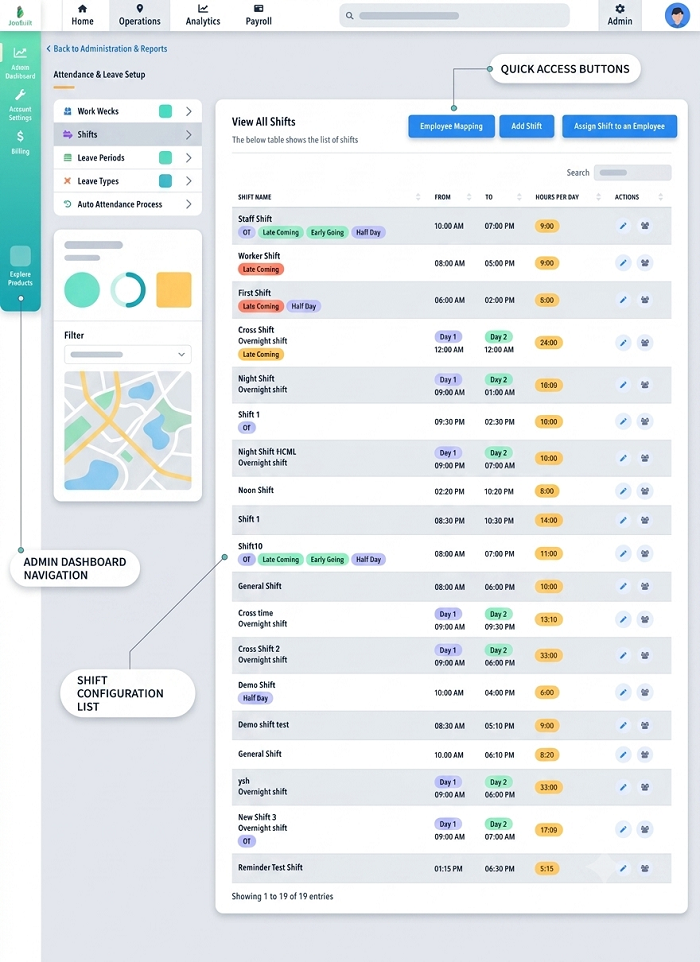
3. Connect Attendance Records With Approved Shift Schedules
Employees working multiple shifts may have different reporting times, break periods, and scheduled working hours.
If attendance software does not recognise these differences, employees may be able to record attendance outside their assigned shift without proper verification.
Businesses should configure attendance systems to match employee check-ins with approved shift schedules.
For example:
| Shift | Scheduled timing |
|---|---|
| Morning shift | 6:00 AM – 2:00 PM |
| Afternoon shift | 2:00 PM – 10:00 PM |
| Night shift | 10:00 PM – 6:00 AM |
The system should identify the employee's assigned shift and compare actual attendance against the approved schedule.
This helps HR teams identify employees who check in during another shift or record attendance without an authorised schedule change.
4. Enable Real-Time Attendance Monitoring
Real-time attendance monitoring helps supervisors identify attendance irregularities as they happen rather than discovering them during payroll processing.
For businesses operating multiple shifts, attendance dashboards can display employee check-ins, absences, late arrivals, and missing punches.
Managers should monitor:
- Employees who have not checked in after shift commencement.
- Multiple attendance attempts using the same employee account.
- Employees recording attendance outside assigned shifts.
- Unusual check-in patterns across departments.
- Attendance records requiring supervisor verification.
For example, if an employee assigned to the morning shift has no verified check-in, the supervisor can investigate immediately instead of waiting until the end of the month.
Real-time visibility improves attendance accountability and reduces opportunities for proxy attendance.
5. Use Mobile Face Attendance With Appropriate Verification
Employees working across multiple locations may not always report to a central attendance terminal.
Construction sites, delivery operations, field service teams, and distributed business locations may require mobile attendance solutions.
Mobile face attendance applications can allow employees to verify their identities using authorised smartphones.
Depending on the software, employers can configure:
- Facial verification during check-in.
- GPS-based location verification.
- Approved workplace geofencing.
- Device authentication.
- Timestamp recording.
- Location-specific attendance permissions.
For example, a field employee assigned to a customer location can record attendance through a mobile application with facial verification and an authorised location check.
However, businesses should avoid collecting unnecessary location information. They should clearly explain location-tracking practices and comply with applicable Malaysian personal data protection requirements.
6. Monitor Shift Changes and Employee Substitutions
Shift swapping is common in businesses that operate around the clock. Employees may exchange shifts because of personal commitments, operational requirements, or unexpected absences.
However, informal shift changes can create opportunities for proxy attendance.
Employers should introduce a formal shift-swap approval process.
An effective workflow should include:
- The employee submits a shift-change request.
- The replacement employee is identified.
- The supervisor reviews the request.
- HR or an authorised manager approves the change.
- The attendance system updates the employee's assigned shift.
- Attendance records are checked against the revised schedule.
This ensures that employees record attendance against their actual approved shifts rather than another employee's schedule.
7. Introduce Supervisor Verification at Shift Handover
Shift handovers are important opportunities to verify employee presence and identify attendance discrepancies.
In manufacturing, healthcare, logistics, and other round-the-clock operations, outgoing and incoming teams frequently overlap.
Supervisors should verify:
- Which employees have reported for the incoming shift.
- Whether all scheduled employees are present.
- Whether replacement employees have received approval.
- Whether any employee has recorded attendance for another person.
- Whether attendance exceptions have been reported.
Attendance software can provide shift-wise employee lists to support these checks.
Combining digital attendance verification with supervisor oversight makes proxy attendance more difficult to conceal.
8. Configure Alerts for Suspicious Attendance Patterns
Automated alerts can help HR teams identify unusual attendance behaviour across multiple shifts.
Rather than manually checking every attendance record, businesses can configure software to flag suspicious transactions.
Useful alerts include:
- Multiple check-in attempts within a short period.
- Attendance recorded outside an employee's assigned shift.
- Repeated check-ins from unusual locations.
- Duplicate or conflicting attendance transactions.
- Missing check-out records.
- Unusual attendance activity involving shared devices.
For example, if an employee's attendance is recorded at two different locations within an unrealistic time interval, the system can flag the records for investigation.
Employers should treat these alerts as indicators requiring verification rather than automatic proof of misconduct.
9. Integrate Attendance Data With Payroll Software
Proxy attendance can create payroll problems when inaccurate records are used to calculate salary, overtime, and other employee payments.
Malaysian businesses should integrate their attendance management systems with payroll software to ensure that payroll calculations are based on verified attendance information.
Integration can help HR and payroll teams:
- Compare scheduled hours with actual working hours.
- Identify unauthorised attendance entries.
- Calculate approved overtime.
- Track late arrivals and early departures.
- Review missing attendance records.
- Maintain accurate monthly attendance reports.
For example, if an employee's attendance is recorded through a proxy transaction, the system should allow HR to investigate and correct the record before it affects salary calculations.
Payroll administrators should also ensure that any attendance correction is properly documented and authorised.
10. Secure Attendance Devices Across Different Shifts
Shared attendance terminals can create security challenges when employees from different shifts use the same device.
Businesses should ensure that attendance devices are properly configured and protected.
Important security measures include:
- Restricting administrator access.
- Using secure employee authentication.
- Preventing unauthorised changes to attendance settings.
- Maintaining attendance transaction logs.
- Updating device software regularly.
- Protecting stored biometric information.
- Monitoring device access and maintenance activities.
Employers should also position attendance terminals in appropriate locations where employee verification can take place without unnecessary obstruction or interference.
11. Establish Clear Attendance and Anti-Proxy Policies
Technology alone cannot eliminate proxy attendance. Employees should understand the organisation's attendance rules and the consequences of deliberately recording attendance for another person.
Malaysia businesses should establish written policies covering:
- Employee responsibility for personal check-in and check-out.
- Prohibition of shared attendance credentials.
- Approved shift-swapping procedures.
- Rules for missed attendance transactions.
- Procedures for correcting inaccurate records.
- Supervisor responsibilities for attendance verification.
- Disciplinary procedures for proven attendance fraud.
Employers should communicate these policies during employee onboarding and provide periodic reminders to existing staff.
Any disciplinary action should follow a fair investigation process and applicable employment requirements.
12. Protect Employee Privacy When Using Biometric Attendance
Although biometric attendance can reduce proxy marking, employers must consider employee privacy when introducing facial recognition or fingerprint verification.
In Malaysia, biometric data is classified as sensitive personal data under the Personal Data Protection Act 2010, as amended.
Businesses should therefore consider:
- Providing appropriate privacy notices.
- Obtaining express consent where required by law.
- Collecting only necessary biometric information.
- Using appropriate security and access controls.
- Establishing clear data retention and deletion policies.
- Reviewing third-party attendance software providers.
- Providing appropriate procedures for employee enquiries and complaints.
Employers should also assess whether alternative attendance methods are necessary for employees who cannot reasonably use biometric verification.
Privacy protection helps organisations build employee confidence while improving attendance management.
13. Analyse Attendance Trends Across Multiple Shifts
Regular attendance analysis can help businesses identify recurring proxy attendance risks.
HR teams should review attendance data across different departments, locations, and shifts to identify unusual patterns.
Useful reports include:
| Attendance report | Business purpose |
|---|---|
| Shift-wise attendance report | Identifies attendance patterns across shifts |
| Duplicate transaction report | Highlights potentially conflicting entries |
| Late arrival report | Tracks repeated late check-ins |
| Missing punch report | Identifies incomplete attendance records |
| Shift-swap report | Monitors approved and unapproved changes |
| Attendance exception report | Highlights records requiring investigation |
| Overtime comparison report | Compares approved overtime with actual attendance |
These reports help HR managers identify potential issues before they create payroll or workforce management problems.
Best Practices for Reducing Proxy Attendance in Malaysia
Businesses can strengthen attendance controls by following these practical measures:
- Adopt biometric verification: Use face recognition or another suitable identity verification method to reduce attendance marking through shared credentials.
- Maintain unique employee profiles: Ensure every employee has an individual attendance identity.
- Configure shift-based access: Match attendance transactions with approved employee schedules.
- Monitor attendance in real time: Give supervisors visibility into shift-wise check-ins and exceptions.
- Formalise shift swapping: Require approval before changing employee shift assignments.
- Use automated alerts: Identify suspicious attendance patterns for further investigation.
- Integrate attendance with payroll: Ensure verified attendance information flows into payroll calculations.
- Conduct regular audits: Review attendance exceptions and unusual transaction patterns.
- Train employees and supervisors: Explain attendance policies and verification procedures.
- Protect biometric information: Follow applicable Malaysian personal data protection requirements.
Conclusion
Reducing proxy attendance across multiple shifts requires a combination of technology, employee accountability, and effective HR procedures. For Malaysian businesses operating morning, afternoon, night, and rotating shifts, traditional attendance methods may not provide sufficient identity verification or visibility.
Face recognition attendance software, unique employee profiles, shift-based scheduling, real-time monitoring, and automated exception alerts can help organisations prevent unauthorised attendance marking.
Integrating attendance records with payroll software further improves the accuracy of working hours, overtime calculations, and monthly salary processing.
By combining reliable employee verification with clear attendance policies and appropriate privacy safeguards, Malaysia businesses can create a more transparent, accurate, and accountable workforce management process.
Proxy punching is difficult to spot when multiple shifts change over quickly. InnBuilt Face Attendance Software can help Malaysia worksites compare identity-linked check-ins with scheduled staff.