What Privacy Controls Should Qatar Employers Consider for Face Attendance Data?
What Privacy Controls Should Qatar Employers Consider for Face Attendance Data?
Introduction
Many employers in Qatar use face-recognition attendance systems to record employee check-ins, reduce proxy attendance, and simplify workforce management. These systems may be installed at office entrances, factories, warehouses, construction sites, retail outlets, hotels, and other workplaces.
Although facial recognition can improve attendance administration, it also introduces privacy and security risks. Depending on the system, the employer may collect facial images, biometric templates, employee identifiers, timestamps, and attendance histories. If this information is accessed by unauthorized users, shared improperly, or retained unnecessarily, it can expose employees to privacy harms and create compliance concerns.
Employers therefore need more than a functioning attendance device. They need clear rules governing why facial data is collected, how employees are informed, who can access the records, how long the data is retained, and what happens when a system produces an incorrect match or experiences a security incident.
In Qatar, these controls should be assessed against the Personal Data Privacy Protection Law, Law No. 13 of 2016, and applicable guidance issued by the National Cyber Security Agency (NCSA). The law requires appropriate handling and protection of personal data, including transparency about processing purposes and safeguards against unauthorised access or disclosure.
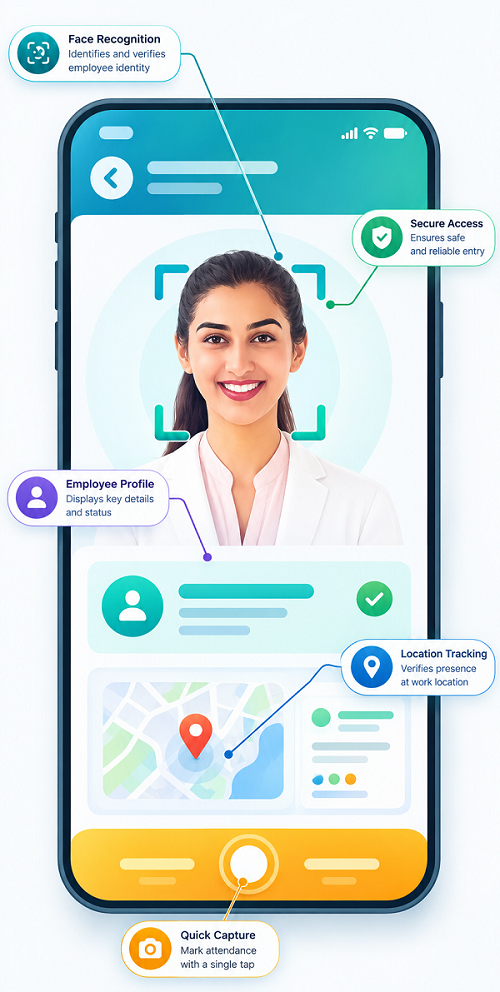
1. Establish a Clear Purpose for Collecting Facial Data
Before introducing face-recognition attendance, employers should document the specific business purpose for collecting facial data.
Common purposes may include:
- Recording employee attendance and punctuality.
- Reducing unauthorised clock-ins on behalf of other employees.
- Verifying identity at controlled workplace entrances.
- Improving the accuracy of shift and timesheet records.
- Supporting attendance reconciliation and payroll administration.
The system should not collect facial information simply because the technology is available. Employers should determine whether facial recognition is necessary and proportionate to the attendance problem they are trying to solve.
For example, a company experiencing repeated proxy check-ins may consider face recognition. However, if individual access cards and supervisor verification can meet the same objective effectively, the employer should evaluate whether biometric collection is justified.
A documented purpose also helps prevent facial data collected for attendance from being reused for unrelated employee monitoring without a proper assessment.
2. Review Qatar's Personal Data Protection Requirements
Qatar's Personal Data Privacy Protection Law, Law No. 13 of 2016, provides the main legal framework for assessing many forms of personal data processing.
Employers should pay particular attention to the following provisions:
- Article 3: Personal data processing must respect privacy, transparency, integrity, and human dignity.
- Article 4: Processing generally requires the individual's consent unless an applicable legal basis, including processing necessary for a legitimate purpose, applies.
- Article 8: Controllers must process personal data lawfully and take appropriate administrative, technical, and physical precautions.
- Article 9: Individuals must be informed of specified information about the processing before it begins.
- Article 10: Collected data must be relevant and adequate for the lawful purpose, accurate and up to date, and not retained longer than necessary.
- Articles 13 and 14: The law addresses safeguards against data loss, damage, alteration, disclosure, and unauthorised access, as well as notification obligations for certain serious breaches.
Employers should not assume that employee consent automatically resolves every compliance issue or that the employment relationship itself creates unrestricted permission to collect biometric information.
They should assess the applicable legal basis, the circumstances of the employment relationship, the type of data collected, and any relevant requirements for special-nature personal data. Article 16 identifies certain categories of special-nature personal data and provides for additional requirements; employers should obtain specific advice on how the provision and any applicable implementing decisions affect their biometric system.
3. Provide a Clear Employee Privacy Notice
Employees should understand how the face-attendance system works before their facial data is enrolled.
A privacy notice should explain:
- The employer responsible for collecting the data.
- The purpose of facial recognition.
- What information is collected, such as a facial image, biometric template, employee ID, or attendance timestamp.
- Whether images are stored or converted into a biometric template.
- Whether the system operates locally or through a cloud service.
- Which departments or service providers can access the information.
- How long the data is retained.
- How employees can raise concerns or request access or correction where applicable.
- What procedure applies if facial recognition fails.
- The available alternative attendance process, where provided.
The notice should use clear language that employees can understand. Employers may provide it in the languages appropriate for their workforce.
The NCSA provides guidance for organisations on privacy notices, individual rights, data handling, and compliance practices. Employers can use these materials when designing their own procedures.
A notice should reflect the actual system configuration. For example, an employer should not state that facial images are immediately deleted if the vendor retains them for troubleshooting or stores them in cloud backups.
4. Minimise the Facial Data Collected
Data minimisation is an important control for reducing privacy risk.
Employers should identify the minimum information needed to verify an employee's attendance and avoid retaining unnecessary facial images or associated information.
A typical system may process several different data elements:
| Data element | Privacy consideration |
|---|---|
| Original facial image | May reveal identifiable visual characteristics |
| Biometric template or facial embedding | May be used to compare or recognise a person |
| Employee ID | Links biometric processing to an individual |
| Check-in and check-out timestamps | Creates an attendance and work-pattern history |
| Device and system logs | May reveal access patterns and technical activity |
| Location or terminal identifier | Indicates where attendance was recorded |
A biometric template is not automatically anonymous simply because it is stored as numerical data. If it can be linked to an employee or used to recognise them, it may still be personal data.
Employers should ask vendors whether the system needs to retain original images after enrolment, whether templates can be protected against unauthorised extraction, and whether attendance records can be stored separately from biometric information.
Where the system can meet its purpose without retaining original facial photographs, the employer should evaluate that configuration.
5. Restrict Access to Facial Images and Biometric Templates
Access controls help prevent facial data from being viewed, copied, changed, or exported by people who do not need it for their jobs.
Employers should establish role-based permissions so that each user can access only the information required for their responsibilities.
For example:
- HR administrators may manage employee enrolment and attendance exceptions.
- Line managers may review approved attendance summaries for their teams.
- Payroll staff may receive verified attendance totals without needing access to facial images.
- IT administrators may maintain the system under controlled and logged procedures.
- Vendors should receive only the access necessary to provide authorised support.
Additional safeguards should include:
- Unique user accounts.
- Multi-factor authentication for privileged accounts, where supported.
- Strong authentication and secure password policies.
- Periodic access reviews.
- Immediate removal of access when a person changes roles or leaves.
- Restrictions on bulk exports and downloads.
- Logging of administrative actions and sensitive-data access.
Employers should avoid shared administrator accounts because they make it difficult to determine who viewed or modified a record.
6. Secure Data in Storage and During Transmission
Facial data should be protected against unauthorised access, theft, tampering, and accidental disclosure.
Employers should review the technical controls provided by the attendance vendor and confirm that the configuration meets the organisation's risk requirements.
Important safeguards include:
- Encryption during transmission and, where appropriate, at rest.
- Secure communication between attendance devices and central servers.
- Controlled access to device-management interfaces.
- Timely security updates and vulnerability management.
- Secure backups and recovery procedures.
- Protection against unauthorised copying of biometric templates.
- Physical protection of attendance terminals and servers.
- Secure deletion processes for information that is no longer needed.
Where facial templates are stored on a central server, access to the database should be restricted and monitored. Where templates are stored on devices, employers should confirm that the devices are protected against theft, tampering, and unauthorised extraction.
The employer should also understand which security responsibilities belong to the vendor and which remain with the employer.
7. Set a Retention and Deletion Schedule
Facial data should not be retained indefinitely simply because storage is inexpensive.
Employers should define retention periods separately for biometric templates, original facial images, attendance logs, audit trails, and payroll records. These records may have different operational and legal retention requirements.
A retention policy should explain:
- When facial data is created.
- How long it is required for attendance verification.
- When an employee leaves the organisation.
- How data is deleted or disabled after the relevant purpose ends.
- How backups and vendor-held copies are handled.
- What exceptions apply where records must be retained for a lawful reason or an active dispute.
For example, an employer may no longer need an employee's facial template after the employment relationship ends, while certain attendance or payroll records may still need to be retained under applicable requirements.
The employer should not assume that deleting a worker's profile from the main application automatically deletes all associated biometric data. The vendor should explain how deletion applies to replicas, backups, support systems, and other relevant storage locations.
Qatar's Article 10 requires personal data not to be retained beyond the period necessary for the lawful purpose. The employer should document and justify its retention schedule.
8. Provide a Reliable Alternative When Face Recognition Fails
Face-recognition systems can fail for legitimate reasons. Lighting, camera placement, device quality, changes in appearance, or other technical factors may affect matching accuracy.
A failed scan should not automatically be treated as absence, lateness, or misconduct.
Employers should establish an exception process that allows employees to record attendance through an alternative approved method, such as:
- An access card or employee ID.
- A supervisor-verified attendance entry.
- An authorised attendance terminal using another verification method.
- A documented manual correction supported by appropriate evidence.
The alternative process should record the actual attendance event and identify the person who approved the correction.
For example, if a worker arrives on time but the device repeatedly fails to recognise their face, the supervisor should be able to verify the arrival and send the correct attendance record for review.
The organisation should also monitor false rejection rates and investigate whether the problem affects particular devices, locations, or groups of employees.
9. Assess Vendors and Cloud Storage Arrangements
Many employers rely on third-party providers to supply face-attendance devices, software, biometric matching, cloud hosting, and technical support.
Before signing a contract, the employer should establish how the vendor collects, stores, uses, and deletes facial data.
Questions to ask include:
- Does the vendor store original facial images, biometric templates, or both?
- Where is the data hosted?
- Can the vendor access biometric information during support activities?
- Is the data encrypted?
- Does the vendor use employee data for product development or other independent purposes?
- Which subcontractors may process the information?
- How are data breaches reported to the employer?
- Can the employer retrieve its records in a usable format?
- How does the vendor delete information when the contract ends?
- Can the vendor provide evidence of its security controls?
Contracts should define the permitted processing purposes, security responsibilities, access restrictions, incident reporting, deletion obligations, and support arrangements.
If data is processed or stored outside Qatar, the employer should assess the applicable cross-border processing requirements and any relevant legal restrictions or safeguards. It should not assume that a cloud service is compliant solely because the vendor operates internationally.
The NCSA's guidance hub includes resources on controller and processor responsibilities, privacy by design, and data protection impact assessments.
10. Consider a Privacy Impact Assessment Before Deployment
Before introducing face recognition across a large workforce, employers should assess the potential risks to employees and the effectiveness of the proposed controls.
A privacy impact assessment can help answer:
- Is facial recognition necessary for the stated attendance purpose?
- Could a less intrusive method achieve the same objective?
- What types of facial and attendance data will be collected?
- How many employees will be affected?
- Who will be able to access the data?
- What happens if the system produces an incorrect match?
- How will employees challenge or correct attendance records?
- What are the consequences of unauthorised disclosure?
- How will data be deleted when no longer needed?
- What safeguards are required from the vendor?
The assessment should be completed before deployment and reviewed when the system changes materially, such as when introducing new recognition functions, connecting a new vendor, expanding to additional sites, or changing retention practices.
A privacy impact assessment is particularly useful when the system covers a large workforce, multiple locations, or workers with limited access to HR support.
The NCSA provides a dedicated guidance resource on data privacy impact assessments and other privacy controls for organisations.
11. Establish a Data Breach Response Procedure
A security incident involving facial data can have consequences beyond the loss of an ordinary attendance spreadsheet. Employers should establish a clear process for identifying, investigating, containing, and responding to a possible breach.
Examples include:
- Unauthorised access to the biometric database.
- Theft of a device containing facial templates.
- Accidental disclosure of facial images.
- A compromised vendor account.
- Unauthorised exports of employee records.
- Misconfiguration exposing records to other customers or users.
The response procedure should identify who must be notified internally, how access can be suspended, how affected systems are secured, and how the incident is documented.
The employer and its service providers should agree on how quickly a vendor must report a suspected incident and what information the report must contain.
Qatar's Article 13 requires appropriate safeguards, while Article 14 addresses notification to the individual and the competent department where a breach may cause serious harm to personal data or individual privacy. Employers should follow the applicable notification requirements and seek legal advice when a serious incident occurs.
12. Train HR, Payroll, IT, and Supervisors
Privacy controls are only effective when employees understand their responsibilities.
HR teams should know the purpose of biometric enrolment, the applicable privacy notice, and the process for handling employee questions. Payroll teams should receive verified attendance information without unnecessary access to facial images. IT administrators should understand secure configuration, access management, and incident response.
Supervisors should be trained to:
- Avoid sharing facial images through informal messaging channels.
- Use approved methods for attendance corrections.
- Refer employee privacy questions to the appropriate team.
- Avoid treating a failed facial match as conclusive proof of absence.
- Report suspected unauthorized access promptly.
- Follow the retention and deletion policy.
Training should be provided before implementation and refreshed when the system or procedures change.
The organisation should also maintain a clear escalation route for employee complaints and requests relating to their personal data.
13. Use a Practical Privacy Control Checklist
Employers can use the following checklist when introducing or reviewing a face-attendance system.
| Control area | Recommended action |
|---|---|
| Purpose | Document why facial recognition is required |
| Legal assessment | Review applicable Qatar privacy requirements and legal basis |
| Employee notice | Explain collection, purpose, access, retention, and rights |
| Data minimisation | Collect and retain only necessary information |
| Access control | Limit access by role and review permissions regularly |
| Security | Protect devices, databases, backups, and communications |
| Retention | Define deletion periods for each data category |
| Accuracy | Provide a procedure for failed or incorrect matches |
| Vendor management | Review contracts, hosting, subcontractors, and deletion |
| Privacy assessment | Evaluate risks before deployment and major changes |
| Incident response | Document escalation, investigation, and notification procedures |
| Training | Train HR, IT, payroll, and supervisors |
| Audit | Review system access, corrections, retention, and compliance periodically |
The checklist should be adapted to the employer's size, workforce, deployment environment, and the actual technical design of the attendance system.
Frequently Asked Questions
1. Is facial attendance data considered personal data in Qatar?
Facial images and identifiable biometric templates will generally need to be assessed as personal data when they relate to an identifiable individual. Employers should determine which provisions and any additional requirements apply to their specific system.
2. Does Qatar's privacy law automatically prohibit face-recognition attendance?
The law should not be treated as a blanket prohibition on every face-attendance system. Employers need to assess the lawful basis, transparency requirements, necessity of the processing, applicable safeguards, and whether additional rules apply to the biometric information being processed.
3. Must employers obtain employee consent before using facial recognition?
Article 4 generally requires consent unless an applicable legal basis, including processing necessary for a legitimate purpose, applies. Employers should assess the circumstances carefully and obtain Qatar-specific legal advice rather than assuming consent is always required or that consent alone resolves all compliance issues.
4. How long should facial attendance data be stored?
There is no single retention period that is appropriate for every system and record type. Employers should establish a documented schedule based on the purpose of the processing, applicable legal obligations, and the need to retain relevant attendance records.
5. Can an employer store facial data with an overseas cloud provider?
Potentially, but the employer should assess the applicable cross-border processing requirements, vendor responsibilities, security controls, and relevant legal restrictions before transferring or hosting the data abroad.
6. What should happen if face recognition incorrectly rejects an employee?
The employer should provide an alternative verification process, investigate the technical or operational issue, and correct the attendance record where appropriate. A failed match should not automatically be treated as proof of absence or misconduct.
7. What should employers do if facial data is exposed?
They should activate their incident response process, secure affected systems, investigate the scope of the exposure, document the incident, and assess applicable notification obligations. Legal and privacy specialists should be involved when the incident may create serious harm.
Conclusion
Qatar employers using face-recognition attendance should combine clear privacy notices, purpose limitation, data minimisation, restricted access, strong security, defined retention periods, vendor oversight, and a reliable alternative for failed scans.
They should also assess the legal basis for processing, determine whether additional requirements apply to their biometric data, and document how the system protects employees throughout the data lifecycle.
A well-designed face-attendance system should improve attendance accuracy without creating unnecessary privacy risks. By reviewing the technology and its procedures regularly, employers can strengthen workforce management while maintaining transparency, security, and employee trust.
Face attendance records call for careful handling. InnBuilt Face Attendance Software can support a defined Qatar enrollment and access process while employers review employee notices, data retention and local requirements.