How Can Qatar Hospitality Businesses Manage Rotating Shifts and Weekly Rest Days?
Introduction
Hospitality businesses in Qatar operate in a fast-paced environment where customer demand can change throughout the day and across the week. Hotels, restaurants, cafés, resorts, catering companies, and event venues often need employees working early mornings, late evenings, overnight shifts, weekends, and public holidays.
Managing these schedules can be challenging when businesses must maintain service quality while coordinating employee availability, weekly rest days, leave requests, and changing staffing requirements. Poor scheduling can lead to understaffing, excessive overtime, attendance disputes, employee fatigue, and payroll errors.
A structured shift management process helps hospitality businesses allocate staff fairly, maintain adequate coverage, and record working hours accurately. By combining clear scheduling policies with digital attendance and workforce management software, employers can coordinate rotating shifts and weekly rest days more efficiently.
This article explains how Qatar hospitality businesses can organise rotating shifts, manage weekly rest days, monitor attendance, and connect scheduling information with payroll processes.
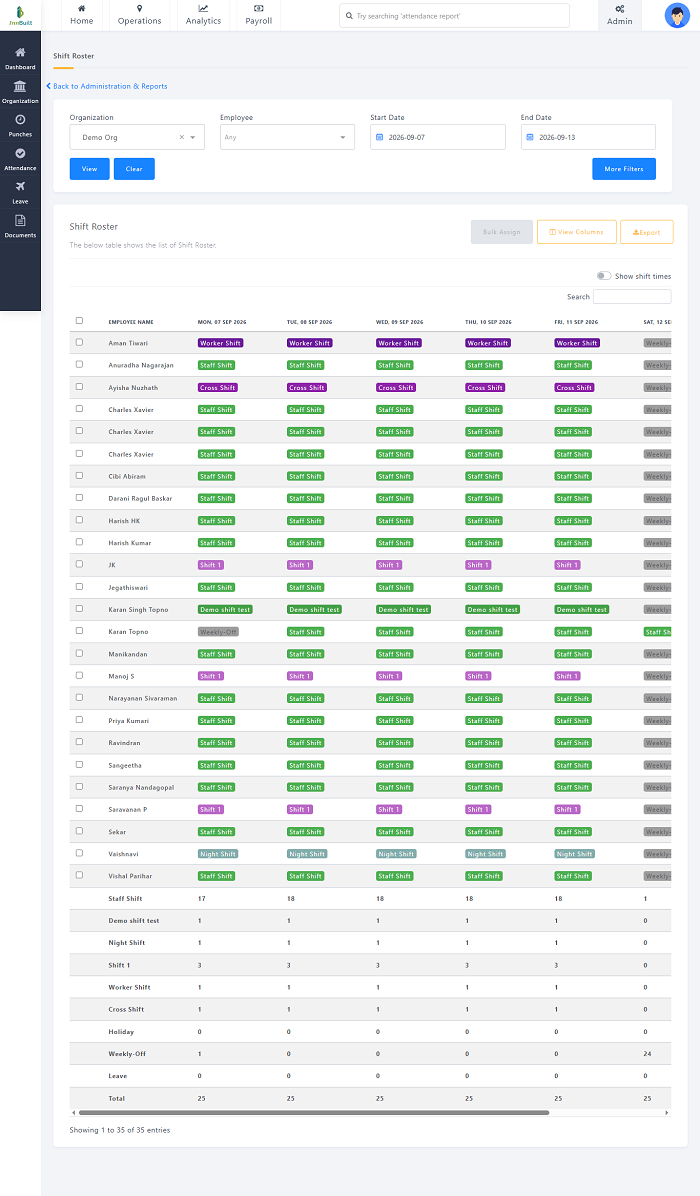
1. Understand Qatar's Working-Hour and Weekly Rest Requirements
Before designing rotating schedules, hospitality employers should identify the working-hour and rest-day requirements applicable to their employees.
Under Qatar's Labour Law No. 14 of 2004, ordinary working hours for employees covered by Article 73 are generally limited to eight hours per day and 48 hours per week outside Ramadan. During Ramadan, the general limits are six hours per day and 36 hours per week. Exceptions may apply to particular categories of workers and certain types of work.
Article 75 generally provides workers covered by the provision with a weekly paid rest of at least 24 consecutive hours. Friday is ordinarily the weekly rest day, subject to exceptions, including provisions for shift workers. Employers should verify the applicable rules and any relevant exceptions before finalising their rosters.
Hospitality businesses should also review the rules covering overtime, work performed on weekly rest days, public holidays, night work, and any sector-specific requirements.
What HR teams should verify
Before publishing a roster, HR should check:
- Applicable ordinary daily and weekly working-hour limits.
- Ramadan working-hour requirements.
- Required breaks and rest intervals.
- Weekly paid rest-day arrangements.
- Rules governing overtime and additional work.
- Public-holiday entitlements and payment requirements.
- Any special provisions applicable to the employee's role or employment category.
A rotating schedule should not be considered compliant simply because the same number of employees work each day. Each employee's actual working hours, rest periods, and applicable entitlements must also be reviewed.
2. Identify Staffing Requirements for Each Hospitality Department
Different hospitality departments have different coverage requirements. A hotel reception desk may need continuous coverage, while a restaurant may require additional staff during meal periods.
Employers should determine the minimum number of employees needed for each role and time period before assigning individual shifts.
Typical staffing requirements include:
| Department | Common scheduling considerations |
|---|---|
| Front office and reception | Continuous guest service, check-in peaks, and overnight coverage |
| Housekeeping | Room occupancy, checkout times, and room turnaround |
| Food and beverage | Breakfast, lunch, dinner, and late-evening demand |
| Kitchen | Food preparation, service periods, cleaning, and closing duties |
| Security | Continuous site coverage and handovers |
| Maintenance | Scheduled inspections, urgent repairs, and on-call requirements |
| Banquets and events | Event schedules, setup, service, and dismantling |
| Reservations and customer support | Call volumes and booking patterns |
Managers should use occupancy forecasts, restaurant reservations, event calendars, historical sales, and service-level requirements to estimate staffing needs.
This prevents the business from assigning the same number of employees to every shift when demand varies significantly throughout the day.
3. Create a Clear Rotating Shift Structure
A rotating shift system allows employees to work different shifts according to a defined schedule. It can help hospitality businesses maintain coverage without assigning the same employees to the least desirable shifts indefinitely.
For example, a hotel may use early, late, and overnight teams. Employees can rotate between these shifts according to an approved pattern, operational requirements, and applicable working-hour and rest requirements.
A shift plan should specify:
- Shift start and finish times.
- Employee assignments.
- Required breaks.
- Handover responsibilities.
- Weekly rest days.
- Rules for shift swaps.
- Overtime approval procedures.
- The process for handling unexpected absences.
Example of a shift-planning framework
| Shift | Illustrative time | Typical coverage |
|---|---|---|
| Early | 6:00 a.m.–12:00 p.m. | Breakfast service and morning operations |
| Day | 12:00 p.m.–6:00 p.m. | Afternoon operations and guest services |
| Evening | 6:00 p.m.–12:00 a.m. | Dinner service and evening guest activity |
| Overnight | 12:00 a.m.–6:00 a.m. | Night reception and essential overnight operations |
These are illustrative six-hour coverage windows, not a complete legally compliant roster. Employers must account for handovers, actual working time, breaks, weekly totals, required rest, and the staffing needed to operate each department.
Where a shift crosses midnight, the scheduling system should correctly record the shift's start date, end date, and working hours.
4. Plan Weekly Rest Days Before Assigning Shifts
Weekly rest days should be built into the roster rather than added after shifts have already been allocated.
Hospitality businesses often need to operate seven days a week, so all employees cannot necessarily take their weekly rest on the same day. Managers should stagger rest days while maintaining the minimum staffing levels required for each department.
A practical process includes:
- Determine the number of employees required for each shift.
- Identify the weekly rest entitlement applicable to each employee.
- Allocate rest days across the team.
- Check that critical roles remain covered.
- Review the intervals between shifts.
- Confirm that weekly working-hour totals comply with applicable requirements.
- Publish the roster and communicate changes through an approved process.
For example, a hotel may assign different weekly rest days to reception employees so that the front desk remains staffed throughout the week.
Employers should avoid relying on informal agreements that leave employees without the required rest period. The roster should show when each employee is scheduled to work and when their weekly rest is provided.
5. Use Fair and Predictable Rotation Rules
A rotating schedule is easier to manage when employees understand how shifts and rest days are assigned.
Without a consistent policy, employees may feel that certain individuals repeatedly receive preferred shifts or more favourable weekends off.
Hospitality employers can improve fairness by establishing transparent rules for shift allocation.
Recommended practices include:
- Rotating early, late, and overnight assignments according to a defined pattern.
- Distributing weekend and public-holiday work fairly, where operationally possible.
- Considering approved leave and documented availability.
- Avoiding repeated last-minute schedule changes.
- Recording the reason for exceptions.
- Providing employees with a process for raising scheduling concerns.
- Reviewing shift distribution periodically.
Fairness does not necessarily mean that every employee works exactly the same number of each shift. Different roles, qualifications, and operational requirements may justify different arrangements. However, the criteria should be clear and consistently applied.
6. Manage Shift Handover Between Teams
Shift handover is especially important in hotels, restaurants, security teams, and facilities management departments where one team takes over from another.
An incomplete handover can lead to missed guest requests, unresolved maintenance issues, cash discrepancies, delayed room preparation, or service interruptions.
A standard handover process should cover:
- Outstanding guest requests.
- Pending reservations or check-ins.
- Room or facility issues.
- Equipment faults and maintenance work.
- Cash and payment reconciliation where relevant.
- Safety incidents or operational concerns.
- Tasks that remain incomplete.
- Escalations requiring managerial attention.
Where appropriate, the outgoing and incoming employees should acknowledge the handover through a digital checklist or approved log.
Managers should also allow sufficient time for handover activities when creating schedules. If the handover is a required part of the employee's work, the employer should account for it correctly when recording working time.
7. Manage Shift Swaps and Employee Availability
Employees may need to request shift changes because of family commitments, transport issues, approved leave, or other personal circumstances.
Hospitality employers should introduce a consistent shift-swap procedure that protects both employee well-being and business coverage.
A recommended workflow is:
- The employee submits a shift-change request.
- The manager checks staffing requirements.
- The proposed replacement's skills and availability are verified.
- HR or the authorised manager reviews working-hour and rest-day implications.
- The request is approved or rejected.
- The roster is updated.
- Both employees receive confirmation.
Employees should not be encouraged to arrange informal swaps without updating the official roster. Unrecorded changes can create confusion over attendance, overtime, and responsibility for particular shifts.
For unexpected absences, managers can maintain a list of trained backup employees or an approved relief arrangement. Any replacement schedule must still comply with the applicable working-hour and rest requirements.
8. Monitor Attendance Against the Published Roster
Accurate attendance records are essential for determining whether employees worked their assigned shifts and received the required rest.
Hospitality businesses can use biometric devices, employee ID cards, mobile attendance applications, or other approved methods to record check-in and check-out times.
Attendance management software can compare actual attendance with the published roster and flag exceptions such as:
- Late arrivals.
- Early departures.
- Missing check-ins or check-outs.
- Unplanned absences.
- Employees assigned to the wrong shift.
- Unapproved shift changes.
- Unexpected overtime.
- Insufficient recorded rest between assignments.
Managers should investigate exceptions before finalising timesheets. A missing attendance record should not automatically be treated as an absence without checking the circumstances.
For employees who work across different hotel properties or restaurant branches, the system should record the relevant work location and approved transfer.
9. Connect Shift Scheduling With Payroll
Rotating shifts can create payroll complications when employees work overnight, change schedules, cover absent colleagues, or work on weekly rest days and public holidays.
A connected workforce management process helps employers maintain consistent records across scheduling, attendance, and payroll.
The system should distinguish between:
- Scheduled working hours.
- Actual hours worked.
- Breaks and other non-working periods.
- Approved overtime.
- Work performed on weekly rest days.
- Work performed on public holidays.
- Leave and absence.
- Shift allowances, where applicable under the employment terms.
- Attendance corrections and approvals.
Recommended payroll reconciliation process
- Compare the approved roster with actual attendance.
- Investigate missing punches and unusual working-hour patterns.
- Confirm that shift swaps and replacement assignments were approved.
- Review overtime and rest-day work.
- Apply the relevant legal requirements and employment terms.
- Obtain the required approvals.
- Transfer verified records to payroll.
- Retain supporting records for audit and dispute resolution.
Employers should not assume that all overnight shifts or public-holiday assignments receive the same treatment. Payment and entitlement rules should be checked against the applicable law, employee category, and contractual terms.
10. Use Workforce Management Software to Automate Scheduling
Managing rotating shifts manually becomes increasingly difficult as a hospitality business adds departments, properties, or employees.
Workforce management software can centralise scheduling and help managers identify conflicts before the roster is published.
Useful features include:
Shift templates: Create reusable early, late, overnight, and event-based schedules.
Automated roster generation: Suggest assignments based on staffing requirements, employee availability, skills, and configured rules.
Rest-day monitoring: Flag schedules that may conflict with required rest arrangements.
Attendance integration: Compare scheduled shifts with actual check-in and check-out records.
Leave management: Show approved leave and pending requests during scheduling.
Shift-swap workflows: Record requests, approvals, and roster changes.
Overtime alerts: Identify assignments that may create additional working hours.
Multi-property dashboards: Help managers monitor staffing across hotels, restaurants, and other locations.
Payroll integration: Transfer verified attendance and approved additional hours to payroll.
Automated scheduling should support, rather than replace, HR review. The system must be configured using accurate legal rules, and managers should investigate alerts before making decisions.
11. Prepare for Ramadan, Public Holidays, and Peak Tourism Periods
Hospitality businesses in Qatar may need to revise staffing arrangements during Ramadan, Eid, public holidays, major events, and periods of high tourist demand.
These periods can change customer traffic, restaurant operating hours, room occupancy, and employee availability.
Employers should:
- Forecast demand using previous operational data.
- Identify critical roles and minimum staffing levels.
- Prepare temporary shift templates.
- Review applicable working-hour and holiday requirements.
- Communicate schedule changes early.
- Arrange trained backup employees.
- Monitor overtime and employee fatigue.
- Reconcile attendance and payroll records carefully.
During Ramadan, for example, some hospitality businesses may experience increased evening demand while adjusting daytime schedules. Employers should plan coverage around these operating patterns without overlooking the working-hour requirements applicable to their employees.
For public holidays, businesses should confirm the relevant official holiday dates and applicable employee entitlements before publishing the roster.
12. Protect Employee Scheduling and Attendance Data
Digital scheduling systems contain employee information, work patterns, leave records, and attendance data. Employers should protect this information and ensure that it is accessible only to authorised personnel.
Recommended practices include:
- Restricting access according to job responsibilities.
- Using secure authentication.
- Maintaining records of schedule changes and approvals.
- Defining appropriate data-retention periods.
- Protecting employee information during system integrations.
- Establishing clear procedures for correcting attendance records.
- Reviewing vendor data-handling practices.
- Providing employees with appropriate information about monitoring and data use.
Hospitality employers should review applicable Qatar data-protection requirements, including Law No. 13 of 2016 on Protecting Personal Data Privacy, when selecting and configuring workforce management systems.
13. Measure Shift Management Performance
Hospitality managers can use key performance indicators (KPIs) to evaluate whether their rotating shift arrangements are effective.
| KPI | What it measures |
|---|---|
| Shift coverage rate | Whether scheduled staffing requirements are met |
| Unplanned absence rate | The frequency of unexpected absences |
| Overtime hours | Additional hours requiring monitoring |
| Shift-swap frequency | How often published schedules are changed |
| Attendance discrepancy rate | The proportion of records requiring correction |
| Rest-day compliance | Whether required rest arrangements are being met |
| Payroll adjustment rate | The frequency of time-record issues affecting payroll |
| Service-level performance | Whether customer service requirements are met |
| Employee scheduling feedback | Employee views on predictability and fairness |
Managers should review these indicators regularly. For example, frequent shift swaps may suggest that schedules are published too late or do not adequately reflect employee availability. Repeated overtime may indicate understaffing or uneven workload distribution.
KPIs should be used to identify operational improvements rather than relying on a single metric to judge employee performance.
14. Implement a Structured Shift Management Process
Hospitality businesses can improve scheduling by introducing a consistent process across all departments.
Phase 1: Review current schedules
Assess existing shift patterns, staffing requirements, weekly rest arrangements, attendance records, and payroll procedures.
Phase 2: Establish scheduling rules
Define shift templates, rest-day allocation, overtime approval, shift-swap procedures, and responsibility for roster changes.
Phase 3: Configure the workforce management system
Set up employee records, work locations, shift patterns, attendance rules, and relevant alerts.
Phase 4: Train managers and employees
Explain how rosters are published, how employees request changes, and how attendance discrepancies should be reported.
Phase 5: Pilot the new process
Test the system in one department or property before extending it to the entire business.
Phase 6: Review and improve
Monitor coverage, overtime, attendance discrepancies, and employee feedback. Update schedules and procedures when operational needs change.
A consistent process reduces administrative work and makes it easier for employees and managers to understand their responsibilities.
Frequently Asked Questions (FAQs)
1. How can hospitality businesses in Qatar manage rotating shifts?
They can use a structured roster that defines shift timings, staffing requirements, employee assignments, handovers, and weekly rest days. Digital scheduling tools help managers maintain coverage and identify conflicts before publishing the schedule.
2. What are the ordinary working-hour limits during Ramadan in Qatar?
For employees covered by Article 73 of Qatar's Labour Law, ordinary working hours are generally limited to six hours per day and 36 hours per week during Ramadan. Employers should verify the applicable rules and any exceptions relevant to their workforce.
3. How should hotels schedule weekly rest days?
Hotels should stagger employees' weekly rest days according to operational requirements while meeting applicable legal entitlements. The roster should identify each employee's scheduled shifts and rest arrangements, with changes recorded and approved.
4. Can employees swap shifts with colleagues?
Employers can establish a shift-swap process that requires approval and checks staffing, qualifications, working hours, and rest requirements. Employees should not rely on informal arrangements that are absent from the official roster.
5. How can attendance software improve rotating shift management?
It can compare scheduled shifts with actual attendance, flag missing punches, record shift changes, monitor overtime, and provide reports for managers and payroll teams.
6. How can hospitality businesses reduce overtime during peak periods?
They can forecast customer demand, allocate staffing according to expected workload, maintain a trained relief team, and monitor overtime trends. Any additional working hours must be managed in accordance with applicable requirements.
Conclusion
Managing rotating shifts and weekly rest days is essential for Qatar hospitality businesses that need to maintain reliable service throughout the week. Hotels, restaurants, cafés, and other hospitality operations must balance staffing requirements with employee availability, working-hour rules, rest arrangements, and payroll accuracy.
The most effective approach combines demand forecasting, transparent shift rotation, planned weekly rest days, accurate attendance records, and clear procedures for shift swaps and absences.
Workforce management software can help hospitality employers centralise schedules, identify staffing gaps, monitor attendance, and connect verified working hours with payroll. When supported by appropriate legal reviews and regular performance monitoring, these practices can improve operational efficiency, reduce scheduling disputes, and support a more predictable working environment for employees.
Busy hospitality teams need rosters that show both shifts and rest days. InnBuilt Shift Management can help Qatar managers organise rotations, leave requests and coverage changes in one schedule.