How Can Qatar Employers Plan Shifts During Ramadan?
Introduction
Planning employee shifts during Ramadan requires Qatar employers to balance business continuity, employee well-being, customer service, and compliance with applicable labour regulations. During the holy month, daily routines change, fasting employees may prefer different working hours, and customer demand can shift toward evenings and nights in industries such as retail, hospitality, healthcare, logistics, and food services.
A well-organised Ramadan shift plan helps businesses maintain adequate staffing without creating unnecessary overtime, scheduling conflicts, attendance errors, or payroll discrepancies. Employers should begin planning before Ramadan, review the applicable working-hour requirements, and communicate revised schedules clearly to employees.
For HR teams, payroll managers, and operations leaders, attendance and shift management software can make this process easier by centralising schedules, recording actual working hours, tracking overtime, and supporting accurate payroll calculations.
1. Understand Qatar’s Ramadan Working-Hour Requirements
The first step is to confirm the working-hour rules that apply to the organisation and its employees.
Under Article 73 of Qatar’s Labour Law No. 14 of 2004, the maximum ordinary working hours for workers covered by the provision are generally:
- Six hours per day during Ramadan.
- Thirty-six hours per week during Ramadan.
The same article sets ordinary working-hour limits of eight hours per day and 48 hours per week outside Ramadan. It also addresses rest intervals, which generally must total at least one hour and no more than three hours, with employees not working more than five consecutive hours. Specific exceptions apply to certain categories of work and employees. Employers should review the applicable legal provisions before finalising schedules.
These limits should guide shift design for employees covered by the relevant provisions. Employers should not assume that a shorter shift automatically resolves every compliance issue: overtime, weekly rest, special employee categories, and sector-specific rules may also need consideration.
What employers should check
Before creating the Ramadan roster, HR teams should:
- Identify the employees and roles covered by the applicable working-hour rules.
- Calculate each employee’s planned daily and weekly working time.
- Check whether breaks are counted as working time under the applicable rules.
- Review weekly rest days and shift-rotation arrangements.
- Establish a process for approving and recording overtime where legally permitted.
- Confirm any additional requirements applicable to the industry or worksite.
For reference, the Qatar government’s Al Meezan legal portal provides the text of the Labour Law and its working-hour provisions.
2. Review Business Demand Before Assigning Shifts
Ramadan does not affect every industry in the same way. Some offices may experience lower daytime activity, while restaurants, supermarkets, delivery businesses, hotels, and shopping centres may need additional evening coverage.
Employers should examine operational demand before choosing shift timings.
For example:
- Corporate offices: May adjust start and finish times to support employees and maintain essential service availability.
- Retail stores: May require more employees during evening shopping periods.
- Restaurants and catering: May need stronger coverage before iftar and after sunset.
- Healthcare facilities: Must maintain appropriate coverage throughout the day and night.
- Warehousing and logistics: May need to redistribute workloads across cooler or less congested periods, subject to safety requirements.
- Customer support teams: May stagger shifts to maintain service availability without requiring every employee to work the same hours.
Reviewing previous Ramadan attendance, sales, customer traffic, delivery volumes, and service requests can help managers forecast the staffing levels required for each shift.
3. Create a Ramadan Shift Plan in Advance
Employers should prepare a temporary Ramadan roster instead of making informal changes every day.
A practical planning process includes the following steps.
Step 1: Identify essential roles
List the positions that must remain covered during each operating period. These may include supervisors, customer service representatives, cashiers, security personnel, technicians, drivers, and operational staff.
Step 2: Calculate staffing requirements
Estimate the minimum number of employees required for each role, department, and location. Use historical demand and current business forecasts rather than assigning the same staffing level to every shift.
Step 3: Set compliant shift durations
Design shifts around the applicable working-hour limits and ensure that each employee’s total scheduled hours remain within the relevant requirements.
Step 4: Assign employees fairly
Consider skills, availability, transport arrangements, approved leave, and employee requests. Avoid repeatedly assigning the least desirable shifts to the same employees.
Step 5: Review the complete roster
Before publishing the schedule, check for overlapping assignments, uncovered periods, insufficient staffing, weekly rest issues, and potential overtime.
Step 6: Communicate the final schedule
Publish the approved roster early and provide employees with a clear process for requesting changes or reporting scheduling problems.
4. Use Staggered Shifts to Maintain Coverage
Staggered shifts allow different groups of employees to begin and finish at different times. This can help businesses maintain service availability while respecting applicable working-hour limits.
For example, a business operating throughout the day might use an early team and a later team, with each employee assigned an appropriate shift duration. The exact timings should depend on customer demand, the nature of the work, and the applicable legal requirements.
A sample planning table is shown below.
| Team | Illustrative shift | Main purpose |
|---|---|---|
| Early team | 7:00 a.m.–1:00 p.m. | Morning operations and administration |
| Midday team | 9:00 a.m.–3:00 p.m. | Overlapping customer and operational coverage |
| Evening team | 4:00 p.m.–10:00 p.m. | Evening customer demand and operational activity |
These are illustrative scheduling windows, not a universal or legally approved roster. Employers must confirm actual working time, unpaid breaks, daily and weekly totals, and any applicable restrictions before implementing them. The schedule also needs to account for whether the business is required to operate continuously.
Where longer business operating hours are necessary, managers can rotate teams across the week instead of expecting each employee to cover the entire operating period.
5. Consider Employee Well-Being and Fatigue
Effective Ramadan scheduling is not only about filling shifts. It also involves managing fatigue and creating a practical working environment for employees who are fasting.
Employers can support their workforce by:
- Considering reasonable employee requests for earlier or later shifts where operationally feasible.
- Avoiding unnecessary last-minute roster changes.
- Planning demanding physical tasks carefully.
- Ensuring required rest periods are provided.
- Reviewing transport arrangements for employees working late.
- Encouraging managers to report fatigue-related safety concerns.
- Providing clear information about shift timings and reporting procedures.
For outdoor and physically demanding work, employers should separately review applicable occupational health and safety requirements. Ramadan shift planning does not replace heat-stress controls or other workplace safety obligations.
Managers should also avoid assuming that every employee has the same preference. Some employees may prefer early shifts, while others may prefer later schedules. A consistent request and approval process can help balance individual needs with business requirements.
6. Plan Evening and Night Coverage Carefully
In sectors such as hospitality, retail, transport, security, and logistics, demand may increase after sunset. Businesses that operate late should plan their evening and night staffing requirements before Ramadan begins.
A useful approach is to divide operations into coverage periods:
- Before sunset: Prepare staff and resources for expected demand.
- After sunset: Increase coverage where customer traffic or service requests are expected to rise.
- Late evening: Maintain the essential operational and supervisory positions.
- Overnight: Schedule only the roles needed for continuous operations.
Employers should review night-work provisions and overtime requirements when assigning these shifts. Under Article 74 of Qatar’s Labour Law, overtime and certain night-work payments are subject to specific rules, with exceptions for some shift workers and other categories. HR should verify how these provisions apply to each employee before approving the roster.
A business should not treat night shifts as a way to bypass Ramadan working-hour limits. Every roster must be checked against the rules applicable to the employees concerned.
7. Manage Shift Swaps and Last-Minute Absences
Employees may need to request shift swaps because of family commitments, transport arrangements, health concerns, or other personal circumstances during Ramadan.
Without a clear process, informal changes can create attendance disputes and leave critical roles uncovered.
Employers should establish a simple approval workflow:
- The employee submits a shift-change request.
- The manager checks skill requirements and staffing levels.
- HR or the authorised supervisor reviews working-hour and rest-day implications.
- The change is approved or rejected.
- The roster is updated.
- The employee and relevant team members receive confirmation.
The original schedule and the approved change should both remain available for audit purposes. This helps HR understand why actual attendance differs from the original roster and reduces confusion during payroll processing.
For unexpected absences, businesses can maintain a list of trained backup employees or designate an approved relief team. Backup coverage should be arranged without creating unrecorded hours or avoidable overtime.
8. Use Attendance Software to Monitor Ramadan Shifts
Managing Ramadan schedules across multiple departments or worksites can become difficult when rosters are maintained in spreadsheets and attendance is collected through separate systems.
Attendance management software can centralise the process by connecting planned shifts with actual check-in and check-out records.
Useful features include:
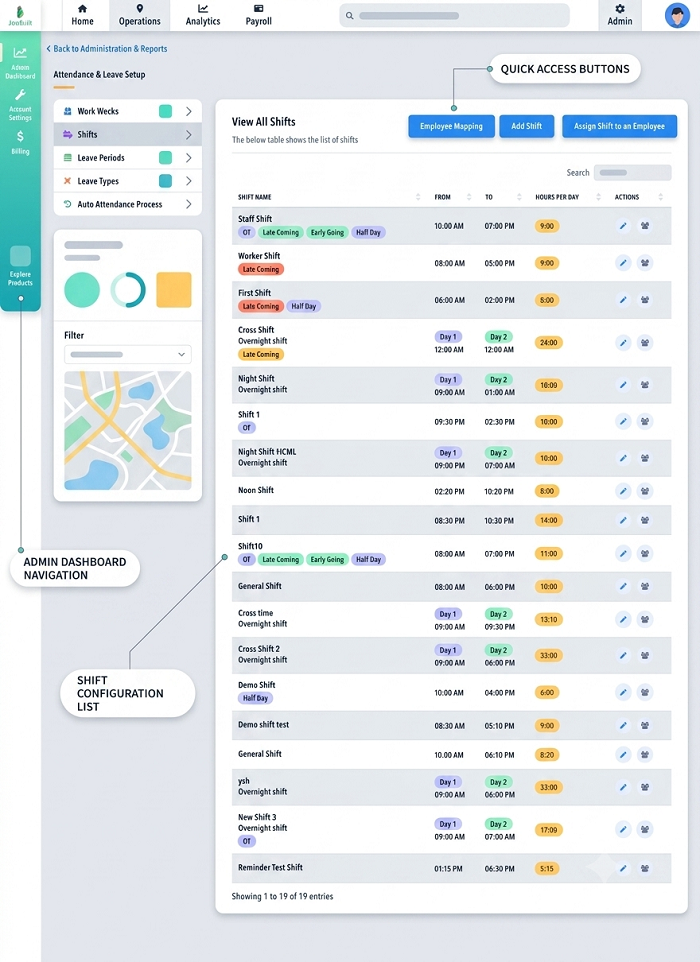
- Flexible shift configuration: Set temporary Ramadan schedules for different departments and locations.
- Attendance tracking: Record employee check-in and check-out times.
- Late arrival and early departure alerts: Identify deviations from approved schedules.
- Shift-swap approvals: Track changes and preserve approval history.
- Overtime monitoring: Flag hours that require review before approval.
- Multi-location visibility: Allow managers to monitor staffing across branches and worksites.
- Payroll integration: Transfer verified attendance and approved overtime data to payroll.
- Reports and audit trails: Keep records of planned hours, actual hours, corrections, and approvals.
A digital system does not automatically guarantee compliance. HR teams must configure the correct rules, check exceptions, and ensure that attendance data is reviewed before payroll is finalised.
9. Connect Shift Planning With Payroll
Ramadan roster changes can affect payroll when actual hours differ from scheduled hours, overtime is approved, employees work on rest days, or attendance records require correction.
Employers should establish a clear link between scheduling, attendance, approvals, and payroll.
A recommended process is:
- Publish the approved Ramadan roster.
- Record actual employee attendance.
- Investigate missing punches and unusual working-hour patterns.
- Reconcile actual hours against scheduled hours.
- Review overtime and rest-day work under the applicable rules.
- Obtain the required approvals.
- Transfer verified data to payroll.
- Retain the supporting records.
HR and payroll teams should distinguish between scheduled hours, actual hours worked, approved overtime, unpaid breaks, and absences. These categories should not be treated as interchangeable.
Employers should also avoid automatically reducing an employee’s salary simply because the Ramadan schedule contains fewer ordinary working hours. Salary treatment must follow the applicable law, employment terms, and relevant official guidance.
10. Publish Clear Ramadan Scheduling Policies
A written Ramadan scheduling policy helps employees understand how temporary arrangements will work.
The policy should explain:
- The effective dates of the Ramadan roster.
- Normal reporting and finishing times for each team.
- Applicable break arrangements.
- How employees can request shift changes.
- Who approves overtime and schedule exceptions.
- How employees should report attendance errors.
- The process for handling unplanned absences.
- How the business will communicate urgent changes.
- Whom employees should contact with questions.
Managers should receive the same guidance so that policies are applied consistently across departments. Where the organisation has multiple branches, HR should maintain one approved source of schedule information.
Employers should also display or communicate working-hour schedules as required by applicable law. Article 77 of Qatar’s Labour Law addresses displaying workplace information on working hours and rest intervals and furnishing the relevant department with a copy.
11. Monitor Scheduling Performance Throughout Ramadan
A Ramadan roster should be reviewed regularly rather than treated as a fixed plan that cannot be changed.
HR teams can track a small set of useful indicators:
| KPI | What it helps measure |
|---|---|
| Shift coverage rate | Whether required roles are staffed |
| Unplanned absence rate | The level of unexpected employee absence |
| Overtime hours | Whether staffing or scheduling needs adjustment |
| Attendance correction rate | The frequency of missing or inaccurate records |
| Shift-change frequency | Whether the roster is meeting employee and operational needs |
| Payroll adjustment rate | How often attendance issues require payroll corrections |
| Service-level performance | Whether customer or operational requirements are being met |
Managers should review these indicators weekly and make controlled adjustments where necessary. For example, repeated understaffing after sunset may indicate that evening coverage needs to be increased, while frequent overtime may suggest that workloads should be redistributed.
The objective is to improve coverage without breaching working-hour requirements or placing excessive pressure on employees.
12. A Practical Ramadan Shift-Planning Checklist
Before Ramadan begins, employers can use the following checklist:
- Confirm the applicable working-hour and overtime requirements.
- Identify essential roles and minimum staffing levels.
- Review historical demand and expected business activity.
- Prepare temporary rosters for every department and worksite.
- Check daily and weekly working-hour totals.
- Confirm rest days, break arrangements, and safety requirements.
- Create a shift-swap and absence-management process.
- Configure attendance software for Ramadan schedules.
- Brief supervisors on approvals and recordkeeping.
- Communicate the final roster to employees.
- Reconcile attendance and payroll data throughout the month.
- Review performance and prepare improvements for the next Ramadan.
Frequently Asked Questions (FAQs)
1. What are the ordinary working-hour limits during Ramadan in Qatar?
For workers covered by Article 73 of Qatar’s Labour Law, ordinary working hours are generally limited to six hours per day and 36 hours per week during Ramadan. Employers should check the applicable rules and any relevant exceptions for their workforce.
2. Can Qatar employers introduce different shifts during Ramadan?
Yes. Employers can design staggered or rotating shifts to meet operational needs, provided the schedules comply with the working-hour, rest-day, overtime, and other requirements applicable to the employees concerned.
3. How can employers maintain customer service with shorter working hours?
Businesses can forecast demand, stagger employee start times, prioritise essential roles, cross-train staff, and allocate additional coverage to periods with higher customer traffic. Staffing plans should be reviewed regularly as demand changes.
4. Should employers track attendance separately during Ramadan?
Employers should continue maintaining accurate attendance records and should configure their systems to reflect the approved Ramadan roster. This makes it easier to reconcile scheduled hours, actual attendance, approved overtime, and payroll.
5. Can employees work overtime during Ramadan in Qatar?
Overtime is governed by applicable legal provisions, including Article 74 of Qatar’s Labour Law for covered workers. Employers should verify the relevant limits, compensation rules, and exceptions before scheduling or approving additional hours.
6. How can HR reduce payroll errors during Ramadan?
HR can reduce errors by publishing approved rosters, recording actual attendance, resolving missing punches, documenting shift changes, reviewing overtime approvals, and reconciling verified records with payroll before salary processing.
7. When should employers prepare Ramadan shift schedules?
Employers should begin planning several weeks before Ramadan where possible. Early preparation gives HR time to forecast demand, review legal requirements, collect employee requests, configure attendance systems, and communicate the final roster.
Conclusion
Planning shifts during Ramadan requires Qatar employers to combine legal awareness, workforce forecasting, employee communication, and reliable attendance management. A structured roster helps businesses maintain essential services while reducing avoidable overtime, scheduling conflicts, and payroll errors.
The most effective approach is to confirm the applicable working-hour rules, forecast demand by time and location, distribute shifts fairly, establish clear procedures for changes, and connect approved schedules with attendance and payroll records.
For organisations managing multiple departments or worksites, attendance and shift management software can provide the visibility needed to track coverage and respond quickly to operational changes. With advance planning and regular reviews, employers can support their workforce while maintaining reliable business operations throughout Ramadan.
Ramadan schedules may differ from standard rosters. InnBuilt Shift Management can help Qatar employers plan adjusted shifts and review attendance against the assigned timetable.