How Can Qatar Restaurants Manage Split Shifts and Actual Hours Worked?
How Can Qatar Restaurants Manage Split Shifts and Actual Hours Worked?
Introduction
Restaurants in Qatar often experience significant changes in customer demand throughout the day. Breakfast service, business lunches, evening dining, late-night orders, and weekend rushes can require different staffing levels at different times. To match employee availability with these demand patterns, restaurants may use split shifts, in which an employee works two separate periods during the same day with a longer break between them.
For example, a restaurant employee may work from 10:00 a.m. to 2:00 p.m., take a break, and return from 6:00 p.m. to 10:00 p.m. Although the employee is scheduled across a 12-hour span, the two work periods total eight hours. Accurate records must distinguish actual working time from the intervening break and any other unpaid or non-working periods, subject to the applicable employment rules.
Without a reliable system, restaurant managers may struggle to track actual hours, calculate overtime, manage employee breaks, approve shift changes, and prepare accurate payroll. These challenges become more complicated when employees cover different roles, work at multiple branches, or receive last-minute schedule changes.
Qatar restaurants can manage split shifts more effectively by creating clear rosters, recording each work period separately, verifying attendance, reconciling timesheets, and reviewing applicable labour requirements.
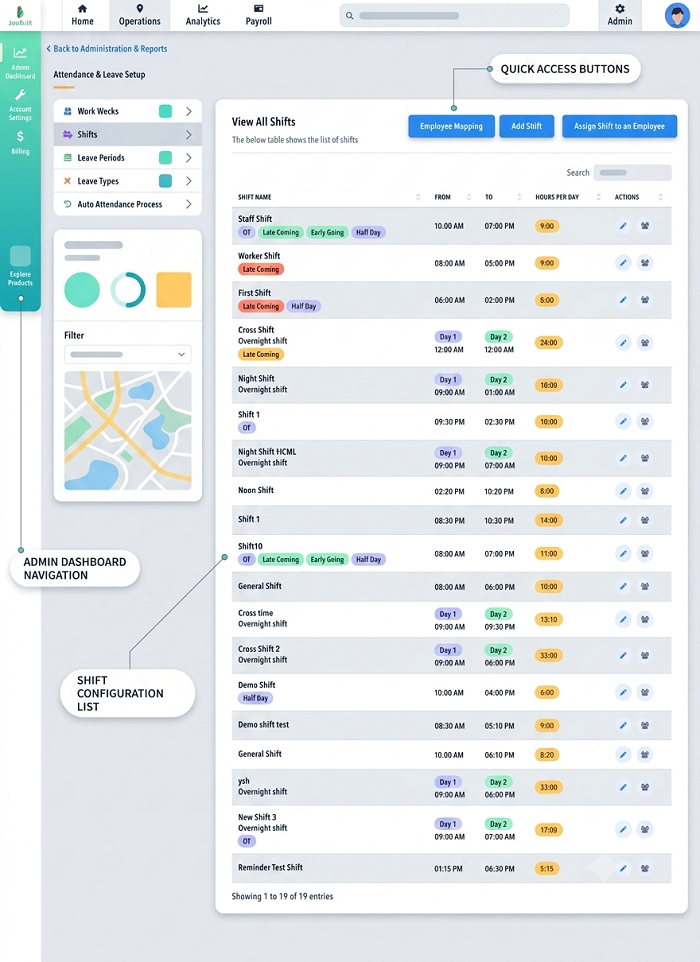
1. Understand How Split Shifts Work in Restaurant Operations
A split shift divides an employee's scheduled workday into two or more separate working periods, usually to cover different peaks in customer demand.
Restaurants may use split shifts for:
- Kitchen staff during lunch and dinner preparation.
- Waiters and servers during meal-service peaks.
- Hosts and reception staff during busy booking periods.
- Baristas and counter staff in high-traffic locations.
- Delivery coordination teams during lunch and evening order surges.
- Cleaning and support staff working around restaurant opening hours.
For example, a restaurant may schedule a server from 11:00 a.m. to 3:00 p.m. and again from 7:00 p.m. to 11:00 p.m. The employee works eight hours in total, although the time between the two shifts extends the day across 12 hours.
Managers should define the start and end times of each working period and specify when the employee is expected to return.
A split-shift arrangement should not be treated as an informal schedule that changes every day without documentation. Employees should understand their assigned work periods, the duration of the intervening break, and how schedule changes are communicated.
2. Create Clear Split-Shift Rosters
A well-designed roster is the foundation of accurate split-shift management. Restaurant managers should plan working periods according to expected customer demand, required staffing levels, employee availability, and applicable working-time requirements.
Each roster should identify:
- Employee name and ID.
- Job role and department.
- Branch or restaurant location.
- First work period's start and end times.
- Second work period's start and end times.
- Scheduled breaks and intervening non-working periods.
- Weekly hours and planned days off.
- Assigned supervisor.
- Approved shift swaps or schedule changes.
A sample roster might look like this:
| Employee | First work period | Second work period | Total scheduled work |
|---|---|---|---|
| Server A | 10:00 a.m.–2:00 p.m. | 6:00 p.m.–10:00 p.m. | 8 hours |
| Cook B | 11:00 a.m.–3:00 p.m. | 7:00 p.m.–11:00 p.m. | 8 hours |
| Cashier C | 9:00 a.m.–1:00 p.m. | 5:00 p.m.–9:00 p.m. | 8 hours |
These are illustrative schedules, not a statement that each arrangement is legally compliant in every circumstance.
The roster should be published early enough for employees to plan transportation, meals, rest, and personal commitments. If a manager changes the second shift, the revised schedule should be communicated and recorded.
3. Record Each Work Period Separately
One of the most important controls is recording the beginning and end of each work period independently.
A single clock-in at the start of the day and a single clock-out at night may make it difficult to determine how much time the employee actually worked. It may also cause the long intervening break to be included incorrectly in the daily total.
For split shifts, restaurants should normally record:
- Clock-in for the first work period.
- Clock-out at the end of the first period.
- Clock-in when the employee returns.
- Clock-out at the end of the second period.
If a third work period is authorised, the same approach should be applied to that period.
For example, an employee's roster may show a first shift from 10:00 a.m. to 2:00 p.m. and a second shift from 6:00 p.m. to 10:00 p.m. If the employee actually leaves at 2:15 p.m. and returns at 5:50 p.m., the attendance system should preserve the actual timestamps rather than automatically replacing them with scheduled times.
Any differences should be reviewed according to the restaurant's attendance policy.
4. Calculate Actual Hours Worked Correctly
Restaurant managers should distinguish scheduled hours, actual hours worked, break time, and the overall span between the first arrival and final departure.
The basic calculation is:
Actual hours worked = Total recorded working periods − Excluded non-working time that falls within those periods
Where the employee clocks out between split shifts, the intervening period is not included in the sum of the recorded work periods. Other breaks should be handled according to their actual nature and the applicable rules.
Consider this example:
| Attendance event | Time |
|---|---|
| First shift starts | 10:00 a.m. |
| First shift ends | 2:00 p.m. |
| Second shift starts | 6:00 p.m. |
| Second shift ends | 10:00 p.m. |
| Total actual working time, assuming no other breaks | 8 hours |
| Overall span from first start to final end | 12 hours |
| Intervening gap between shifts | 4 hours |
The four-hour gap should not automatically be counted as working time merely because it falls within the employee's overall daily span. However, if the employee performs duties, attends required work activities, or is subject to arrangements that affect how the period must be treated, the employer should review the circumstances rather than relying only on clock records.
Restaurants should use a consistent calculation method across all branches and document how attendance corrections are approved.
5. Use Digital Attendance Systems
Digital attendance systems can reduce manual calculations and improve visibility over split-shift working hours.
Suitable systems may include mobile attendance applications, biometric terminals, branch-based clocking devices, or integrated workforce management platforms.
Useful features include:
- Multiple clock-in and clock-out events per day.
- Employee-specific shift schedules.
- Branch or location identification.
- Alerts for missed punches.
- Automatic calculation of recorded working periods.
- Overtime flags and approval workflows.
- Attendance correction requests.
- Timesheet exports for payroll.
- Audit trails showing who changed a record and why.
For example, if a server clocks in for the morning shift but fails to clock out before the long break, the system can flag the missing event. The manager can then investigate and correct the record using approved supporting evidence.
A digital system should not silently assume that an employee worked continuously until the evening clock-out. Missing attendance events should be reviewed instead of filled using unsupported assumptions.
Restaurants should also provide a clear backup process for device failures, network outages, or forgotten punches.
6. Coordinate Staffing With Lunch and Dinner Demand
Split shifts can help restaurants align staffing with customer demand, but poor planning can create unnecessary gaps, excessive working-day spans, and employee dissatisfaction.
Managers should analyse sales patterns, reservation volumes, delivery orders, seasonal demand, and historical customer traffic before preparing the roster.
A practical staffing process includes:
- Identify peak service periods.
- Estimate the required number of employees by role.
- Assign staff to lunch, dinner, and other service periods.
- Identify employees who may benefit from split shifts.
- Check employee availability and rest requirements.
- Confirm that the roster meets applicable legal and contractual requirements.
- Review actual demand after each service period.
For example, a restaurant with a large lunch trade may need more servers from noon to 2:00 p.m., while dinner service may peak between 7:00 p.m. and 10:00 p.m. Split shifts can provide coverage for both periods without automatically scheduling the full team continuously throughout the afternoon.
However, not every employee needs a split shift. Restaurants should compare split shifts with alternatives such as staggered start times, overlapping shifts, part-time schedules where permitted, and separate lunch and dinner teams.
7. Distinguish Meal Breaks From the Gap Between Split Shifts
The gap between two scheduled work periods is not necessarily the same as a meal or rest interval within a continuous shift.
A meal or rest interval may be governed by specific working-time requirements, while a longer gap between separate work periods is part of the overall split-shift arrangement. Managers should record these periods accurately and avoid assuming that a long gap automatically satisfies every break requirement.
Under Article 73 of Qatar Labour Law No. 14 of 2004, the general rules for covered workers provide for one or more intervals for prayer, rest, and meals totalling at least one hour and no more than three hours. These intervals are excluded from working-hour calculations, and covered workers should not work more than five consecutive hours. The law also provides for a ministerial decision identifying work that may continue without interruption for rest purposes.
Restaurants should verify how these provisions apply to the employee's actual working arrangement and any relevant exceptions or implementing decisions. Managers should not assume that a long gap between lunch and dinner automatically resolves all requirements relating to rest intervals during work.
8. Monitor Overtime and Extended Daily Working Time
Split shifts can create a long span between the first arrival and final departure, even when the total working hours appear moderate. Restaurants should therefore monitor both actual working time and the overall schedule.
Overtime can arise when employees stay late to complete service, attend an extended event, prepare for an unexpected rush, or return earlier than scheduled.
Managers should establish a clear approval process that requires:
- The reason for additional work.
- The employee and branch concerned.
- The scheduled end time.
- The actual departure time.
- Supervisor approval or documented emergency circumstances.
- Payroll review under the applicable rules.
Under Article 74 of Qatar Labour Law, the general provisions for covered workers allow additional hours subject to the statutory conditions, including a general limit of ten actual working hours per day except in specified circumstances. The article also provides for an additional payment of at least 25% above the basic wage for qualifying overtime. It includes a separate night-work provision and an exception for shift workers, so the relevant classification and current legal requirements should be verified before applying a premium.
Restaurants should not assume that every employee who works late automatically qualifies for the same overtime calculation, nor should they assume that a split-shift employee is exempt from overtime requirements simply because the roster contains a long break.
Overtime records should be checked against actual hours, the employee's category, the approved work arrangement, and the applicable legal and contractual provisions.
9. Review Weekly Hours and Rest Days
Managing split shifts on individual days is not enough. Restaurant managers should also monitor cumulative hours across the week and ensure that employees receive the rest applicable to their employment arrangements.
A worker may be rostered for several lunch and dinner shifts over consecutive days. Even if each day's scheduled working hours appear reasonable, the combined weekly workload and limited recovery time may create fatigue.
Managers should review:
- Total recorded hours for the week.
- Approved overtime.
- Consecutive working days.
- Weekly rest arrangements.
- Shift changes and last-minute call-backs.
- The time between the end of one day's final shift and the next day's first shift.
Article 75 of Qatar Labour Law provides for a paid weekly rest period of at least 24 consecutive hours for covered workers and contains provisions concerning work on the weekly rest day. The precise application should be assessed against the worker's category, shift arrangement, and applicable legal rules.
Restaurants should use roster controls to flag excessive hours and inadequate recovery time before the schedule is finalised, rather than relying on payroll to identify the issue after the week has ended.
10. Prepare for Ramadan and Seasonal Changes
Restaurants in Qatar may need to adjust their staffing patterns during Ramadan, public holidays, school holidays, tourism periods, and major events.
During Ramadan, restaurants may experience a shift in demand toward the evening and late-night hours. Iftar and Suhoor service can require different staffing patterns from the normal daytime roster.
Managers should consider:
- Revised opening and closing times.
- Changes in lunch and dinner demand.
- Separate Iftar and Suhoor staffing requirements.
- Employee availability and transportation.
- Approved schedule changes.
- Applicable Ramadan working-hour requirements.
- The need to avoid excessive consecutive hours or insufficient rest.
Article 73 of Qatar Labour Law sets general ordinary working-hour limits for covered workers at 48 hours per week and eight hours per day, reduced during Ramadan to 36 hours per week and six hours per day. Employers should verify the applicable scope and any relevant exceptions before using these general limits to calculate a particular employee's schedule.
Restaurants should update rosters and payroll rules before the seasonal schedule takes effect, and communicate revised reporting times clearly to employees.
11. Reconcile Attendance Records With Payroll
Payroll errors can occur when scheduled hours are used instead of actual hours or when the gap between split shifts is treated incorrectly.
Restaurant payroll teams should reconcile attendance, approved overtime, leave, and schedule changes before processing employee payments.
The reconciliation process should include:
- Approved roster.
- Actual clock-in and clock-out records for each work period.
- Missing-punch corrections.
- Supervisor-approved overtime.
- Approved shift swaps.
- Leave and absence records.
- Weekly hours and rest-day work where relevant.
- Applicable wage and premium calculations.
For example, if a cook is scheduled for eight hours but works an additional hour during dinner service, payroll should review the extra time and determine the correct treatment under the applicable rules. The restaurant should not simply pay eight scheduled hours without checking the actual record.
Likewise, an employee who works fewer hours than scheduled should not have the record changed automatically without confirming the reason and applying the appropriate policy and legal requirements.
Attendance records should provide an auditable basis for payroll decisions, with clear documentation of corrections and approvals.
12. Use a Consistent Process Across Multiple Branches
Restaurant groups operating several locations may use different managers, clocking devices, and scheduling methods. Without common procedures, the same split-shift arrangement can be recorded differently across branches.
A standard group-wide policy should define:
- How split shifts are created and approved.
- How work periods are recorded.
- How intervening gaps and breaks are classified.
- When employees may swap shifts.
- How late arrivals and early departures are handled.
- How missing punches are corrected.
- Who approves overtime?
- When timesheets must be submitted.
- How payroll discrepancies are resolved.
Branch managers should use the same attendance codes and reporting deadlines. Head-office teams can then compare labour costs, attendance compliance, overtime, and service coverage more reliably.
Where employees work temporarily at another branch, the attendance system should record the actual location and approved assignment to prevent duplicate hours or incorrect cost allocation.
13. Protect Employee Data and Maintain Accurate Records
Attendance systems may collect employee identifiers, timestamps, location information, and payroll-related records. Restaurants should restrict access to authorised personnel and establish a clear process for correcting inaccurate data.
Recommended practices include:
- Using individual employee accounts or IDs.
- Restricting roster and payroll access by role.
- Recording the reason for attendance corrections.
- Keeping an audit trail of changes.
- Explaining attendance procedures to employees.
- Retaining records according to applicable requirements.
- Limiting location tracking to legitimate operational needs.
- Allowing employees to raise attendance discrepancies.
Managers should avoid sharing detailed attendance and payroll information through unsecured group messages or unrestricted spreadsheets.
Reliable records protect both employees and employers by making it easier to resolve disputes about hours worked, overtime, and shift changes.
14. Track Key Performance Indicators for Split Shifts
Restaurants can use key performance indicators (KPIs) to assess whether split-shift schedules are delivering the intended operational benefits.
| KPI | What it measures |
|---|---|
| Attendance compliance rate | Percentage of scheduled work periods with valid attendance records |
| Actual-hours variance | Difference between scheduled and recorded working hours |
| Missed-punch rate | Frequency of incomplete clock-in or clock-out records |
| Overtime rate | Overtime hours compared with total recorded hours |
| Labour cost per sales hour | Labour cost in relation to sales generated during a defined period |
| Split-shift coverage rate | Percentage of required service periods adequately staffed |
| Schedule change rate | Frequency of roster changes after publication |
| Payroll correction rate | Percentage of timesheets requiring adjustment |
| Employee absence rate | Frequency of recorded absences over a defined period |
| Service coverage gaps | Periods when staffing falls below the planned requirement |
Managers should analyse these metrics by branch, role, day of the week, and service period. High overtime during dinner service may indicate insufficient evening staffing, while frequent missed punches may indicate poor clocking procedures or unsuitable attendance technology.
KPIs should support better scheduling and employee management rather than encouraging staff to skip breaks or record inaccurate working hours.
Frequently Asked Questions
1. What is a split shift in a Qatar restaurant?
A split shift is a work schedule in which an employee works two or more separate periods in the same day, usually with a longer gap between them. Restaurants may use this arrangement to cover lunch and dinner service.
2. How should restaurants calculate actual hours worked during split shifts?
Restaurants should add the actual hours recorded for each working period and exclude periods that are properly classified as non-working time. Missing punches and disputed records should be reviewed rather than estimated without evidence.
3. Does the gap between lunch and dinner count as working time?
Not automatically. Its treatment depends on the actual arrangement and applicable legal and contractual rules. Restaurants should record the gap clearly and distinguish it from work performed or required rest intervals.
4. Can restaurant employees work overtime during split shifts?
Overtime may arise when actual hours exceed the applicable ordinary working-time limits or other relevant thresholds. Employers should verify the employee's legal classification, working arrangement, and applicable overtime rules before calculating additional pay.
5. How can restaurants prevent payroll errors with split shifts?
They should record each work period separately, use approved attendance corrections, reconcile actual hours against the roster, and review overtime before payroll is finalised.
Conclusion
Qatar restaurants can manage split shifts and actual hours worked more effectively by preparing clear rosters, recording each working period separately, monitoring attendance exceptions, reviewing overtime, and reconciling timesheets before payroll.
The key is to distinguish between scheduled hours, actual working hours, intervening gaps, and rest intervals. These periods should not be combined or classified automatically without considering the actual arrangement and applicable employment requirements.
A consistent process across branches helps restaurants match staffing with customer demand while improving payroll accuracy, employee communication, operational planning, and compliance. By combining reliable attendance technology with clear policies and manager accountability, restaurant groups can make split-shift scheduling more transparent and manageable.
A split shift should not be mistaken for a single uninterrupted day. InnBuilt Shift Management can help Qatar restaurants record separate work periods and reconcile actual hours.