How Can Qatar Retail Chains Schedule Staff Across Stores During Peak Shopping Hours?
How Can Qatar Retail Chains Schedule Staff Across Stores During Peak Shopping Hours?
Introduction
Managing staff schedules across multiple stores is a major workforce planning challenge for retail chains in Qatar. Shopping demand can fluctuate throughout the day, with higher customer traffic during evenings, weekends, public holidays, Ramadan, Eid, promotional campaigns, and major shopping events. Retailers must ensure that each branch has enough employees to serve customers efficiently without creating unnecessary labour costs or overloading staff.
For businesses operating supermarkets, fashion outlets, electronics stores, pharmacies, shopping mall units, and convenience stores, a centralized scheduling process can improve staffing decisions across locations. It allows HR teams and store managers to plan shifts according to customer demand, employee availability, store opening hours, and applicable working-time requirements.
A well-designed scheduling strategy also helps retailers coordinate temporary staff, manage last-minute absences, allocate experienced employees to busy periods, and maintain consistent service standards across branches.
1. Analyse Customer Traffic at Each Store
The first step is to understand when each store experiences its highest customer demand. Retail chains should avoid using the same staffing pattern for every branch because customer behaviour can vary by location, product category, store size, and shopping centre.
For example, a supermarket in a residential area may experience higher traffic after typical working hours, while a fashion outlet in a major shopping mall may need additional staff during evenings, weekends, and promotional events.
Retailers should analyse:
- Hourly customer footfall
- Number of transactions per hour
- Average queue and checkout times
- Sales revenue by time slot
- Customer service requests
- Stock replenishment requirements
- Online order collection and delivery volumes
- Historical demand during seasonal events
- Absence patterns and staffing shortages
Point-of-sale (POS) systems, footfall counters, and workforce management software can help identify recurring demand patterns.
Instead of scheduling employees based only on total daily sales, retailers should examine demand by hour and department. This makes it easier to identify when additional cashiers, sales associates, stockroom employees, supervisors, or customer service representatives are needed.
2. Build a Centralised Workforce Schedule Across All Branches
Retail chains operating several locations should maintain a central workforce planning system that provides visibility into staffing levels across stores.
A centralised schedule should contain:
- Store location and operating hours
- Employee names and identification numbers
- Job roles and required skills
- Shift start and end times
- Break schedules
- Weekly rest days
- Approved leave and employee availability
- Planned staffing levels by department
- Shift vacancies and coverage requirements
- Overtime approvals
- Actual attendance and exceptions
Head offices can establish staffing guidelines, while individual store managers adjust schedules to local customer demand within approved limits.
For example, a chain may set minimum staffing requirements for checkout counters and customer service desks, while allowing store managers to allocate additional employees during locally busy periods.
The central system should display staffing shortages and surplus capacity across branches. However, any transfer of employees between stores must be handled in accordance with applicable employment arrangements, operational requirements, and internal approval procedures.
3. Forecast Peak Shopping Hours Using Historical Data
Accurate demand forecasting helps retailers assign the right number of employees to the right shifts.
Retailers should use historical sales and customer traffic data to estimate staffing requirements for different periods. Forecasts should consider both predictable patterns and unusual events that may affect shopping behaviour.
Important forecasting inputs include:
- Previous weeks’ and months’ sales
- Day-of-week shopping patterns
- Public holidays and school holidays
- Ramadan and Eid shopping trends
- Seasonal promotions and clearance sales
- New store openings
- Product launches and advertising campaigns
- Mall events and extended trading hours
- Weather or other factors affecting local footfall
For example, if a store consistently experiences increased customer traffic between 6 p.m. and 9 p.m., the manager may schedule additional checkout staff and floor assistants during that period instead of increasing staffing throughout the entire day.
Forecasts should be updated when actual results differ from expectations. Retailers can compare predicted and actual footfall weekly to improve future scheduling decisions.
4. Match Staffing Levels to Each Store’s Operational Needs
Not every employee performs the same role, so workforce planning should account for the skills required at each location and time slot.
A store may need different combinations of employees for:
- Checkout and payment processing
- Sales assistance
- Customer service and returns
- Shelf replenishment
- Inventory management
- Receiving and dispatching goods
- Security coordination
- Store supervision
- Online order fulfilment
During peak shopping hours, retailers should prioritise roles that directly affect customer experience and operational safety.
A fashion store, for example, may need more fitting-room attendants and sales associates during busy periods. A supermarket may require additional checkout operators, shelf replenishment staff, and customer service personnel.
Managers should also account for the time required to open and close stores, receive deliveries, conduct stock counts, and complete cash reconciliation. These activities should not be overlooked simply because they occur outside peak customer hours.
5. Create Flexible Shifts for Different Shopping Periods
Flexible shift patterns help retail chains match staffing levels to changing customer demand without scheduling every employee for the same hours.
Common scheduling options include:
Opening shifts: Employees prepare displays, replenish shelves, check stock, and complete opening procedures before or as customers arrive.
Peak-hour shifts: Additional employees start shortly before the busiest period and finish after customer traffic declines.
Closing shifts: Staff manage late trading, final customer requests, stock recovery, cash reconciliation, and closing procedures.
Weekend shifts: Additional coverage is assigned to branches that consistently experience higher weekend footfall.
Promotional shifts: Temporary or adjusted staffing supports product launches, sales campaigns, and seasonal promotions.
For example, a store that experiences its busiest period between 5 p.m. and 9 p.m. might schedule some employees for a standard daytime shift and others for a later shift that overlaps with the evening rush.
The schedule should provide adequate handover time between shifts. Retailers should also ensure that employees understand their assigned start times, finish times, breaks, and store locations before the schedule becomes effective.
6. Balance Staffing Costs With Customer Service
Overstaffing during quiet periods increases labour costs, while understaffing during peak hours can lead to long queues, missed sales, and poor customer experiences.
Retail chains should use staffing forecasts to determine the number of employees needed for each time slot. A basic planning calculation is:
Required staff = Forecast workload ÷ Average workload capacity per employee
For example, if a store expects 120 customer transactions in an hour and a cashier can comfortably process 30 transactions per hour, the store may need approximately four cashier-hours of capacity for that period. The final staffing decision should also account for transaction complexity, customer assistance, breaks, and service targets.
Retailers can monitor the following indicators:
- Transactions per employee-hour
- Sales per labour hour
- Average checkout waiting time
- Customer complaints during peak periods
- Overtime hours per branch
- Labour cost as a percentage of sales
- Number of shifts with insufficient coverage
These metrics help managers decide whether a staffing shortage requires additional employees, better shift timing, improved checkout processes, or a different allocation of duties.
7. Coordinate Employee Availability and Shift Preferences
A reliable schedule should account for operational requirements as well as employee availability and approved leave.
HR teams should maintain current records of:
- Employee availability
- Approved annual leave and other absences
- Contracted working arrangements
- Relevant skills and training
- Store and department assignments
- Approved shift swaps
- Restrictions or accommodations that must be considered
- Weekly rest-day arrangements
Employees should have a clear process for submitting availability updates and requesting shift changes. Managers should review requests against staffing requirements and apply consistent approval rules.
For multi-store retailers, a central scheduling system can identify employees with the required skills who may be available for a shift at another branch. Before assigning an employee to another location, the employer should verify that the arrangement is consistent with the employment terms and applicable requirements.
A fair allocation process can also help prevent the same employees from repeatedly receiving the busiest or least desirable shifts.
8. Manage Ramadan, Eid, and Seasonal Shopping Peaks
Retail demand in Qatar can change substantially during Ramadan, Eid, public holidays, and major promotional periods. Some stores experience increased evening traffic, while others need additional staff for delivery preparation, replenishment, or extended trading hours.
Retail chains should create separate staffing plans for these periods rather than relying entirely on normal weekly schedules.
A seasonal planning process should include:
- Review previous years’ sales and footfall patterns.
- Identify branches and departments likely to need additional coverage.
- Forecast staffing needs by hour and role.
- Approve temporary recruitment or additional shifts where necessary.
- Publish schedules early enough for employees to plan.
- Verify working-time and rest requirements.
- Monitor attendance and customer traffic during the event.
- Adjust later shifts based on actual demand.
During Ramadan, retailers must also account for the applicable reduced ordinary working hours for covered employees. Under Article 73 of Qatar’s Labour Law, ordinary working hours are generally limited to eight hours per day and 48 hours per week outside Ramadan, and six hours per day and 36 hours per week during Ramadan. Break and other applicable requirements must also be observed.
Ramadan opening hours for a store do not automatically determine how many hours each employee may work. Retailers should plan sufficient coverage using compliant shifts, appropriate handovers, and additional staffing where needed.
9. Monitor Attendance Against the Published Schedule
A published schedule is useful only if managers can compare it with actual attendance.
Retailers should use attendance systems to record when employees start and finish work, whether they attend the assigned branch, and whether any shift changes have been approved.
Depending on operational needs, attendance may be recorded through:
- Biometric terminals
- Employee cards or RFID readers
- Mobile check-in systems
- QR-code check-in at designated locations
- Manager-verified attendance records
The attendance system should integrate with the scheduling platform so that managers can identify late arrivals, early departures, missed shifts, and unplanned absences.
For example, if two checkout employees are absent shortly before the evening rush, the store manager should receive an alert and use the approved coverage process to address the gap.
Attendance data should not be treated as proof of misconduct without reviewing relevant circumstances. Retailers should establish a documented process for employees to explain discrepancies and for managers to correct genuine errors.
10. Manage Shift Swaps, Absences, and Last-Minute Coverage
Retail operations can be disrupted by illness, transport delays, unexpected customer traffic, or employees being unable to attend a scheduled shift.
A standard exception process allows managers to respond quickly without losing control of working hours or payroll records.
The process should include:
- Recording the absence or coverage request
- Identifying employees available for the required role
- Checking skills, rest periods, and working-hour limits
- Obtaining the necessary approval
- Updating the published schedule
- Notifying affected employees
- Recording actual attendance
- Passing approved changes to payroll
Shift swaps should be documented in the system rather than agreed informally and left out of the official schedule.
For multi-store retailers, a central dashboard can show which branches have shortages and which have limited spare capacity. Managers can then assess whether a temporary transfer, approved additional hours, or a change in task allocation is the most appropriate response.
11. Comply With Qatar’s Working-Time and Weekly Rest Requirements
Peak shopping hours can tempt retailers to extend shifts or repeatedly schedule employees on rest days. Workforce planning should prevent this from becoming a routine practice.
For employees covered by Qatar’s Labour Law, key provisions include:
- Ordinary working hours: Article 73 generally sets a maximum of eight hours per day and 48 hours per week, reduced to six hours per day and 36 hours per week during Ramadan.
- Breaks: Article 73 provides for one or more breaks for prayer, rest, and meals, generally totalling at least one hour and no more than three hours. Employees generally must not work more than five consecutive hours.
- Overtime: Article 74 addresses additional working hours and provides for overtime compensation of at least the basic wage plus an increment of 25%, subject to the applicable rules and exceptions. It also generally limits actual daily working time to ten hours, subject to specified exceptional circumstances.
- Weekly rest: Article 75 provides for paid weekly rest of at least 24 consecutive hours. The article also sets out compensation requirements where work on a weekly rest day is necessary.
These provisions should be reviewed against the current law, employee category, and any applicable exceptions. Retailers should configure scheduling software to flag potential working-time violations before a schedule is approved.
12. Connect Scheduling With Payroll and Overtime Tracking
Scheduling, attendance, and payroll should work together so that approved hours are reflected accurately in wage calculations.
A well-integrated system helps payroll teams compare planned shifts with actual attendance, approved overtime, and absence records.
Before payroll is finalised, retailers should verify:
- Scheduled hours versus recorded hours
- Approved shift swaps and schedule changes
- Overtime eligibility and approvals
- Work performed on weekly rest days
- Applicable night-work payments and exceptions
- Unpaid absences and other authorised adjustments
- Employee transfers between branches
- Payroll discrepancies requiring investigation
The system should distinguish between scheduled overtime, overtime approved in advance, and actual additional hours worked. A manager’s approval process should not be used to disregard hours that must be accounted for under applicable law.
Accurate records help businesses explain payroll calculations and investigate disputes without reconstructing schedules from emails or handwritten attendance sheets.
13. Use Workforce Management Software Across Multiple Stores
A workforce management platform can help retail chains coordinate staffing at scale and respond more quickly to changing demand.
Important features include:
- Multi-store scheduling and centralised dashboards
- Demand forecasting by hour and branch
- Role-based staffing requirements
- Employee availability and leave management
- Shift swaps and approval workflows
- Attendance integration
- Overtime and rest-period alerts
- Payroll integration
- Mobile schedule access for employees
- Reports on labour costs and service performance
- Audit logs for schedule changes
When selecting software, retailers should check whether it can handle different store opening hours, employee roles, Ramadan scheduling, and local working-time rules.
A phased implementation is often more effective than changing every branch at once. A retailer can pilot the system in a few stores, compare forecasts with actual staffing needs, and then roll it out across the remaining locations.
14. Protect Employee Data and Ensure Schedule Transparency
Employee schedules and attendance records contain personal information. Retailers should limit access to authorised users and use secure systems to manage employee details.
Good practices include:
- Role-based access to schedules and attendance records
- Clear employee notifications when schedules change
- Audit trails for shift edits and approvals
- A process to correct inaccurate attendance data
- Appropriate retention of payroll and scheduling records
- Responsible use of location-based attendance tools
- Compliance with applicable data-protection requirements
Employees should be able to view their schedules, understand approved changes, and know whom to contact if a shift is incorrect.
Transparent scheduling helps reduce misunderstandings and improves trust between employees, store managers, and HR.
Frequently Asked Questions (FAQs)
1. How can Qatar retail chains identify peak shopping hours?
Retailers can analyse hourly footfall, POS transactions, sales data, queue times, and historical seasonal trends. Comparing these indicators across branches helps managers forecast when additional staff are needed.
2. How can retailers schedule employees across multiple branches?
A central workforce management system can consolidate store schedules, employee availability, skills, attendance, and staffing requirements. Managers can use the system to identify shortages, coordinate approved coverage, and maintain visibility across locations.
3. What are the general working-hour limits for covered employees in Qatar?
Article 73 of Qatar’s Labour Law generally limits ordinary work to eight hours per day and 48 hours per week, with reduced limits of six hours per day and 36 hours per week during Ramadan. Applicable exceptions and employee categories should be checked before scheduling.
4. How should retailers manage staff schedules during Ramadan?
Retailers should forecast expected customer traffic, plan shifts around the applicable reduced working hours, allocate sufficient staff to evening peaks, and verify rest periods and payroll treatment. Store opening hours should not be confused with an individual employee’s permitted working hours.
5. How can retailers reduce overtime costs during peak hours?
They can improve demand forecasts, stagger shift start times, assign additional staff only where needed, maintain a trained pool of available employees, and monitor overtime before schedules are approved. Overtime should still be recorded and paid in accordance with applicable requirements.
6. How can retailers handle last-minute employee absences?
Managers should record the absence, identify available employees with the right skills, check rest periods and working-hour limits, approve the replacement arrangement, and update the schedule. The actual hours worked should then be reconciled with payroll.
7. Why should attendance systems integrate with scheduling software?
Integration allows managers to compare planned and actual working hours, detect unplanned absences, identify coverage gaps, and provide payroll with reliable attendance data. It also creates a clearer audit trail for shift changes and overtime.
8. What KPIs should retail chains monitor for staff scheduling?
Useful KPIs include sales per labour hour, transactions per employee-hour, checkout waiting time, overtime hours, labour cost as a percentage of sales, unfilled shifts, and schedule adherence. Reviewing these metrics helps retailers improve both customer service and staffing efficiency.
Conclusion
Qatar retail chains can schedule staff across multiple stores more effectively by analysing customer traffic, forecasting demand, setting role-based staffing levels, and coordinating employee availability through a central workforce management system.
Flexible shifts and real-time attendance monitoring help stores respond to busy shopping periods without relying on excessive overtime or last-minute informal arrangements. Connecting schedules with payroll also improves the accuracy of working-hour records and wage calculations.
Most importantly, retailers should combine demand-driven scheduling with clear communication, fair shift allocation, and compliance with applicable working-time and weekly rest requirements. This approach helps maintain customer service while controlling labour costs and supporting employees across every branch.
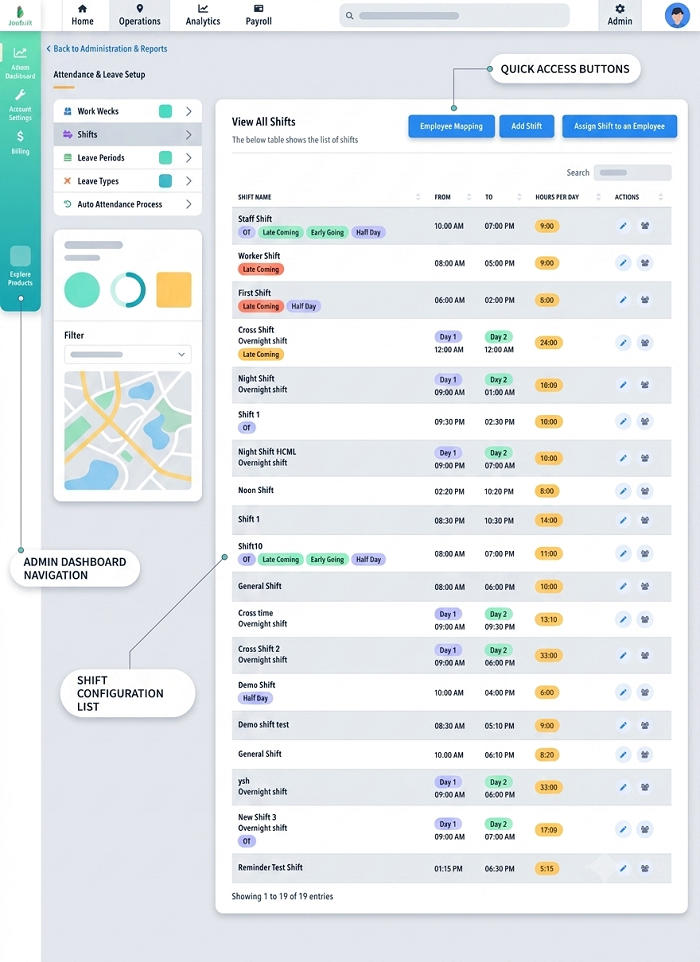
Peak shopping periods shift staffing needs across outlets. InnBuilt Shift Management can help Qatar retail managers compare store coverage, employee availability and planned rosters before publishing.