Is Employee Biometric Attendance Data Considered Sensitive under Saudi Arabia’s PDPL?
Is Employee Biometric Attendance Data Considered Sensitive under Saudi Arabia’s PDPL?
Employee biometric attendance data is considered sensitive personal data under Saudi Arabia’s Personal Data Protection Law (PDPL) when the biometric data is used for identification purposes. This is particularly relevant to businesses using fingerprint, facial-recognition, iris, or other biometric technologies to identify employees during attendance check-in and check-out.
For employers, this means biometric attendance should not be treated in the same way as an ordinary attendance record. Organizations need to consider the additional requirements that apply to sensitive personal data, including the appropriate lawful basis, transparency, security, access controls, retention, and vendor management.
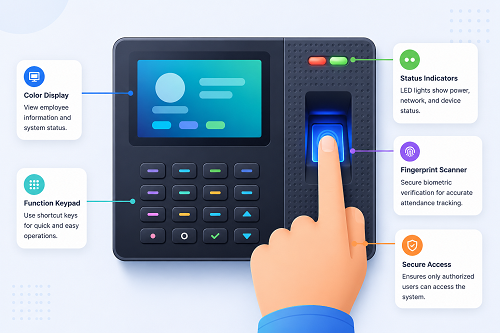
What Is Biometric Data Under the Saudi PDPL?
The PDPL defines sensitive data to include biometric data used to identify an individual. SDAIA's guidance gives biometric identification data as one of the categories of sensitive personal data requiring additional safeguards.
For example, biometric information used by an employer to identify an employee could include:
- Facial-recognition data
- Fingerprint data
- Iris or retinal identification data
- Other biometric characteristics used to identify an individual
The classification depends importantly on the purpose of the biometric processing. The PDPL specifically refers to biometric data where it is used for identification.
Is a Face Attendance System Covered?
Yes, where facial information is processed to identify an employee for attendance purposes, it falls within the PDPL's sensitive-data category.
For example, if an employee looks at a face-recognition terminal and the system matches the employee against a registered facial profile before recording the attendance event, the biometric identification component should be treated as sensitive personal-data processing.
The attendance record itself may also contain ordinary personal data, such as:
- Employee name
- Employee ID
- Check-in time
- Check-out time
- Branch
- Department
- Shift
- Attendance status
These different categories should be considered separately when designing the organization's privacy and security controls.
Why Does Sensitive Classification Matter?
The PDPL applies additional protections to sensitive personal data because unauthorized access to such information may cause serious harm to individuals. SDAIA's guidance specifically identifies sensitive data as requiring additional safeguards.
For employers, this means a biometric attendance project should involve more than simply purchasing an attendance device and registering employees.
The organization should assess:
- Why biometric data is required
- What lawful basis applies
- What information is collected
- How the information is protected
- Who can access it
- How long it is retained
- Whether a third-party provider processes it
- Whether information is transferred outside Saudi Arabia
Can an Employer Rely on Legitimate Interest?
Businesses should be particularly careful here.
SDAIA's official guidance states that legitimate interest cannot be used as a lawful basis for processing sensitive personal data under Article 6(4) of the PDPL.
Therefore, an employer should not simply document "legitimate interest" and assume that this is sufficient to justify employee biometric attendance.
The employer should determine which lawful basis applies to its specific processing activity under the PDPL and applicable regulations.
Is Employee Consent Required?
Consent is one possible lawful basis, but it should not automatically be assumed to be the only basis for every employee attendance system.
Where an organization relies on consent to process sensitive personal data, the consent must be explicit under the Implementing Regulation. SDAIA's guidance specifically confirms this requirement.
The organization should therefore assess its specific circumstances before deciding how biometric attendance should be legally established.
If consent is used, the employer should maintain appropriate evidence of the consent and clearly explain the relevant processing purpose.
What Should Employees Be Told?
Employees should receive appropriate information about how their biometric information is processed.
An employee privacy notice can explain:
- Why biometric attendance is being introduced
- What biometric information is processed
- How the system verifies identity
- What attendance information is recorded
- Who can access the information
- How long information is retained
- Whether a third-party provider is involved
- Whether information is transferred outside Saudi Arabia
- How employees can exercise applicable data rights
- Who to contact regarding privacy questions
Transparency is one of the core principles reflected in SDAIA's guidance on the PDPL.
How Should Biometric Attendance Data Be Protected?
Because biometric identification data is sensitive, organizations should implement appropriate technical and organizational safeguards.
These can include:
Restricted Access
Only authorized HR, IT, or other personnel should have access to biometric information where such access is necessary.
Encryption
Organizations should evaluate encryption for biometric information both during transmission and while stored.
Role-Based Permissions
A branch manager may need access to attendance records without needing unrestricted access to the underlying biometric information.
Audit Logs
Systems should maintain appropriate records of administrative access and changes.
Secure Devices
Attendance terminals, tablets, and mobile devices should be protected against unauthorized access and tampering.
Vendor Security
Organizations should evaluate the security practices of external attendance-software providers.
What About Cloud-Based Attendance Software?
Many modern attendance systems use cloud infrastructure. A Saudi employer should therefore determine where employee biometric data is stored and processed.
Important questions include:
- Is the data hosted in Saudi Arabia?
- Does the vendor use international cloud infrastructure?
- Can vendor employees access the data?
- Are subcontractors involved?
- What happens to the data when the contract ends?
- How is the data deleted or returned?
- Are there transfers outside Saudi Arabia?
Saudi Arabia has a specific regulatory framework concerning personal-data transfers outside the Kingdom, which organizations should consider when their attendance provider processes data internationally. SDAIA identifies this regulation as part of the Saudi Arabia data-protection framework.
Should Employers Store the Original Face Image or Fingerprint?
Not necessarily.
A business should evaluate what information is actually necessary to achieve the attendance purpose.
For example, some systems create a biometric template or other representation for matching rather than retaining an unrestricted collection of original photographs or fingerprint images.
However, pseudonymization or coding does not automatically take information outside the PDPL if the individual can still be identified. SDAIA distinguishes pseudonymized data from properly anonymized data.
Employers should therefore evaluate the actual technical architecture of their chosen attendance system rather than assuming that a vendor's use of terms such as "template" or "encrypted biometric" automatically eliminates regulatory obligations.
How Long Should Biometric Attendance Data Be Retained?
Organizations should establish a documented retention approach.
The employer should consider separately:
- Biometric registration data
- Daily attendance records
- Payroll-related records
- Audit logs
- Backup copies
Different categories may have different business or legal retention requirements.
When information is no longer required for the relevant purpose, the organization should follow applicable requirements and its documented procedures for destruction, anonymization, or pseudonymization.
SDAIA provides specific guidance covering personal-data destruction, anonymization, and pseudonymization.
What If a Third-Party Attendance Provider Processes the Data?
The employer should determine whether the attendance provider is acting as a processor on behalf of the organization.
The PDPL defines a processor as an entity that processes personal data for the benefit and on behalf of a controller.
Businesses should therefore review the provider's:
- Data-processing arrangements
- Security controls
- Subprocessors
- Data-storage locations
- Data-transfer practices
- Retention procedures
- Incident-management processes
- Data-deletion procedures
Vendor selection should form part of the organization's overall PDPL compliance assessment.
Example: Face Attendance at a Saudi Arabia Company
Consider a company with 500 employees in Riyadh, Jeddah, and Dammam.
The company installs facial-recognition terminals at each branch.
An employee:
- Approaches the attendance terminal.
- The system captures facial information.
- The system compares it against the employee's registered biometric profile.
- The employee is identified.
- Check-in time is recorded.
- The attendance record is sent to the HR platform.
The company should recognize that the biometric identification component involves sensitive personal data under the PDPL.
The organization should then assess its lawful basis, employee transparency, security controls, access permissions, retention, vendor arrangements, and any international data transfers.
Biometric Attendance Compliance Checklist
| Area | Key Question |
|---|---|
| Classification | Is biometric data being used to identify employees? |
| Purpose | Is there a clearly defined attendance purpose? |
| Lawful basis | Has the appropriate PDPL basis been assessed? |
| Consent | If consent is relied upon, is it explicit where required? |
| Transparency | Have employees been appropriately informed? |
| Minimization | Is only necessary information collected? |
| Security | Are biometric records adequately protected? |
| Access | Is access restricted to authorized personnel? |
| Retention | Are retention and deletion procedures documented? |
| Vendor | Has the attendance provider been assessed? |
| Data location | Is the storage and processing location known? |
| Transfers | Have transfers outside Saudi Arabia been assessed? |
| Rights | Is there a process for applicable employee data requests? |
Conclusion
Yes, employee biometric attendance data can be sensitive personal data under Saudi Arabia's PDPL when biometric information is used to identify employees. SDAIA's official guidance expressly includes biometric data used for identification within the definition of sensitive data.
For Saudi Arabia employers using facial recognition, fingerprint attendance, or similar technologies, the key issue is not simply whether the attendance system works technically. The organization should also establish an appropriate lawful basis, provide transparency, apply stronger security controls, restrict access, establish retention practices, assess vendors, and consider cross-border processing.
Businesses implementing biometric attendance should review the current PDPL, Implementing Regulations, SDAIA guidance, and applicable data-transfer requirements for their particular circumstances. This article is informational and should not be treated as legal advice.
InnBuilt Face Attendance Software helps businesses apply stronger controls to biometric attendance records through restricted access, secure processing, and clear data-management policies. Employers can manage verified check-ins while treating employee identity data responsibly.