Face Recognition Attendance in Saudi Arabia: Features, Benefits, and Compliance Considerations
Face Recognition Attendance in Saudi Arabia: Features, Benefits, and Compliance Considerations
Face recognition attendance is becoming an important option for businesses that want to automate employee time tracking and reduce manual attendance processes. In Saudi Arabia, organizations operating offices, retail stores, construction sites, hospitals, restaurants, and multiple branches can use face recognition technology to verify employee identity during check-in and check-out.
A face recognition attendance system in Saudi Arabia uses facial characteristics to verify an employee and record an attendance event. Depending on the solution, the system may work through dedicated attendance terminals, tablets, smartphones, or other connected devices.
However, businesses should consider not only functionality but also privacy, security, data protection, and applicable Saudi Arabia requirements when implementing biometric attendance.
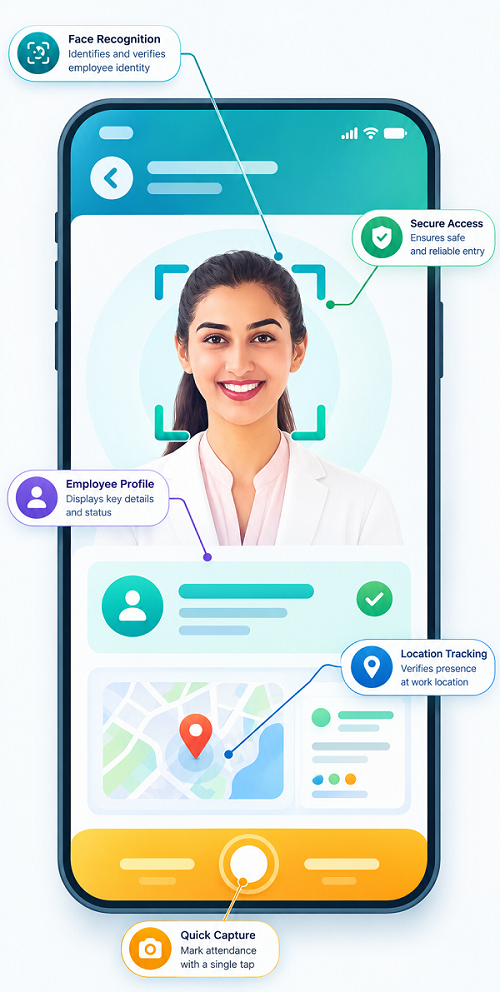
What Is Face Recognition Attendance?
Face recognition attendance combines employee attendance management with facial verification technology.
Instead of employees signing a paper register or entering an identification number, the system captures or analyzes facial information and matches it against the employee's registered profile.
A typical process is:
- Employee approaches the attendance device.
- The system detects the employee's face.
- Facial characteristics are compared with the registered profile.
- The employee's identity is verified.
- Check-in or check-out time is recorded.
- The attendance record is stored in the organization's system.
Depending on the software, additional information such as location, device, shift, and attendance status may also be recorded.
Key Features of Face Recognition Attendance Software
1. Automated Check-In and Check-Out
Employees can record attendance without manually entering their employee number or signing a register. The system automatically records the time of the attendance event.
2. Employee Identity Verification
Facial recognition can help verify that the person recording attendance corresponds to the registered employee profile. This can help organizations reduce certain forms of attendance misuse, including one employee attempting to record attendance for another.
3. Contactless Attendance
Face recognition provides a contactless method of recording attendance. This can be useful for offices, hospitals, hotels, factories, retail stores, and other workplaces with frequent employee check-ins.
4. Real-Time Attendance Records
Attendance events can be transmitted to a centralized system, allowing HR and authorized managers to view current attendance information.
Dashboards may show:
- Present employees
- Absent employees
- Late arrivals
- Early departures
- Missing check-outs
- Overtime
- Attendance exceptions
5. Shift Management
Face recognition can be connected with shift schedules.
For example, employees can be assigned to:
- Morning shifts
- Evening shifts
- Night shifts
- Rotating shifts
- Weekend shifts
The system can compare actual attendance with the assigned schedule.
6. Multi-Branch Attendance
Companies operating in several Saudi Arabia cities can use a centralized system to manage attendance across different locations.
For example, a company may have branches in:
- Riyadh
- Jeddah
- Dammam
- Makkah
- Madinah
- Khobar
Employees can be associated with their assigned branches, while central HR can monitor attendance across locations.
7. Attendance Reports
The system can generate reports covering:
- Daily attendance
- Monthly attendance
- Late arrivals
- Early departures
- Absences
- Working hours
- Overtime
- Employee attendance history
- Branch-wise attendance
These reports can reduce the need for manual spreadsheet preparation.
8. Payroll Integration
Face recognition attendance systems can provide attendance information to payroll software. Relevant information may include working days, attendance records, overtime, absences, and approved attendance adjustments. Payroll teams can review the data before using it for salary processing.
Benefits of Face Recognition Attendance in Saudi Arabia
Reduces Manual Attendance Work
Automated attendance reduces the need to maintain paper registers and manually enter employee attendance information.
Helps Reduce Proxy Attendance
Because attendance is linked to facial verification, it can make it more difficult for employees to record attendance on behalf of colleagues.
Saves Administrative Time
HR teams can access attendance reports without manually collecting registers from departments or branches.
Supports Multiple Locations
Organizations with several offices, stores, hospitals, restaurants, or project sites can manage attendance through one centralized platform.
Provides Better Attendance Visibility
Managers can quickly identify attendance exceptions and review employee attendance records.
Supports Payroll Processes
Automated attendance data can provide a structured input for payroll calculations and reduce repetitive data entry.
Face Recognition vs. Traditional Attendance
| Feature | Manual Register | ID/Card Attendance | Face Recognition |
|---|---|---|---|
| Automated recording | Limited | Yes | Yes |
| Identity verification | Low | Moderate | Higher |
| Proxy attendance risk | Higher | Possible | Can be reduced |
| Contactless | No | Yes | Yes |
| Multi-branch monitoring | Difficult | Possible | Possible |
| Real-time reporting | No | Usually | Usually |
| Payroll integration | Manual | Possible | Possible |
Face Recognition for Different Saudi Arabia Industries
Retail
Retail businesses can use face recognition to manage employee attendance across stores and shifts.
Hospitality
Hotels and hospitality businesses can track employees across departments such as housekeeping, food and beverage, front office, and administration.
Restaurants
Restaurant groups can use facial attendance across multiple branches and shift schedules.
Construction
Face recognition can be used at appropriate project-site entry points to record attendance for workers and supervisors.
Hospitals
Hospitals can use attendance terminals for different departments and employee groups, including employees working day and night shifts.
Security Agencies
Security companies can use attendance systems to record employees assigned to different client locations, subject to the organization's operational and privacy requirements.
Compliance and Privacy Considerations in Saudi Arabia
Face recognition involves biometric information, so businesses should treat implementation as a data-protection issue rather than simply an attendance technology decision.
Saudi Arabia has a comprehensive personal data protection framework under the Personal Data Protection Law (PDPL) and related rules and guidance. Organizations should assess their processing activities and determine the applicable requirements before deploying facial-recognition attendance.
Important areas to review include:
Purpose of Data Collection
The organization should have a clear and legitimate purpose for collecting and processing employee information.
Transparency
Employees should receive appropriate information about how their personal data is collected, used, stored, and otherwise processed.
Data Security
Organizations should implement suitable technical and organizational safeguards to protect attendance and biometric-related information from unauthorized access, disclosure, alteration, or loss.
Access Control
Only authorized personnel should have access to employee attendance information and associated biometric data.
Data Retention
Organizations should establish appropriate retention practices rather than keeping personal data indefinitely without a valid reason.
Third-Party Providers
If the face recognition system is provided by an external vendor, businesses should understand how the vendor processes, stores, transfers, and protects employee data.
Cross-Border Data Considerations
Companies should determine whether employee data is stored or processed outside Saudi Arabia and assess any applicable requirements concerning transfers or disclosures.
Because data-protection obligations can depend on the organization's circumstances and the nature of processing, businesses should review the current requirements of the Saudi Arabia data-protection framework and obtain professional legal advice where necessary.
How to Implement Face Recognition Attendance
A practical implementation can follow these steps:
Step 1: Identify Attendance Requirements
Determine the number of employees, branches, shifts, and attendance locations.
Step 2: Select Appropriate Technology
Choose between dedicated terminals, mobile devices, tablets, or other supported hardware.
Step 3: Create Employee Profiles
Register employees and configure their attendance permissions.
Step 4: Configure Locations and Shifts
Set up branches, project sites, departments, and working schedules.
Step 5: Establish Privacy and Security Controls
Define who can access attendance information and how data will be protected.
Step 6: Test the System
Run a pilot with a limited group of employees before deploying it throughout the organization.
Step 7: Train Employees and Managers
Explain the check-in process, attendance policies, privacy information, and procedures for correcting attendance errors.
Step 8: Integrate With Payroll
If required, connect approved attendance information with the organization's payroll system.
Best Practices for Saudi Arabia Businesses
Businesses implementing face recognition attendance should:
- Clearly define the purpose of facial recognition.
- Inform employees about the relevant processing.
- Limit access to authorized personnel.
- Protect biometric and attendance information.
- Review vendor security practices.
- Establish appropriate retention policies.
- Maintain audit records for administrative changes.
- Provide a process for correcting attendance errors.
- Review applicable Saudi Arabia data-protection requirements regularly.
- Consider alternative attendance methods where appropriate.
Conclusion
Face recognition attendance in Saudi Arabia can provide businesses with an automated way to verify employees and record attendance. Features such as facial verification, contactless check-in, shift management, multi-branch monitoring, real-time reporting, and payroll integration can help reduce administrative work and improve attendance visibility.
Because facial recognition involves biometric information, implementation should also address privacy, security, access control, data retention, third-party processing, and applicable Saudi Arabia personal-data requirements. Businesses should evaluate both the technology and the compliance framework before deploying the system across their workforce.
When properly configured and managed, face recognition can become part of a broader attendance management system that supports HR, operations, and payroll processes across Saudi Arabia workplaces.
InnBuilt Face Recognition Attendance Software provides identity-verified, time-stamped check-ins for workplaces in Saudi Arabia. Mobile access, shift integration, location controls, and privacy-focused settings support accurate attendance across offices and worksites.