Mobile Attendance for Delivery Drivers and Logistics Teams in Saudi Arabia
Mobile Attendance for Delivery Drivers and Logistics Teams in Saudi Arabia
Delivery drivers and logistics teams in Saudi Arabia often work away from traditional offices. They may start their day at a warehouse, travel across multiple customer locations, deliver shipments, collect goods, or work from different distribution centers. Because of this, conventional biometric attendance systems installed at a single office may not be practical.
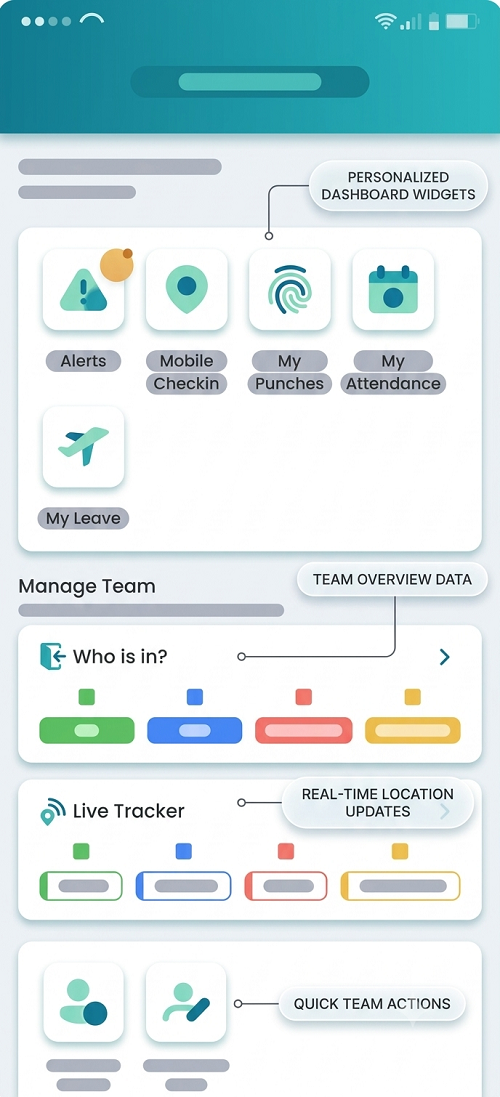
Mobile attendance allows companies to record employee attendance through smartphones or other connected devices while providing HR teams with better visibility into field operations. When combined with GPS, geofencing, shift scheduling, route planning, and payroll integration, mobile attendance can help logistics companies manage distributed workforces more efficiently.
1. Why Mobile Attendance Is Useful for Logistics Teams
Delivery drivers may not return to the same location every day. Their working locations can change based on delivery routes and customer requirements.
Mobile attendance can allow employees to:
- Clock in from an approved location
- Clock out after completing their shift
- Record breaks
- View assigned schedules
- Receive shift notifications
- Submit attendance corrections
- Access work instructions
HR teams can monitor attendance without requiring every driver to report to a physical attendance machine.
2. Use GPS-Based Attendance
GPS can help employers verify where an employee records attendance.
For example, a logistics company may configure attendance locations for:
- Warehouses
- Distribution centers
- Delivery hubs
- Branch offices
- Customer service centers
- Authorized project locations
When an employee clocks in, the system can capture the location according to the company's attendance policy.
GPS should be used transparently and proportionately, with appropriate privacy and data-protection controls.
3. Configure Geofencing
Geofencing creates a virtual boundary around an authorized location.
For example, a company could create a geofence around a distribution center. Employees can be permitted to clock in when they are physically within the designated area.
This can help reduce situations where employees record attendance from unauthorized locations.
For mobile delivery teams, companies may also use different rules for warehouse check-in, route activity, and customer visits, rather than treating every location as an attendance location.
4. Support Multiple Delivery Hubs
Large logistics companies may operate across cities such as:
- Riyadh
- Jeddah
- Dammam
- Makkah
- Madinah
- Khobar
- Abha
Employees may occasionally work from a different hub because of operational requirements.
Mobile attendance allows authorized employees to be assigned to different locations without requiring HR teams to manually maintain separate paper attendance registers.
5. Manage Driver Shifts
Delivery operations may use different schedules depending on customer demand.
A workforce management system can assign:
- Morning shifts
- Afternoon shifts
- Evening shifts
- Night shifts
- Weekend schedules
- Peak-period shifts
- Temporary schedules
The mobile application can display the employee's assigned shift and allow attendance to be compared against scheduled working hours.
6. Record Breaks and Working Hours
Delivery drivers may spend most of their working day on the road. Recording working hours manually can therefore become difficult.
Mobile attendance can help capture:
Clock-in → Working time → Break → Resume work → Clock-out
This provides HR and payroll teams with a more structured record of actual working time.
Break management should be aligned with applicable Saudi labor requirements and the employer's policies.
7. Handle Offline Connectivity
Drivers may travel through areas where mobile connectivity is temporarily weak or unavailable.
A useful mobile attendance solution should support appropriate offline functionality where available, allowing attendance information to be captured and synchronized when connectivity returns.
This can reduce missing attendance records caused solely by temporary network problems.
8. Integrate Attendance With Delivery Operations
Mobile attendance becomes more useful when it is connected with logistics workflows.
For example:
Driver assigned → Shift scheduled → Driver clocks in → Route begins → Deliveries completed → Driver clocks out → Working hours sent to payroll
This gives operations managers a clearer picture of employee availability and workload.
Attendance and delivery tracking should remain appropriately separated where necessary, particularly when handling employee location data.
9. Monitor Late Arrivals
Automated attendance alerts can help logistics managers identify employees who have not reported for their scheduled shift.
For example:
- 8:00 a.m. – Driver scheduled to start
- 8:10 a.m. – No attendance recorded
- 8:15 a.m. – Supervisor receives alert
- 8:20 a.m. – Driver confirms delay or attendance issue
This allows managers to arrange replacement coverage when necessary.
10. Manage Overtime for Drivers
Delivery volumes can fluctuate significantly. Drivers may sometimes work beyond their scheduled hours because of traffic, additional deliveries, peak demand, or operational delays.
Mobile attendance can record actual working time and send approved overtime information to payroll.
Managers can review:
- Scheduled hours
- Actual hours
- Breaks
- Overtime
- Additional shifts
- Early starts
- Late finishes
Overtime should be approved and processed according to applicable Saudi requirements and company policy.
11. Improve Attendance Accuracy
Manual registers and spreadsheets can create problems such as:
- Incorrect times
- Duplicate entries
- Missing records
- Delayed submissions
- Manual calculation errors
- Difficulty verifying field attendance
Mobile attendance creates a digital record that can be accessed by authorized HR and operations personnel.
12. Manage Temporary Driver Assignments
Logistics companies may move drivers between warehouses or routes to handle demand.
The system can support temporary assignments by recording:
- Original location
- Temporary location
- Assignment dates
- New shift
- Supervisor
- Route or project
Once the assignment ends, the employee can return to the normal schedule.
13. Support Contractor and Third-Party Drivers
Many logistics operations involve contractors and third-party delivery personnel.
A workforce platform can maintain separate records for:
- Direct employees
- Contract drivers
- Agency workers
- Temporary workers
- Subcontractor teams
Access and attendance permissions can be configured according to the organization's operational requirements.
14. Protect Employee Location Data
Because mobile attendance may involve GPS or location information, organizations should establish clear controls around collection and use of employee data.
Companies should consider:
- Informing employees about location-based attendance
- Limiting access to authorized personnel
- Protecting stored location data
- Establishing appropriate retention periods
- Using data only for legitimate business purposes
- Maintaining appropriate security controls
Saudi organizations should consider applicable personal-data protection requirements when implementing location-based workforce systems.
15. Connect Attendance With Payroll
One of the biggest benefits of mobile attendance is integration with payroll.
The workflow can be:
Mobile attendance → Working hours → Approved overtime → Leave adjustments → Payroll
This reduces manual data entry and helps payroll teams calculate employee pay using approved attendance information.
16. Use Attendance Analytics
HR and logistics managers can use dashboards to analyze workforce patterns.
Useful reports include:
- Driver attendance
- Branch-wise attendance
- Late arrivals
- Absence
- Overtime
- Working hours
- Shift coverage
- Location-based attendance
- Attendance exceptions
These reports can help managers identify staffing shortages and recurring attendance issues.
Conclusion
Mobile attendance is particularly useful for Saudi Arabia's delivery drivers and logistics teams because employees frequently work away from traditional offices. GPS, geofencing, mobile clock-in, shift scheduling, offline capabilities, attendance alerts, and payroll integration can provide greater visibility into a distributed workforce.
For companies operating warehouses, delivery hubs, transportation fleets, and field logistics teams, an integrated workforce management system can connect attendance, scheduling, location, overtime, leave, and payroll while maintaining appropriate privacy and data-security controls.
Delivery and logistics teams can capture mobile attendance, route-based check-ins, work hours, and delivery-area presence through the InnBuilt Employee Tracking App without returning to a fixed device in Saudi Arabia.